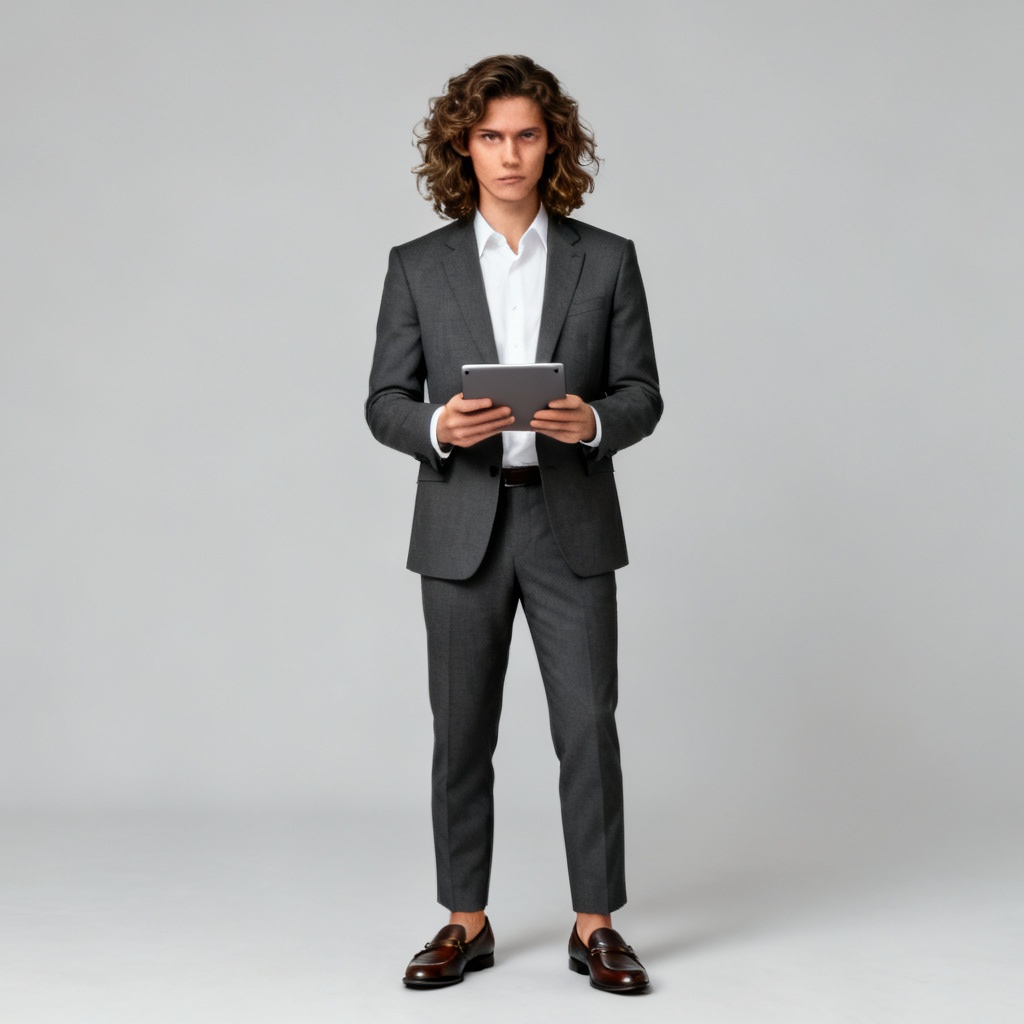
Premium Double-Knit Jacquard Fabric for Structured Suits
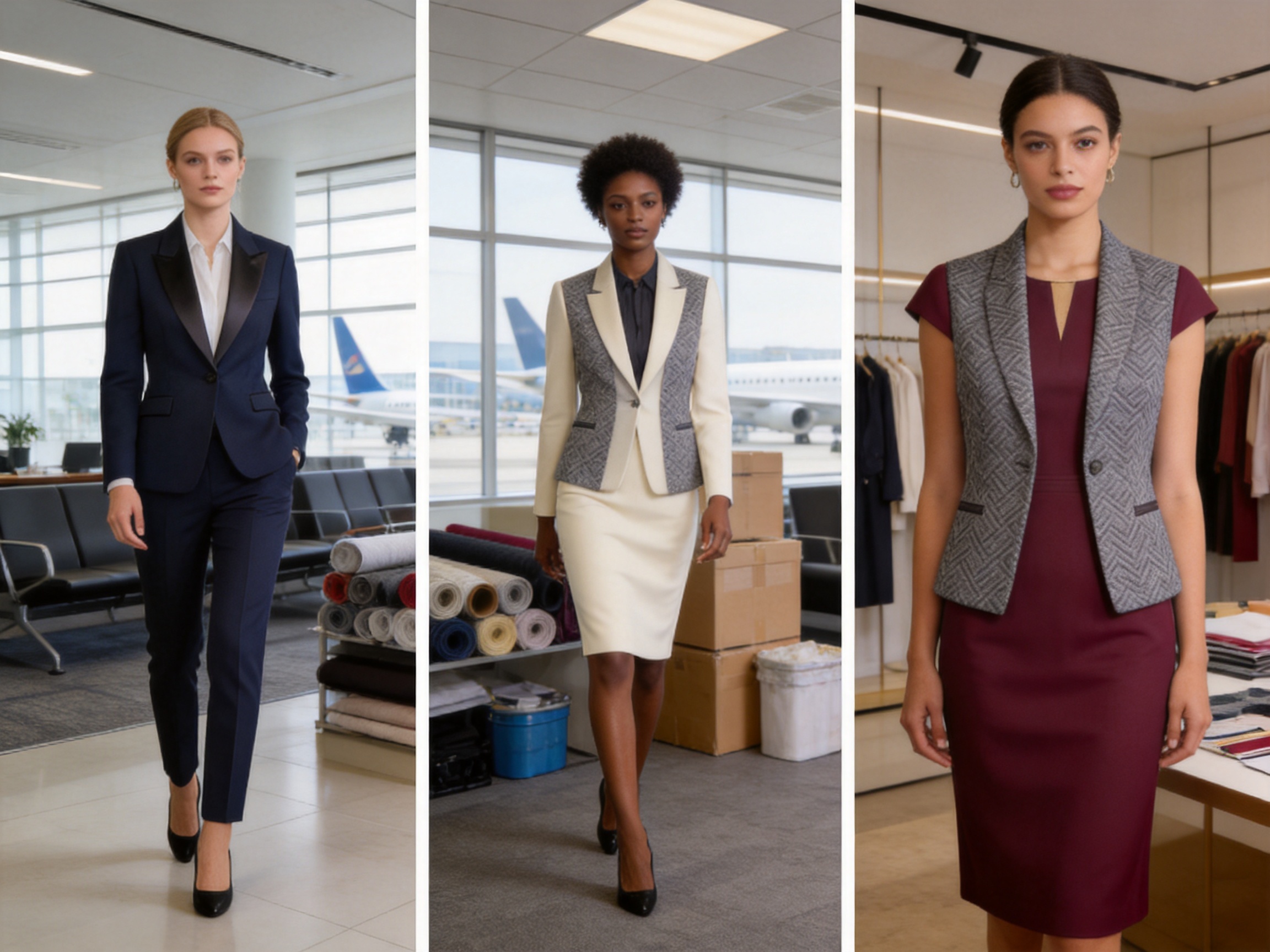
In modern apparel manufacturing, suiting fabrics must deliver more than a polished appearance. Designers and garment brands increasingly require materials that combine structure, elasticity, comfort, durability, easy care, and reliable production performance. The premium double-knit jacquard fabric presented in this article has been developed to meet these demands. With a composition of 75% polyester, 20% rayon, and 5% spandex, this heavy-weight textile provides a balanced combination of resilience, softness, stretch, drape, and visual refinement.
Designed for structured suits, blazers, trousers, skirts, dresses, and selected outerwear, this knitted jacquard fabric offers an alternative to conventional woven suiting materials. Its dense double-knit construction creates a stable surface while preserving useful elasticity. The result is a fabric that supports modern silhouettes without creating the stiffness or discomfort often associated with traditional formalwear.
Produced by Hangzhou Jinfeng Textile Co., Ltd., the fabric benefits from an integrated manufacturing system covering research and development, knitting, dyeing, finishing, quality control, and export sales. The company’s broader production capabilities also include polyester rayon fabric, knitted jacquard fabric, NTR knitted fabric, NR knitted fabric, and slight intermingled drawn textured yarn. This combination of fabric expertise and polyester yarn production provides a strong foundation for consistent raw-material management and customized textile development.
1. Product Overview
Premium double-knit jacquard is a structured knitted textile created on high-gauge knitting equipment. Unlike a simple single-layer knit, the double-knit construction forms a denser and more stable body. This construction helps the fabric retain its shape, resist surface distortion, and provide a smooth foundation for tailored garments.
The jacquard technique introduces a subtle geometric texture into the fabric surface. Rather than relying on printed decoration, the pattern is integrated into the knitted structure. This gives the material a sophisticated appearance that can be used in businesswear, smart casual collections, travel clothing, and elevated athleisure.
The textile weighs approximately 320 grams per square meter and has a usable width of 150 centimeters, or approximately 59 inches. Its heavy weight supports garments that require body and coverage, while the 5% spandex content introduces stretch for movement and comfort. The rayon component contributes softness and a refined hand feel, and the polyester component supports strength, dimensional stability, and easy maintenance.
The fabric is particularly suitable for brands seeking a material that looks formal without feeling restrictive. Its surface has enough visual interest to create a premium impression, yet the geometric jacquard pattern remains controlled and versatile. This makes it appropriate for coordinated collections, capsule wardrobes, corporate uniforms, premium private-label products, and seasonal suit programs.
Core Product Specifications
| Specification | Product Detail | Commercial Significance |
|---|---|---|
| Fabric Type | Double-knit jacquard | Provides structure, texture, and stretch |
| Composition | 75% polyester, 20% rayon, 5% spandex | Balances durability, softness, drape, and elasticity |
| Weight | 320 g/m² | Suitable for structured garments and heavier tailoring |
| Width | 150 cm / approximately 59 inches | Supports efficient cutting for apparel production |
| Key Features | High elasticity, wrinkle resistance, excellent drape | Improves wearer comfort and garment performance |
| Pilling Resistance | Grade 4.0 | Supports long-term appearance retention |
| Shrinkage | Less than 3% after standard industrial washing | Helps maintain finished garment dimensions |
| Minimum Order Quantity | 800 meters per color or design | Suitable for commercial production programs |
| Bulk Lead Time | Approximately 15–20 days after lab-dip approval | Supports efficient product launch planning |
2. Why Double-Knit Jacquard Is Suitable for Modern Suits
Traditional suit fabrics are often selected for their crisp appearance and tailoring response. However, many woven suiting fabrics can feel rigid, crease during travel, and restrict movement. Modern consumers now expect business clothing to accommodate commuting, extended working hours, air travel, and flexible dress codes. This shift has increased demand for fabrics that preserve a tailored appearance while offering the comfort of knitwear.
Double-knit jacquard responds to this market need by combining a structured surface with controlled stretch. The fabric can support the shape of a blazer or skirt while allowing the wearer to sit, walk, bend, and move more naturally. This is particularly useful for business garments designed for frequent travel or long periods of wear.
The fabric’s heavy weight also helps it hang cleanly. A lightweight stretch fabric may cling to the body or lose its shape, while a dense 320 g/m² material creates a more substantial silhouette. This weight is appropriate for structured blazers, trousers, pencil skirts, sheath dresses, vests, and selected transitional outerwear.
The subtle geometric pattern adds depth without overpowering the garment design. A solid-color suit made from this material can appear more distinctive than a completely plain fabric while remaining suitable for professional settings. Designers can use the jacquard texture as a quiet branding element, especially when developing coordinated collections that require visual differentiation.
Comfort Without Losing Tailored Shape
The 5% spandex content gives the fabric useful mechanical stretch. This does not turn the material into a lightweight sports jersey; instead, it adds flexibility to a dense and stable textile. The wearer can experience greater comfort around the shoulders, waist, elbows, knees, and hips, depending on the garment design.
Rayon contributes a smooth, comfortable hand and helps soften the feel of the polyester base. This balance is important in tailored clothing because a fabric can be technically durable yet unpleasant against the skin. The blend is intended to offer a more refined touch while retaining the production advantages of synthetic fibers.
For garment manufacturers, stretch can also improve fit tolerance. Small differences in body shape are easier to accommodate when a fabric has controlled elasticity. This can support more comfortable ready-to-wear sizing and reduce the risk of garments feeling excessively tight in motion.
Wrinkle Resistance for Travel and Daily Wear
Wrinkle resistance is one of the principal advantages of this double-knit construction. Travelers and professionals often need clothing that can be packed, transported, and worn with minimal pressing. A dense knitted structure combined with a polyester-rich composition can help the garment recover from normal handling and reduce the appearance of everyday creases.
This benefit makes the fabric especially appropriate for travel suits, coordinated separates, business-casual trousers, and garments sold as easy-care wardrobe essentials. It can also reduce maintenance demands for consumers who prefer practical clothing that does not require constant ironing.
Wrinkle resistance does not eliminate the need for appropriate garment care. Manufacturers should still validate washing, drying, pressing, and finishing instructions for each garment style. Nevertheless, the material’s construction gives brands a strong foundation for developing low-maintenance tailored products.
3. Composition and Functional Contribution of Each Fiber
Polyester: Strength and Production Reliability
Polyester represents 75% of the blend and forms the primary performance foundation of the fabric. It contributes tensile strength, abrasion resistance, shape retention, and relatively stable behavior during production and use. Polyester is also widely available in commercial textile supply chains, making it suitable for repeat programs and larger-volume orders.
In a structured suit fabric, polyester helps the material retain its form after repeated wear. It supports resistance to everyday friction from seating, bags, office furniture, and garment handling. Its dimensional stability also helps manufacturers maintain more consistent width and length during knitting, dyeing, finishing, cutting, and sewing.
The polyester component is also compatible with the company’s experience in DTY polyester yarn production. Drawn textured yarn can be engineered to provide specific bulk, flexibility, and surface characteristics. Access to related yarn expertise can support closer control of the raw-material base and facilitate communication between yarn development and fabric production teams.
Rayon: Softness and Refined Drape
Rayon accounts for 20% of the composition. It is valued for its soft hand, fluid drape, and ability to create a more luxurious tactile impression. In suiting fabric, rayon helps reduce the overly technical feel that can sometimes be associated with high-polyester textiles.
The rayon component is particularly valuable in garments that must look structured but still move gracefully. It can contribute to a smoother fall through the body of a jacket, skirt, or dress. When combined with the density of the double-knit construction, it helps create a balanced appearance: neither excessively stiff nor too limp.
Rayon also supports color depth and surface sophistication. The final visual effect will depend on the dyeing and finishing process, but the blended structure can produce a rich appearance appropriate for premium businesswear and fashion-led collections.
Spandex: Controlled Stretch and Mobility
Spandex makes up 5% of the blend and provides the principal stretch component. The percentage is carefully suited to a fabric that must remain structured. Excessive stretch could weaken tailoring lines or create unwanted recovery issues, while too little stretch would limit comfort.
At this level, spandex can improve mobility in close-fitting garments without eliminating the formal character of the fabric. It is suitable for fitted blazers, pencil skirts, sheath dresses, tapered trousers, and garments designed to follow the body without feeling restrictive.
Manufacturers should consider seam construction, pressing temperature, pattern direction, and recovery testing when producing spandex-containing garments. Proper processing helps preserve the fabric’s elasticity and contributes to consistent finished-garment quality.
4. Advanced Manufacturing Process
The performance of a premium knitted jacquard fabric depends not only on fiber composition but also on the manufacturing system used to create it. Hangzhou Jinfeng Textile Co., Ltd. operates an integrated textile business that includes research and development, production, processing, post-dyeing, finishing, and sales. This structure allows the company to manage multiple stages of the process and respond more efficiently to customer requirements.
Raw-Material and Yarn Preparation
Manufacturing begins with the selection and preparation of polyester, rayon, and spandex yarns. The yarns must be compatible in terms of fineness, tension behavior, stretch response, and dyeing requirements. Consistent yarn quality is essential because irregularities introduced at this stage can appear as bars, streaks, uneven texture, or inconsistent elasticity in the final fabric.
The company’s production experience with DTY polyester yarn adds value at the yarn-management stage. Slight intermingled drawn textured yarn can provide improved cohesion and a controlled textured character. Such yarn expertise supports a better understanding of how filament behavior influences knitting performance, surface appearance, and fabric stability.
Before knitting, yarns are typically checked for package quality, tension consistency, moisture condition, and compatibility with the intended machine settings. Careful preparation can reduce yarn breaks, improve machine efficiency, and contribute to more uniform jacquard pattern formation.
High-Gauge Knitting
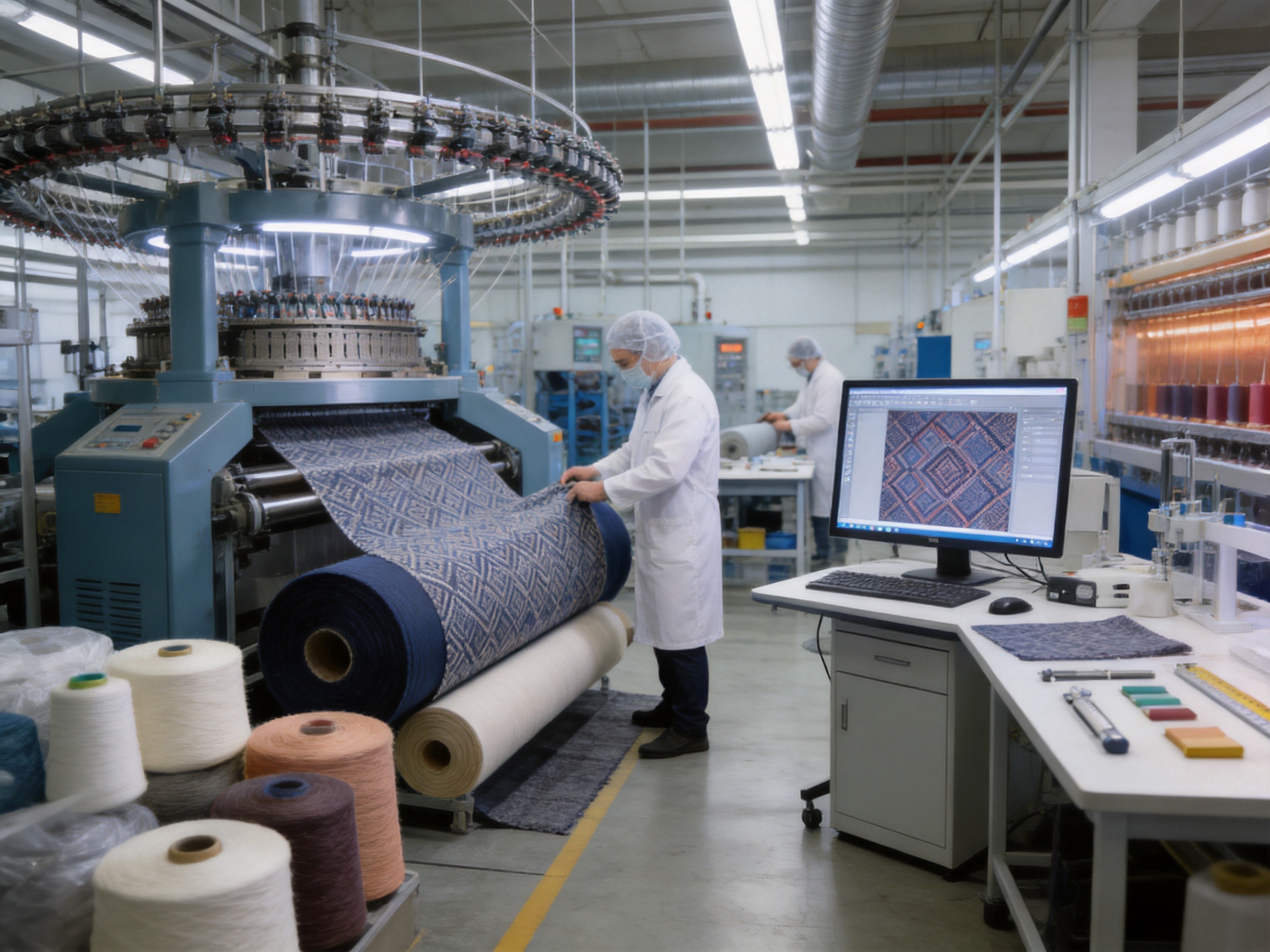
The double-knit jacquard structure is produced on high-gauge knitting equipment. High-gauge production is important for creating a refined surface and controlled pattern definition. It allows the fabric to achieve a relatively fine texture while maintaining the density required for structured garments.
During knitting, stitch formation, yarn tension, take-down settings, machine speed, and pattern programming must be carefully coordinated. Jacquard designs depend on accurate interaction between the machine’s needle selection system and the yarn feed. Even a small variation in tension can influence pattern clarity, fabric weight, or surface uniformity.
The double-knit construction creates a stable body with greater thickness than many single-knit fabrics. This helps the material support tailored shapes and reduces the likelihood of excessive curling at the edges. It also contributes to opacity and coverage, which are important for professional garments.
High-gauge knitting requires experienced operators and appropriate process monitoring. The goal is not simply to produce a pattern, but to create a repeatable fabric in which the pattern, weight, stretch, width, and hand remain consistent from roll to roll.
Jacquard Pattern Development
The fabric’s geometric design can be developed using computer-aided design tools. An in-house CAD team enables the company to work with customers on exclusive pattern concepts, repeat sizes, scale adjustments, and surface effects.
Pattern customization is valuable for brands that want a recognizable textile identity. A supplier-developed base pattern may be suitable for general use, while an exclusive design can help a collection stand apart from competing products. Designers may request a subtle tonal effect for conservative businesswear or a more visible geometric structure for fashion collections.
CAD development also improves communication between the buyer and the production team. Digital artwork can be reviewed and adjusted before bulk knitting begins. This may reduce development time and help prevent misunderstandings related to pattern scale or repeat placement.
Dyeing and Color Development
Color development is handled through laboratory sampling and lab-dip approval. Before bulk production, the desired shade is matched and evaluated under appropriate lighting conditions. This process helps the buyer confirm that the color meets the intended standard.
Because the fabric contains polyester, rayon, and spandex, dyeing must account for the different behavior of each component. Temperature, time, dye selection, chemical balance, and post-dyeing treatment require careful coordination. The objective is to achieve a consistent shade without damaging the elastic performance or surface quality of the fabric.
Color consistency is particularly important for suit programs, where jackets, trousers, skirts, and accessories may need to coordinate across multiple production lots. Clear approval standards and retained references can help reduce color variation during repeat orders.
Heat Setting and Dimensional Stabilization
Heat setting is an important stage in the production of spandex-containing knitted fabric. Proper heat-setting conditions help stabilize the knitted structure, control width, and improve dimensional consistency. The process must be carefully managed because excessive heat or unsuitable tension can affect stretch recovery, hand feel, and overall appearance.
The stated shrinkage performance of less than 3% after standard industrial washing reflects the importance of controlled finishing. Final results can vary according to washing conditions, garment construction, and care procedures, so manufacturers should conduct their own verification tests. Nevertheless, precise heat setting provides a strong basis for reliable finished dimensions.
Finishing and Surface Enhancement
Finishing determines how the fabric feels, looks, drapes, and performs after production. The process may include compacting, brushing or smoothing, softening, width control, relaxation, and final inspection. Each treatment must be selected according to the intended end use.
For structured suits, the finish should preserve body and pattern clarity while providing a comfortable hand. Excessive softening may reduce the fabric’s ability to support tailored lines, while insufficient finishing may leave the surface too harsh. The desired result is a balanced textile with a polished appearance and stable construction.
Post-dyeing and finishing expertise is one of the company’s notable strengths. By managing these stages within an integrated operation, the supplier can coordinate fabric development more efficiently than a business that relies entirely on disconnected subcontractors.
5. Advantages Over Conventional Competitor Fabrics
Compared with Standard Woven Suiting
Conventional woven suiting can offer excellent crispness and tailoring response, but it may be less forgiving in motion. The double-knit jacquard fabric introduces elasticity that can improve comfort in fitted garments and active daily use.
The knitted construction can also provide better wrinkle recovery in situations where a garment is packed or worn for extended periods. This is an important advantage for travel-oriented businesswear, where consumers want a professional appearance without extensive pressing.
Another distinction is surface texture. A conventional plain weave may require additional design elements to create visual interest. The jacquard structure builds a geometric pattern directly into the textile, allowing designers to achieve a sophisticated appearance without relying exclusively on printing or surface decoration.
Compared with Lightweight Stretch Knits
Lightweight stretch knits can be comfortable but may lack the body necessary for structured jackets, tailored skirts, and formal trousers. At approximately 320 g/m², this fabric provides greater substance and coverage. It is better suited to silhouettes that require a clean outline and a stable drape.
The dense construction can also help reduce transparency and improve garment presence. This is useful for brands that want the comfort of knitwear without presenting an overly casual or lightweight appearance.
Compared with Printed Fabrics
Printed fabrics place the design on the surface, whereas jacquard fabrics integrate the pattern into the construction. The resulting texture can appear more dimensional and refined. A knitted jacquard pattern may also remain visually attractive when the fabric is stretched or draped, because the design is not merely a flat surface image.
For buyers considering complex visual effects, the manufacturer may recommend printed TR fabric when printing is more appropriate for the design objective. However, for subtle geometric texture and durable surface character, double-knit jacquard offers a distinct advantage.
Durability and Pilling Performance
The fabric is specified with a pilling resistance rating of Grade 4.0. This indicates a strong level of resistance under the applicable test conditions. Pilling performance is especially important for business garments that experience repeated friction at the elbows, sides, seat, and underarms.
Durability does not mean the fabric is immune to every form of wear. Care conditions, garment construction, abrasion intensity, and laundering practices all influence service life. However, the dense knit structure and polyester-rich blend provide a strong foundation for long-term appearance retention.
Commercial Flexibility
The fabric can serve several product categories rather than one narrow garment type. A single approved quality may be developed into women’s blazers, men’s jackets, trousers, skirts, dresses, and vests. This flexibility can simplify seasonal collection planning and help brands build coordinated ranges.
The minimum order quantity of 800 meters per color or design is appropriate for commercial apparel programs. It is large enough to support meaningful production but may remain accessible to emerging brands, uniform suppliers, and private-label manufacturers that need more than sample quantities.
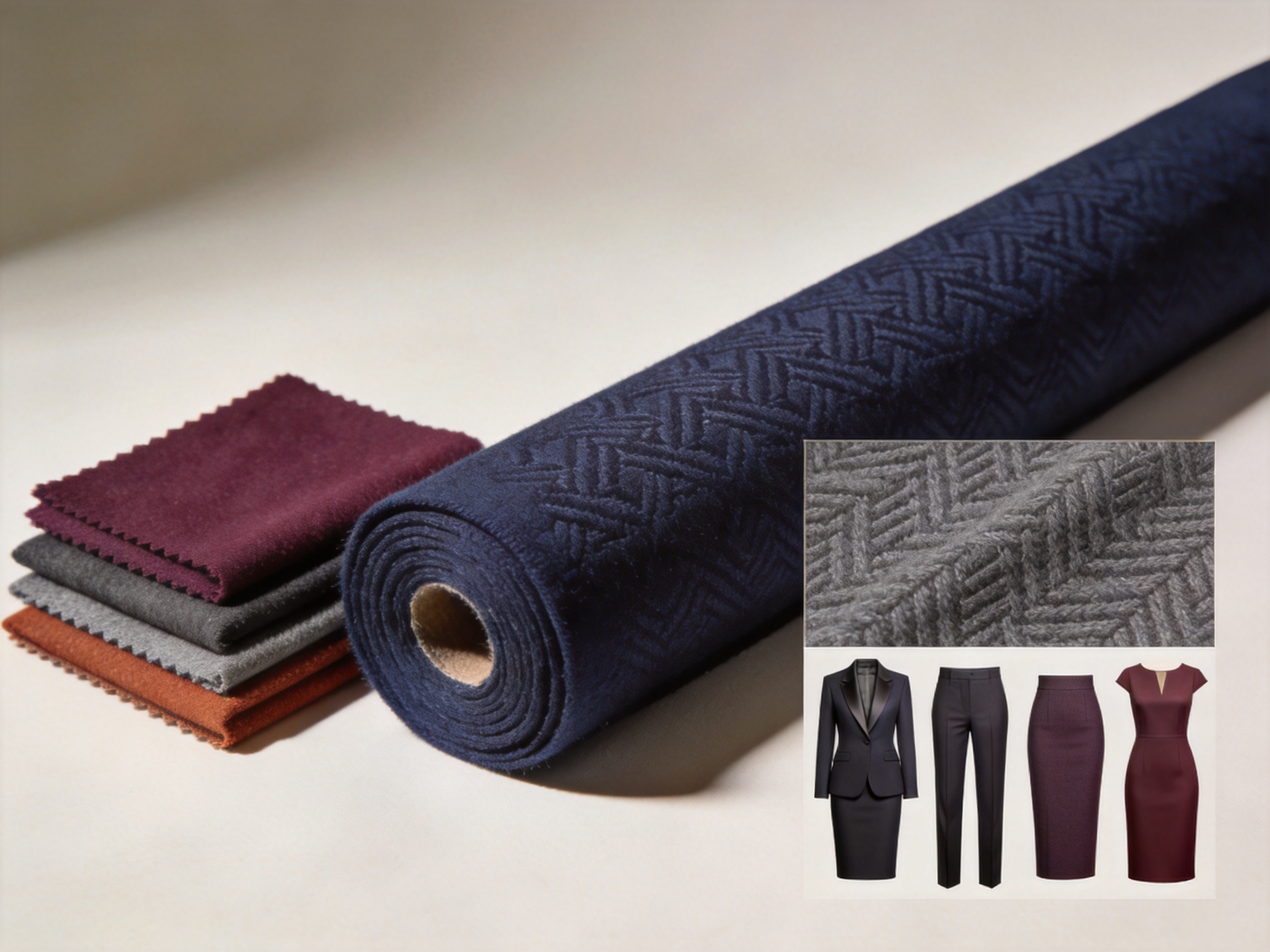
6. Recommended Apparel Applications
Men’s and Women’s Structured Blazers
Blazers are one of the most suitable applications for this fabric. The dense body supports lapels, shoulder lines, front panels, and tailored seams. Stretch helps improve comfort around the upper body, particularly in fitted or semi-fitted styles.
Designers may use the material for single-breasted jackets, double-breasted styles, collarless jackets, cropped blazers, and coordinated suit jackets. The geometric pattern can remain tonal for a conservative appearance or be emphasized through color contrast and garment paneling.
Business-Casual Trousers
The fabric’s elasticity and wrinkle resistance make it appropriate for business-casual trousers. It can be developed into straight-leg, tapered, wide-leg, ankle-length, or pull-on tailored styles. The heavy weight helps maintain a clean trouser line, while spandex improves sitting and walking comfort.
For trousers, pattern layout should account for the direction and repeat of the jacquard design. Careful cutting can ensure that the geometric texture remains aligned across garment panels and that paired items coordinate visually.
Pencil Skirts and Sheath Dresses
Close-fitting skirts and dresses benefit from the blend’s combination of structure and stretch. The fabric can follow the body while maintaining a smooth and professional silhouette. Its drape helps avoid an excessively rigid appearance, and its weight can provide useful coverage.
Garment makers should select linings, zippers, seam allowances, and stitch types that work with stretch construction. Depending on the pattern and fit, partial lining or stretch lining may be considered to preserve mobility and comfort.
High-End Outerwear Vests
The fabric can also be used for tailored vests and lightweight structured outerwear. Its substantial weight gives a vest a premium hand and helps it function as a layering piece over shirts, blouses, knit tops, or dresses.
For outerwear applications, designers should evaluate exposure to moisture, abrasion, and repeated cleaning. The jacquard surface can provide a distinctive alternative to plain woven shell fabrics in urban, office, and travel collections.
Travel and Athleisure-Inspired Tailoring
One of the strongest opportunities for this material is the growing category of travel tailoring. Consumers increasingly want garments that look appropriate in professional settings but function comfortably during movement and transportation.
A coordinated travel suit made from double-knit jacquard can offer a refined appearance, wrinkle resistance, stretch, and easy outfit coordination. The material can also support athleisure-inspired blazers and trousers that use tailored construction while incorporating comfort-focused design details.
7. Quality Control and Production Consistency
Quality control should be applied throughout the textile process rather than only at final inspection. For this product, important control points include yarn inspection, knitting stability, pattern accuracy, fabric weight, width, stretch, recovery, color, shrinkage, surface appearance, and pilling performance.
Fabric weight should be checked across the roll to identify significant variation. Width should be measured after the relevant finishing process because knitted textiles can change dimensions during relaxation and heat setting. Stretch and recovery testing should be conducted in both the lengthwise and crosswise directions where appropriate.
Pattern clarity is another important quality factor. A geometric jacquard design should remain consistent across the width and length of the fabric. Any distortion, missing motif, needle mark, or irregular repeat can affect garment appearance, especially when used in tailored pieces.
Color inspection should be performed under standardized lighting. Buyers may also request shade bands or approved color standards for repeat production. These procedures help maintain consistency when fabrics are ordered for multiple garment styles or across different seasons.
The reported pilling resistance of Grade 4.0 provides a useful benchmark for product evaluation. Buyers may also perform abrasion, wash fastness, dimensional stability, spirality, seam slippage, and stretch recovery tests according to their own technical requirements.
Sample Approval Before Bulk Production
Before bulk production, buyers should approve the color, pattern, weight, width, hand feel, and performance characteristics. Lab-dip approval is particularly important because color appearance can vary according to fiber blend, lighting, finishing, and viewing conditions.
It is also advisable to make a prototype garment before finalizing a large order. A sample jacket, trouser, skirt, or dress can reveal how the fabric behaves during cutting, sewing, pressing, lining, and wear testing. This step may identify adjustments that are difficult to detect from a small fabric swatch.
8. Customization and Product Development Support
Textile buyers increasingly seek exclusive materials rather than standard qualities available from many suppliers. The manufacturer’s in-house CAD capability supports customized jacquard pattern development. Customers can discuss motif scale, geometric direction, repeat size, surface contrast, and color arrangement according to brand positioning.
Customization can be useful for different market segments. A conservative corporatewear brand may request a fine, low-contrast pattern that appears almost solid from a distance. A contemporary fashion label may prefer a larger repeat or stronger tonal contrast. A uniform supplier may request a restrained design that communicates professionalism while helping garments stand apart from generic basics.
Customization may also involve color development, fabric weight, finish, width, and fiber balance, subject to technical feasibility and order volume. Early communication is important because changes to yarn, machine settings, pattern programming, or finishing may affect development time and minimum order requirements.
With an in-house development team, the customer can move from concept artwork to sample fabric and then to bulk production through a more coordinated process. This can reduce communication gaps and allow technical questions to be addressed before production begins.
9. Manufacturing Strengths of Hangzhou Jinfeng Textile Co., Ltd.
Hangzhou Jinfeng Textile Co., Ltd. is located in Jingjiang Street Industrial Park, Xiaoshan District, Hangzhou City, Zhejiang Province. The company covers approximately 32.6 acres and has a plant area of approximately 18,000 square meters.
The company integrates research and development, production, processing, post-dyeing, finishing, and sales. It manufactures and processes blended fabrics including polyester and spandex materials, produces DTY polyester yarn, and serves customers in domestic and international markets.
This integrated structure is a significant advantage for buyers who require reliable communication and coordinated production. Instead of treating yarn, knitting, dyeing, finishing, and sales as entirely separate functions, the company can connect these stages within one operating system.
Manufacturer-direct supply can also support competitive ex-factory pricing. Buyers may benefit from more direct communication regarding technical specifications, production schedules, quality requirements, packaging, and shipment arrangements.
Stable Supply Chain
Stable supply is essential for apparel brands that need to replenish successful products. A fabric may perform well in development but become commercially difficult if subsequent lots vary significantly or production capacity is uncertain. The company’s manufacturing base and related yarn capabilities support a more stable supply-chain model.
Repeat orders should still be planned with sufficient lead time, particularly when they involve customized jacquard patterns or new colors. The stated bulk production schedule is approximately 15 to 20 days after lab-dip approval, although actual timing may depend on order volume, design complexity, raw-material availability, and production planning.
Export Experience
As a self-operated export company, the manufacturer serves customers at home and abroad. Export capability includes preparation of customs documentation and support for international freight arrangements. Standard shipping terms include FOB Shanghai or Ningbo, while CIF and DDP assistance may be available upon request.
Clear shipping arrangements help buyers evaluate the total landed cost of the fabric. Freight method, destination, customs requirements, insurance, packaging, and local delivery should be confirmed before order placement.
Customer-Oriented Business Philosophy
The company follows a cooperation and win-win business philosophy. For textile buyers, this approach is relevant because successful product development depends on long-term communication rather than one-time transactions. Technical feedback, quality discussions, delivery coordination, and repeat-order planning all benefit from a cooperative supplier relationship.
10. Ordering, Payment, and Logistics Considerations
The standard minimum order quantity is 800 meters per color or design. This quantity is designed for commercial production and can support a meaningful number of garments depending on the pattern, garment type, fabric consumption, and cutting efficiency.
Buyers should provide a detailed inquiry that includes fabric category, target composition, preferred color, approximate order volume, intended garment type, required finish, delivery destination, and testing standards. If a customized jacquard pattern is required, artwork or reference samples should be provided at the earliest stage.
Typical payment terms include T/T with a 30% deposit and 70% payment before shipment, or an L/C at sight. Open-account terms may be considered for long-term partners with an established credit history. Final terms should be confirmed in a formal quotation or sales contract.
Shipping is commonly arranged on an FOB Shanghai or Ningbo basis. The supplier can manage customs documentation and may assist with global freight forwarding under CIF or DDP arrangements when requested. Buyers should confirm whether their chosen shipping term includes destination customs clearance, import duties, taxes, inland transportation, and final delivery.
11. Care, Testing, and Garment-Making Recommendations
Although the fabric is designed for durability and easy maintenance, final care instructions should be determined through garment-level testing. The behavior of a finished product depends on lining, trims, interlinings, fusibles, seam construction, and washing conditions.
The fabric is reported to achieve less than 3% shrinkage after standard industrial washing. Buyers should confirm this performance under their specific testing protocol. Testing should include lengthwise and crosswise shrinkage, appearance after washing, color fastness, stretch recovery, and dimensional stability.
When cutting, manufacturers should pay attention to jacquard repeat direction. If the pattern has a clear orientation, all garment panels should be laid consistently. Pattern matching may increase consumption, particularly on large front panels, lapels, pockets, and center-back seams.
During sewing, suitable stretch needles, thread, stitch length, and seam allowance may be required. Overly rigid seams can restrict the fabric’s elasticity and create stress during wear. Pressing temperatures should be controlled to protect the spandex component and preserve the surface texture.
For tailored garments, appropriate interlining selection is important. A very rigid interlining may conflict with the fabric’s natural stretch, while an unsuitable lightweight interlining may fail to support the desired shape. Trial construction is recommended before bulk production.
12. Sustainability and Responsible Product Planning
While the material is a synthetic-blend textile, responsible product planning can still improve resource efficiency and product longevity. Durable fabrics that remain attractive through repeated wear may reduce the need for frequent replacement. Wrinkle resistance can also reduce the energy associated with repeated ironing, depending on the consumer’s care habits.
Manufacturers can support more responsible production by controlling defects, reducing unnecessary reprocessing, optimizing cutting layouts, and maintaining accurate color standards. Brands can contribute by ordering realistic quantities, developing versatile garments, and providing clear care instructions.
Because the fabric is suitable for multiple garment categories, it can support coordinated collections that use one textile across several products. This may simplify material management and reduce the need to source numerous small fabric qualities for a single seasonal range.
Buyers seeking specific environmental certifications, recycled content, chemical-management standards, or restricted-substance documentation should communicate these requirements before development. Any certification or compliance claim should be verified through appropriate documentation and testing.
13. Positioning for Different Markets
Premium Businesswear
For premium businesswear, the fabric offers a refined texture, stable body, and polished drape. It can support garments positioned above basic officewear while remaining practical for regular use. The subtle jacquard pattern creates a distinctive surface without compromising professional styling.
Corporate Uniforms
Corporate uniform programs often require durability, comfort, repeat availability, and a consistent appearance. The fabric’s pilling resistance, wrinkle resistance, and structured construction make it a candidate for jackets, skirts, trousers, and vests used in office, hospitality, transportation, and service environments.
Contemporary Fashion Labels
Fashion brands can use the textile as a foundation for sculptural tailoring, coordinated separates, fitted dresses, or statement suiting. Custom CAD jacquard development allows the surface pattern to be adjusted to match a collection’s visual language.
Travel and Flexible Workwear
The fabric aligns well with flexible workwear trends. Consumers who divide their time between offices, home environments, meetings, and travel often prefer clothing that can transition across occasions. The blend of stretch, weight, drape, and wrinkle resistance supports this lifestyle-oriented market.
14. Frequently Asked Questions
A: The standard composition is 75% polyester, 20% rayon, and 5% spandex. Polyester contributes durability and stability, rayon improves softness and drape, and spandex provides controlled stretch.
Q: Is this fabric woven or knitted?
A: It is a knitted jacquard fabric produced in a dense double-knit construction on high-gauge knitting equipment. The jacquard effect is integrated into the knitted structure.
Q: What garments are best suited to this material?
A: Recommended applications include men’s and women’s structured blazers, business-casual trousers, pencil skirts, sheath dresses, high-end outerwear vests, travel suits, and athleisure-inspired tailoring.
Q: Can the fabric be used for formal suits?
A: Yes. Its 320 g/m² weight, dense construction, excellent drape, and subtle geometric texture make it suitable for formal and business-oriented garments. Pattern, lining, and interlining choices should be developed according to the desired level of formality.
Q: How much stretch does the fabric have?
A: The fabric contains 5% spandex and is described as having high elasticity. Exact stretch and recovery values should be confirmed through laboratory testing for the specific production lot and direction of stretch.
Q: Can the jacquard fabric be printed?
A: It can be over-dyed, but it is primarily valued for its knitted texture. For complex printed patterns, a printed TR fabric may be more appropriate because it can preserve knit integrity while delivering the requested visual design.
Q: What is the shrinkage rate?
A: The stated performance is less than 3% shrinkage after standard industrial washing. Buyers should confirm the result under their own washing and testing conditions before final garment production.
Q: What is the pilling resistance rating?
A: The fabric is specified with a pilling resistance rating of Grade 4.0. Testing conditions and standards should be confirmed when comparing results with other suppliers.
Q: What is the minimum order quantity?
A: The standard minimum order quantity is 800 meters per color or design.
Q: How long does bulk production take?
A: The stated production schedule is approximately 15 to 20 days after lab-dip approval. Timing may change according to order size, customized pattern requirements, color development, and production capacity.
Q: Can the jacquard pattern be customized?
A: Yes. The manufacturer has an in-house CAD team that can assist with exclusive jacquard pattern development, including geometric design adjustments and collection-specific concepts.
Q: What payment terms are available?
A: Typical terms are T/T with a 30% deposit and 70% payment before shipment, or an L/C at sight. Open-account terms may be considered for qualified long-term partners.
Q: Which shipping terms are available?
A: Standard shipping is available on an FOB Shanghai or Ningbo basis. Assistance with CIF or DDP freight forwarding may be available upon request.
Q: Does the manufacturer produce other textile products?
A: Yes. The company produces and supplies polyester rayon fabrics, knitted jacquard fabrics, NTR knitted fabrics, NR knitted fabrics, and slight intermingled drawn textured yarn. It also manufactures and sells DTY polyester yarn.
15. Conclusion
Premium double-knit jacquard fabric provides a practical and sophisticated solution for modern structured apparel. Its 75% polyester, 20% rayon, and 5% spandex composition combines resilience, softness, stretch, drape, and shape support. The 320 g/m² weight gives the textile the substance required for tailored garments, while the double-knit construction helps improve comfort and wrinkle resistance compared with many conventional woven suit fabrics.
The fabric’s subtle geometric jacquard texture gives brands a way to add visual distinction without relying on bold printing. Its versatility extends from blazers and business trousers to pencil skirts, sheath dresses, vests, travel suits, and flexible workwear. A Grade 4.0 pilling-resistance specification, less than 3% stated shrinkage after standard industrial washing, and controlled stretch further strengthen its commercial appeal.
Hangzhou Jinfeng Textile Co., Ltd. supports the product through integrated textile manufacturing, DTY polyester yarn expertise, post-dyeing and finishing capabilities, CAD-based design customization, export experience, and manufacturer-direct supply. Its production base in Xiaoshan, Hangzhou, provides a platform for serving both domestic and international buyers.
For apparel companies seeking a fabric that bridges tailoring and knitwear, this premium double-knit jacquard offers a compelling combination of appearance, performance, and development flexibility. With appropriate sample approval, testing, garment engineering, and production planning, it can become a reliable foundation for durable, comfortable, and commercially distinctive suit collections.
References
1. Hangzhou Jinfeng Textile Co., Ltd. Product specifications for premium double-knit jacquard fabric.
2. Hangzhou Jinfeng Textile Co., Ltd. Company information and manufacturing capability statement.
3. Textile Exchange. Fiber, material, and textile sustainability terminology guidance.
4. International Organization for Standardization. Textile testing principles for dimensional change, pilling, color fastness, and fabric performance.
5. ASTM International. Standard practices for evaluating textile stretch, recovery, abrasion, and appearance retention.
6. Apparel manufacturing technical guidance covering knitted fabric cutting, sewing, pressing, interlining, and garment testing.