NR Strip Roman Fabric: A Practical Guide to Structure, Performance, Manufacturing, and Apparel Applications
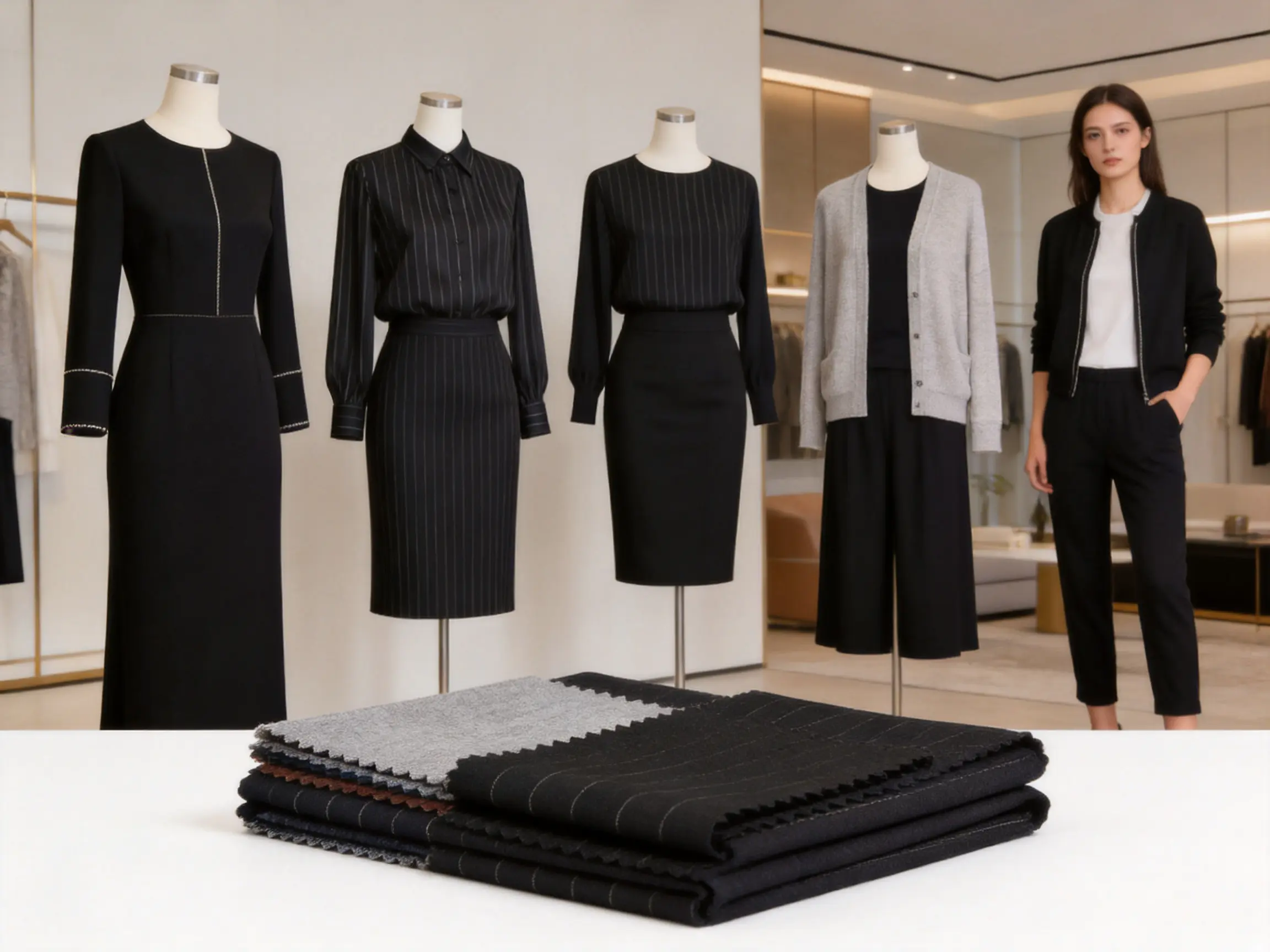
NR Strip Roman Fabric is a knitted fabric designed for apparel manufacturers, fashion brands, garment wholesalers, and sewing professionals who need a stable, comfortable, and visually distinctive material. As an NR knitted fabric, it combines the useful characteristics associated with nylon and rayon-based textile development with the dimensional flexibility of a knitted construction. Its strip or rib-like visual effect adds surface interest, while the Roman-style structure can provide a firmer hand and better body than many lightweight single-knit fabrics.
For buyers, the value of NR Strip Roman Fabric is not limited to appearance. A successful fabric must perform consistently from the first roll to the last roll, remain suitable for cutting and sewing, accept color evenly, and support the intended garment silhouette. It must also be produced through a controlled process that addresses yarn selection, knitting tension, dyeing, finishing, inspection, packaging, and shipment. These factors are especially important when the fabric is used for commercial collections or repeated seasonal production.
Hangzhou Jinfeng Textile Co., Ltd. develops and supplies blended fabrics, knitted fabrics, and DTY polyester yarn. Its manufacturing activities include production and processing, post-dyeing, finishing, and sales of blended textile materials such as polyester and spandex-related fabrics. The company also produces, processes, and sells DTY polyester yarn, giving it experience across both yarn and fabric stages of textile production.
This article examines NR Strip Roman Fabric in detail. It explains its construction, advantages, potential applications, production process, quality considerations, comparison with alternative fabrics, and recommended handling methods. It also outlines why an integrated textile supplier can offer meaningful benefits to buyers seeking reliable fabric development and repeat orders.
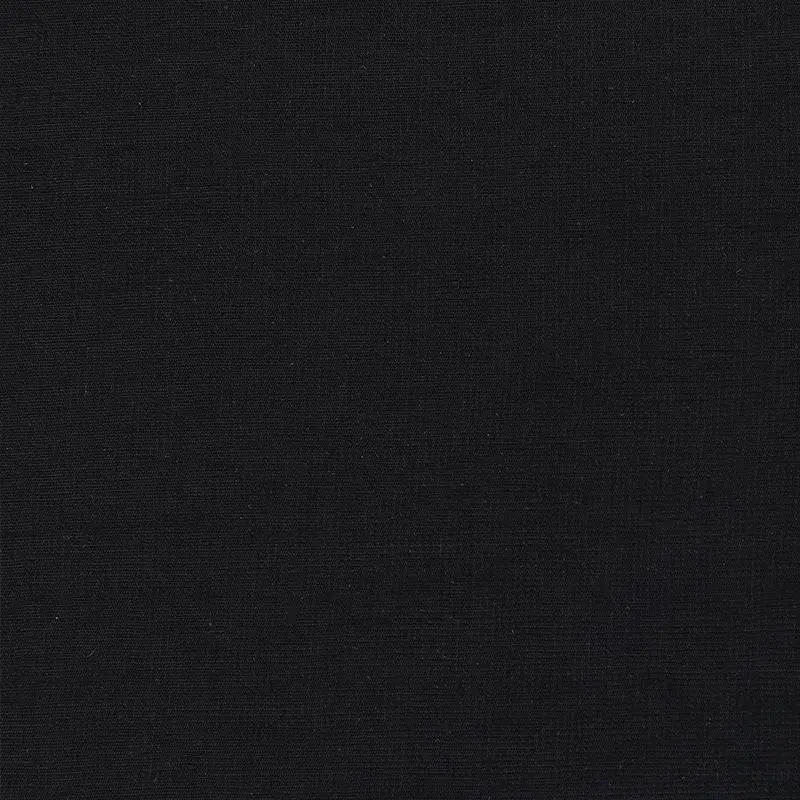
NR Strip Roman Fabric
Understanding NR Strip Roman Fabric
The term “NR” is commonly used in textile product naming to indicate a nylon-rayon combination or an NR-related knitted fabric construction. However, the exact fiber ratio, yarn count, weight, width, stretch level, and finishing recipe can vary from one product specification to another. Buyers should therefore treat the product name as a starting point and confirm the technical specification before placing a production order.
“Roman fabric” generally refers to a compact knitted construction with a smooth or structured face and a relatively stable body. Compared with very light jersey, a Roman-style fabric often feels more substantial and can support garments that require shape retention. The construction may be developed with different knitting arrangements, yarn combinations, and surface treatments depending on the intended end use.
The word “strip” describes the visible surface effect of the product. The effect may be created through the knitting structure, yarn arrangement, color organization, or finishing treatment. It can appear as narrow ribs, subtle vertical lines, tonal bands, or a repeating textured pattern. This gives designers a way to add visual dimension without relying on printed artwork or complicated garment construction.
NR Strip Roman Fabric is therefore best understood as a structured knitted fashion fabric rather than a single universal composition. Its commercial performance depends on the relationship between fiber content, yarn quality, knitting parameters, dyeing conditions, and finishing settings. A carefully balanced structure can provide a comfortable hand, a polished appearance, useful stretch, and a stronger silhouette than many ordinary lightweight knits.
Core Product Characteristics
Structured knitted appearance
The strip effect gives the fabric a recognizable appearance that can make a garment look more refined and carefully engineered. Depending on the scale of the strip and the color contrast, the effect can be understated for office clothing or more noticeable for fashion-forward collections. The vertical direction of a strip pattern may also create a visual lengthening effect when used strategically in garment design.
Comfortable wear potential
Rayon-related fibers are often valued for their soft hand and comfortable contact with the skin. When combined with a suitable knitted construction, the fabric can offer a balance between softness and body. Nylon can contribute strength and resilience, while the knitted structure allows the material to move with the wearer. The final comfort level depends on the precise blend, fabric weight, finishing process, and garment pattern.
Useful body and drape
A Roman-style construction can provide more body than a fine single jersey while retaining a degree of flexibility. This makes the material suitable for garments that need to drape without appearing limp. Dresses, skirts, tops, cardigans, and selected structured fashion pieces can benefit from this balance. A fabric with too little body may lose its shape, while a fabric with too much firmness may feel restrictive. NR Strip Roman Fabric is intended to occupy a practical middle ground.
Adaptability to apparel design
The product can be considered for a wide range of clothing categories. Possible applications include dresses, blouses, skirts, cardigans, lightweight jackets, fashion tops, casual separates, and coordinated garments. The best use depends on the product’s measured weight, width, stretch, recovery, opacity, colorfastness, and care performance.
Color and pattern flexibility
Knitted fabrics with a strip structure can be developed in neutral shades, seasonal colors, deep fashion tones, and coordinated color groups. A subtle strip in a single color creates a premium minimalist appearance, while contrasting shades produce a stronger graphic effect. The construction can also be combined with garment panels, binding, pleats, or layered details.
| Product factor | Potential contribution | Buyer consideration |
|---|---|---|
| NR knitted construction | Flexible wear, soft hand, and adaptable garment performance | Confirm exact fiber composition and stretch behavior |
| Roman-style structure | More body and stability than many lightweight knits | Check weight, drape, and recovery for the intended design |
| Strip surface effect | Visual texture and fashion value without additional printing | Confirm strip direction, repeat, scale, and roll consistency |
| Post-dyeing capability | Opportunity for color development and finishing adjustment | Request lab dips and colorfastness test results |
| Integrated yarn and fabric experience | Better coordination between yarn selection and fabric production | Discuss yarn, knitting, finishing, and repeat-order requirements |
Advantages Compared with Competing Fabric Options
Every fabric has an appropriate application, and NR Strip Roman Fabric should be selected according to the required garment performance. Its advantages become clearer when it is compared with common alternatives such as lightweight jersey, ordinary rib knit, woven rayon, polyester-only knit, and decorative lace knit.
Compared with lightweight single jersey
Lightweight single jersey is popular because it is soft, flexible, and economical. However, it may curl at the edges, show a more casual appearance, or lack sufficient body for certain dresses and skirts. NR Strip Roman Fabric can provide a more substantial hand and a more stable visual structure. This may reduce the need for additional lining or heavy internal support in some designs, although the decision should always be based on testing.
The Roman structure can also help a garment look more polished. A blouse or dress made from a compact structured knit may hold a seam line more neatly than a very light jersey. The strip effect adds further visual interest, allowing a simple silhouette to appear more developed.
Compared with ordinary rib knit
Rib knits are known for stretch and are commonly used for cuffs, neckbands, fitted garments, and body-hugging designs. However, a pronounced rib can sometimes create a highly elastic appearance or a strongly directional texture. NR Strip Roman Fabric can offer surface definition with a potentially more balanced appearance between stretch and stability.
For customers who want a fabric that moves comfortably but does not look excessively casual, NR Strip Roman Fabric may be a suitable alternative. It can provide a cleaner fashion surface for dresses, tops, and coordinated separates while retaining the advantages of a knitted material.
Compared with woven rayon
Woven rayon can provide excellent softness and fluid drape, but it does not normally offer the same inherent flexibility as a knitted construction. Woven fabrics may also require more careful pattern planning when a garment must accommodate movement. NR Strip Roman Fabric can simplify the design of garments that need ease, comfort, and moderate stretch.
At the same time, the knitted fabric may provide more body than a very fluid woven rayon. This distinction is important for designers who want a dress or skirt to fall smoothly without becoming excessively clingy or shapeless.
Compared with polyester-only knitted fabric
Polyester-only knits can offer strength, color retention, quick drying, and easy-care performance. However, some constructions may feel less natural or less soft against the skin. An NR-based fabric can be selected when the buyer wants to balance resilience with a softer, more comfortable hand.
The correct choice depends on the end-use priorities. Sportswear and highly quick-drying garments may require a different polyester performance fabric, while fashion dresses, blouses, cardigans, and lifestyle apparel may benefit more from the hand and appearance of an NR knitted material.
Compared with lace knit
Lace knit is useful for overlays, decorative panels, and garments requiring transparency or openwork effects. Its openness, however, may require lining or additional construction. NR Strip Roman Fabric offers a denser and more supportive surface, making it better suited to main garment panels where coverage and shape are important.
Designers can also combine the two materials. NR Strip Roman Fabric can form the body of a garment, while lace knit can be used for sleeves, yokes, overlays, or decorative inserts. This combination creates contrast between a stable base and a lighter ornamental layer.
Comfort, Performance, and Design Value
The primary commercial strength of NR Strip Roman Fabric is its balance. It is not designed only for softness, only for stretch, or only for appearance. Instead, the product can be developed to combine comfort, structure, visual texture, and practical sewing performance.
For everyday apparel, comfort begins with the hand of the fabric. A smooth surface is generally easier to wear for extended periods, particularly in blouses, dresses, and close-fitting tops. The fabric should not feel excessively harsh, sticky, or rigid. Yarn selection and finishing are important in achieving this result.
Stretch is another important consideration. Knitted fabrics naturally offer more flexibility than many woven fabrics, but the amount and direction of stretch vary substantially. Some NR Strip Roman constructions may stretch primarily across the width, while others may provide additional lengthwise movement. Buyers should measure both directions and evaluate recovery after repeated extension.
Recovery affects the long-term appearance of a garment. A fabric that stretches but does not recover may become loose at the neckline, elbows, waist, or seat. A well-balanced product should be tested for growth and recovery before large-scale production. The results will help the pattern maker determine ease, seam allowance, and construction details.
Opacity is also relevant. A compact Roman structure can provide better coverage than an open knit, but color, weight, and lighting conditions still influence the final result. Pale shades may require lining or a double layer, while darker colors may offer greater visual coverage. Testing under natural and artificial light is recommended.
The strip effect has both aesthetic and technical implications. Designers must decide whether the strips should run vertically, horizontally, or according to the fabric grain. Cutting direction can influence the appearance of the finished garment. Pattern matching may be required at side seams, center fronts, pockets, or sleeve joins if the strip repeat is prominent.
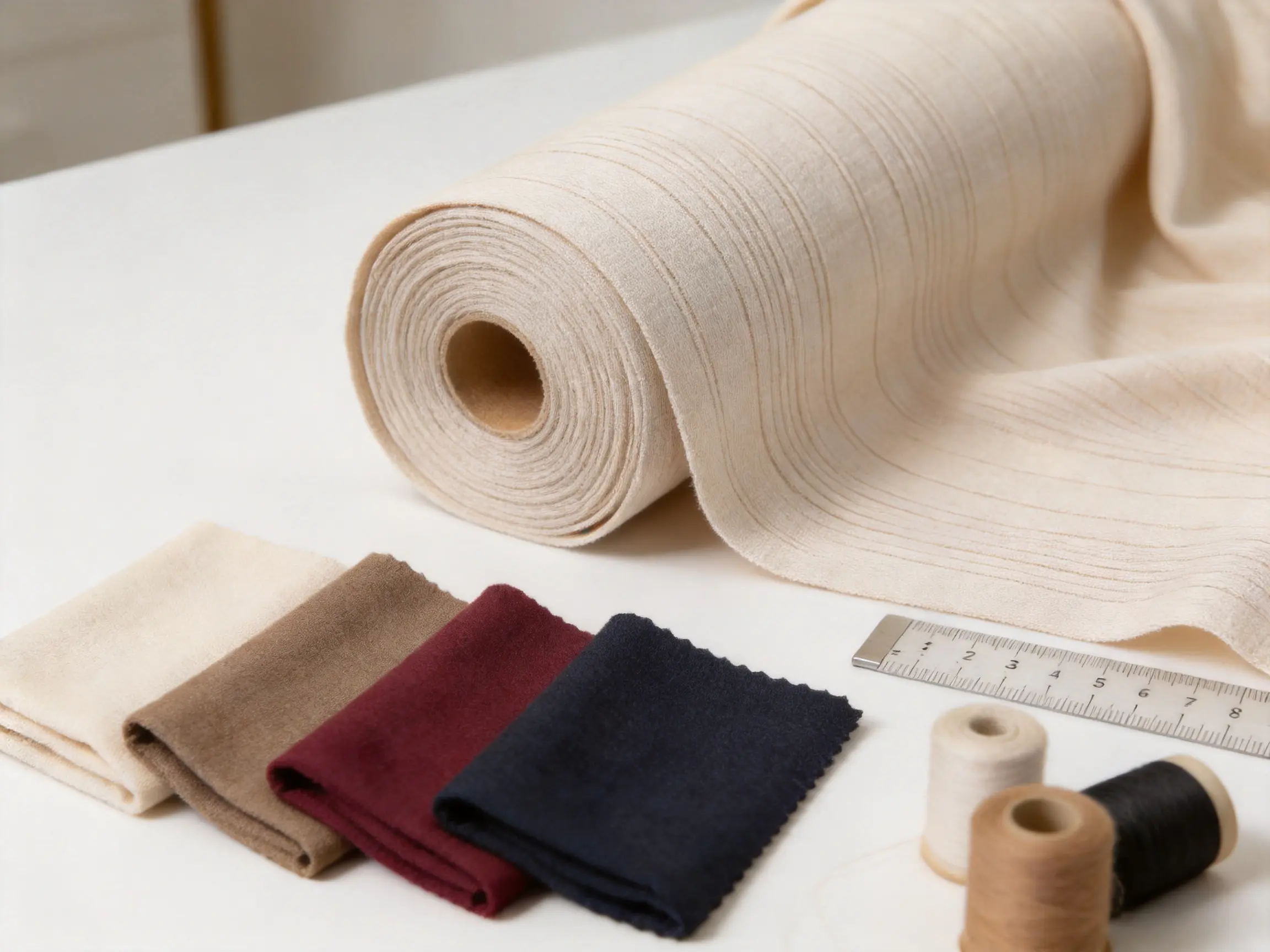
Recommended Apparel Applications
Dresses
NR Strip Roman Fabric is well suited to dresses that require a smooth fall with moderate body. Shift dresses, fitted midi dresses, relaxed day dresses, and long-sleeved casual styles are possible applications. The structured knit can help the garment maintain a clean outline, while the strip effect prevents a simple silhouette from looking flat.
Designers should select the fabric weight according to the season and silhouette. A lighter version may work for warm-weather dresses, while a denser version may be appropriate for transitional or cool-season clothing. If the dress is fitted, stretch and recovery testing is particularly important.
Blouses and fashion tops
Blouses made from NR Strip Roman Fabric can offer a balance between knitted comfort and a more polished appearance. The material may be used for long-sleeved tops, mock-neck styles, draped blouses, pullovers, and simple workwear silhouettes. It can also be paired with woven collars, lace inserts, or contrast trims.
Because the fabric may have a stable body, it can support details such as soft gathers, shaped seams, cuffs, and clean hems. The designer should nevertheless confirm whether the material is suitable for fine pleats or very sharp tailoring, as a structured knit does not behave exactly like a woven suiting fabric.
Skirts
The fabric can be used for straight skirts, pull-on skirts, softly flared skirts, and coordinated skirt sets. Its knitted flexibility can improve comfort at the waist and hips, while its body may help the skirt maintain a smooth appearance. A lining may be needed for light colors, close-fitting designs, or garments intended for formal use.
Cardigans and layering pieces
Cardigans and light layering garments benefit from materials that combine comfort with sufficient stability. NR Strip Roman Fabric can be considered for open-front cardigans, fitted layering jackets, longline tops, and relaxed outer layers. The strip structure can add depth to a monochromatic outfit.
For a cardigan with buttons, snaps, or other hardware, the fabric should be tested for local distortion. Interfacing, a stabilized placket, or a narrow support tape may be appropriate depending on the construction.
Baby and children’s clothing
Knitted fabrics are often considered for children’s garments because of their flexibility and comfort. NR Strip Roman Fabric may be suitable for selected children’s apparel when the composition, softness, colorfastness, and safety requirements have been verified. Baby garments require especially careful evaluation of skin contact, chemical compliance, loose accessories, seam comfort, and laundering performance.
Product suitability for babywear should never be assumed from the fabric name alone. Buyers should request relevant testing and ensure that the finished garment meets the requirements of the target market.
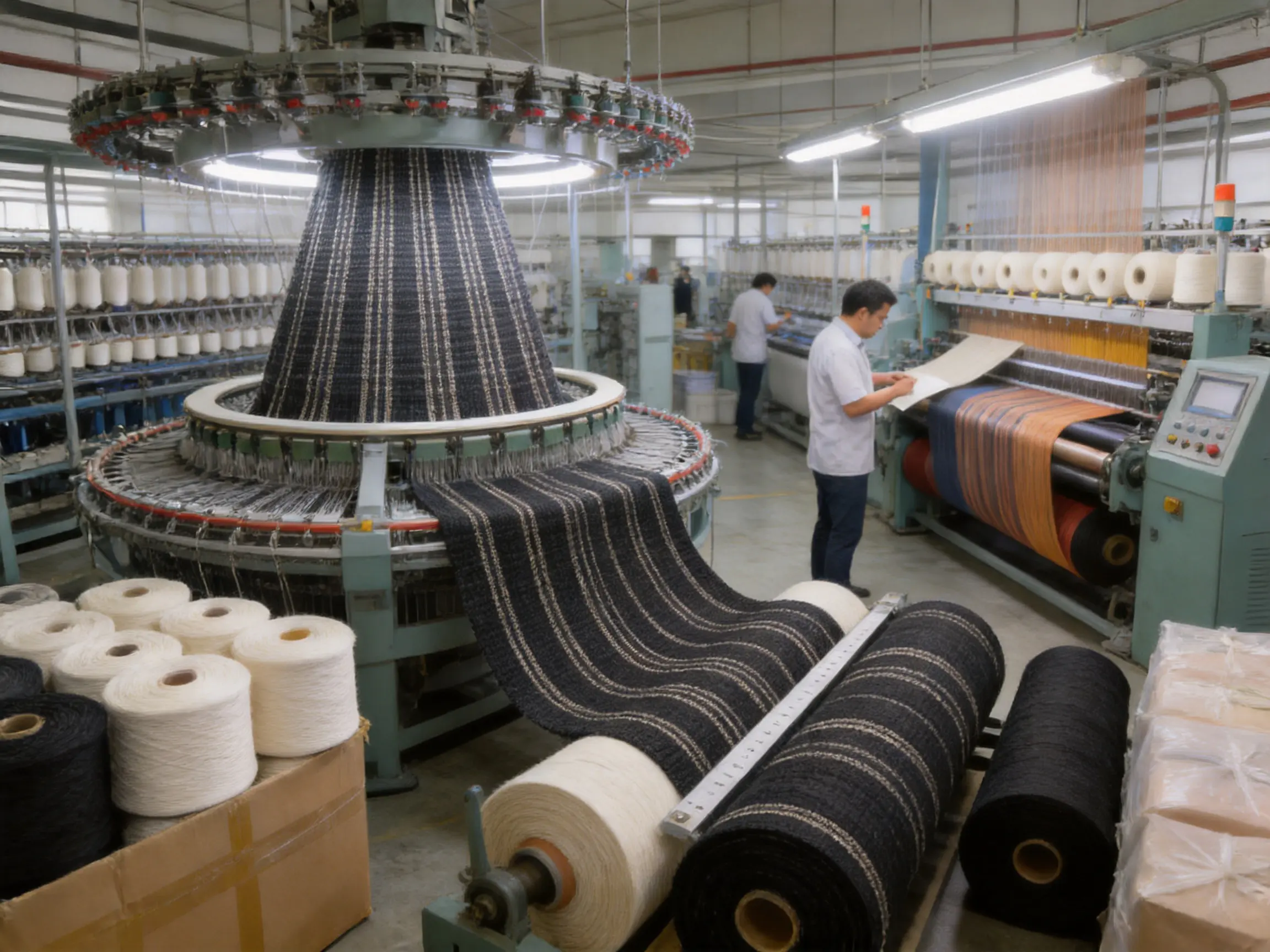
Manufacturing Process and Technical Strengths
The performance of a knitted fabric is determined long before it reaches the cutting table. At Hangzhou Jinfeng Textile Co., Ltd., the production model includes fabric production and processing, post-dyeing, finishing, DTY polyester yarn production, processing, sales, and product development. This combination gives the supplier a broader understanding of how yarn properties affect fabric behavior.
1. Product planning and yarn selection
Production begins with the definition of the target product. The development team must consider fiber content, yarn type, yarn count, color, fabric weight, finished width, stretch, surface appearance, and end use. For an NR Strip Roman fabric, the yarn arrangement must support the desired strip effect and the intended level of compactness.
Yarn selection influences softness, strength, surface regularity, dye uptake, and appearance. If polyester or spandex components are included in a specific construction, their compatibility with the primary fiber system must be evaluated. A supplier with experience in DTY polyester yarn can better understand texturing, bulk, filament behavior, and the effect of yarn characteristics on knitting performance.
2. Knitting preparation
Before knitting, yarn packages should be checked for identification, winding condition, tension consistency, and visible defects. Proper preparation reduces the risk of yarn breaks, uneven feeding, needle lines, and irregular strip formation.
Knitting parameters are then established according to the product design. Machine gauge, loop length, feeding tension, stitch arrangement, and fabric take-down tension all influence the final appearance. Small variations can affect width, weight, stretch, and the balance between the face and reverse sides of the fabric.
3. Knitting and structure formation
The Roman-style structure is formed through a controlled arrangement of knitted loops. The precise construction determines how the fabric behaves during relaxation, dyeing, finishing, cutting, and wear. The strip effect must remain sufficiently regular across the width and along the length of the roll.
During knitting, operators and quality personnel monitor issues such as dropped stitches, holes, needle marks, oil contamination, uneven density, and pattern inconsistency. Early detection is valuable because defects identified at the knitting stage are easier to correct than defects discovered after dyeing or garment assembly.
4. Greige fabric inspection and relaxation
After knitting, greige fabric may be inspected and allowed to relax. Knitted materials can change dimensions when tension is released. Measuring the fabric too soon or under excessive tension may produce inaccurate results. Relaxation helps reveal the fabric’s natural width, length, weight, and surface condition before wet processing.
At this stage, rolls can be classified, marked, and prepared for dyeing or other treatments. A clear production record supports traceability and helps the manufacturer repeat a successful specification.
5. Dyeing and color development
Post-dyeing is an important part of the manufacturing process. The dyeing recipe must be matched to the fiber composition and desired shade. Temperature, time, liquor ratio, chemical concentration, and mechanical action influence color uniformity and fabric handle.
Striped or textured fabrics require special attention because uneven dye penetration can make the surface effect look irregular. Lab dips and approval samples allow the buyer and supplier to confirm the color before bulk production. The target shade should be evaluated under suitable lighting and compared with an approved standard.
6. Washing and finishing
Finishing can modify softness, width, weight, surface smoothness, dimensional stability, and overall handle. Depending on the product specification, finishing may include compacting, softening, heat setting, brushing, calendaring, or other controlled treatments. The correct process should enhance the intended performance without flattening or damaging the strip effect.
For a knitted fabric, finishing tension must be managed carefully. Excessive tension can create misleading width measurements and later shrinkage. Insufficient control may lead to uneven edges or inconsistent roll appearance. The finishing department therefore plays a central role in converting knitted goods into a commercially usable fabric.
7. Final inspection and packing
Before dispatch, the finished fabric should be checked for width, weight, appearance, shade, surface defects, stretch, recovery, and roll presentation. Inspection systems may use a point-based defect classification or another agreed quality method. Buyers should establish acceptable limits before production begins.
Correct packing protects the fabric during storage and transportation. Rolls should be identified with product name, color, batch number, length, width, and other relevant information. Clear labeling supports inventory control and makes repeat ordering more efficient.
Why an Integrated Supplier Can Add Value
A supplier that works across yarn and fabric operations can offer practical advantages during development. Yarn and fabric decisions are closely connected. A yarn that appears suitable on paper may create unwanted surface irregularity, excessive hairiness, weak recovery, or inconsistent dye uptake when knitted. Experience at both stages helps the manufacturer identify these relationships earlier.
Hangzhou Jinfeng Textile Co., Ltd. is located in Jingjiang Street Industrial Park, Xiaoshan District, Hangzhou City, Zhejiang Province. The company reports an area of approximately 32.6 acres and a plant area of approximately 18,000 square meters. Its activities include research and development, production, processing, post-dyeing, finishing, and sales.
This manufacturing scope can support several buyer needs. A fashion brand may require a custom color and a specific hand feel. A garment factory may need stable width and reliable cutting performance. A wholesaler may prioritize repeat availability and consistent packaging. An export customer may need organized documentation, communication, and shipment coordination.
The company describes itself as an export-oriented enterprise integrating research and development, production, and sales. Its stated business philosophy emphasizes cooperation, mutual benefit, and service to domestic and overseas customers. For buyers, the practical importance of this approach is the possibility of communicating development, manufacturing, and commercial requirements through one supplier relationship.
Integrated production does not eliminate the need for inspection or testing. Instead, it can make problem-solving more direct. If a buyer reports uneven stretch or a change in hand feel, the supplier can review yarn selection, knitting parameters, dyeing conditions, and finishing settings as connected parts of the same process.
Quality Control Priorities for Buyers
Before ordering NR Strip Roman Fabric in bulk, buyers should prepare a clear specification sheet. The document should identify composition, fabric name, construction, finished width, target weight, color standard, stretch requirement, recovery expectation, shrinkage limit, surface appearance, packing method, and inspection standard.
Fiber composition
Confirm the exact fiber composition through supplier documentation and, when necessary, laboratory testing. Product names such as NR, Roman, or blended knit do not replace a formal composition specification. If the fabric is intended for a regulated market, verify applicable labeling and fiber-content requirements.
Weight and width
Fabric weight affects drape, opacity, warmth, sewing behavior, and garment cost. Finished width affects marker efficiency and fabric consumption. Both measurements should be taken after appropriate relaxation and under agreed testing conditions.
Stretch and recovery
Measure stretch in the width and length directions. Record the extension percentage, applied load, recovery time, and residual growth. For fitted garments, recovery is often as important as initial stretch.
Dimensional stability
Wash testing helps determine shrinkage and distortion. The test method should match the care label that will be used for the finished garment. A fabric that performs well before washing may change after laundering if relaxation and finishing have not been properly controlled.
Colorfastness
Evaluate colorfastness to washing, rubbing, perspiration, light, and other relevant conditions. Dark and saturated colors often require particular attention to crocking and wash performance. The testing level should reflect the end use and destination market.
Appearance and defects
Inspect the fabric under consistent lighting. Look for holes, needle lines, slubs, streaks, oil marks, uneven dyeing, shade variation, width fluctuation, edge curling, and irregular strip formation. The fabric should be inspected across the full usable width, not only near the center.
| Inspection area | Suggested evaluation | Reason |
|---|---|---|
| Composition | Supplier declaration and laboratory confirmation when required | Ensures correct labeling and product compliance |
| Finished width | Measure at multiple points after relaxation | Supports accurate marker planning and consumption estimates |
| Fabric weight | Record grams per square meter or agreed unit | Controls hand, opacity, drape, and cost |
| Stretch and recovery | Test both directions and record residual growth | Helps prevent poor fit and bagging |
| Colorfastness | Wash, rubbing, perspiration, and light tests as appropriate | Protects finished-garment quality |
| Surface appearance | Inspect strips, texture, shade, and visible defects | Maintains visual consistency across production |
| Shrinkage | Wash or relaxation test using the planned care method | Improves pattern accuracy and size stability |
Sewing and Garment Production Guidance
NR Strip Roman Fabric is generally suitable for conventional apparel production, but sewing settings should be adjusted to the fabric’s thickness, stretch, and surface structure. A ballpoint or stretch needle may be appropriate for some constructions because it can pass between knitted loops more smoothly than a sharp needle.
Thread selection should support the required seam flexibility. The machine tension should be balanced to prevent seam puckering or excessive thread exposure. Stretch seams may be useful for fitted styles, armholes, side seams, and waist areas. The correct stitch depends on the fabric and the performance expected from the garment.
Cutting should be performed on a stable, clean surface without excessive stretching. If the fabric is pulled during spreading, the cut panels may contract later and create size differences. Allowing the fabric to relax before cutting is recommended, especially when the material has been rolled tightly or transported over a long distance.
Strip direction should be considered during marker planning. If the strips are intended to run vertically, all major pattern pieces should be aligned consistently. If the design uses horizontal strips, the pattern maker should evaluate how the effect interacts with bust, waist, hip, and sleeve proportions.
For prominent strip repeats, matching at selected seams can improve the appearance of the finished garment. Full matching may increase fabric consumption, so the designer should decide which seams require alignment. Side seams, center fronts, pocket edges, and yokes are common areas for attention.
Hems may be completed with a coverstitch, twin needle, blind hem, or another method suitable for the weight and stretch of the fabric. Testing is necessary because some finishing methods may cause tunneling, waviness, or local distortion. A narrow stabilizing tape can be used in areas that need additional support.
Care, Storage, and Handling
Care instructions should be determined through testing rather than assumed. Depending on the final blend and finishing, the fabric may be suitable for gentle machine washing, hand washing, or professional care. Excessive heat can affect dimensions, surface appearance, and stretch recovery.
Finished garments should be stored away from direct sunlight, moisture, dust, and strong chemical odors. Rolls should not be compressed unnecessarily for long periods. Proper storage helps preserve color, surface condition, and dimensional stability before cutting.
When fabric is received, the buyer should inspect the shipment promptly. Check the roll labels, quantities, colors, widths, visible condition, and any signs of moisture or transport damage. If a problem is found, record the roll number and photograph the issue before further processing.
Development and Ordering Recommendations
A professional development process normally begins with a product brief. The brief should describe the intended garment, target market, season, preferred color range, required hand feel, approximate weight, stretch expectations, and estimated order quantity.
The supplier can then prepare a development sample or fabric swatch. The buyer should assess the sample under realistic conditions, including drape testing, sewing trials, washing, ironing, and wear simulation. A small garment prototype is often more informative than a loose swatch because it reveals how the fabric behaves in seams and shaped panels.
Color development should use an approved lab dip or physical standard. Digital color references can assist communication, but they may not accurately represent the appearance of fabric under different lighting conditions. The approval record should identify the color name, code, date, fabric construction, and responsible parties.
For repeat orders, the original approved sample should be preserved and referenced. The supplier should be informed if the fabric is required to match an earlier lot. Because knitted fabrics can vary with yarn batch, machine setting, dyeing recipe, and finishing condition, repeat production requires documented controls.
Buyers should also discuss minimum order quantity, production lead time, sample charges, payment conditions, packaging, shipping marks, inspection procedures, and claim handling before confirming the order. Clear commercial terms reduce delays and provide a common basis for cooperation.
Sustainability and Responsible Textile Production
Responsible textile production involves more than selecting a particular fiber. It includes efficient use of yarn, water, energy, dyes, packaging, and labor. A stable production process can reduce rework, rejected fabric, and unnecessary waste. Accurate planning also helps buyers order the correct quantity rather than carrying excessive inventory.
Knitted fabric development should consider cutting efficiency. A consistent width and predictable shrinkage level can reduce marker waste. Strip alignment may increase consumption in some designs, but careful planning can limit unnecessary offcuts while maintaining the required visual quality.
Color and finishing processes should be managed according to applicable environmental and chemical requirements. Buyers serving international markets may need restricted-substance declarations, testing reports, or other compliance documentation. These requirements should be discussed at the beginning of development rather than after bulk production.
Durability is also part of responsible consumption. A comfortable garment that retains its appearance and fit through repeated use may provide greater value than a garment that quickly loses shape. Testing NR Strip Roman Fabric for pilling, colorfastness, shrinkage, and recovery can support better product life-cycle decisions.
Q&A
What is NR Strip Roman Fabric?
NR Strip Roman Fabric is a structured knitted fabric with a strip-like surface effect. “NR” generally refers to an NR-related fiber or fabric designation, often associated with nylon and rayon, while the exact composition must be confirmed in the technical specification. The Roman construction gives the fabric a more stable body than many lightweight knits.
Is NR Strip Roman Fabric suitable for dresses?
Yes, it can be suitable for dresses, particularly styles that need a combination of comfort, moderate stretch, body, and visual texture. The correct version should be selected according to weight, opacity, recovery, drape, and care requirements.
Can it be used for blouses and skirts?
Yes. The fabric can be considered for blouses, pull-on skirts, straight skirts, coordinated separates, and casual fashion garments. Sewing tests should be completed to determine the best needle, stitch, seam, and hem construction.
Does the fabric have stretch?
Knitted fabrics usually provide flexibility, but the exact stretch level depends on the construction and composition. Buyers should not rely only on the product name. Stretch and recovery should be measured in both directions using an agreed method.
How does it compare with single jersey?
NR Strip Roman Fabric can offer more body, a more stable appearance, and stronger surface definition than many lightweight single jerseys. Single jersey may be lighter and more fluid, so the better choice depends on the garment’s intended silhouette and performance requirements.
How does it compare with woven rayon?
Woven rayon often provides fluid drape and softness but less natural stretch. NR Strip Roman Fabric can offer greater flexibility and a more supportive knitted body, which may be advantageous for comfortable fitted or semi-fitted apparel.
Can the strip effect be used as a design feature?
Yes. Designers can use the strip direction to create visual length, emphasize garment panels, or add texture to a simple silhouette. Pattern placement and seam matching should be considered during cutting and marker planning.
Is the fabric suitable for baby clothes?
It may be suitable for selected baby or children’s garments if the exact composition, softness, colorfastness, chemical compliance, and safety requirements have been verified. Babywear should receive more extensive testing than ordinary fashion apparel.
What should be confirmed before bulk ordering?
Confirm fiber composition, weight, width, color, stretch, recovery, shrinkage, pilling, colorfastness, surface appearance, packaging, inspection standards, minimum order quantity, lead time, and repeat-order requirements.
What manufacturing capabilities support this product?
The supplier’s capabilities include fabric production and processing, post-dyeing, finishing, research and development, and DTY polyester yarn production and processing. These connected operations can support better coordination between yarn properties, knitting performance, finishing, and final fabric quality.
Where is the supplier located?
Hangzhou Jinfeng Textile Co., Ltd. is located at 1279 Shenda Road, Jingjiang Branch, Xiaoshan District, Hangzhou, Zhejiang. The company operates in Jingjiang Street Industrial Park and serves domestic and overseas customers.
Conclusion
NR Strip Roman Fabric offers a practical combination of knitted comfort, structured body, visual texture, and apparel versatility. Its strip effect can add fashion value to dresses, blouses, skirts, cardigans, and coordinated garments, while its Roman-style construction can provide more stability than many lightweight knit alternatives.
The product’s final performance depends on the complete manufacturing chain. Yarn selection, knitting control, relaxation, dyeing, finishing, inspection, and packing must work together. Buyers who define the specification clearly and test the material in a garment prototype can make better decisions about fit, construction, care, and production cost.
Hangzhou Jinfeng Textile Co., Ltd. brings together blended fabric production, post-dyeing, finishing, DTY polyester yarn operations, research and development, and export-oriented sales. Its reported 32.6-acre site and 18,000-square-meter plant provide a substantial manufacturing base for textile development and production coordination.
For customers seeking a fabric that is more distinctive than basic jersey, more flexible than many woven materials, and more supportive than delicate open knits, NR Strip Roman Fabric deserves consideration. The best results will come from close communication, approved samples, documented standards, and systematic quality control from yarn to finished garment.
References
1. Product information supplied for NR Strip Roman Fabric and NR knitted fabric applications.
2. Product information supplied for polyester, rayon, blended fabric, and DTY polyester yarn operations.
3. International textile testing principles for knitted fabric dimensional stability, stretch, recovery, colorfastness, and appearance evaluation.
4. General apparel manufacturing practices for knitted fabric cutting, sewing, finishing, inspection, and packing.
5. General textile quality management principles for yarn preparation, knitting control, dyeing, finishing, traceability, and repeat production.
6. General textile design references concerning fiber properties, knitted structures, garment drape, surface effects, and apparel applications.