NR Bamboo Fabric: A Responsible Choice for Comfortable, Durable Knitted Textiles
Introduction
NR bamboo fabric is a knitted textile developed for manufacturers and consumers who are looking for softness, comfort, durability, and a more responsible approach to fiber selection. Produced from bamboo-derived cellulose through a viscose rayon process, the fabric transforms a renewable plant resource into a practical textile material suitable for a broad range of apparel and household applications.
As the textile industry continues to examine the environmental impact of raw materials, production methods, and end products, bamboo-based viscose has attracted considerable attention. Bamboo grows quickly and can provide a renewable source of cellulose. However, bamboo cannot simply be turned into a soft, uniform textile fiber through mechanical processing alone in most commercial applications. The cellulose must be dissolved and regenerated through a chemical process. NR bamboo fabric therefore represents a balance between renewable raw-material sourcing and modern textile manufacturing.
The fabric is especially suitable for underwear, socks, T-shirts, loungewear, lightweight apparel, and selected household textiles. Its smooth handle, comfortable drape, and ability to be knitted into flexible structures make it attractive for products that remain close to the skin. At the same time, the strength and long-lasting performance associated with viscose rayon processing can help manufacturers create products that perform reliably during regular use.
For buyers, the value of NR bamboo fabric is not limited to its fiber content. Product quality also depends on yarn preparation, knitting precision, dyeing, finishing, inspection, and the supplier’s ability to coordinate production from development through delivery. Hangzhou Jinfeng Textile Co., Ltd. combines fabric production, post-dyeing, finishing, blended-fabric manufacturing, and DTY polyester yarn operations within one textile business structure. This integrated capability provides a foundation for developing fabrics that meet practical requirements for appearance, hand feel, construction, and application.
This article examines the characteristics, advantages, manufacturing considerations, applications, and purchasing value of NR bamboo fabric while explaining why a coordinated production partner can offer advantages over less integrated textile suppliers.
NR Bamboo Fabric
What Is NR Bamboo Fabric?
NR bamboo fabric is a knitted fabric made with bamboo-derived viscose rayon fibers. The bamboo plant supplies cellulose, which is processed into a dissolvable form and then regenerated as textile fiber. Once the fiber has been converted into yarn, it can be knitted into a wide variety of constructions, weights, and surface effects.
The term “NR” is used here as the product designation for this knitted fabric. It identifies the product within the supplier’s NR knitted fabric category. The exact fiber blend, yarn specification, weight, width, color, and finishing route may vary according to the buyer’s technical requirements and the intended end use.
Unlike woven fabric, knitted fabric is created through interlocking loops. This structure gives the material natural flexibility and makes it especially useful for garments that need to stretch, recover, drape, or conform to body movement. Depending on the knitting construction, NR bamboo fabric can be developed for lightweight single jersey, rib structures, interlock-like constructions, or other knitted formats.
The resulting textile is generally recognized for a soft surface and comfortable touch. These qualities are important in products such as underwear, socks, T-shirts, sleepwear, and casual clothing because the fabric may remain in direct contact with the skin for extended periods. A well-designed knitted bamboo viscose fabric can also provide a smooth appearance that supports both basic and premium apparel collections.
It is important to distinguish between bamboo fiber and bamboo viscose. Bamboo as a plant is renewable, but bamboo viscose is a regenerated cellulose fiber produced through chemical processing. Responsible product communication should describe this accurately rather than suggesting that the final textile is an untreated natural bamboo fiber. This distinction helps buyers make informed decisions about sustainability, performance, labeling, and care.
Fiber Conversion and Textile Performance
The viscose rayon process converts plant cellulose into a form that can be extruded and regenerated as fiber. The process enables manufacturers to achieve the fineness, uniformity, and softness required for textile production. It also makes bamboo-derived cellulose suitable for spinning into yarn and knitting into consistent fabric structures.
Once spun, the yarn’s performance depends on more than the original plant source. Fiber length, fineness, yarn count, twist, spinning quality, knitting parameters, dyeing conditions, and finishing treatments all influence the final result. A professional supplier must therefore manage the entire chain rather than treating bamboo content as the only measure of fabric quality.
Key Advantages of NR Bamboo Fabric
Softness and Skin Comfort
One of the main reasons buyers choose NR bamboo fabric is its soft hand feel. Bamboo-derived viscose can produce a smooth and pleasant surface that is well suited to intimate apparel, base layers, and everyday garments. Compared with some coarser cellulosic or synthetic fabrics, it may provide a more refined touch, particularly when the yarn and finishing process are carefully controlled.
Softness is not merely a marketing benefit. It can influence how often a garment is worn, how comfortable it feels during movement, and how consumers perceive product quality. For underwear and T-shirts, surface comfort is often one of the first characteristics noticed by the wearer. A smooth knitted surface can also reduce the harsh feeling that some consumers associate with low-quality fabrics or poorly controlled finishing.
Flexible Knitted Construction
The looped construction of knitted fabric allows NR bamboo fabric to provide flexibility and movement comfort. This makes it suitable for garments that need to stretch across the shoulders, torso, waist, or legs. The fabric can be designed with different loop densities and structures to achieve a balance between elasticity, coverage, breathability, and shape retention.
For manufacturers, knitted construction offers design flexibility. A single fabric family can be adapted for lightweight summer T-shirts, comfortable underwear, sleepwear, socks, or layered garments by changing the knitting specification, yarn arrangement, fabric weight, and finishing route. This adaptability can help brands develop coordinated product ranges without changing to an entirely different fiber platform.
Comfortable Drape
Viscose-based textiles are commonly associated with a fluid and comfortable drape. In a bamboo knitted fabric, this characteristic can support relaxed silhouettes, soft layering pieces, and garments designed to move naturally with the body. The drape may be particularly attractive in T-shirts, lounge garments, lightweight dresses, and casual tops.
Drape must always be evaluated together with fabric weight and construction. A very light fabric may drape elegantly but require careful handling to prevent transparency or distortion. A denser construction can provide better coverage and stability while retaining a soft touch. The supplier’s ability to adjust fabric parameters is therefore important when buyers seek a specific visual effect.
Renewable Cellulose Source
Bamboo is a rapidly growing plant and can serve as a renewable source of cellulose. This characteristic makes bamboo-derived viscose attractive to companies that want to explore alternatives to exclusively petroleum-based textile fibers. It can also support product stories centered on plant-derived raw materials and more considered material selection.
However, the environmental profile of the fabric must be assessed across the entire life cycle. The chemical conversion process, energy consumption, water use, chemical recovery, dyeing, finishing, transport, and garment care all contribute to the overall impact. NR bamboo fabric should therefore be presented as a plant-cellulose textile option rather than described as automatically impact-free.
Durability for Regular Apparel Use
A well-produced bamboo viscose knitted fabric can provide dependable performance for everyday apparel. The fiber is converted into a strong, usable textile material through the viscose process, and the final durability is further influenced by yarn quality, fabric construction, and finishing. When these factors are properly managed, the fabric can be used in garments that are washed and worn regularly.
Durability is particularly important for underwear, socks, and T-shirts because these products are frequently laundered. Buyers should evaluate dimensional stability, pilling resistance, colorfastness, seam performance, and recovery after washing rather than judging durability by fiber content alone. A competent textile supplier can provide development samples and support testing before bulk production.
Versatility Across Product Categories
NR bamboo fabric can be used in several product categories, including intimate apparel, casualwear, base layers, sleepwear, socks, children’s garments, and household textiles. The same general fiber platform can be adjusted to produce different surface effects and levels of stretch.
This versatility provides a commercial advantage over fabrics limited to one narrow application. A brand may use a soft lightweight construction for underwear, a more stable construction for T-shirts, and a denser or ribbed construction for cuffs, necklines, or close-fitting garments. The ability to coordinate related fabric qualities can simplify collection development and improve visual consistency across products.
NR Bamboo Fabric Compared with Other Textile Options
| Comparison factor | NR bamboo fabric | Conventional cotton knitted fabric | Polyester knitted fabric | Typical blended fabric |
|---|---|---|---|---|
| Primary material route | Bamboo-derived regenerated cellulose | Natural cotton fiber | Synthetic polymer fiber | Combination of two or more fibers |
| Surface feel | Generally smooth and soft when properly produced | Can range from crisp to soft depending on yarn and finishing | Often smooth, resilient, or technical in handle | Depends on the blend ratio and finishing |
| Stretch potential | Provided mainly by knitted construction or added elastane | Provided mainly by knitted construction or added elastane | Can be enhanced through yarn design or elastane | Varies according to fiber combination |
| Moisture behavior | Cellulosic fiber with comfortable moisture interaction | Cellulosic fiber with familiar comfort properties | Generally low moisture absorbency | Balanced according to component fibers |
| Common applications | Underwear, socks, T-shirts, sleepwear, household textiles | Everyday apparel, underwear, shirts, towels | Sportswear, uniforms, outer layers, technical products | Fashion apparel, performance fabrics, cost-optimized products |
| Key purchasing consideration | Viscose process, fabric stability, finishing, and accurate labeling | Fiber quality, shrinkage, softness, and cultivation-related sourcing | Hand feel, static behavior, breathability, and recycled content | Blend compatibility, dyeing behavior, and fiber separation considerations |
This comparison shows that NR bamboo fabric does not need to compete with every textile on a single performance measure. Its strongest position is often the combination of softness, plant-derived cellulose content, flexible knitted construction, and suitability for skin-contact garments. Polyester may offer stronger resilience and faster drying in some applications, while cotton may provide a familiar natural-fiber option. Blended fabrics can combine properties from multiple fibers. NR bamboo fabric is attractive when comfort, drape, and a renewable cellulose story are central to the product concept.
Compared with basic polyester jersey, NR bamboo fabric may offer a softer and less synthetic touch. Compared with ordinary cotton jersey, it may provide a smoother drape and a distinct comfort experience. Compared with some inexpensive blended fabrics, it can support a more focused material story based on bamboo-derived cellulose. These advantages are strongest when supported by consistent production and accurate technical communication.
Environmental Considerations
Renewability and Responsible Communication
Bamboo is widely recognized as a fast-growing plant resource. This is one reason bamboo-derived textiles have become popular among brands seeking renewable raw-material options. Nevertheless, the final fabric is regenerated cellulose rather than raw bamboo fiber. The environmental discussion must therefore include both the renewable source and the industrial conversion process.
A responsible supplier should avoid unsupported claims such as “chemical-free,” “completely sustainable,” or “naturally antibacterial.” Bamboo viscose requires chemical processing, and the antibacterial properties sometimes associated with the living bamboo plant do not necessarily remain in the finished garment. Once the cellulose has been processed into viscose fiber and made into fabric, any performance claim must be supported by appropriate testing on the finished textile.
This point is especially important for intimate apparel. Consumers may choose bamboo fabric because they have heard that bamboo is antibacterial. However, the antibacterial characteristics of the original plant should not automatically be transferred to the regenerated fiber or garment. Clear product information protects both buyers and manufacturers and supports long-term trust.
Process Management Matters
The environmental value of a bamboo fabric depends heavily on process management. Fiber conversion, yarn production, knitting, dyeing, finishing, and wastewater treatment all influence the final footprint. Efficient production planning can reduce waste, avoid unnecessary reprocessing, and improve material utilization.
Integrated textile operations can help coordinate these stages. When fabric manufacturing, post-dyeing, finishing, blended-fabric production, and yarn-related operations are managed by an experienced textile company, communication between departments may be more direct. This can make it easier to adjust fabric specifications, identify defects, and reduce delays caused by fragmented sourcing.
Buyers should ask suppliers about fiber composition, production route, dyeing process, restricted substances controls, colorfastness testing, dimensional stability, and packaging practices. They should also request documentation that matches the actual product rather than relying on broad environmental language.
Manufacturing Process of NR Bamboo Fabric
Raw Material and Fiber Preparation
The production of NR bamboo fabric begins with bamboo-derived cellulose fiber. The fiber must be suitable for textile spinning and compatible with the selected knitting specification. Important considerations include fineness, fiber strength, moisture condition, uniformity, and the ability to form a stable yarn.
Fiber preparation affects downstream performance. Poorly prepared or inconsistent fiber can lead to irregular yarn, uneven dye uptake, increased hairiness, or surface defects. Careful sourcing and incoming inspection are therefore essential before spinning or fabric production begins.
Yarn Formation
During yarn formation, fibers are aligned and spun into a continuous yarn with the required count and strength. The yarn specification determines how the fabric will behave during knitting. A finer yarn may support a lightweight, smooth fabric, while a heavier yarn can create greater coverage and body.
Yarn evenness is important for appearance. Uneven yarn can produce streaks, bars, or irregular loop formation. Twist also affects handle, strength, and surface character. A supplier with experience in both fabric manufacturing and DTY polyester yarn production understands how yarn properties influence knitting and final fabric performance, even when the products use different fiber systems.
Knitting
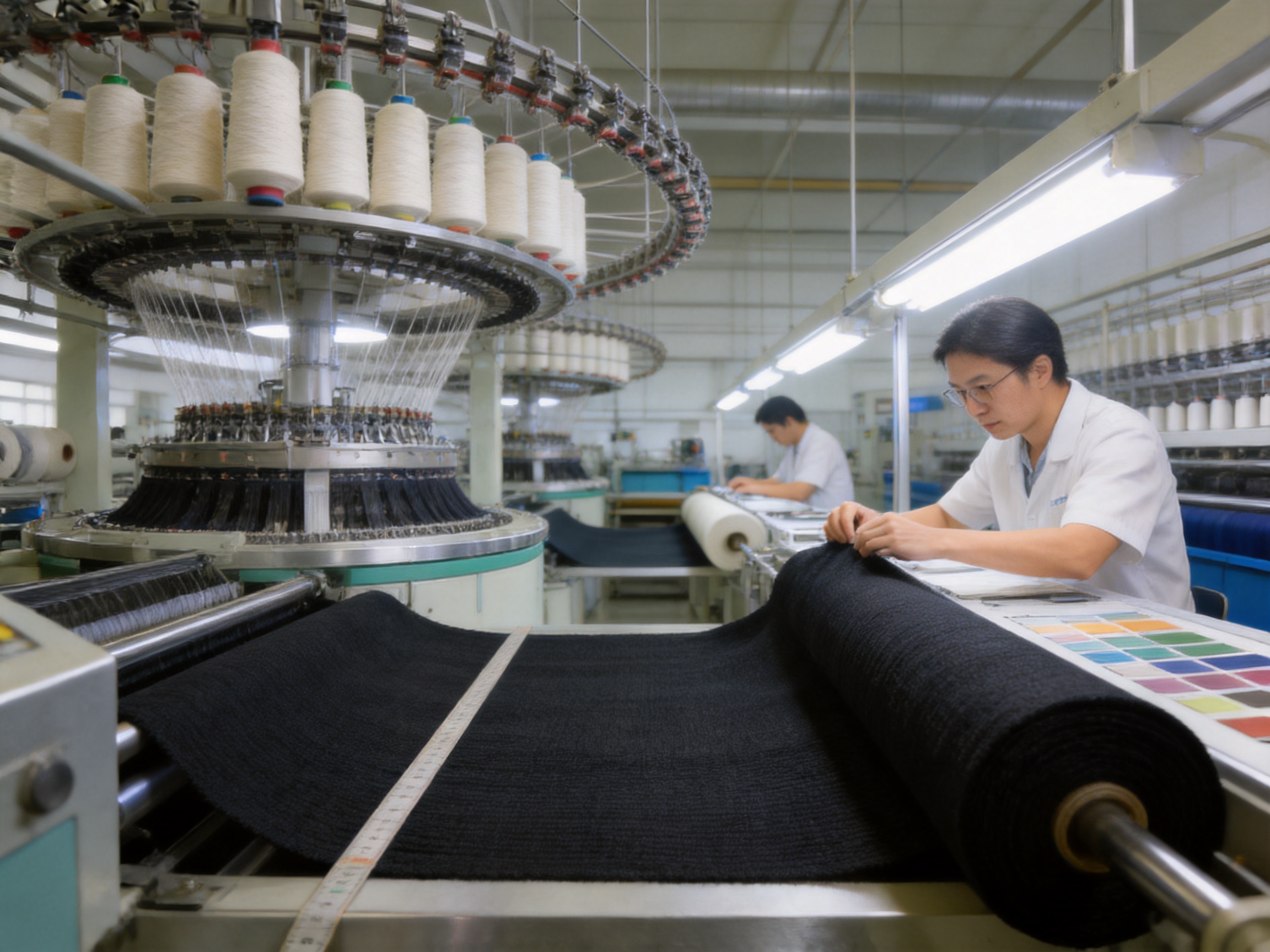
Knitting transforms the yarn into a flexible fabric through a controlled arrangement of loops. The knitting machine, gauge, stitch length, loop density, yarn tension, and fabric take-up all affect the final construction. These parameters must be selected according to the product’s intended use.
For underwear, the fabric may need a soft surface, moderate stretch, and comfortable recovery. For T-shirts, buyers may prioritize opacity, dimensional stability, and a smooth appearance. For socks or close-fitting products, the construction may need additional resilience and a suitable balance between thickness and flexibility.
Knitting precision helps prevent common problems such as needle lines, dropped stitches, holes, uneven width, excessive spirality, or inconsistent weight. Regular inspection during production allows problems to be identified before large quantities of fabric are completed.
Dyeing and Color Development
After knitting, the fabric may be prepared for dyeing. Bamboo viscose has cellulosic characteristics and must be processed under conditions selected for the fiber type, color depth, and required fastness. Dye selection, bath control, temperature, time, and washing all influence shade consistency and fabric handle.
Color matching is a critical commercial requirement. A supplier must be able to reproduce approved laboratory dips or standards across production lots. Small differences in fiber condition, fabric weight, dye concentration, or finishing can affect the final shade. Careful records and controlled procedures help improve repeatability.
Post-dyeing operations may include washing, softening, drying, compacting, or other finishing treatments. These steps can improve touch, reduce residual shrinkage, and stabilize the fabric. However, finishing must be controlled because excessive softener or aggressive processing may affect absorbency, strength, colorfastness, or the ability of the fabric to accept printing and additional treatments.
Finishing and Fabric Stabilization
Finishing gives the fabric its final appearance and performance characteristics. The selected route depends on whether the buyer wants a clean smooth surface, a softer hand, greater compactness, reduced shrinkage, improved width stability, or a particular visual effect.
Fabric stabilization is important for garments because knitted materials can change dimensions after washing or during cutting and sewing. Proper finishing can reduce unexpected shrinkage and improve consistency between production lots. Buyers should still conduct their own wash tests because the final garment may behave differently depending on pattern design, sewing tension, trims, and laundering instructions.
A professional supplier should communicate fabric width, weight, construction, shrinkage range, colorfastness, and finishing conditions clearly. This information helps garment factories plan cutting, marker efficiency, sewing, and quality inspection.
Inspection and Quality Control
Quality inspection should cover both physical appearance and measurable performance. Typical checks include fabric width, weight, shade, knitting defects, holes, oil marks, surface contamination, bowing, skewing, spirality, pilling tendency, and dimensional change after washing.
For skin-contact products, surface cleanliness and handle consistency are particularly important. For commercial production, lot-to-lot consistency is equally important because buyers need the same fabric quality across repeated orders. A reliable inspection system can reduce claims, minimize garment cutting losses, and protect the final brand image.
Testing should be matched to the intended application. A T-shirt fabric may require one set of priorities, while sock or underwear fabric may require another. Cooperation between the fabric supplier and garment manufacturer helps ensure that testing reflects the real conditions of use.
Integrated Manufacturing Strengths
Experience in Multiple Textile Categories
Hangzhou Jinfeng Textile Co., Ltd. works across several textile categories, including polyester rayon fabric, knitted jacquard fabric, NTR knitted fabric, NR knitted fabric, and slightly intermingled draw textured yarn. This product range provides experience with different yarns, structures, surfaces, and end-use requirements.
Experience across categories can benefit NR bamboo fabric development. A buyer may require a bamboo fabric for the main body of a garment, a polyester or elastane blend for reinforcement, a jacquard section for visual interest, or DTY yarn for another product line. A supplier familiar with several textile technologies can help coordinate these requirements more efficiently than a company focused on only one narrow construction.
Production and Processing Capability
The company’s operations include production and processing, post-dyeing, finishing, and sales of blended fabrics such as polyester and spandex, as well as DTY polyester yarn production, processing, and sales. These capabilities indicate a business structure that covers several important stages between material development and finished textile supply.
For NR bamboo fabric buyers, this broader capability can support customization. Fabric weight, width, color, finishing, yarn selection, and construction may be discussed within one coordinated supply relationship. Consolidated communication can reduce the risk that specifications are interpreted differently by separate yarn, knitting, dyeing, and finishing vendors.
Research, Development, and Customization
Textile buyers increasingly need fabrics that are differentiated by feel, appearance, construction, and performance. Standard stock fabrics may not always meet the requirements of a particular collection. Research and development support can help turn a product concept into a practical specification.
NR bamboo fabric development may involve sampling several yarn counts, stitch lengths, fabric weights, dye shades, and finishing methods. The supplier can compare these options and help determine which configuration provides the best balance between comfort, cost, appearance, and durability.
Customization is also useful when a buyer wants a unique hand feel or a coordinated color program. Sample development should be followed by testing and approval so that the selected quality can be reproduced during bulk production.
Facility and Organizational Capacity
Hangzhou Jinfeng Textile Co., Ltd. is located in Jingjiang Street Industrial Park, Xiaoshan District, Hangzhou City, Zhejiang Province. The company covers approximately 32.6 acres and has a plant area of about 18,000 square meters. This physical scale supports organized production, material handling, sampling, processing, and order coordination.
Facility size alone does not guarantee quality, but it can provide the space needed for equipment placement, workflow separation, inventory control, inspection, and finished-goods management. These practical factors matter when a supplier handles multiple textile categories and serves both domestic and overseas customers.
Export-Oriented Service
The company operates as a self-employed export enterprise integrating research and development, production, and sales. For international buyers, an export-oriented structure can simplify communication about specifications, packing, documentation, sample approvals, production schedules, and shipment arrangements.
Effective export service depends on accurate information and timely responses. Buyers benefit when the supplier can provide clear quotations, sample records, production updates, packing details, and quality documents. These service elements are especially important for textile products because color, width, weight, and finishing can affect the buyer’s garment production plan.
Applications of NR Bamboo Fabric
Underwear and Intimate Apparel
Underwear is one of the most suitable applications for NR bamboo fabric because softness and skin comfort are central purchasing considerations. The fabric can be developed in lightweight or medium-weight constructions and combined with elastane when additional stretch and recovery are needed.
Manufacturers should evaluate the fabric’s seam compatibility, recovery, shrinkage, pilling resistance, and colorfastness. They should also ensure that product descriptions accurately explain the material. Bamboo-derived viscose may be promoted for its soft, plant-cellulose origin, but unsupported antibacterial claims should be avoided.
Socks
NR bamboo fabric can be used in socks where a smooth touch and comfortable fit are desired. Sock construction usually requires attention to abrasion, stretch, recovery, heel and toe reinforcement, and laundering performance. The bamboo viscose component may contribute softness, while the overall yarn and blend must provide sufficient durability for high-friction areas.
Depending on the design, a bamboo fabric may be used alone or combined with other fibers. A technical evaluation should determine whether the selected construction can withstand repeated wear and washing without excessive thinning or loss of shape.
T-Shirts and Casualwear
T-shirts made from NR bamboo fabric can offer a soft, fluid, and comfortable alternative to standard jersey products. The fabric may be suitable for relaxed silhouettes, lightweight layering, travel clothing, and casual collections.
For T-shirt production, buyers should confirm opacity, body, recovery, spirality, shrinkage, and compatibility with screen printing, digital printing, embroidery, or other decoration methods. A smooth and stable surface is valuable for maintaining a clean appearance after repeated wear.
Sleepwear and Loungewear
Comfort is the principal requirement in sleepwear and loungewear. A soft knitted bamboo viscose fabric can support relaxed garments designed for extended wear. The drape may also help create a loose and comfortable silhouette.
Because sleepwear is often washed frequently, dimensional stability and colorfastness must be considered carefully. Buyers should select a finish that maintains softness without creating excessive surface instability or compromising the fabric’s ability to absorb moisture.
Household Textiles
Beyond clothing, NR bamboo fabric can be considered for selected household textiles. Potential products include lightweight home garments, soft accessories, liners, pillow-related products, and other textile items where a smooth hand feel is beneficial.
The exact application should determine the fabric specification. Household textiles may require greater width, stronger construction, different colorfastness standards, or enhanced resistance to repeated laundering. Product development should be based on testing rather than assumptions about the fiber alone.
How NR Bamboo Fabric Supports Product Differentiation
In a crowded textile market, product differentiation often comes from a combination of material story and tangible user experience. NR bamboo fabric can support both. Its bamboo-derived cellulose origin offers a recognizable material narrative, while its softness, drape, and knitted flexibility provide qualities consumers can directly feel.
Compared with basic commodity fabrics, a carefully developed bamboo fabric can help a brand create a more distinctive collection. The differentiation may be expressed through premium underwear, comfort-focused T-shirts, soft loungewear, or collections emphasizing plant-derived materials. The product story becomes stronger when it is supported by accurate composition labeling, responsible environmental language, and reliable quality.
The fabric can also be differentiated through construction. Ribbed surfaces, fine-gauge jersey, heavier constructions, blended yarns, and specialized finishing can create different visual and tactile effects. A supplier with experience in knitted fabrics and blended materials can help buyers explore these options without losing control over production feasibility.
Purchasing and Specification Guide
Confirm Fiber Composition
Buyers should begin by confirming the exact fiber composition. “Bamboo fabric” can refer to different textile routes, and bamboo-derived viscose should be identified accurately. If the fabric includes polyester, spandex, cotton, or another component, the blend ratio should be clearly specified.
Define Fabric Construction
The buyer should state the desired knit structure, width, weight, yarn count, stretch requirement, color, and finish. Vague descriptions can lead to inconsistent quotations and samples. A detailed specification creates a reliable basis for development and bulk production.
Evaluate Physical Performance
Recommended evaluations include dimensional stability after washing, colorfastness to washing and rubbing, pilling, bursting strength, tensile behavior, stretch and recovery, fabric skew, spirality, and surface appearance. The exact test program should reflect the garment category and the buyer’s market requirements.
Review Sample and Bulk Consistency
A sample must represent the quality that will be produced in bulk. Buyers should compare approved samples with production submissions and define acceptable tolerances for weight, width, color, and hand feel. A clear approval procedure helps reduce misunderstandings during manufacturing.
Consider Garment Manufacturing Requirements
Fabric performance is only one part of a successful garment. The material must also be suitable for cutting, sewing, pressing, printing, labeling, and packing. Buyers should conduct a garment trial before confirming large-volume production, especially when using a new bamboo fabric quality.
Recommended Quality-Control Workflow
| Stage | Main control points | Purpose |
|---|---|---|
| Material confirmation | Fiber composition, yarn specification, color, and source documents | Ensures the ordered material matches the product concept |
| Knitting inspection | Loop formation, width, weight, holes, needle lines, and surface defects | Detects structural issues early |
| Dyeing control | Shade matching, bath parameters, color uniformity, and washing | Improves color consistency and fabric cleanliness |
| Finishing control | Handle, width, compactness, shrinkage, and surface appearance | Stabilizes the fabric for garment production |
| Final inspection | Defects, measurements, shade, packing, and lot identification | Confirms shipment quality and traceability |
| Garment trial | Cutting, sewing, washing, fit, and finished appearance | Verifies suitability for the final product |
This workflow is valuable because quality problems often arise from interactions between stages. For example, a fabric may meet its weight target but shrink excessively after washing. A color may match visually but fail rubbing requirements. A soft finish may improve touch while reducing dimensional stability. Coordinated inspection helps identify these trade-offs before shipment.
Care, Labeling, and Consumer Expectations
NR bamboo fabric should carry care instructions appropriate to its actual construction and finishing. Washing temperature, detergent selection, tumble drying, ironing, and exposure to high heat can affect shrinkage, color, and surface appearance. Proper care guidance helps consumers maintain the product and can reduce unnecessary premature replacement.
Labels and marketing materials should identify bamboo-derived viscose accurately. Claims should focus on verifiable characteristics such as fiber composition, softness, knitted comfort, and plant-cellulose origin. Antibacterial claims should not be made unless the finished textile has been tested under an accepted method and the claim is legally appropriate for the target market.
Clear communication benefits all parties. Consumers receive a realistic description, brands reduce compliance risk, and manufacturers avoid unrealistic performance expectations. Responsible labeling is particularly important as sustainability-related textile claims receive increasing attention from regulators and customers.
Why Work with an Integrated Textile Manufacturer?
An integrated manufacturer can provide value beyond the fabric itself. When a supplier combines development, production, dyeing, finishing, and sales, the buyer can communicate with one organization about the complete textile requirement. This can shorten the feedback loop between sample evaluation and production adjustment.
For NR bamboo fabric, integration is useful because the final result depends on many connected variables. Yarn quality influences knitting. Knitting affects dyeing behavior. Dyeing affects hand feel and color. Finishing affects shrinkage and garment performance. When these stages are coordinated, the supplier is better positioned to identify the source of a problem and make an appropriate correction.
Hangzhou Jinfeng Textile Co., Ltd. has established its operations around research and development, production, processing, post-dyeing, finishing, and sales. Its experience with blended fabrics, knitted fabrics, and DTY polyester yarn provides a broad technical base for buyers seeking both single-fiber and blended textile solutions.
The company’s stated business philosophy emphasizes cooperation and mutual benefit. In practical terms, this approach can be reflected in collaborative sample development, clear technical communication, quality discussions, and long-term order planning. A stable supplier relationship is especially valuable for brands that need repeated colors, consistent fabric lots, and reliable delivery schedules.
Q&A: NR Bamboo Fabric
What is NR bamboo fabric made from?
NR bamboo fabric is made from bamboo-derived cellulose that has been converted into viscose rayon fiber and knitted into fabric. The exact composition may vary if the product is developed as a blend with other fibers such as polyester, spandex, or cotton.
Is bamboo viscose the same as untreated bamboo fiber?
No. Bamboo viscose is a regenerated cellulose fiber. Bamboo supplies the cellulose, but the cellulose is dissolved and regenerated through a chemical manufacturing process before it becomes textile fiber.
Is NR bamboo fabric suitable for underwear?
Yes. Its soft hand feel, flexible knitted construction, and comfortable drape make it suitable for underwear and other skin-contact garments. Buyers should confirm stretch, recovery, shrinkage, pilling, colorfastness, and seam performance for the specific underwear design.
Is bamboo fabric naturally antibacterial?
The antibacterial characteristics associated with the living bamboo plant should not automatically be attributed to finished bamboo viscose fabric. Processing into viscose fiber and garments can remove or change such properties. Any antibacterial claim should be supported by testing of the finished textile.
How does NR bamboo fabric compare with polyester?
NR bamboo fabric generally emphasizes softness, plant-derived cellulose content, and comfortable drape. Polyester may offer advantages in resilience, fast drying, and certain technical applications. The best choice depends on the intended garment, performance requirements, price target, and consumer expectations.
How does it compare with cotton?
Both bamboo viscose and cotton are cellulosic textile options, but they differ in fiber structure, processing route, hand feel, drape, and performance. NR bamboo fabric is often selected for its smoothness and fluid comfort, while cotton remains a familiar and versatile choice with a broad range of constructions.
Can NR bamboo fabric be blended with other fibers?
Yes. Blending may be considered when a buyer wants to balance softness with stretch, resilience, strength, cost, or drying performance. The final blend must be evaluated for dyeing compatibility, fabric behavior, labeling, and end-use requirements.
Can the fabric be customized?
Customization may include fabric weight, width, knit construction, color, yarn specification, finishing, and blend ratio. Buyers should provide a detailed technical brief and approve samples before bulk production.
What tests should buyers request?
Common evaluations include fiber composition, fabric weight, width, dimensional stability, colorfastness, pilling, bursting strength, tensile behavior, stretch and recovery, spirality, and surface appearance. The exact test plan should be based on the final product and destination market.
What products can be made from NR bamboo fabric?
Typical applications include underwear, socks, T-shirts, sleepwear, loungewear, base layers, casual clothing, and selected household textiles. Construction and finishing should be adjusted for each application.
Why is supplier integration important?
Knitting, dyeing, finishing, and garment performance are closely connected. An integrated textile supplier can coordinate these stages, respond more efficiently to technical feedback, and help maintain consistency from development through bulk production.
Where is the manufacturing company located?
Hangzhou Jinfeng Textile Co., Ltd. is located in Jingjiang Street Industrial Park, Xiaoshan District, Hangzhou City, Zhejiang Province, China. Its listed address is 1279 Shenda Road, Jingjiang Branch, Xiaoshan District, Hangzhou.
Conclusion
NR bamboo fabric offers a practical combination of soft comfort, flexible knitted construction, attractive drape, renewable plant-cellulose sourcing, and broad application potential. It is particularly suitable for underwear, socks, T-shirts, sleepwear, loungewear, and household textiles where touch and comfort are important.
Its advantages over competing fabrics are application-specific rather than absolute. Polyester may be preferable for certain technical products, cotton may be selected for familiar natural-fiber performance, and blended fabrics may provide a targeted balance of properties. NR bamboo fabric stands out when the product requires a soft, smooth, comfortable textile supported by a bamboo-derived cellulose story.
The quality of the final product depends on responsible fiber processing, suitable yarn preparation, precise knitting, controlled dyeing, effective finishing, and thorough inspection. Environmental communication must also remain accurate. Bamboo viscose is not untreated bamboo fiber, and antibacterial claims should not be assumed without finished-product testing.
With experience in knitted fabrics, blended fabrics, post-dyeing, finishing, DTY polyester yarn, research and development, production, and export service, Hangzhou Jinfeng Textile Co., Ltd. provides a broad manufacturing platform for buyers seeking reliable textile development and supply. Through clear specifications, collaborative sampling, systematic testing, and coordinated production, NR bamboo fabric can become a dependable and differentiated material for modern apparel and household textile collections.
References
1. Textile Exchange. Preferred Fiber and Materials Market Reports. Guidance on fiber categories, material sourcing, and textile sustainability considerations.
2. International Organization for Standardization. Textiles — Fibre Composition Analysis and Related Test Methods.
3. AATCC. AATCC Technical Manual. Methods for evaluating colorfastness, dimensional change, pilling, and textile performance.
4. ASTM International. Standard Test Methods for Textile Fabric Construction, Strength, Stretch, Recovery, and Appearance.
5. Food and Agriculture Organization of the United Nations. Publications on bamboo resources, cultivation, and renewable plant materials.
6. The Textile Institute. Textile Terms and Definitions. Reference material covering regenerated cellulose fibers, knitted fabrics, yarns, dyeing, and finishing.
7. Supplier-provided product and company information for NR Bamboo Fabric, NR knitted fabric production, blended fabrics, DTY polyester yarn, manufacturing capacity, and company operations.