
Jacquard Houndstooth Fabric for Apparel, Upholstery, and Modern Interior Projects
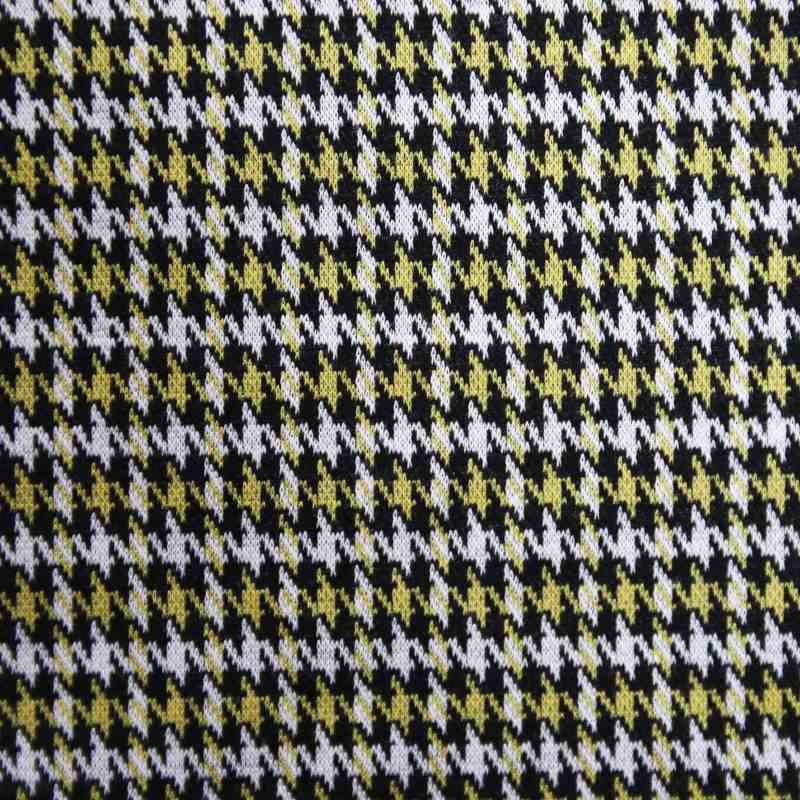
Jacquard houndstooth fabric is a timeless textile with a strong visual identity, practical performance, and broad design flexibility. The classic broken-check pattern has remained popular because it communicates elegance, movement, and structure at the same time. When produced through knitted jacquard technology, the houndstooth design becomes more than a surface decoration. It becomes part of the fabric construction, giving the material a richer hand feel, better depth, and a more durable appearance than many printed alternatives.
This article focuses on Jacquard Houndstooth Fabric in the knitted jacquard fabric category, a soft, thick, and robust material suitable for fashion apparel and interior decoration. It is designed for coats, blazers, cushions, curtains, caravan interiors, sofas, chairs, and other projects that require both visual style and reliable daily performance. Its two-direction stretch gives designers, manufacturers, upholsterers, and home sewing users more freedom when cutting, shaping, and fitting the fabric.
Hangzhou Jinfeng Textile Co., Ltd. supports this product with integrated textile capabilities that include yarn production, fabric production and processing, post-dyeing, finishing, and sales. With experience in blended fabrics, polyester, spandex-related materials, and DTY polyester yarn, the company is positioned to control multiple stages of fabric quality, from yarn characteristics to final hand feel and appearance. This manufacturing depth is one of the key reasons the fabric can offer dependable softness, thickness, pattern clarity, and practical versatility.
Jacquard Houndstooth Fabric
Understanding Jacquard Houndstooth Fabric
Jacquard Houndstooth Fabric combines two major textile ideas: the houndstooth pattern and jacquard fabric construction. Houndstooth is recognized by its jagged, abstract check appearance, often associated with refined tailoring, classic coats, structured jackets, and sophisticated interiors. Jacquard construction refers to a fabric-making method in which the pattern is formed during production rather than simply printed on top of the surface.
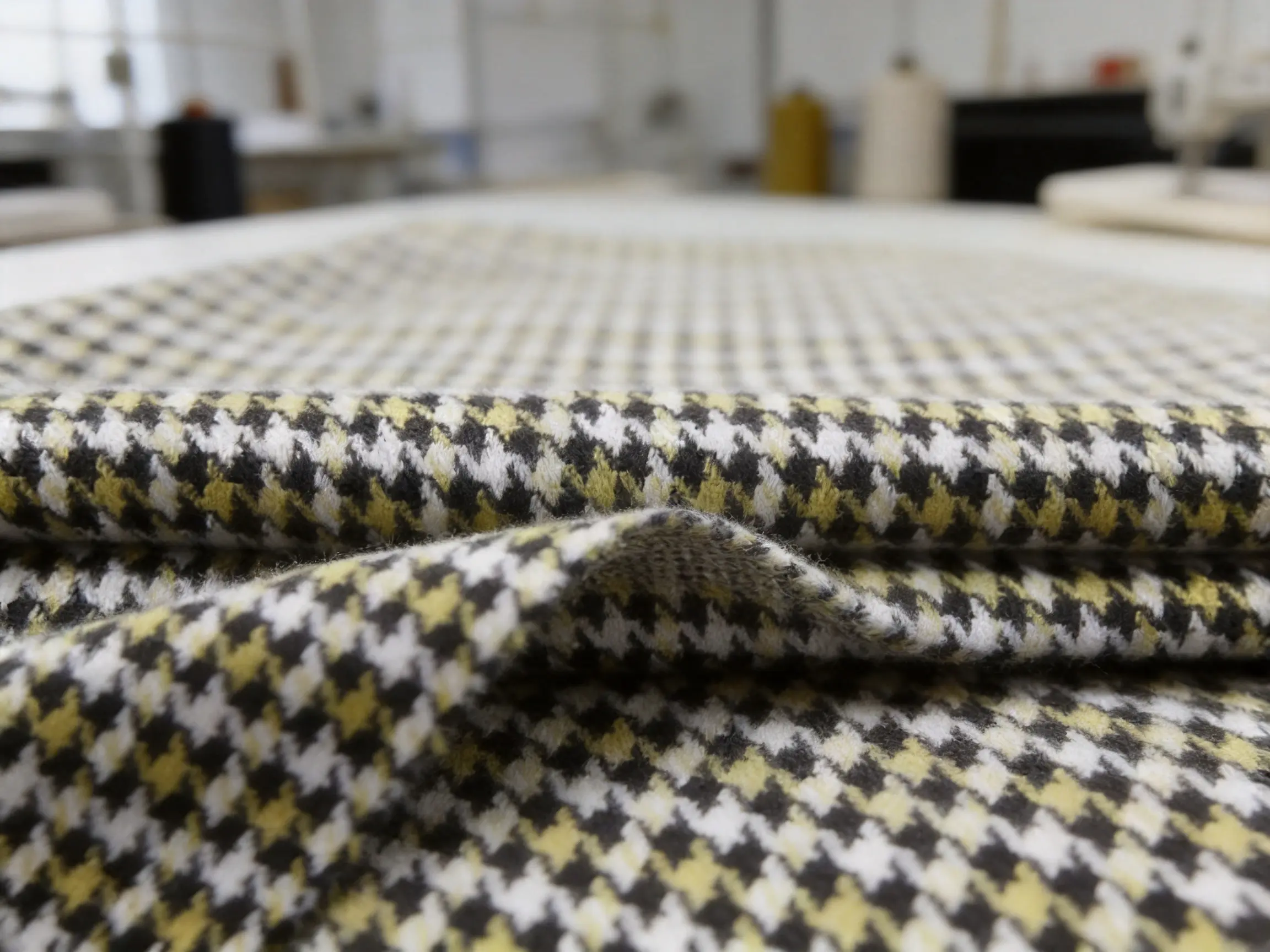
In a knitted jacquard fabric, the pattern is created through controlled loop formation and yarn arrangement. This gives the fabric a more integrated look and feel. The design has dimension, and the surface can appear more substantial than a flat print. For buyers who want a premium effect, this is an important distinction. A printed pattern may fade or lose sharpness faster under friction, washing, or upholstery use. A jacquard pattern, by contrast, is embedded in the textile structure, supporting long-lasting visual quality.
The product described here is especially valued for its soft hand, thick body, and robust structure. It is not merely decorative. It is intended to perform across apparel and furnishing applications. Fashion designers may choose it for coats and blazers because it offers warmth, body, and a strong silhouette. Interior decorators and upholstery makers may use it for cushions, curtains, caravan seating, sofas, and chairs because the pattern adds character while the fabric remains comfortable and adaptable.
Key Product Advantages
The major advantages of this Jacquard Houndstooth Fabric include softness, thickness, pattern durability, two-direction stretch, project versatility, and the option to be supplied in one continuous piece. Each of these qualities matters in real textile applications.
Softness is important because houndstooth fabrics can sometimes appear formal or heavy. A fabric that looks strong but feels harsh may be unsuitable for apparel or living spaces. This product is designed to be super soft, making it appropriate for garments worn close to the body and furnishings used every day.
Thickness gives the fabric substance. A thicker fabric can create stronger garment shapes, better cushion coverage, and improved visual presence on furniture. For coats and blazers, thickness helps the finished item hold structure. For upholstery, it contributes to a more premium look and a more durable feel.
Robustness supports long-term use. In projects such as sofa covers, chair cushions, or caravan interiors, fabric must withstand handling, seating pressure, rubbing, and repeated movement. A robust knitted jacquard construction offers a practical balance of comfort and resilience.
Two-direction stretch is another valuable feature. Stretch allows the fabric to adapt to curves, edges, and fitted shapes. In apparel, it improves comfort and mobility. In upholstery, it can simplify installation around rounded corners, padded forms, and shaped seating. This flexibility gives users more options than a rigid woven material might provide.
The possibility of ordering the required quantity and receiving it in one continuous piece is also a practical advantage. Continuous supply reduces cutting interruption, pattern mismatch, seam planning difficulties, and material waste. For large cushions, curtains, sofas, or coordinated interior projects, continuity can make production smoother and more professional.
Why Knitted Jacquard Construction Matters
Knitted jacquard fabric offers a combination of design detail and fabric flexibility. Unlike some woven jacquards that may feel firm or less forgiving, knitted jacquard can provide stretch and softness while maintaining pattern definition. This makes it especially suitable for uses where comfort and appearance must work together.
The houndstooth pattern benefits from jacquard knitting because the design needs clarity. The broken-check geometry must appear sharp enough to be recognizable while still blending naturally into the fabric surface. With advanced knitting control, the fabric can show a classic pattern without relying on surface printing alone.
Knitted construction also allows the fabric to move. This is one reason the product can stretch in two directions. For apparel, this movement supports fit and wearability. For interiors, it helps the material conform to padded furniture and decorative items. Compared with stiff houndstooth materials, this fabric offers a more user-friendly experience during cutting, sewing, covering, and daily use.
Another advantage is texture. Jacquard knitting can create a fabric with a richer surface and more tactile appeal. In fashion, texture adds depth to a coat or blazer. In interiors, it makes cushions and upholstery feel more inviting. The result is a fabric that looks classic but functions in contemporary settings.
Comparison with Common Alternatives
Many buyers compare jacquard houndstooth fabric with printed fabric, plain knitted fabric, woven check fabric, and lower-density upholstery materials. Each alternative has its place, but this knitted jacquard houndstooth fabric offers a strong balance of design, softness, stretch, and durability.
| Feature | Jacquard Houndstooth Fabric | Printed Houndstooth Fabric | Plain Knitted Fabric | Rigid Woven Check Fabric |
|---|---|---|---|---|
| Pattern formation | Integrated through jacquard construction | Applied mainly on the surface | No complex pattern unless printed | Formed by woven yarn arrangement |
| Visual depth | Rich and dimensional | Often flatter | Simple surface appearance | Clear but may feel formal or stiff |
| Softness | Super soft and comfortable | Depends on base fabric | Usually soft but less decorative | Can be firmer |
| Stretch | Two-direction stretch | Depends on base fabric | Often flexible | Usually limited |
| Application range | Apparel, upholstery, curtains, cushions, caravan interiors | Fashion or decoration with lighter use | Comfort garments and basic textiles | Tailoring and structured interiors |
| Professional finish | Strong balance of pattern and performance | May be less premium over time | Needs extra design treatment | Classic but less adaptable |
This comparison shows why the product is useful for customers who do not want to choose between style and function. It provides the recognizable elegance of houndstooth, the design integrity of jacquard construction, and the comfort of knitted fabric.
Applications in Fashion Apparel
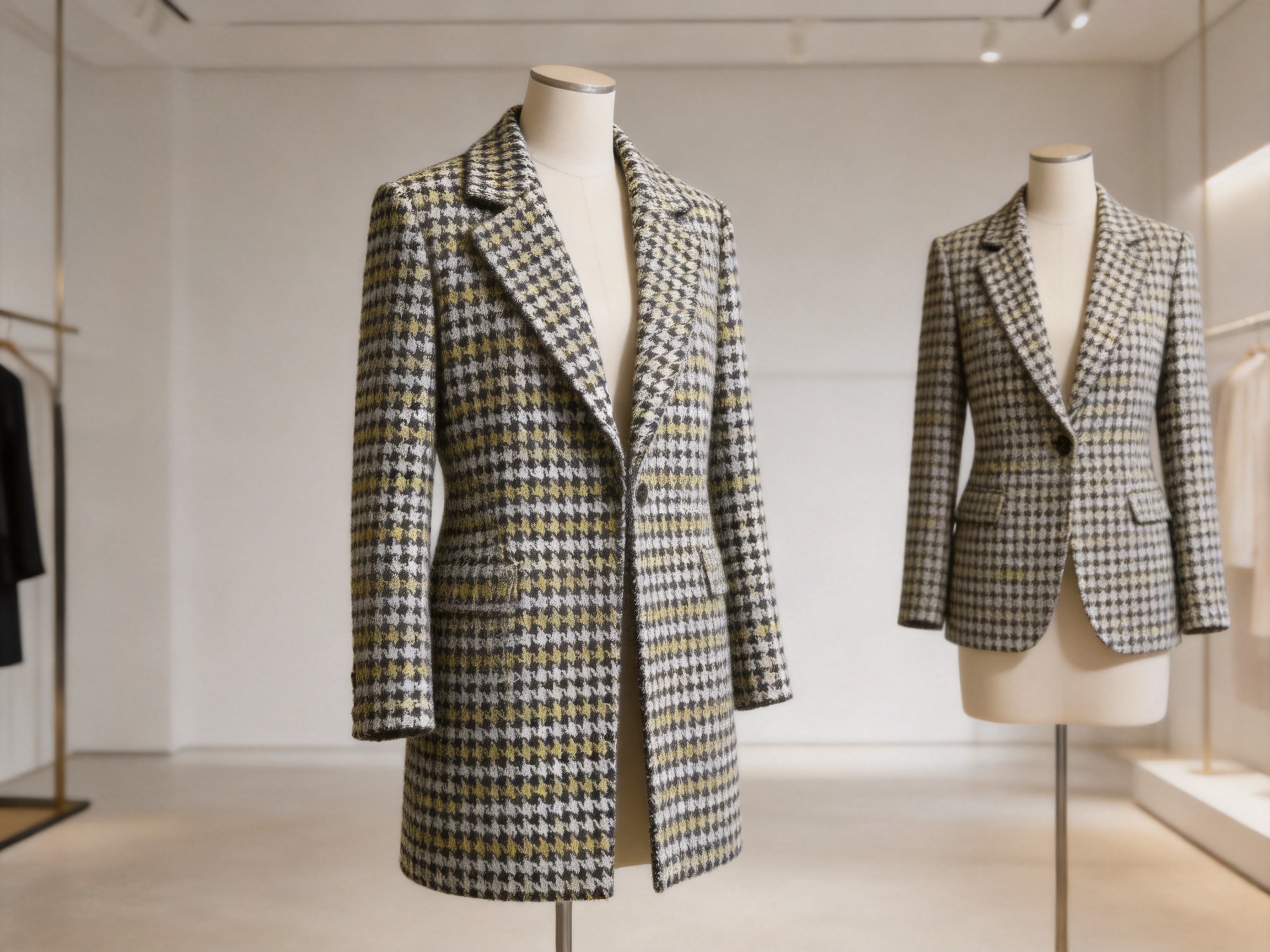
Jacquard Houndstooth Fabric is especially well suited for coats and blazers. These garments need fabric with body, structure, and visual impact. A coat made from a thick houndstooth jacquard can look polished while remaining comfortable. The pattern gives the garment character without requiring excessive embellishment.
For blazers, the fabric offers a balance between tailored appearance and knitted comfort. Traditional blazer fabrics can sometimes feel restrictive, especially when made from rigid woven materials. A two-direction stretch fabric improves comfort across the shoulders, arms, and body. This makes it useful for modern fashion designs that combine classic style with ease of movement.
The houndstooth pattern is also highly adaptable. It can be used in vintage-inspired collections, contemporary streetwear, professional outfits, and statement outerwear. Depending on garment design, it can appear bold, refined, academic, retro, or modern. This flexibility gives designers more creative possibilities from a single fabric type.
Because the fabric is soft, it can be used for garments that require a pleasant touch. Customers increasingly value comfort, especially in outerwear and smart-casual clothing. A fabric that looks structured but feels soft can improve the user experience and increase the perceived quality of the finished garment.
Applications in Upholstery and Interior Decoration
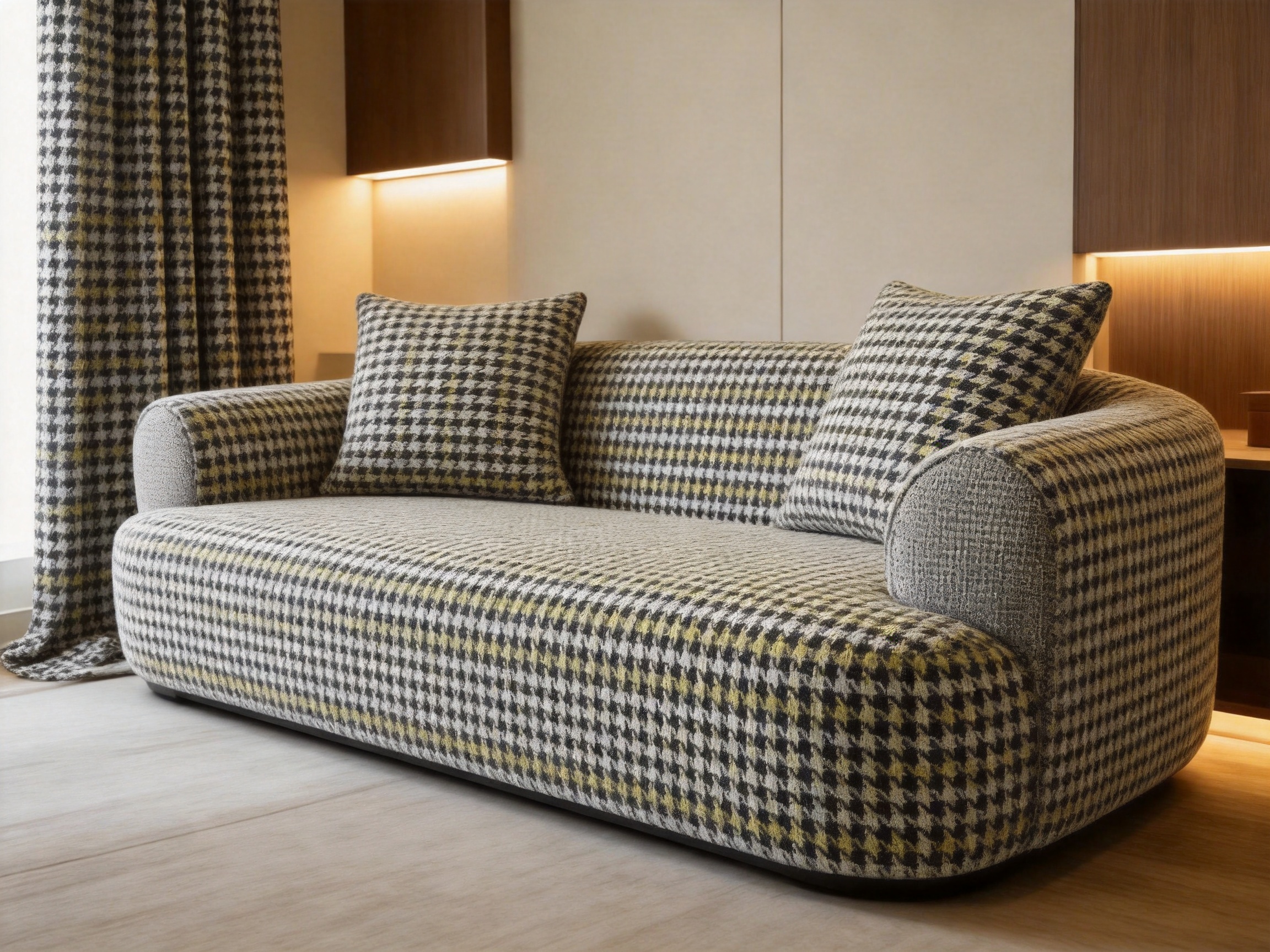
Beyond fashion, the fabric is suitable for upholstery and interior projects. The product information highlights use in curtains, caravan interiors, cushions, sofas, chairs, and other furnishing applications. These uses benefit from the fabric’s thickness, robustness, and decorative pattern.
In cushions, houndstooth creates immediate visual interest. It works well as a feature fabric, accent fabric, or coordinating textile. A houndstooth cushion can complement plain furniture, leather seating, minimalist rooms, or traditional interiors. The geometric nature of the design makes it easy to coordinate with solid colors and other patterns.
For sofas and chairs, the fabric offers both comfort and a stylish surface. The two-direction stretch can help fit padded forms more smoothly, while the jacquard construction provides a more premium appearance than basic printed fabric. In upholstery, fabric must be more than attractive. It must feel pleasant, cover well, and maintain its look through repeated contact. The thick and robust character of this material supports those needs.
Caravan interiors are another practical application. Caravan seating and soft furnishings need fabrics that are attractive, comfortable, and space-efficient. Houndstooth adds a classic decorative touch, while knitted stretch helps with fitting compact seating and shaped cushions. The ability to order continuous pieces also helps when coordinating multiple seating areas and curtains within a limited interior.
For curtains, the fabric provides weight and pattern. While very light fabrics may lack presence, a thicker jacquard houndstooth can create a stronger decorative effect. It can be used in home interiors, boutique spaces, hospitality decoration, or themed rooms where classic patterning is desired.
Design Value of the Houndstooth Pattern
Houndstooth has remained relevant because it is both traditional and graphic. It has enough history to feel established, yet enough visual energy to feel modern. The pattern can be scaled, contrasted, softened, or paired with different materials. In black and white, it appears iconic. In tonal shades, it becomes subtle and elegant. In larger scales, it becomes bold and contemporary.
The pattern’s broken geometry helps hide minor irregularities better than plain fabric in some applications. For upholstery and cushions, this can be useful because daily use may create small shadows, pressure marks, or folds. A patterned surface often maintains a lively appearance under use.
In garments, houndstooth creates instant recognition. A simple coat silhouette can become distinctive when made from houndstooth jacquard. A blazer can become a statement piece without relying on complicated cutting. This reduces design complexity while maintaining market appeal.
The jacquard version of houndstooth is especially valuable because it gives the pattern depth. Instead of looking like ink on cloth, the design feels like part of the textile. This can improve perceived value for both fashion and interior products.
Advanced Manufacturing Support
The quality of a jacquard houndstooth fabric depends heavily on manufacturing control. Hangzhou Jinfeng Textile Co., Ltd. has capabilities across yarn production, fabric production, processing, post-dyeing, finishing, and sales. This integrated approach supports consistency and allows the company to manage important quality factors at multiple stages.
Yarn quality is one of the foundations of fabric performance. The company’s involvement in DTY polyester yarn production and processing is important because drawn textured yarn can contribute to softness, elasticity, bulk, and fabric recovery. DTY polyester yarn is widely used in knitted fabrics because it can create a comfortable hand and stable textile structure. When yarn characteristics are controlled properly, the finished fabric is more likely to achieve the desired softness, thickness, and stretch.
Fabric formation is another critical stage. In knitted jacquard production, loop structure, yarn tension, pattern programming, machine setting, and production stability all influence the final result. A high-quality jacquard houndstooth fabric requires clear pattern edges, stable repeat alignment, consistent thickness, and balanced stretch. Advanced knitting processes help ensure that the pattern remains recognizable and the fabric surface remains attractive.
Post-dyeing and finishing also affect the final product. Dyeing must support color consistency, while finishing improves hand feel, dimensional behavior, appearance, and usability. A fabric may be technically well knitted but still fail customer expectations if finishing is poor. Proper finishing can enhance softness, improve surface smoothness, reduce harshness, and prepare the fabric for cutting and sewing.
The company’s plant area and production base provide room for coordinated textile operations. Located in Xiaoshan District, Hangzhou, the company operates within a region known for textile activity and industrial supply networks. Its self-operated export orientation also supports communication with customers in different markets, including buyers seeking wholesale fabric, DTY yarn, and blended textile products.
Process Flow from Yarn to Finished Fabric
A reliable jacquard fabric is not created in one step. It is the result of a sequence of controlled operations. While exact production settings vary according to specification, the general process can be understood through several stages.
Yarn Selection and Preparation
The first stage is selecting suitable yarns for the required hand feel, stretch, pattern clarity, and thickness. Polyester, rayon, blended fibers, and elastic components may be considered depending on the desired product specification. DTY polyester yarn can be used to add texture, bulk, and flexibility. Yarn preparation helps ensure that the knitting process runs smoothly and that the final fabric has consistent quality.
Jacquard Knitting
During jacquard knitting, the houndstooth pattern is formed through programmed control. The machine must accurately manage yarn placement and loop formation. Pattern repeat, alignment, and surface balance are carefully monitored. For this product, the goal is to achieve a classic houndstooth appearance while maintaining softness and two-direction stretch.
Dyeing and Color Control
Dyeing affects both aesthetics and batch consistency. Color must be even, compatible with the fabric composition, and suitable for the intended market. For houndstooth designs, contrast and clarity are especially important. If colors are unstable or uneven, the pattern loses impact. Controlled dyeing helps maintain professional appearance across production batches.
Finishing
Finishing gives the fabric its final touch. Softening, heat treatment, relaxation, setting, or surface finishing may be used according to the product requirement. The objective is to improve softness, stabilize dimensions, enhance appearance, and make the fabric pleasant to handle. Since this product is promoted as super soft, finishing quality is a central part of its appeal.
Inspection and Packing
Before delivery, fabric should be inspected for pattern defects, holes, stains, uneven dyeing, width variation, and hand-feel inconsistency. Proper rolling and packing protect the fabric during transport. Continuous-piece supply is especially important for customers who need longer lengths for large projects.
Quality Characteristics Buyers Should Evaluate
When selecting Jacquard Houndstooth Fabric, buyers should evaluate several characteristics. These include pattern clarity, hand feel, thickness, stretch behavior, recovery, color consistency, surface condition, and sewing performance.
Pattern clarity is essential. The houndstooth motif should be recognizable and balanced. The edges should not appear blurred, distorted, or uneven. In jacquard fabric, this depends on machine control and yarn behavior.
Hand feel is equally important. The fabric should feel soft enough for apparel and comfortable enough for interiors. A rough or stiff houndstooth fabric may not meet modern user expectations. The soft character of this product is therefore a major selling point.
Thickness should match the intended use. For coats, upholstery, and cushions, thickness provides structure and coverage. However, it should not make the fabric overly difficult to sew or handle. A good fabric balances body with workability.
Stretch behavior should be even in the relevant directions. Two-direction stretch gives designers more flexibility, but recovery is also important. If a fabric stretches but does not recover well, it may distort over time. Proper yarn selection and finishing help maintain stable stretch.
Color consistency matters for both fashion and furnishings. Customers ordering multiple pieces or larger quantities expect consistent shades. This is especially true for continuous interior projects where different panels will be seen together.
Sewing performance determines how easily the fabric can be transformed into a final product. A good jacquard houndstooth fabric should cut cleanly, feed smoothly through sewing equipment, and maintain pattern alignment when handled properly.
Advantages Over Competitors
This Jacquard Houndstooth Fabric stands out against many competitor fabrics because it combines a classic design with practical knitted performance. Some competing houndstooth fabrics may offer visual appeal but lack softness. Others may be soft but too thin for coats or upholstery. Some may stretch but lose a premium appearance because the pattern is printed rather than structurally integrated.
The first competitive advantage is the jacquard pattern construction. Because the design is created within the fabric, it has greater depth and a more substantial feel than many printed options. This helps finished products look more refined and durable.
The second advantage is softness. A fabric used for garments, cushions, or sofas must feel good. The super soft hand of this material helps it serve both fashion and interior markets, increasing its commercial flexibility.
The third advantage is thickness and robustness. Thin decorative fabrics may be suitable for light craft projects but not for structured garments or upholstery. This fabric is described as thick and robust, making it more suitable for demanding applications.
The fourth advantage is two-direction stretch. This offers comfort in apparel and easier fitting in interior projects. Compared with rigid woven houndstooth fabrics, the stretch property can improve practical usability.
The fifth advantage is integrated manufacturing support. Hangzhou Jinfeng Textile Co., Ltd. works across yarn, fabric, dyeing, finishing, and sales. This broader capability allows closer attention to the relationship between yarn texture, fabric structure, color, finishing, and final performance.
The sixth advantage is order practicality. The ability to supply fabric in one continuous piece is valuable for professional users. It supports cleaner cutting, better pattern planning, and fewer joining issues in large projects.
Role of DTY Polyester Yarn and Blended Fabric Expertise
DTY polyester yarn, also known as drawn textured yarn, is important in many modern knitted fabrics. It can provide bulk, elasticity, softness, and improved fabric coverage. When used appropriately, it supports comfortable knitted structures and helps fabrics maintain shape. The company’s experience with DTY polyester yarn is therefore relevant to the performance of Jacquard Houndstooth Fabric.
Blended fabric expertise is also important. Many successful textiles combine different fiber properties to achieve a balanced result. Polyester can contribute strength, durability, easy care, and dimensional stability. Rayon can contribute softness, drape, and comfort. Spandex or elastic components can contribute stretch and recovery. By understanding blended textile behavior, a manufacturer can develop fabrics that meet specific customer needs rather than relying on one-dimensional performance.
For a houndstooth jacquard fabric, the blend and yarn structure influence visual sharpness, surface softness, thickness, stretch, and durability. A well-controlled blend can help the fabric feel pleasant while remaining strong enough for garments and furnishings. This is especially important for buyers who want one fabric suitable for many end uses.
Guidance for Designers and Manufacturers
Designers working with Jacquard Houndstooth Fabric should consider pattern scale, garment or product shape, seam placement, and direction of stretch. Houndstooth is visually active, so pattern alignment can strongly affect the final appearance. In coats and blazers, designers may align the pattern at front openings, lapels, pockets, and side seams for a more professional result.
For upholstery, pattern placement should be planned across visible surfaces such as seat cushions, back panels, and armrests. Continuous fabric supply helps with this planning because longer lengths make it easier to match repeats and maintain direction.
Because the fabric stretches in two directions, cutting should be done with attention to relaxation. Fabric should be laid smoothly without excessive pulling. If stretched during cutting, pieces may shrink back and create size variation. Allowing the fabric to relax before cutting can improve accuracy.
Needle selection and stitch type should match the fabric thickness and knitted structure. For apparel, stretch-compatible seams may be preferred in areas of movement. For upholstery, stronger stitching and reinforced seams may be necessary depending on use. Testing on a small piece before full production is always recommended.
Designers can pair houndstooth jacquard with solid fabrics, leather, faux leather, velvet, plain knits, or neutral linings. In garments, it works well with black, white, grey, beige, navy, burgundy, and camel tones. In interiors, it coordinates with wood, metal, plain upholstery, and minimalist decorative schemes.
Care and Handling Considerations
Care requirements depend on the exact fiber composition, finishing, and end use, so buyers should confirm care instructions for their specific order. However, general handling principles can help preserve jacquard houndstooth fabric.
For apparel, avoid unnecessary abrasion and follow recommended washing or dry-cleaning instructions. Structured coats and blazers are often best maintained with professional cleaning, especially when lining, interlining, or tailored construction is involved.
For upholstery and cushions, routine vacuuming or gentle brushing can help remove dust. Spills should be addressed promptly according to suitable textile cleaning methods. Harsh chemicals should be avoided unless approved for the fabric composition.
For cutting and sewing, fabric should be stored clean, dry, and away from direct sunlight for extended periods. Rolls should be handled carefully to avoid crushing or creasing. Before production, checking fabric width, stretch direction, shade, and pattern repeat can reduce errors.
Sustainability and Efficient Use
Modern textile buyers increasingly consider waste reduction, durability, and efficient production. A fabric that can serve multiple applications may help reduce development complexity. Jacquard Houndstooth Fabric can be used in apparel, cushions, curtains, and upholstery, allowing buyers to coordinate collections and reduce the need for multiple unrelated fabrics.
Continuous-piece supply can also reduce waste by improving cutting efficiency. When fabric is supplied in broken lengths, manufacturers may lose material at joins or struggle with repeat matching. A continuous piece supports better planning and cleaner production.
Durability is another sustainability-related factor. A fabric that maintains its appearance and performance over time can extend the life of finished products. The robust character and integrated jacquard pattern of this product support longer use compared with less durable decorative alternatives.
Manufacturing integration can also improve process efficiency. When a company understands yarn production, knitting, dyeing, and finishing, it can optimize specifications more directly and reduce quality risks that lead to waste.
Company Manufacturing Strengths
Hangzhou Jinfeng Textile Co., Ltd. is located in Jingjiang Street Industrial Park, Xiaoshan District, Hangzhou City, Zhejiang Province. The company covers an area of 32.6 acres and has a plant area of 18,000 square meters. This production foundation supports textile manufacturing, processing, post-dyeing, finishing, and sales.
The company works with blended fabrics such as polyester and spandex-related textiles and is also engaged in DTY polyester yarn production, processing, and sales. This combination gives it a broad understanding of both yarn and fabric performance. For customers, this can mean better support when selecting fabric for different applications.
As a self-operated export company integrating research and development, production, and sales, the company is positioned to respond to domestic and international customer needs. Its business philosophy emphasizes cooperation and win-win relationships, which is important in textile supply because fabric buyers often require stable communication, reliable delivery, and ongoing product support.
For Jacquard Houndstooth Fabric, these strengths matter because the product requires coordination between design, yarn behavior, knitting structure, finishing, and final inspection. A company with experience across these stages is better able to maintain consistent product value.
Frequently Asked Questions
What is Jacquard Houndstooth Fabric?
Jacquard Houndstooth Fabric is a patterned textile in which the classic houndstooth design is formed through jacquard construction. In this product, the fabric is a knitted jacquard material, giving it softness, thickness, stretch, and visual depth.
What makes this fabric different from printed houndstooth fabric?
Printed houndstooth fabric usually has the pattern applied to the surface. Jacquard houndstooth fabric forms the pattern as part of the textile structure. This gives the design more depth, a more premium feel, and better long-term visual appeal.
Is the fabric suitable for clothing?
Yes. It is suitable for fashion apparel, especially coats and blazers. Its soft hand, thick body, and two-direction stretch make it comfortable and stylish for structured garments.
Can it be used for upholstery?
Yes. The fabric can be used for upholstery projects such as cushions, sofas, chairs, caravan interiors, and decorative furnishings. Its robust construction and attractive houndstooth pattern make it useful for both functional and decorative applications.
Does the fabric stretch?
Yes. The fabric stretches in two directions. This improves comfort in apparel and helps the fabric fit shaped upholstery or padded forms more easily.
Can customers order continuous lengths?
Yes. The fabric can be supplied in one continuous piece according to order needs, which is helpful for large projects, pattern matching, and reducing waste.
Why is the fabric described as thick and robust?
The fabric has a substantial structure that provides body and durability. This makes it more suitable for coats, blazers, cushions, curtains, and upholstery than very light decorative fabrics.
What manufacturing strengths support this product?
The manufacturer has capabilities in DTY polyester yarn production, blended fabric production, knitting, processing, post-dyeing, finishing, and sales. These integrated operations help control quality from yarn to finished fabric.
How should designers work with the houndstooth pattern?
Designers should plan pattern placement carefully, especially at seams, openings, cushions, and visible upholstery panels. The continuous-piece option helps with repeat matching and professional cutting.
What should buyers check before production?
Buyers should check fabric width, shade, stretch direction, hand feel, thickness, pattern repeat, and sewing performance. A sample test is recommended before large-scale production.
Conclusion
Jacquard Houndstooth Fabric is a strong choice for buyers who need classic style, tactile softness, and practical performance in one material. Its houndstooth pattern offers timeless visual appeal, while knitted jacquard construction gives the fabric depth, stretch, and a more premium feel than many printed alternatives.
The fabric’s thick and robust character makes it suitable for fashion apparel such as coats and blazers, as well as interior applications such as cushions, curtains, caravan furnishings, sofas, and chairs. Its two-direction stretch improves comfort, fit, and handling, giving designers and manufacturers more flexibility across different projects.
Compared with many competitor materials, this product offers a more balanced combination of pattern durability, softness, thickness, stretch, and application versatility. The ability to order continuous pieces further improves its practicality for professional and creative users.
Supported by Hangzhou Jinfeng Textile Co., Ltd.’s experience in DTY polyester yarn, blended fabrics, fabric processing, post-dyeing, finishing, and export-oriented service, the product reflects an integrated approach to textile manufacturing. From yarn selection to final finishing, every stage contributes to the fabric’s appearance, hand feel, and usability.
For apparel brands, upholstery makers, interior decorators, wholesalers, and fabric retailers, Jacquard Houndstooth Fabric provides a reliable way to combine heritage design with modern textile performance.
References
1. Kadolph, S. J. Textiles. Pearson Education.
2. Spencer, D. J. Knitting Technology: A Comprehensive Handbook and Practical Guide. Woodhead Publishing.
3. Saville, B. P. Physical Testing of Textiles. Woodhead Publishing.
4. Sinclair, R. Textiles and Fashion: Materials, Design and Technology. Woodhead Publishing.
5. Horrocks, A. R., and Anand, S. C. Handbook of Technical Textiles. Woodhead Publishing.