
Floral-Patterned Knitted Jacquard Fabric for Elegant, Comfortable Apparel
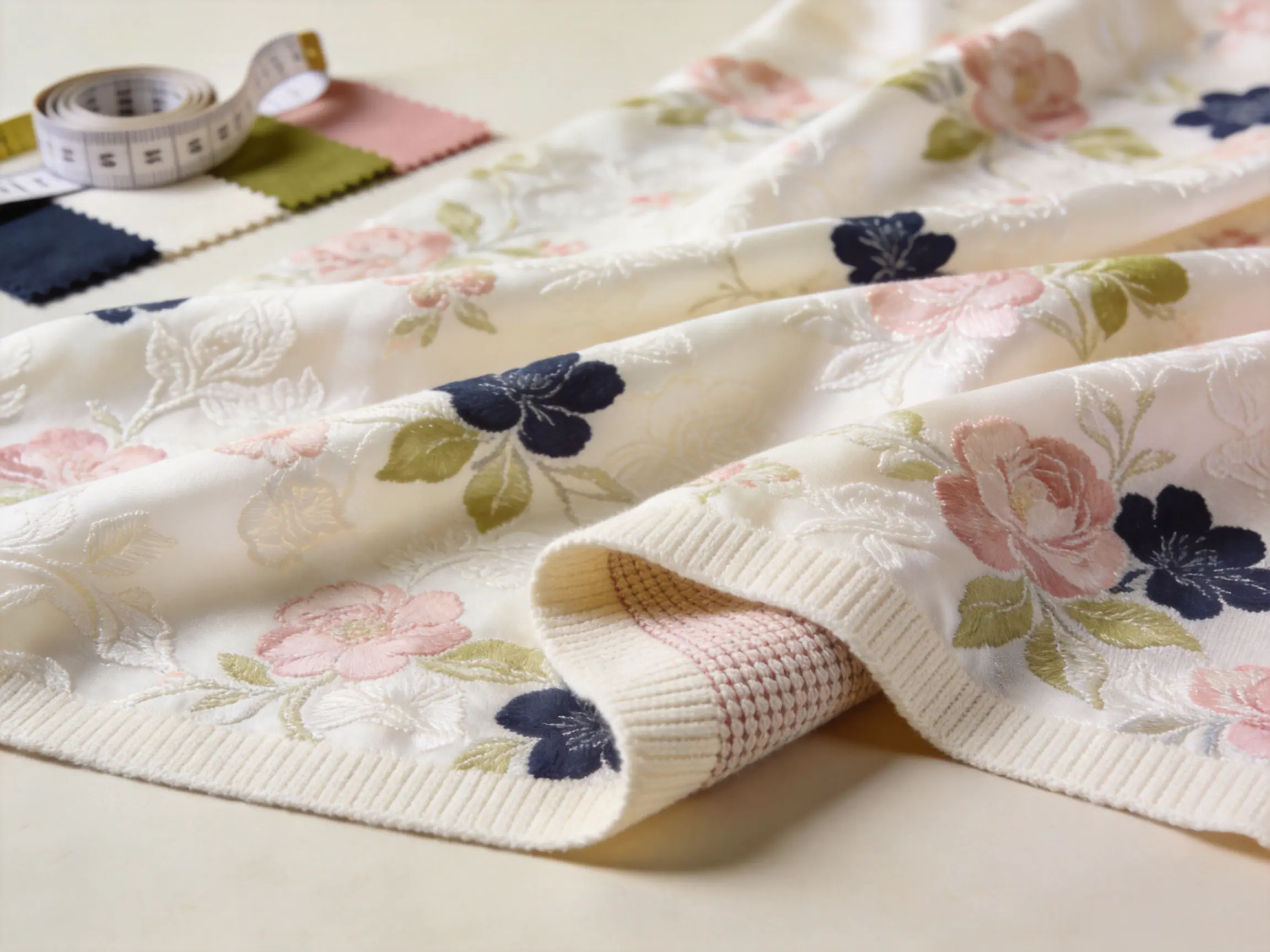
Floral-patterned knitted jacquard fabric brings together decorative surface design, soft comfort, stretch, and practical wearability. Unlike many conventional woven jacquards, this medium-weight knitted construction is designed to move with the body while maintaining an elevated, textured appearance. It is particularly suitable for women's dresses, coordinated fashion sets, lightweight jackets, and luxury children's clothing.
The fabric combines 60% viscose, 35% nylon, and 5% spandex. This composition creates a balanced performance profile: viscose contributes softness, fluid drape, and a refined appearance; nylon supports strength, abrasion resistance, and color performance; and spandex provides comfortable stretch and recovery. At approximately 240 grams per square meter and 145 centimeters wide, the fabric offers enough body for structured garments while remaining comfortable for everyday use.
Designed for fashion brands, garment manufacturers, wholesalers, and apparel buyers, this floral knitted jacquard provides the visual appeal of intricate decorative fabric without sacrificing the flexibility expected from modern knitwear. Its delicate floral pattern can help elevate a simple garment design, reduce the need for additional embellishment, and support collections positioned between casual comfort and occasion-ready elegance.
Understanding Floral Knitted Jacquard Fabric
Knitted jacquard is produced by controlling yarn selection and stitch formation during the knitting process. Instead of applying a printed image after the fabric has been made, the pattern is incorporated into the knitted structure. This approach creates a tactile surface and gives the floral motif a more integrated appearance.
The floral design offers a refined alternative to plain jersey, rib, or basic interlock fabrics. A plain fabric may require embroidery, applique, printing, or additional trim to create visual interest. With knitted jacquard, the decorative effect is developed as part of the textile itself. This can simplify garment styling and help brands achieve a distinctive appearance with fewer external components.
Because the material is knitted, it has a degree of natural flexibility and movement that is not typically associated with rigid woven jacquard. The addition of 5% spandex further improves comfort and helps the finished garment follow the body's movement. This makes the fabric suitable for garments that need both an elegant surface and practical ease.
The fabric has a distinct face and back. The face displays the primary floral effect, while the reverse side presents a neat and clean knitted structure. This construction is appropriate for most single-layer apparel applications. For buyers requiring a reversible appearance, double-sided jacquard production may be discussed as a customized option.
Key Product Specifications
The following specifications provide a clear starting point for product development, sampling, costing, and production planning.
| Specification | Details |
|---|---|
| Fabric type | Knitted jacquard fabric |
| Pattern | Floral pattern |
| Composition | 60% Viscose, 35% Nylon, 5% Spandex |
| Weight | Approximately 240 g/m² |
| Usable width | Approximately 145 cm, or 57 inches |
| Hand feel | Soft touch with a smooth, comfortable surface |
| Drape | Fluid and suitable for feminine garment silhouettes |
| Stretch contribution | Provided by the spandex content and knitted construction |
| Color performance | Designed for vibrant color retention through controlled dyeing |
| Certification | OEKO-TEX Standard 100 |
| Standard face and back | Distinct floral face with a neat knitted reverse |
Specifications may be confirmed against the approved laboratory dip, sample, or production lot before bulk manufacturing. Buyers should always evaluate the final fabric according to the intended garment pattern, washing method, colorway, and finishing requirements.
Composition and Functional Benefits
Viscose for Softness and Fluid Drape
Viscose is valued in fashion textiles for its soft hand and elegant fall. In this fabric, the viscose component helps create a comfortable surface that feels pleasant against the skin. It also contributes to the fluid drape that makes the material suitable for dresses, skirts, and other garments with movement.
The visual character of viscose supports the floral jacquard design by giving the surface a subtle sheen. This sheen is not intended to be excessively glossy. Instead, it provides a refined appearance that can make floral motifs appear more dimensional under different lighting conditions.
For apparel designers, viscose is especially useful when a fabric needs to look graceful without feeling stiff. It can help soften the silhouette of a dress and give a skirt or top a more flowing appearance. When combined with the support of nylon and the elasticity of spandex, the result is a balanced fabric rather than a purely delicate one.
Nylon for Strength and Reliability
Nylon contributes strength and durability to the blend. Its presence helps the fabric withstand the demands of cutting, sewing, handling, and regular wear. It also supports the fabric's resistance to abrasion, which is useful for garments that experience repeated contact with seats, bags, outerwear, or other surfaces.
The nylon content also helps provide structural balance. Viscose alone can create a very soft and fluid textile, while nylon can add practical support and resilience. This combination makes the fabric appropriate for commercial apparel programs where appearance must be matched with reliable production performance.
Spandex for Comfort and Movement
Five percent spandex gives the fabric additional elasticity. The knitted construction already provides flexibility, and the spandex component improves the garment's ability to accommodate movement. This is particularly beneficial for fitted dresses, waist sections, sleeves, coordinated sets, and children's garments.
Stretch also supports ease of dressing and wearing. A garment made from a flexible jacquard may feel more comfortable than one made from a rigid decorative textile. The fabric can follow body movement while preserving the visual interest of the floral pattern.
As with all stretch textiles, garment makers should consider fabric direction, recovery, seam construction, and pattern allowance during product development. Proper testing is recommended before bulk cutting, particularly for close-fitting garments or designs with demanding movement requirements.
Advantages Compared with Conventional Decorative Fabrics
Decorative Appearance Without Separate Embellishment
A primary advantage of floral knitted jacquard is that the pattern is developed within the fabric structure. Brands may therefore achieve a decorative result without adding embroidery, applique, beading, or a separate printed layer. This can reduce the number of production operations and create a cleaner overall appearance.
Embroidery can produce a highly attractive result, but it may add weight, stiffness, labor, and cost. It can also create raised areas that affect comfort or snag more easily. A knitted jacquard offers an integrated alternative in which the floral effect is part of the textile surface.
Printed fabrics provide another common decorative option. However, printing generally places color on the surface, while jacquard construction creates a more tactile and dimensional effect. For brands seeking a richer hand feel and a more premium visual identity, the knitted structure can offer a meaningful point of differentiation.
More Movement Than Rigid Woven Jacquards
Traditional woven jacquards can deliver elaborate patterns and a luxurious appearance, but some constructions are firm or less flexible. This floral knitted jacquard is designed to provide a softer and more comfortable alternative. Its stretch and knit structure are useful for garments that must move with the wearer.
The fabric is therefore suitable for designs that require both polish and comfort. A dress can have a refined floral surface while remaining practical for walking, sitting, and daily movement. A coordinated skirt and top set can appear more sophisticated than a plain knit without becoming restrictive.
Balanced Medium Weight
At approximately 240 g/m², the fabric occupies a versatile middle range. It is substantial enough to create coverage and a stable garment shape, but it remains suitable for flowing silhouettes and comfortable layering. This balance makes it useful across transitional seasons and indoor or outdoor fashion applications.
Very lightweight fabrics may require lining or additional support, while heavy fabrics can feel warm or difficult to drape. A medium-weight jacquard can help designers achieve a more manageable balance between opacity, structure, comfort, and movement.
Suitable for Premium and Commercial Collections
The combination of floral patterning, soft touch, fluid drape, and stretch allows the fabric to serve more than one market position. It can be used in a premium capsule collection, a seasonal dress program, a coordinated set, or an elevated children's range.
This versatility may help buyers simplify sourcing. Instead of purchasing one fabric for decorative dresses and another for comfortable stretch garments, a brand can evaluate one material for multiple related product categories. The final suitability will depend on color, pattern scale, garment design, and finishing, but the base fabric offers a flexible platform.
Applications in Women's Apparel
Elegant Day Dresses
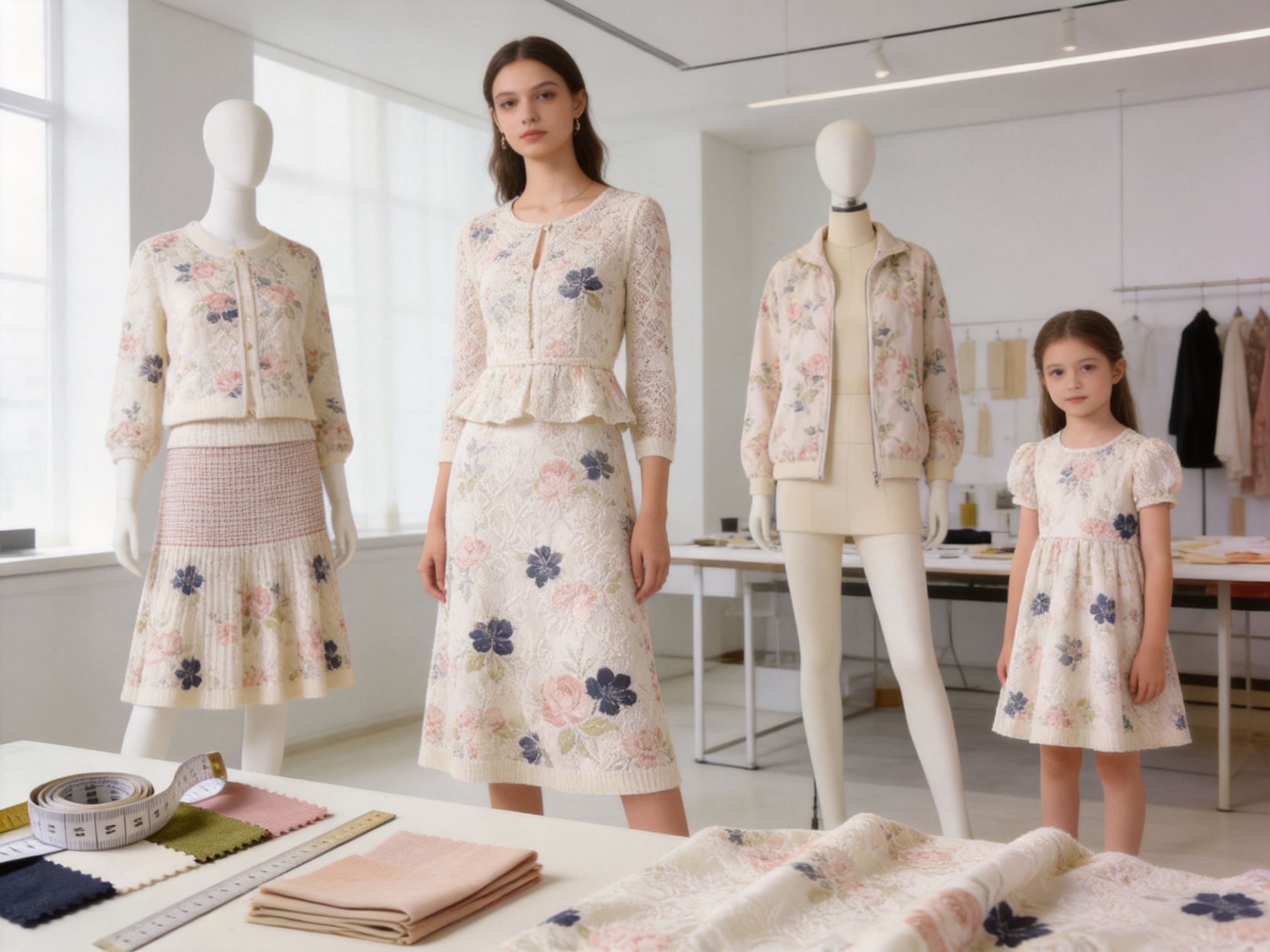
Floral day dresses are one of the most natural applications for this material. The jacquard pattern provides visual detail, while the viscose-rich composition supports a soft and feminine fall. The fabric can be used for fit-and-flare dresses, relaxed midi styles, wrap-inspired silhouettes, shirt dresses, and gently fitted designs.
The 240 g/m² weight can offer a reassuring sense of coverage for everyday dresses. It can also support details such as gathered waists, softly shaped sleeves, pleats, and panel construction. Designers should assess the pattern direction and the behavior of the floral motif at seams before finalizing the cutting layout.
Coordinated Skirt and Top Sets
Matching sets continue to offer commercial value because they provide customers with a complete outfit while allowing the pieces to be worn separately. This floral jacquard can be used for coordinated tops and skirts, creating a unified visual statement.
A fitted top paired with a softly draped skirt can emphasize the contrast between structure and movement. Alternatively, a relaxed top and straight skirt can create an understated daywear look. The stretch component can support comfort in both garments, particularly when used in waistbands, sleeves, or close-fitting panels.
Lightweight Fall Jackets
The fabric can also be considered for lightweight fall jackets and fashion layers. It is not positioned as a heavy protective outerwear fabric, but its medium weight and decorative surface make it suitable for indoor jackets, cropped styles, collarless layers, and soft fashion cardigans with structured finishing.
When used in a jacket, the fabric can add personality to an otherwise simple silhouette. A floral surface may eliminate the need for extensive trims or complex styling. Depending on the garment design, a lining can be used to alter warmth, ease of movement, and interior appearance.
Luxury Children's Wear
The soft hand and floral appearance are also suitable for selected children's clothing. Dresses, special-occasion outfits, skirts, and coordinated sets can benefit from the fabric's comfort and decorative character.
Children's garments require particular attention to softness, seam comfort, wash care, and safety. The OEKO-TEX Standard 100 certification provides an important point of reassurance for buyers evaluating textiles intended for skin contact. As with any product, the finished garment should be assessed according to the requirements of its target market and age range.
Manufacturing and Quality Control
Integrated Production Capabilities
Hangzhou Jinfeng Textile Co., Ltd. operates as an export-oriented textile enterprise integrating research and development, production, processing, finishing, and sales. Its broader product capabilities include polyester and blended fabrics, spandex-related fabric processing, and drawn textured yarn production and processing.
The company is located in Jingjiang Street Industrial Park in Xiaoshan District, Hangzhou, Zhejiang Province. Its facilities cover approximately 32.6 acres, with a plant area of about 18,000 square meters. This physical production base supports a coordinated approach to fabric development and order management.
For buyers, an integrated supply structure can simplify communication. Product development, knitting, dyeing, finishing, inspection, and shipment coordination can be managed through a more connected production system. This can be beneficial when a customer needs a new color, a trial order, or a revised design within a defined development schedule.
Controlled Knitting Process
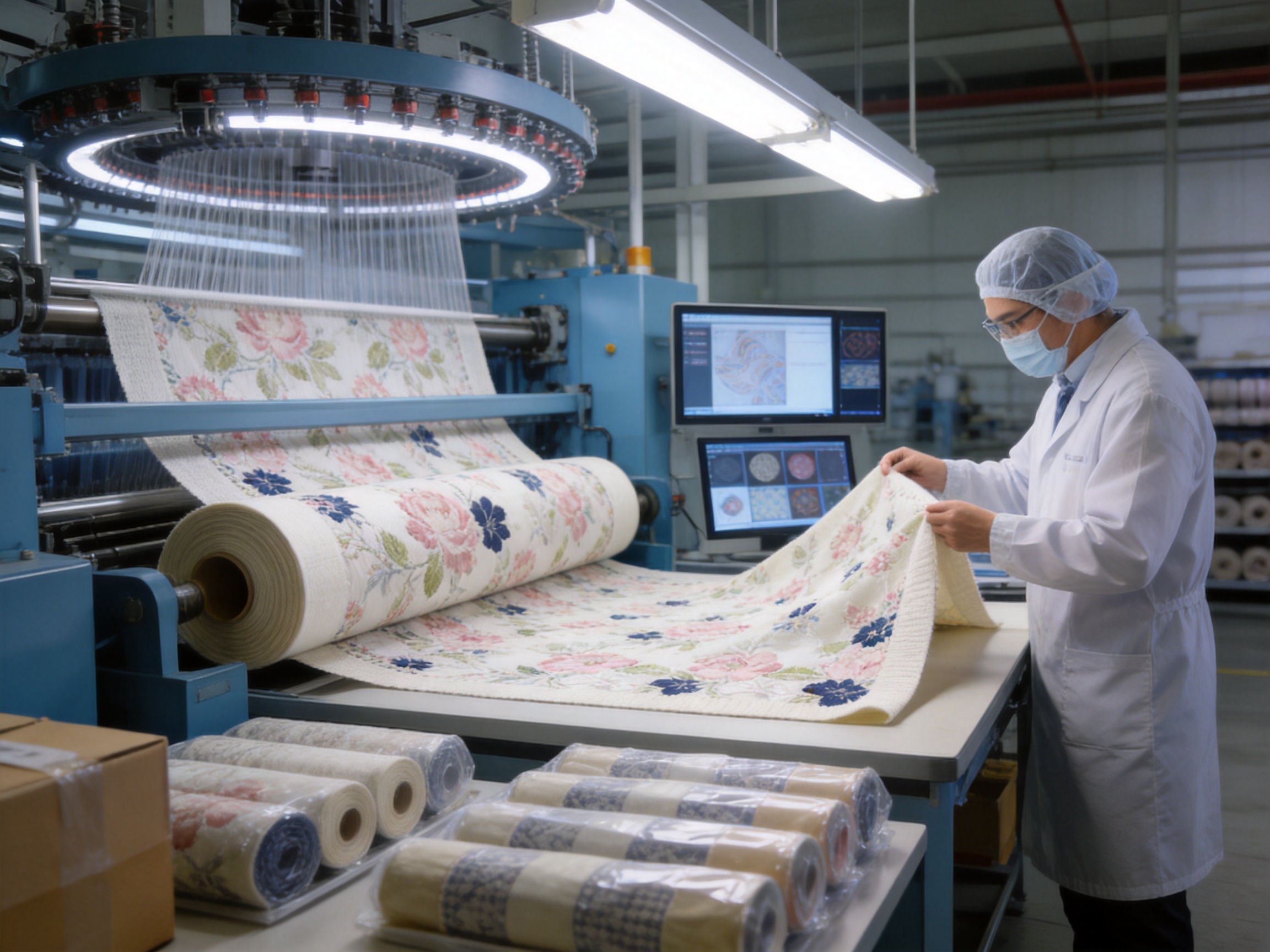
The floral jacquard effect depends on accurate stitch formation and consistent yarn control. The knitting process must maintain the intended pattern repeat, fabric width, weight, and surface appearance. Variations in yarn tension, machine settings, or knitting speed can affect the clarity of the floral motif and the stability of the finished material.
Continuous in-line inspection is used during knitting to identify fabric defects as early as possible. This approach allows production personnel to monitor the textile throughout the process rather than relying only on a final inspection. Early detection can help reduce the amount of material affected by a problem and support more consistent bulk quality.
Inspection may focus on visible defects, pattern consistency, surface uniformity, width, weight, and overall construction. For commercial buyers, in-line monitoring is particularly important because a fabric's appearance must remain consistent across multiple rolls and production lots.
Dyeing and Color Development
The product uses low-temperature reactive dyes as part of its color development approach. The purpose is to support vibrant shades and improved color fastness while maintaining controlled processing conditions for the viscose-containing blend.
Color is a major factor in the commercial success of floral apparel. A pattern may be technically attractive, but poor color control can reduce its value. Consistent dyeing helps ensure that the approved sample and production fabric are aligned as closely as possible in tone and intensity.
Color fastness should be verified according to the buyer's testing requirements and the intended end use. Relevant evaluations may include washing, rubbing, perspiration, and light exposure. The exact testing program should be confirmed for each order, especially when the fabric is intended for children's garments or products sold in markets with specific compliance standards.
Finishing for Hand and Drape
Finishing plays an important role in the final character of knitted jacquard. The finishing process can influence softness, width stability, surface appearance, dimensional behavior, and drape. For this product, the target is a soft-touch surface with fluid movement and a refined appearance.
Careful finishing is also important because viscose blends may respond differently to heat, moisture, tension, and mechanical handling than purely synthetic fabrics. Processing parameters should be managed to preserve the balance between softness and stability. Buyers can request development samples to evaluate the finished hand feel before approving bulk production.
Inspection and Defect Prevention
Zero fabric defects is the stated quality objective, supported by continuous in-line inspection during knitting. In practical textile production, inspection systems are designed to identify and control potential defects before shipment. Final quality review remains important because fabric may be affected during dyeing, finishing, rolling, packing, or transportation.
For large orders, buyers may establish an agreed inspection standard, roll length requirement, shade tolerance, width tolerance, and defect classification system. Clear quality criteria allow both the supplier and buyer to evaluate the product against the same expectations.
Roll inspection, shade grouping, labeling, and packaging are also important parts of quality assurance. Proper packaging can help reduce wrinkles and protect the fabric during handling and freight. The company provides optimized packaging support for large orders, with the aim of minimizing wrinkles and reducing unnecessary transportation costs.
Why Supplier Capability Matters to Buyers
Research and Development Support
Fashion buyers often need more than an existing stock fabric. They may require a new floral arrangement, different colorways, revised weight, alternative yarn selection, or a coordinated fabric program. A supplier with research and development capability can participate in this process rather than simply supplying a fixed product.
Digital sampling for new designs is completed within seven days according to the supplied product information. This supports faster decision-making during seasonal development. A digital sample can help a buyer evaluate the arrangement and general appearance of a proposed pattern before moving to physical sampling and production confirmation.
Digital development does not replace physical testing. The final approval should consider the actual knitted surface, color, stretch, drape, hand feel, and garment performance. Nevertheless, rapid digital sampling can help eliminate unsuitable concepts early and reduce development time.
Flexible Minimum Order Quantity
The company supports trial orders of 500 meters for new design tests. A flexible minimum order quantity can be valuable for emerging brands, independent designers, and established companies testing a new floral pattern before committing to a large production run.
A trial order can be used to evaluate cutting efficiency, sewing behavior, garment fit, wash performance, customer response, and sales potential. It also allows the buyer to confirm whether the fabric works with the intended production equipment and garment construction.
After the trial stage, a larger order can be planned with more confidence. Buyers should confirm available colors, production scheduling, shade continuity, packaging requirements, and any price adjustments associated with different order quantities.
Export and Logistics Assistance
International textile purchasing requires coordination beyond manufacturing. Large orders may involve container planning, consolidation, packaging optimization, documentation, and customs clearance. Dedicated logistics support can help buyers manage these activities more efficiently.
For large orders, the company can assist with container consolidation and packaging designed to minimize wrinkles and freight costs. These services are useful when a buyer is combining different fabric styles or coordinating several shipments for one production program.
The company can also provide Harmonized System codes, such as an example code of 6006.32, and Certificates of Origin in forms such as Form A, E, or F when applicable. Buyers should confirm the correct classification and documentation requirements with their customs broker or relevant authorities because tariff treatment may vary according to composition, construction, destination, and trade agreement.
OEKO-TEX Standard 100 and Skin-Contact Considerations
The fabric is identified as certified under OEKO-TEX Standard 100. This certification is important for buyers who need textiles assessed for harmful substances and intended for products that may come into contact with skin.
Certification can support a brand's compliance and product communication strategy, but buyers should verify the current certificate scope, certificate number, validity period, and applicable product class. A finished garment may include additional components such as thread, labels, zippers, buttons, prints, and trims. Those components may require separate evaluation.
For children's clothing, sleepwear, and close-to-skin apparel, buyers should combine textile certification with their own market-specific testing program. Requirements vary by country and product category. The supplier can provide available certification information for review during the sourcing process.
Design Guidance for Apparel Manufacturers
Pattern Placement
Floral jacquard patterns can influence the visual balance of a garment. Designers should consider whether the floral repeat should align at center fronts, side seams, collars, cuffs, pockets, or waist sections. Strategic placement can make the material appear more premium and reduce visual interruption.
For larger floral motifs, additional attention may be needed when matching pieces. For smaller or more dispersed motifs, cutting may be more flexible. Buyers should request pattern information or a full-width sample when placement is central to the design.
Cutting and Sewing
The fabric's stretch should be considered during marker planning and cutting. The direction of greatest stretch may affect garment fit, especially in fitted dresses and coordinated skirts. Pattern pieces should be laid according to the approved grain and stretch direction.
Needle selection, thread choice, seam allowance, and stitch type should be tested during sample sewing. A suitable stretch seam can help preserve comfort and prevent seam stress. The final sewing method should be determined by the garment design and the equipment used by the manufacturer.
Because knitted fabrics can relax after production, garment makers should evaluate dimensional behavior before bulk cutting. Allowing fabric to rest under controlled conditions may help improve cutting accuracy. The exact procedure depends on the factory's equipment and quality system.
Lining and Interfacing
Many dresses can be made without a full lining, depending on the color, opacity, garment structure, and target market. A lining may nevertheless be used to increase coverage, improve ease of dressing, or provide additional structure.
Interfacing should be selected carefully. A very rigid interfacing may conflict with the soft, flexible character of the knitted jacquard. Light or stretch-compatible support materials may be more appropriate for collars, waistbands, plackets, and selected jacket panels.
Color and Seasonal Planning
The floral surface can be developed in a wide range of color directions. Soft neutrals and muted florals may suit everyday daywear, while deeper tones can support fall and winter collections. Brighter color combinations may be appropriate for resort, spring, or youthful fashion lines.
Color planning should consider the intended retail channel, consumer profile, garment silhouette, and season. Buyers may also request multiple colorways using a common floral construction to create a coordinated collection without making every product identical.
Recommended Care and Handling
Machine washing on a gentle cycle or professional dry cleaning is recommended for maintaining the fabric's drape and helping prevent pilling. Buyers should follow the approved care label instructions developed after testing the final garment.
Cold or moderate-temperature washing, mild detergent, and reduced mechanical agitation are generally appropriate considerations for a viscose-blend knitted fabric. Excessive heat, harsh chemicals, and aggressive tumble drying may affect dimensions, surface appearance, or elasticity.
Garment manufacturers should test care performance before production approval. Testing can include dimensional change, appearance after washing, colorfastness, pilling, stretch recovery, and seam performance. The results should guide the final care label and consumer instructions.
During storage, rolls should be protected from excessive moisture, direct sunlight, dust, and compression. Appropriate packaging can help maintain the fabric's appearance before cutting. If the fabric arrives with temporary wrinkles, controlled relaxation or steaming may be considered, provided the method is compatible with the blend and finishing.
Comparison with Other Fabric Categories
| Fabric option | Typical visual character | Movement and comfort | Potential limitation |
|---|---|---|---|
| Floral knitted jacquard | Integrated, textured floral design with subtle sheen | Soft, flexible, and supported by spandex | Requires attention to stretch direction and pattern placement |
| Printed jersey | Surface-applied graphic or floral image | Usually comfortable and flexible | May offer less tactile depth than jacquard |
| Embroidered knit | Raised decorative threadwork | Can be flexible, depending on embroidery density | May add weight, stiffness, labor, or snag risk |
| Woven jacquard | Structured, often luxurious pattern construction | May have limited stretch unless elastane is added | Can feel firmer or less adaptable to close-fitting designs |
| Plain viscose knit | Clean, smooth, minimal surface design | Soft and draping | May require printing or trims for a more decorative effect |
| Basic polyester knit | Functional and uniform surface | Can be durable and easy to handle | May not provide the same soft hand or natural drape as a viscose blend |
This comparison is intended as a general sourcing guide. Actual performance depends on yarn quality, construction, finishing, weight, color, and garment manufacturing methods. The floral knitted jacquard is most competitive when the buyer values an integrated decorative effect together with stretch comfort and fluid movement.
Commercial Benefits for Fashion Brands
Higher Perceived Value
A textured floral design can help a garment appear more detailed and considered. This may increase perceived value compared with an equivalent silhouette made from a plain fabric. The fabric can support premium visual merchandising while retaining the comfort associated with knitwear.
Because the floral design is already present in the textile, brands may be able to achieve a finished appearance with simpler garment styling. A basic dress shape can become more distinctive through fabric selection alone. This can help product developers create differentiated items without excessive construction complexity.
Collection Versatility
The fabric can be incorporated into several product categories, including dresses, skirts, tops, lightweight jackets, children's clothing, and coordinated sets. This versatility may support a wider collection built around one material family.
A supplier can also help develop related colorways or variations. For example, a brand may use a soft neutral for a core daywear style, a darker shade for fall, and a brighter version for a limited seasonal collection. The same base concept can therefore serve different customer groups and retail environments.
Lower Development Risk
Rapid digital sampling and a 500-meter trial order provide practical tools for reducing development risk. The buyer can review the design, produce a small number of garments, gather internal feedback, and evaluate market response before placing a larger order.
This approach is particularly helpful when the floral design is new, the target customer is uncertain, or the brand is testing a different price position. Trial production can reveal issues that may not be visible in a digital image, including drape, recovery, seam behavior, and color appearance under retail lighting.
Sourcing Process for Wholesale Buyers
Step One: Define the End Use
Before requesting a quotation, buyers should identify the garment category, target season, expected retail price, fit level, color range, and care requirements. A fabric intended for a flowing dress may require different finishing preferences from one intended for a structured jacket.
Step Two: Review Technical Information
Buyers should confirm composition, weight, width, stretch direction, pattern repeat, face and back appearance, color options, certification, and available finishing choices. It is also useful to request information about roll length, packing method, lead time, and production capacity.
Step Three: Request Digital and Physical Samples
Digital sampling can accelerate the initial design review. Physical samples should then be evaluated for hand feel, drape, stretch, recovery, opacity, surface uniformity, and color. A garment sample is recommended when the material will be used in a close-fitting or technically demanding design.
Step Four: Conduct Testing
Testing should be selected according to the product's destination and intended use. Common evaluations may include fiber composition, fabric weight, width, colorfastness, dimensional stability, pilling, stretch recovery, and seam performance. For children's products, additional safety and chemical requirements may apply.
Step Five: Approve the Bulk Standard
Before bulk production, the buyer and supplier should agree on the approved standard. This may include a signed sample, color standard, pattern reference, inspection method, packaging instructions, and tolerance range. Clear approval procedures help reduce disagreements during production and shipment.
Step Six: Coordinate Logistics and Documentation
International orders should be planned around the required delivery date, shipping method, container utilization, and documentation. Buyers can discuss consolidation, optimized packaging, Certificates of Origin, HS classification information, commercial invoices, packing lists, and other customs documents with the supplier and their logistics partners.
Company Manufacturing Strengths
Hangzhou Jinfeng Textile Co., Ltd. combines fabric production and DTY polyester yarn capabilities with post-dyeing, finishing, processing, and sales. This broader textile background supports knowledge across both yarn and fabric stages.
The company operates from a substantial industrial facility in Xiaoshan District, Hangzhou. Its production base and integrated business structure are intended to support domestic and overseas customers. The company describes its business philosophy as cooperation and mutual benefit, with a focus on serving customers through product development, manufacturing, and export support.
For buyers of blended fabrics, this combination of production and processing experience can be useful when discussing yarn selection, fabric construction, dyeing, finishing, and performance requirements. It also provides a foundation for developing products beyond one standard fabric style.
The supplier's broader product categories include polyester rayon fabric, knitted jacquard fabric, NTR knitted fabric, NR knitted fabric, and slightly intermingled drawn textured yarn. This product range indicates experience with both apparel fabrics and polyester yarn-related products.
The company's stated strengths include continuous in-line inspection, low-temperature reactive dyeing, digital sampling within seven days, flexible trial quantities, export documentation support, and logistics assistance for large orders. Together, these capabilities address several concerns commonly faced by textile buyers: consistency, development speed, minimum order flexibility, compliance, and delivery coordination.
Questions and Answers
Q: Is the floral pattern reversible?
A: No. The standard floral knitted jacquard has a distinct face and back. The face displays the principal floral pattern, while the back has a neat and clean knitted structure. Double-sided jacquard constructions can be discussed for customers who require a reversible appearance.
Q: What is the fabric composition?
A: The listed composition is 60% viscose, 35% nylon, and 5% spandex. Viscose contributes softness and drape, nylon contributes strength and support, and spandex contributes stretch and recovery.
Q: What garments are best suited to this fabric?
A: Recommended applications include women's elegant day dresses, coordinated skirt and top sets, lightweight fall jackets, and luxury children's wear. The final suitability depends on the garment design, colorway, lining, and performance testing.
Q: Is the fabric suitable for fitted garments?
A: It can be suitable for selected fitted garments because of its knitted construction and 5% spandex content. Designers should test stretch, recovery, seam performance, and pattern allowance before bulk production.
Q: What is the fabric weight and width?
A: The listed weight is approximately 240 g/m², and the listed width is approximately 145 centimeters, or 57 inches. Actual production measurements should be confirmed against the approved specification.
Q: How should the fabric be cared for?
A: Gentle machine washing or dry cleaning is recommended. Buyers should conduct care testing on the finished garment and issue care instructions appropriate to the final product and market.
Q: Does the fabric have certification?
A: The product information identifies the fabric as OEKO-TEX Standard 100 certified. Buyers should request the current certificate and verify its scope and validity for the specific fabric and intended product category.
Q: How quickly can a new design be sampled?
A: Digital sampling for new designs is stated to be completed within seven days. Physical sampling and bulk production schedules should be confirmed separately because they depend on design complexity, color, quantity, and production planning.
Q: What is the minimum order quantity for a trial?
A: Trial orders of 500 meters are supported for new design testing, subject to confirmation of the requested color, design, and production conditions.
Q: Can the company assist with customs clearance?
A: The company can provide HS code information, such as the example code 6006.32, and Certificates of Origin such as Form A, E, or F when applicable. Buyers should confirm final customs requirements with their broker and destination-country authorities.
Q: Can large orders receive logistics support?
A: Yes. Dedicated logistics support can include container consolidation and optimized packaging intended to reduce wrinkles and freight costs. The exact arrangement should be agreed during order planning.
Q: What quality controls are used during production?
A: Continuous in-line inspection is conducted during the knitting process to identify and control potential fabric defects. Buyers may also establish additional final inspection standards, testing requirements, and tolerances for bulk orders.
Conclusion
Floral-patterned knitted jacquard fabric offers an effective combination of decorative design and everyday comfort. Its 60% viscose, 35% nylon, and 5% spandex composition provides a soft hand, fluid drape, practical support, and comfortable stretch. At approximately 240 g/m² and 145 centimeters wide, the fabric is versatile enough for dresses, coordinated sets, lightweight jackets, and luxury children's clothing.
Its main advantage over plain knits is the integrated floral surface, which provides texture and visual depth without requiring separate embroidery or applique. Compared with more rigid woven jacquards, its knitted construction offers greater flexibility and movement. Compared with basic printed fabrics, its tactile pattern can support a more elevated product identity.
Production strengths include continuous in-line inspection, controlled low-temperature reactive dyeing, finishing for softness and drape, digital sampling within seven days, and flexible trial orders from 500 meters for new design testing. The company's integrated experience in blended fabrics, post-dyeing, finishing, and DTY polyester yarn further supports its role as a textile development and manufacturing partner.
For buyers, the most effective sourcing approach is to request samples, test the fabric in the intended garment, confirm the certification and technical specifications, and establish clear bulk quality standards before production. With proper development and care instructions, this floral knitted jacquard can help fashion brands create garments that look distinctive, feel comfortable, and perform reliably in commercial collections.
References
OEKO-TEX Association. STANDARD 100 by OEKO-TEX: General and Special Conditions.
International Organization for Standardization. ISO 6330: Textiles—Domestic Washing and Dry-Cleaning Procedures for Textile Testing.
International Organization for Standardization. ISO 12945: Textiles—Determination of the Propensity of Textile Fabrics to Surface Fuzzing and to Pilling.
International Organization for Standardization. ISO 105 Series: Textiles—Tests for Colour Fastness.
Textile Institute. Textile Terms and Definitions.
Product technical information supplied for the floral-patterned knitted jacquard fabric, including composition, weight, width, applications, certification, sampling, quality control, and logistics support.