
Jacquard Twill Fabric: Structure, Performance, Manufacturing Excellence, and Application Guide
Introduction to Jacquard Twill Fabric
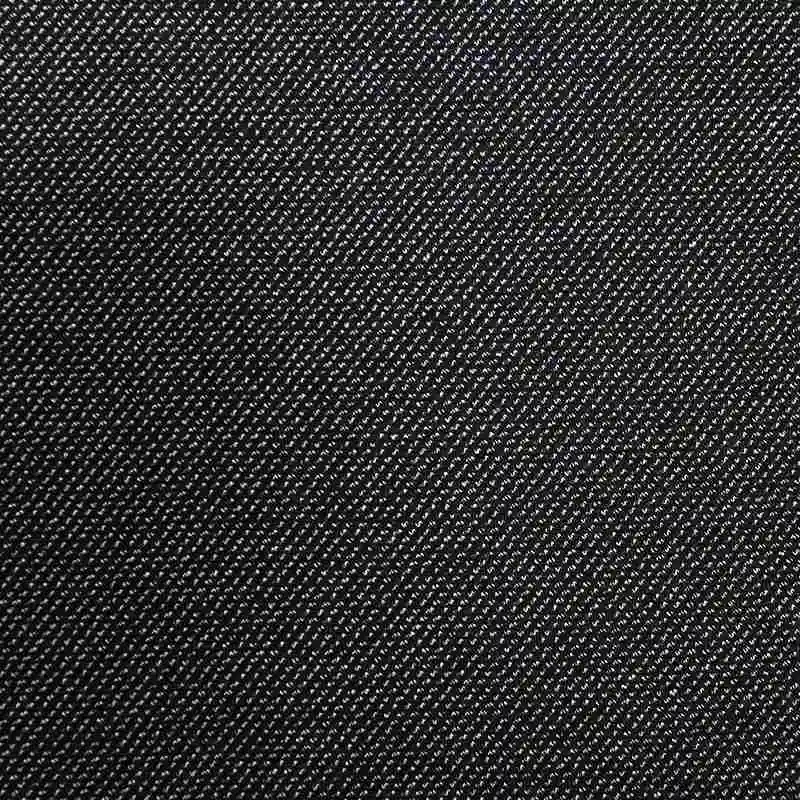
Jacquard twill fabric combines decorative surface design with a strong, practical textile structure. It is valued by apparel designers, garment manufacturers, and textile purchasers who need more than a plain knitted or woven surface. Through carefully controlled interlacing and pattern formation, jacquard fabric can display raised and recessed areas, subtle geometric effects, dimensional motifs, and a refined visual texture. When this construction is combined with a twill-inspired appearance, the result is a material that balances elegance, durability, comfort, and design flexibility.
The product discussed in this article belongs to the knitted jacquard fabric category and is commonly presented as Jacquard Twill Fabric. Its surface character is created by the interaction of yarns and knitting or fabric-forming structures rather than by applying a simple printed image on top of the material. This structural approach gives the fabric a more integrated appearance and allows the design to remain visually effective as the material moves, stretches, and is used in finished garments.
Jacquard fabrics are frequently produced with nylon or other synthetic fibers, although the final fiber composition may vary according to the intended application. Nylon is known for its softness, low weight, strength, and elasticity. These qualities make nylon jacquard suitable for body-hugging clothing, fashion garments, performance-inspired apparel, and products that require a comfortable hand feel. Polyester, spandex, rayon, and blended fibers may also be incorporated when the buyer requires different levels of resilience, moisture management, drape, opacity, or cost efficiency.
The value of this fabric lies not only in its visual design. Its construction can offer a richer surface than ordinary single-color fabric, greater flexibility than many rigid decorative textiles, and more dependable style consistency than surface-only embellishment. For businesses sourcing textile materials, the combination of appearance, process control, customization, and integrated production support is especially important.
Jacquard Twill Fabric
What Makes the Fabric Jacquard?
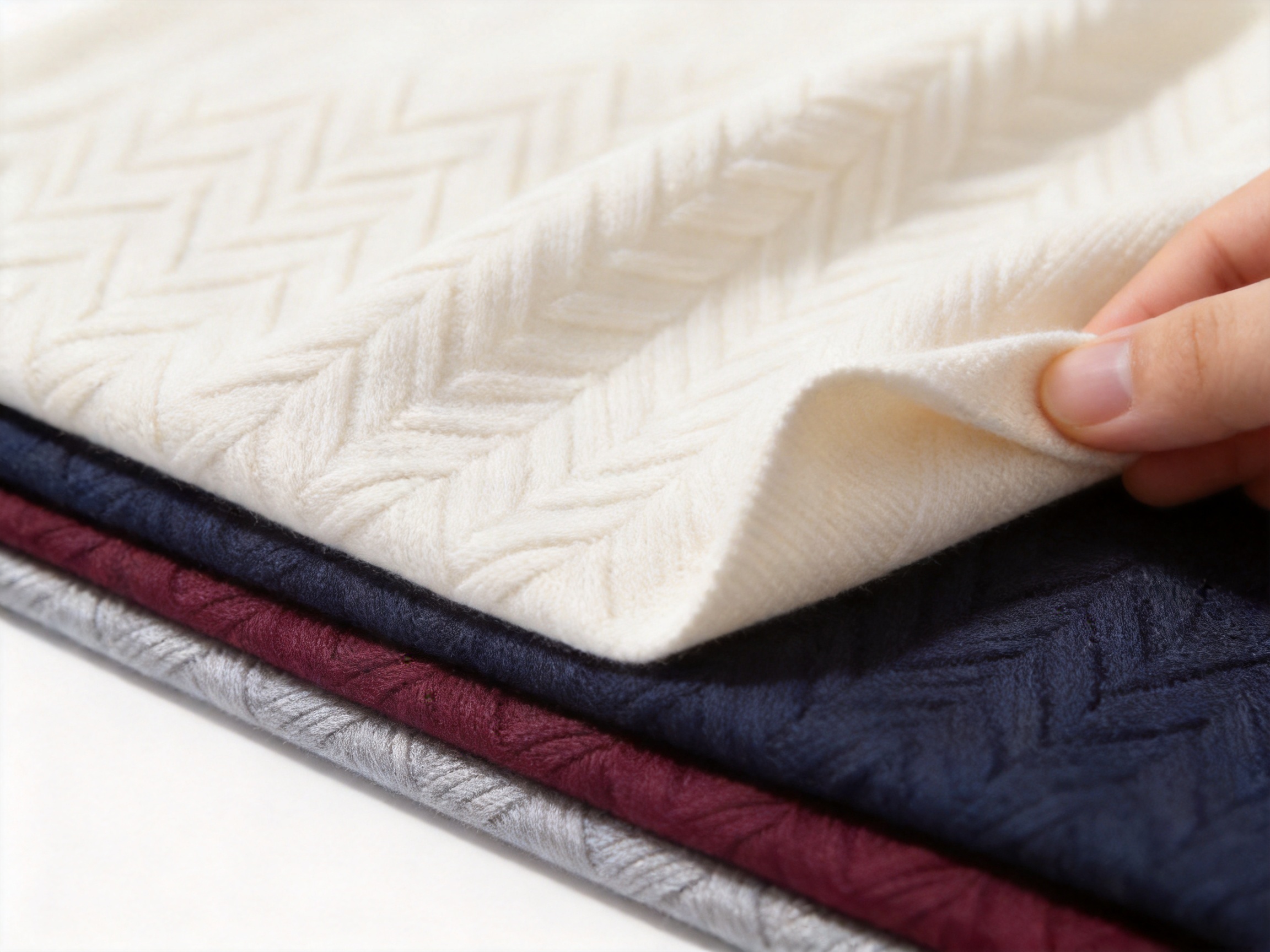
The term jacquard refers to a method of creating patterns through the controlled arrangement of yarns or loops. Instead of placing a design only on the surface with pigment or printing, a jacquard structure forms the pattern as part of the fabric itself. The interlacing or loop arrangement can create contrasts in height, density, direction, sheen, and shadow. These contrasts produce the characteristic concave-convex effect associated with many jacquard textiles.
This three-dimensional quality is one of the product’s most recognizable advantages. Under direct light, raised areas can reflect light differently from recessed areas. When the fabric is draped or stretched, the motif may change subtly in appearance, giving the garment a dynamic and premium character. The effect is especially useful for designers who want texture without relying on heavy embroidery, appliqué, or additional decorative layers.
In a knitted jacquard construction, the loops are arranged to form patterned areas within a flexible textile structure. Compared with many traditional rigid woven jacquards, knitted versions can offer improved stretch, softer movement, and greater suitability for close-fitting styles. The exact performance depends on yarn selection, machine settings, gauge, pattern structure, finishing treatment, and the percentage of elastic or blended fibers used in the fabric.
The twill element generally refers to the visual or structural suggestion of diagonal movement. A twill appearance can make the surface look directional and tailored while contributing to a more substantial hand feel. This visual language is often associated with trousers, jackets, skirts, uniforms, structured dresses, accessories, and contemporary casualwear. When represented through a knitted jacquard format, it can combine the polished look of twill with the flexibility expected from knit fabric.
Structural Depth Rather Than Printed Decoration
A printed fabric may use ink or pigment to place a design on the face of the textile. Printing can be effective and economical, but the printed pattern generally does not create the same physical depth as a jacquard construction. With jacquard fabric, the pattern is related to the arrangement of yarns or loops. The resulting surface can maintain its decorative character even when the textile is folded, handled, or viewed from different directions.
This does not mean that every jacquard fabric is automatically more durable than every printed fabric. Durability is influenced by fiber type, yarn quality, density, finishing, laundering, abrasion, and end use. However, structural pattern formation provides an important design advantage: the visual effect is built into the material rather than being dependent entirely on a coating or printed layer.
Softness, Light Weight, and Elasticity
Nylon jacquard fabric is often selected for its combination of softness and light weight. The yarn can create a smooth and comfortable surface that works well next to the skin. When the fabric structure includes suitable elasticity, it can follow body movement without feeling excessively restrictive. This makes it relevant to fitted dresses, fashion tops, dancewear, stage garments, lingerie-inspired apparel, stretch panels, and other body-conscious designs.
Elasticity can come from the knit construction, the use of spandex or elastane, the selection of textured yarns, or a combination of these factors. The appropriate level depends on the garment’s design. A fitted top may require comfortable two-way or four-way stretch, while a structured jacket may need more controlled movement and dimensional stability. Accurate specification is therefore essential before production begins.
Key Product Advantages Over Conventional Alternatives
Jacquard Twill Fabric competes with plain knitted fabric, printed fabric, standard twill fabric, embroidered fabric, and other textured textiles. Its main advantage is not one isolated property but a balanced combination of visual richness, flexibility, comfort, and customization potential.
| Feature | Jacquard Twill Fabric | Plain Knitted Fabric | Printed Fabric | Heavy Decorative Fabric |
|---|---|---|---|---|
| Surface appearance | Dimensional patterns with structural texture | Usually smooth or minimally textured | Color-based design on the surface | Often highly textured or layered |
| Design flexibility | Patterns can be customized through construction | Generally dependent on color, yarn, or finishing | Strong color and image flexibility | May require additional materials or processes |
| Softness and comfort | Can be soft, light, and elastic depending on fiber blend | Often comfortable and flexible | Depends on base fabric and printing finish | Can be heavier or less flexible |
| Three-dimensional effect | Created through yarn or loop arrangement | Usually limited | Usually visual rather than physical | Often strong but may reduce comfort |
| Suitability for fitted garments | High when stretch and recovery are correctly engineered | High for suitable constructions | Depends on the base material | Variable and sometimes limited |
| Application range | Fashionwear, dresses, tops, skirts, jackets, uniforms, and accessories | Casualwear and basic garments | Fashion and promotional apparel | Outerwear, décor, costumes, and specialty products |
Richer Visual Appeal
One of the strongest selling points is the fabric’s ability to create a premium appearance without requiring excessive surface decoration. A carefully developed motif can provide a garment with depth, movement, and a more memorable identity. The effect can be subtle and refined or bold and graphic, depending on the pattern scale, yarn contrast, color arrangement, and construction settings.
This is valuable in a competitive apparel market where brands need recognizable materials. A plain fabric may require additional printing, embroidery, trim, or finishing to stand out. A jacquard fabric can provide visual interest at the material stage, allowing designers to build a distinctive product while controlling the number of additional decorative operations.
Comfort for Close-Fitting Styles
Many fashion fabrics with attractive surfaces sacrifice comfort or flexibility. Jacquard Twill Fabric can reduce this compromise when the fiber blend and construction are selected appropriately. Nylon provides a soft, smooth feel and useful strength-to-weight performance. Knitted structures can support stretch and recovery. Spandex or other elastic fibers can increase freedom of movement. Together, these characteristics make the fabric appropriate for silhouettes that need to follow the body.
Comfort also depends on finishing. A well-controlled finishing process can improve handle, surface smoothness, dimensional stability, and overall garment performance. Since finishing conditions influence the final feel, a professional supplier should evaluate the fabric after processing rather than relying only on the characteristics of greige fabric.
Customization of Patterns and Fabric Identity
Jacquard technology allows a fabric to be adapted to a buyer’s design direction. Customization may include geometric motifs, diagonal structures, logos or monograms, small repeating patterns, abstract textures, tonal designs, or combinations of raised and flat zones. The feasibility of a particular pattern depends on machine capability, gauge, yarn size, repeat dimensions, color arrangement, and production volume.
Customization is a practical advantage for apparel companies that want to reduce dependence on common stock materials. A distinctive fabric can support a seasonal collection, create a recognizable product family, or provide a coordinated appearance across several garment categories. It can also help a manufacturer offer more value to customers who are seeking private-label or specialized textile solutions.
More Flexible Design Than Rigid Structured Materials
Traditional heavy jacquards and thick decorative textiles can create strong visual impact, but they may be less suitable for lightweight garments or designs requiring movement. A knitted jacquard format can provide a more flexible alternative. It can preserve pattern depth while remaining easier to drape, shape, and sew into garments that require softness.
The fabric may also be easier to integrate into modern fashion concepts that combine tailored details with comfort. For example, a designer may use jacquard twill in a fitted jacket, a stretch skirt, a coordinated top, or a panel within a dress. Its ability to occupy the space between casual knitwear and structured woven material gives it broad creative potential.
Fiber Selection and Blended Fabric Options
The performance of Jacquard Twill Fabric begins with fiber selection. Nylon is a common option because it offers softness, light weight, abrasion resistance, and useful elasticity. It can also provide a smooth surface that highlights the contrast between raised and recessed portions of a jacquard pattern. Nylon is particularly relevant when the finished garment must feel comfortable, follow body movement, and maintain an attractive appearance.
Polyester is another important textile fiber. It is widely used for its strength, dimensional stability, color retention, and processing versatility. Polyester yarn can be produced in different forms, including drawn textured yarn. DTY polyester yarn introduces bulk, softness, and a more developed surface compared with some flat yarn constructions. It may be selected when the fabric requires a particular handle, texture, coverage, or visual effect.
Rayon can contribute softness, fluid drape, and a natural-feeling hand. In blended fabrics, rayon may be combined with polyester or other fibers to balance comfort and performance. Spandex or elastane can provide additional stretch and recovery, especially in body-hugging styles. The ideal composition depends on the product’s intended use, care requirements, target price, and desired appearance.
The Role of DTY Polyester Yarn
Drawn textured yarn, commonly called DTY, is produced by drawing and texturing polyester filaments. The process can give the yarn additional bulk, crimp, softness, and elasticity-like behavior compared with a completely flat filament yarn. DTY polyester yarn is used in many textile applications because it can support comfortable fabric construction while maintaining the practical advantages of polyester.
In a jacquard fabric, the selection of yarn affects pattern clarity, surface reflection, thickness, coverage, and tactile character. Different yarn types can be used in different areas or combined within a broader textile program. A supplier experienced in both yarn production and fabric manufacturing can evaluate these relationships more effectively than a company that handles only one stage of the supply chain.
Yarn quality consistency is critical. Variations in denier, crimp, tension, color, elongation, or winding can create visible differences in the finished fabric. Stable yarn production and appropriate incoming inspection help reduce these risks. For customers ordering repeated lots, consistent yarn preparation is especially valuable because it supports more reliable color and texture continuity from one production cycle to the next.
Why Blending Matters
A blended fabric is designed to combine the strengths of multiple fibers. Polyester can contribute durability and dimensional stability. Rayon can enhance softness and drape. Nylon can provide a smooth hand, light weight, and resilience. Spandex can improve stretch and recovery. The blend ratio determines how these characteristics interact, and even a small change can influence fabric behavior.
Blending also affects dyeing, finishing, shrinkage, pilling resistance, moisture behavior, and care instructions. For this reason, the development process should consider the entire production chain rather than selecting fibers only for their initial hand feel. A technically capable supplier can help match yarn and fabric construction to the buyer’s end-use requirements.
Advanced Manufacturing Process
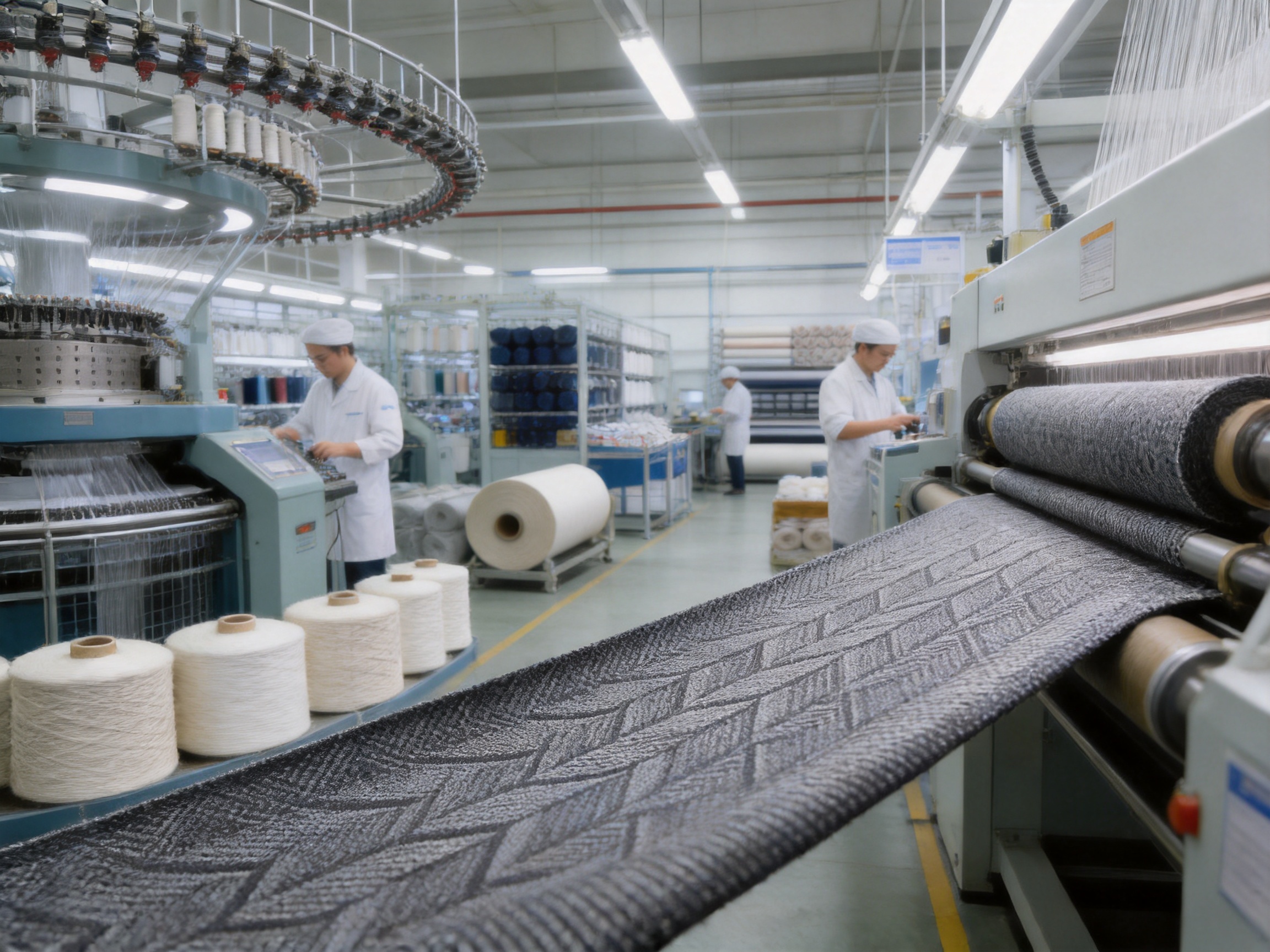
The manufacture of Jacquard Twill Fabric involves several coordinated stages. The exact process varies according to fiber composition and machine type, but quality depends on control at every step. A reliable production program normally begins with material planning, yarn preparation, and pattern development, followed by fabric formation, dyeing or color processing, finishing, inspection, and packing.
1. Product and Pattern Development
The process begins with an understanding of the buyer’s requirements. Important information may include the target composition, fabric width, weight, stretch percentage, pattern repeat, color direction, hand feel, intended garment, minimum order quantity, and expected care performance. Designers and technicians can then convert the visual concept into a construction plan.
Pattern development requires attention to scale and repeat. A motif that looks attractive on a screen may appear too large or too dense on a garment. A very small repeat may lose definition, while an overly complex structure may affect production speed or fabric stability. Sampling allows the supplier and customer to evaluate the relationship between pattern, yarn, color, and final application.
2. Yarn Preparation
Yarn preparation includes checking the selected yarn, organizing packages, and setting suitable feeding conditions. When DTY polyester yarn or blended yarns are used, tension and package consistency are particularly important. Uneven feeding can produce streaks, pattern distortion, barré effects, or differences in fabric density.
Yarns may be inspected for appearance, linear density, strength, elongation, moisture condition, and package quality. The purpose is to identify potential problems before the yarn enters the knitting or fabric-forming stage. Preventive control is more efficient than attempting to correct defects after dyeing and finishing.
3. Jacquard Fabric Formation
During fabric formation, the machine controls yarn placement or loop arrangement according to the selected pattern. The relationship between machine gauge, yarn size, stitch density, tension, and pattern repeat determines the final surface effect. Operators must maintain stable machine conditions so that the design remains consistent across the width and length of the fabric.
The concave-convex effect is developed through differences in structure, yarn position, density, or loop configuration. These differences influence both appearance and handle. If the raised areas are too prominent, the fabric may become less comfortable or more susceptible to snagging. If the structure is too shallow, the design may lack visual impact. Process engineering therefore seeks a balance between decorative depth and practical performance.
For twill-inspired designs, directional lines and diagonal movement must be controlled carefully. Any variation in tension or alignment can weaken the intended visual flow. Proper machine setup, regular monitoring, and experienced operators are essential for achieving a clean and stable pattern.
4. Greige Fabric Inspection
After fabric formation, the greige material is inspected before post-processing. Inspection may identify knitting faults, missing loops, yarn problems, holes, oil marks, uneven density, pattern errors, width variation, or inconsistent tension. Early inspection helps determine whether a roll is suitable for dyeing and finishing.
Roll identification and traceability are also important. Each batch should be connected to information about yarn, machine, production date, operator, and process settings. Traceability supports problem investigation and helps maintain consistency when a buyer places repeat orders.
5. Dyeing and Color Processing
Color processing is selected according to the fiber composition and desired shade. Nylon, polyester, rayon, and elastane may require different dyeing conditions or coordinated treatment. In blended fabrics, achieving a balanced color result can be technically demanding because each fiber may absorb or respond to dye differently.
Color control includes laboratory sample development, shade comparison, batch monitoring, and final approval. The three-dimensional surface of jacquard fabric can affect how color is perceived. Raised areas may appear lighter because they reflect more light, while recessed areas may look deeper or darker. Color evaluation should therefore consider both instrumental readings and visual inspection under appropriate lighting.
6. Finishing and Stabilization
Finishing can improve the fabric’s handle, appearance, width, dimensional stability, and suitability for garment production. Depending on the construction, finishing may include washing, softening, heat setting, drying, compacting, brushing, or other controlled treatments. The selected treatment must preserve the jacquard pattern while achieving the requested touch and performance.
Heat setting may be particularly relevant when synthetic fibers or elastic components are present. It can help stabilize width and reduce unwanted shrinkage, but excessive heat or tension may damage elasticity or flatten the surface effect. Finishing parameters should be established through testing rather than applied without regard to fiber composition.
A professional finishing operation also considers the needs of the cutting room. Excessive curling, unstable width, uneven relaxation, or inconsistent weight can create difficulties during marker planning and garment assembly. A stable finished fabric can reduce cutting waste and improve production efficiency for the garment manufacturer.
7. Final Inspection and Packing
Final inspection verifies that the finished rolls meet the agreed quality requirements. Common checks include appearance, width, weight, color, pattern continuity, stretch, recovery, shrinkage, pilling tendency, surface defects, and hand feel. The inspection standard should be agreed before bulk production so that both supplier and buyer have a clear reference.
Proper rolling and packing protect the fabric during storage and transportation. Rolls should be identified with batch details, quantity, color, composition, and inspection status. Packaging should prevent contamination, excessive moisture, crushing, and unnecessary deformation of the jacquard surface.
Manufacturing Strengths and Integrated Production Capability
Hangzhou Jinfeng Textile Co., Ltd. operates as an integrated textile enterprise involved in research and development, production, processing, post-dyeing, finishing, and sales. Its product scope includes blended fabrics such as polyester and spandex materials, DTY polyester yarn production and processing, and related textile services. This integrated structure is significant because fabric performance often depends on decisions made before the fabric reaches the knitting or finishing stage.
The company is located in Jingjiang Street Industrial Park, Xiaoshan District, Hangzhou, Zhejiang Province. It covers approximately 32.6 acres and has a plant area of approximately 18,000 square meters. This industrial base provides room for coordinated production, process management, material storage, inspection, and customer service activities.
Experience Across Yarn and Fabric Operations
A supplier that understands both yarn and fabric can assess how yarn characteristics influence the final textile. For Jacquard Twill Fabric, this knowledge is particularly useful because yarn texture, tension, fineness, strength, and elasticity directly affect the clarity and feel of the pattern. Experience with DTY polyester yarn and blended fabrics also supports more informed recommendations when customers compare composition options.
Integrated production can shorten communication paths. Instead of transferring technical information through several unrelated suppliers, the buyer can work with one organization that coordinates material selection, fabric development, processing, and finishing. This does not eliminate the need for testing, but it can make problem solving faster and reduce the risk of specification loss between production stages.
Research and Development Support
Textile development is not limited to creating new patterns. It also involves adjusting construction, weight, stretch, handle, surface effect, color, and finishing to meet an end-use requirement. A capable research and development team can help transform a general concept into a manufacturable specification.
For example, a buyer may request a lightweight jacquard with a soft hand for close-fitting apparel. The supplier may need to evaluate a different yarn size, lower or higher density, modified pattern repeat, controlled elastic content, and a gentler finishing route. Alternatively, a buyer seeking a more structured twill effect may require increased coverage, a different yarn combination, or a more stable finishing process. Product development is therefore a process of balancing several properties rather than maximizing one feature alone.
Post-Dyeing and Finishing Control
Post-dyeing and finishing can determine whether a fabric feels ordinary or premium. Consistent finishing helps preserve the dimensional effect of the jacquard pattern, maintain a suitable width, and deliver the hand feel requested by the customer. The ability to manage these stages within the same manufacturing organization supports better coordination and quality accountability.
Finishing quality also influences downstream garment performance. A fabric that changes significantly after cutting or washing may cause seam distortion, size variation, or mismatch between garment panels. Controlled finishing and clear testing reduce these risks and help apparel factories plan their operations more accurately.
Export-Oriented Service
As a self-employed export company integrating research and development, production, and sales, the company serves customers in domestic and international markets. Export-oriented textile service requires attention to documentation, packing, product consistency, delivery coordination, and communication across different technical standards.
For international buyers, clear communication is especially important. The fabric name alone is not sufficient to define a product. A complete specification should include fiber content, finished width, weight, stretch, color standard, pattern repeat, finishing requirements, testing expectations, roll length, and tolerance limits. A supplier with experience serving overseas customers can help establish these details before bulk production.
Applications of Jacquard Twill Fabric
Fashion Dresses and Fitted Tops
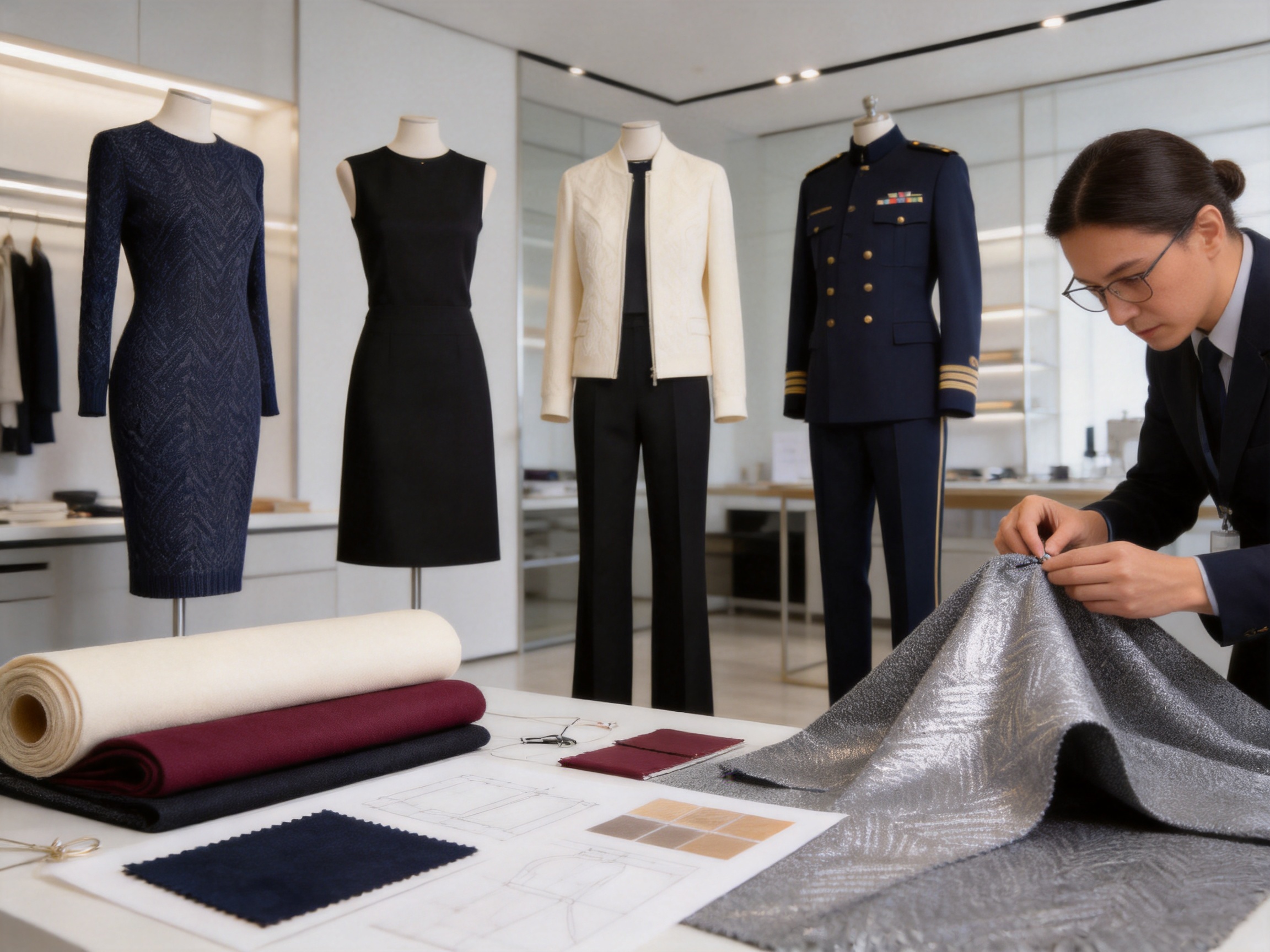
The combination of softness, elasticity, and dimensional texture makes the fabric suitable for dresses and fitted tops. Designers can use the jacquard pattern as the central visual feature or combine it with plain fabric for contrast. The material may be appropriate for body-skimming silhouettes, panel constructions, sleeves, yokes, waist sections, and coordinated two-piece outfits.
When used in close-fitting garments, designers should evaluate stretch direction, recovery, seam allowance, and pattern placement. A large motif may need to be aligned across garment panels, while a small repeating pattern can provide more flexibility during cutting. The fabric’s final behavior should be assessed after washing or relaxation, not only in its roll condition.
Skirts, Trousers, and Tailored Casualwear
The twill-inspired surface can give skirts and trousers a more structured appearance than ordinary jersey fabrics. This makes it useful for tailored casualwear that aims to combine comfort with a polished look. A suitable blend may provide enough stability for clean lines while retaining sufficient flexibility for movement.
For trousers or fitted skirts, important considerations include abrasion resistance, seam strength, recovery, pilling, and dimensional stability. The correct fabric construction can support repeated wear, but the final suitability should be confirmed through testing based on the garment’s intended market.
Jackets and Lightweight Outer Layers
Jacquard Twill Fabric can be used for lightweight jackets, fashion blazers, cropped outer layers, and decorative panels. Its surface texture can reduce the need for additional trim, while its flexibility may make it more comfortable than a heavy woven jacquard. Depending on weight and composition, the fabric may be used alone or supported with lining, interlining, or stabilizing components.
When the fabric is used in a jacket, the pattern scale and direction should be considered carefully. Diagonal twill effects can enhance the garment’s shape, while a symmetrical jacquard motif may require precise matching at center fronts, pocket areas, or side seams.
Uniforms and Branded Apparel
Custom jacquard patterns can support a distinctive identity for uniforms, hospitality garments, event apparel, and branded fashion collections. A tonal logo-inspired design or repeated geometric motif can create visual differentiation without using a large printed graphic. The textile can therefore become part of the brand experience.
Uniform applications require additional attention to laundering, colorfastness, abrasion, and long-term appearance. The fabric should be selected according to the expected service conditions. A pattern that looks attractive in a showroom must also provide practical performance for repeated use.
Accessories and Fashion Details
Depending on its weight and stability, the fabric may also be used for headbands, belts, decorative bags, cuffs, collars, pocket features, and other accessories. The dimensional pattern can make a small accessory appear more distinctive. Designers can combine the fabric with plain polyester, nylon, leather-like materials, or other complementary textiles.
Quality Evaluation and Buyer Checklist
Before placing a bulk order, buyers should define the technical and visual requirements of the fabric. This is particularly important for jacquard materials because a product’s appearance depends on structure, lighting, color, and finishing. A sample that appears satisfactory may still require adjustment when produced at commercial scale.
| Evaluation Area | Recommended Considerations |
|---|---|
| Composition | Confirm nylon, polyester, rayon, spandex, or other fiber percentages. |
| Weight | Specify target grams per square meter and acceptable tolerance. |
| Width | Confirm usable width, finished width, and edge conditions. |
| Stretch | Measure stretch direction, extension percentage, and recovery. |
| Pattern | Approve motif scale, repeat, alignment, depth, and visual continuity. |
| Color | Use an approved standard and define acceptable shade variation. |
| Dimensional stability | Evaluate shrinkage, skew, spirality, and width change after care testing. |
| Surface performance | Check pilling, snagging, abrasion, fuzzing, and appearance after use. |
| Care performance | Confirm washing, drying, ironing, and professional care requirements. |
| Packaging | Specify roll length, labeling, protective wrapping, and moisture control. |
Appearance Inspection
Appearance inspection should be performed under consistent lighting. Inspectors should look for broken patterns, uneven texture, holes, stains, streaks, color bars, width irregularity, and defects in the fabric edges. Since jacquard effects create shadows, visual inspection should be performed from several angles rather than from one fixed position.
Stretch and Recovery Testing
For fitted garments, stretch alone is not enough. Recovery is equally important. A fabric may extend easily but fail to return to its original dimensions after wear. Testing should measure the amount of extension and the percentage of recovery after a defined relaxation period. The test method should reflect the garment’s intended use and be agreed between the buyer and supplier.
Colorfastness and Care Testing
Colorfastness to washing, rubbing, perspiration, and light may be relevant depending on the market and garment type. Blended fabrics can behave differently from single-fiber textiles during care. Buyers should request testing appropriate to the intended product and avoid assuming that one standard applies to every application.
Pilling, Snagging, and Abrasion
Surface texture can improve appearance but may also influence how the fabric reacts to friction or contact with rough objects. Pilling and snagging tests can help assess suitability for trousers, uniforms, active garments, and frequently worn fashion items. The outcome depends on fiber type, yarn construction, loop structure, finishing, and the test method used.
How Jacquard Twill Fabric Supports Sustainable Product Development
Sustainability in textiles involves material selection, product lifespan, processing efficiency, waste reduction, and responsible production decisions. Jacquard fabric can support more durable design when its structure remains attractive after repeated wear and when the garment does not require excessive additional decoration. Reducing extra embroidery, appliqué, or layered trims may simplify production and lower material consumption.
Longer product life is also important. A fabric that combines comfort and visual interest may encourage consumers to wear a garment more frequently and for a longer period. However, sustainability claims should be supported by measurable information such as fiber content, energy use, chemical management, water consumption, waste control, and product life-cycle data. The use of a jacquard structure alone does not automatically make a textile sustainable.
Efficient production planning can reduce waste. Accurate pattern development, stable fabric width, reliable roll inspection, and consistent finishing help lower cutting losses and rejected material. Integrated production may also support better coordination between yarn preparation and fabric manufacturing, reducing unnecessary transportation and communication-related errors.
Design and Production Recommendations
Begin With the End Use
The best fabric is not simply the softest or most decorative option. It is the fabric that meets the functional needs of the finished product. A dress, uniform, jacket, stretch skirt, and accessory may all require different weights, stretch levels, surface depths, and care characteristics. Buyers should identify the end use before selecting the final specification.
Use Sampling to Confirm the Pattern
Sampling is essential for evaluating jacquard scale, direction, depth, color, and garment compatibility. The sample should be reviewed as a fabric and, whenever possible, as a cut-and-sewn garment. A pattern may appear balanced on a flat swatch but create unexpected effects when placed over seams, curves, darts, or body contours.
Check Pattern Matching Requirements
If the design includes directional or symmetrical motifs, the cutting and sewing plan should account for matching. Pattern matching can increase fabric consumption, particularly in jackets, dresses, and garments with center-front symmetry. Confirming the repeat early allows the buyer to estimate material requirements and avoid surprises during production.
Balance Surface Depth With Comfort
A highly raised effect may attract attention, but it can also influence softness, friction, flexibility, and snag resistance. The most successful construction usually balances visual depth with the wearer’s comfort. The appropriate balance depends on whether the textile will touch the skin, be used as an outer layer, or serve as a decorative panel.
Confirm Finishing Before Bulk Production
Finishing can significantly change handle, width, weight, stretch, and appearance. The buyer should approve a finished sample rather than a greige sample alone. Bulk production should follow the approved finishing route, with any changes documented and evaluated before implementation.
Why Choose an Experienced Textile Manufacturing Partner?
Choosing a textile supplier involves more than comparing a catalog price. Buyers should consider technical communication, development support, production stability, quality inspection, finishing capability, delivery coordination, and the supplier’s ability to manage repeat orders. Jacquard products require particular attention because small changes in yarn, tension, pattern settings, or finishing can affect the final result.
Hangzhou Jinfeng Textile Co., Ltd. combines fabric production and processing with DTY polyester yarn production, blended fabric manufacturing, post-dyeing, finishing, research and development, and sales. This broad capability gives customers access to a coordinated textile supply chain. It can be useful for buyers who need to compare nylon, polyester, rayon, spandex, or blended constructions within one development program.
The company’s production base in Xiaoshan, Hangzhou, provides an established industrial setting for textile operations. Its stated business philosophy emphasizes cooperation and mutual benefit, which is relevant to long-term sourcing relationships. A cooperative development process can help both sides clarify technical requirements, evaluate samples, solve production issues, and improve future orders.
For international customers, the company’s export orientation may also support communication and order coordination. Product inquiries can address fabric category, yarn type, pattern concept, weight, width, color, stretch, finishing, packaging, and delivery expectations. The more complete the initial information, the more efficiently the supplier can recommend an appropriate development route.
Frequently Asked Questions
What is Jacquard Twill Fabric?
Jacquard Twill Fabric is a patterned textile with a jacquard surface and a twill-inspired visual or structural effect. The design is formed through the controlled arrangement of yarns or loops, creating a dimensional appearance rather than relying only on surface printing. The product can be produced in different fiber compositions and weights according to the intended application.
Is this fabric woven or knitted?
The product described in the supplied information belongs to the knitted jacquard fabric category. However, the term twill can refer to the visual direction or surface character rather than indicating a conventional woven twill construction. Buyers should confirm the exact construction, fiber content, weight, width, and stretch before ordering.
Is nylon always used in jacquard fabric?
No. Nylon is a common option because it can provide softness, light weight, strength, and elasticity, but jacquard fabrics may also use polyester, rayon, spandex, or blended yarns. The most suitable composition depends on the required hand feel, durability, stretch, color performance, cost, and care conditions.
Can the pattern be customized?
Yes, jacquard construction generally offers significant pattern customization potential. Buyers can discuss geometric designs, tonal effects, diagonal motifs, repeated patterns, and other visual concepts. Feasibility depends on the machine, gauge, yarn, repeat size, pattern complexity, color arrangement, and order quantity. Sampling is recommended before bulk production.
Is Jacquard Twill Fabric suitable for body-hugging clothing?
It can be suitable when the fabric has the required stretch and recovery. Nylon, knitted construction, textured yarn, and spandex content may all contribute to comfort and movement. The final fabric should be tested for extension, recovery, dimensional stability, and comfort in a garment-like application.
What are the main advantages over printed fabric?
The principal advantage is structural texture. A jacquard pattern is created through yarn or loop arrangement, so it can provide raised and recessed areas, changing light reflection, and a more tactile surface. Printed fabric may offer excellent color and image detail, but its design is primarily applied to the surface. The better option depends on the desired appearance, cost, performance, and production method.
Can polyester yarn be used in this product?
Yes. Polyester, including drawn textured yarn, can be used in jacquard and blended fabric development. DTY polyester yarn can contribute bulk, softness, texture, and practical polyester performance. The yarn specification should be matched with the pattern, machine settings, target weight, and finishing route.
What information should be included in a purchase inquiry?
A purchase inquiry should include the desired fiber composition, fabric category, weight, finished width, color, pattern or design reference, stretch requirement, application, order quantity, finishing preference, testing requirements, packing method, and delivery destination. Supplying a physical reference or detailed image can also improve sample accuracy.
How should the fabric be tested before bulk production?
Testing may include appearance, weight, width, stretch, recovery, shrinkage, colorfastness, pilling, snagging, abrasion, seam behavior, and care performance. The exact test list should reflect the end use and the standards of the target market. A finished sample and, when possible, a prototype garment should be evaluated before approval.
Can the company provide blended fabric solutions?
Yes. The company’s stated product and manufacturing scope includes blended fabrics such as polyester and spandex materials, as well as related textile processing. Customers can discuss blended options involving polyester, nylon, rayon, spandex, and other suitable fibers according to the desired performance profile.
What makes integrated production valuable?
Integrated production connects yarn preparation, fabric formation, dyeing, finishing, inspection, and sales support. This can improve communication, traceability, development efficiency, and consistency. It also allows the supplier to consider how an early yarn decision will influence the finished fabric rather than treating each production stage separately.
Conclusion
Jacquard Twill Fabric offers a practical combination of structural beauty, softness, flexibility, and design adaptability. Its concave-convex surface effect gives garments greater visual depth than many plain textiles, while its knitted format can provide comfort and movement for body-conscious styles. Nylon is a particularly suitable fiber option when low weight, softness, elasticity, and a smooth hand are important, while polyester, rayon, spandex, and blended yarns allow the fabric to be adjusted for different markets and applications.
The product’s advantages are strengthened when yarn selection, jacquard construction, dyeing, finishing, and inspection are managed as one coordinated process. Pattern customization, DTY polyester yarn expertise, blended fabric production, post-dyeing, finishing, research and development, and export-oriented service provide a strong foundation for supplying apparel and textile manufacturers.
For buyers, the most reliable approach is to define the end use, approve a detailed specification, evaluate finished samples, test the essential performance characteristics, and maintain clear communication throughout development and bulk production. With these steps in place, Jacquard Twill Fabric can serve as a distinctive and versatile material for fashion garments, fitted clothing, tailored casualwear, uniforms, jackets, skirts, accessories, and other products that require both a premium surface and practical comfort.
References
International Organization for Standardization. Textile Testing Principles for Fibre Composition, Dimensional Stability, Colour Fastness, and Surface Performance.
American Society for Testing and Materials. Standard Methods for Testing Textile Fabrics, Yarn Properties, Abrasion Resistance, Pilling, Stretch, and Recovery.
Udale, Jenny. Textiles and Fashion: Exploring the Relationship Between Fabric Structure, Surface Design, and Garment Development.
Gong, R. H., and Chen, Y. Textile Materials and Processes: Fibre Selection, Yarn Formation, Fabric Construction, Dyeing, and Finishing.
Collier, B. J., and Tortora, P. G. Understanding Textiles: Fabric Properties, Performance Evaluation, and Apparel Applications.
Manufacturer-supplied product information for knitted jacquard fabric, blended fabric, DTY polyester yarn, production facilities, and textile processing capabilities.
