
Jacquard Black and White Grid Fabric: Design, Performance, and Manufacturing Excellence
Jacquard black and white grid fabric combines a strong visual identity with the practical performance required for modern apparel and interior sewing projects. Its structured grid pattern creates a clean geometric effect, while the knitted construction gives the material flexibility, softness, and comfort. This balance makes the fabric suitable for fashion garments, coordinated accessories, decorative products, and selected home-based sewing applications.
Unlike a printed fabric, a jacquard fabric develops its pattern through the arrangement of yarns during the manufacturing process. The grid is therefore integrated into the fabric structure rather than simply placed on the surface. This construction can provide a more distinctive appearance, better pattern stability, and a richer tactile effect. When supported by controlled yarn preparation, accurate knitting, professional finishing, and careful inspection, black and white grid fabric can offer a dependable solution for wholesalers, garment manufacturers, designers, and textile distributors.
Hangzhou Jinfeng Textile Co., Ltd. manufactures and supplies knitted jacquard fabrics as part of a broader textile operation that also includes polyester rayon fabrics, NTR knitted fabrics, NR knitted fabrics, and slightly intermingled draw textured yarn. The company combines production and processing, post-dyeing, finishing, research and development, and sales within one integrated business structure. This integration helps connect fabric design and production with practical customer requirements.
The following article examines the main qualities of jacquard black and white grid fabric, its advantages compared with competing fabric types, the manufacturing processes that influence its performance, and the reasons it can be considered for both apparel and home sewing projects.
Jacquard Black And White Grid Fabric
1. Understanding Jacquard Black and White Grid Fabric
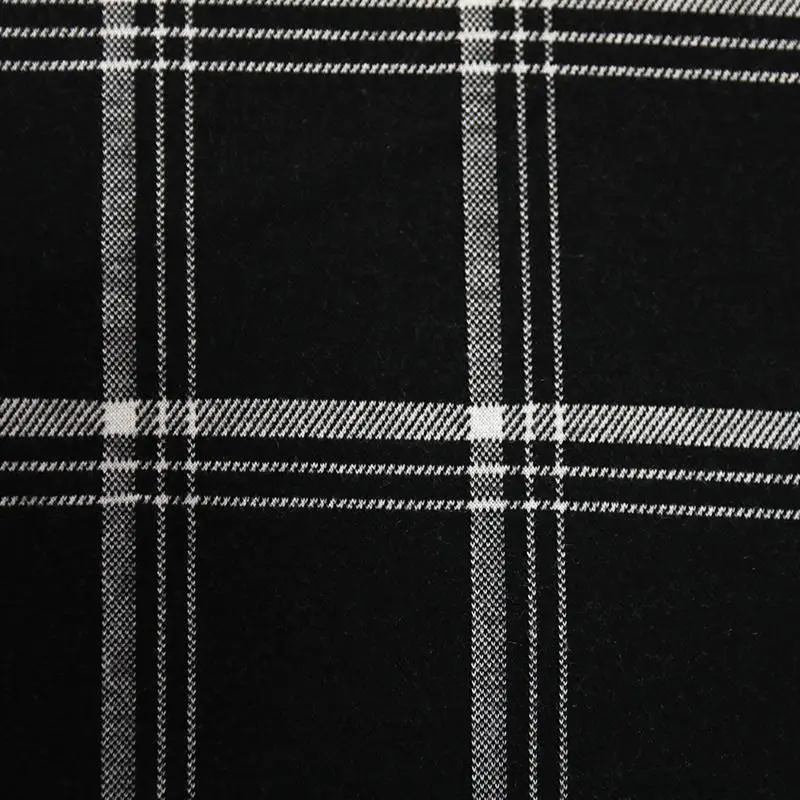
Jacquard black and white grid fabric is a patterned textile characterized by a repeated grid, check, or geometric arrangement in contrasting black and white tones. The exact scale, spacing, surface relief, yarn composition, and weight may vary according to the production specification. Because the product is categorized as a knitted jacquard fabric, its appearance is created within a knitted structure rather than through a simple printed treatment.
The black and white color combination is one of the most versatile choices in textile design. It offers a strong contrast that can appear modern, minimalist, formal, or casual depending on the grid size and garment silhouette. Small grids may create a refined and understated effect, while larger grids can become a bold fashion statement. The neutral palette also allows manufacturers and designers to coordinate the fabric with solid colors, metallic accessories, denim, leather, and other textile materials.
Knitted jacquard fabric differs from many conventional woven patterned fabrics in the way its loops are formed. Knitting generally produces a flexible structure that can move with the wearer and adapt to curved surfaces. This makes knitted jacquard particularly useful for garments that require comfort and visual texture. The fabric can maintain a defined pattern while still offering a softer hand and a degree of stretch or recovery, depending on the selected yarns and knitting construction.
The final behavior of the fabric depends on numerous variables, including fiber composition, yarn count, knitting density, pattern arrangement, finishing method, dyeing conditions, and relaxation treatment. For this reason, buyers should evaluate a sample before confirming large-scale production. Product-specific information such as width, weight, composition, stretch percentage, colorfastness, shrinkage, and recommended care should be confirmed with the supplier for each order.
2. How the Grid Pattern Creates Product Value
A central advantage of jacquard construction is that the visual design becomes part of the fabric architecture. In printed fabric, the design is applied to the surface after the base material has been created. In jacquard fabric, selected yarns are controlled during knitting to build the pattern. This can produce a more dimensional appearance and give the textile a richer surface than a flat printed image.
The integrated pattern can also support a more consistent appearance across the fabric when production is properly controlled. A printed design may be affected by surface abrasion, ink penetration, or variations in printing registration. Jacquard production has different technical challenges, including yarn tension, loop formation, pattern alignment, and color placement, but the finished visual effect is structurally connected to the knitted material.
Texture is another important source of value. The grid may have subtle relief, raised sections, recessed lines, or changes in surface density. These details can create visual depth without depending on additional embellishment. A garment made from this material may therefore appear more sophisticated while requiring fewer decorative treatments.
Jacquard construction also offers design flexibility. The same basic black and white concept can be adapted into different grid proportions, repeat sizes, textures, and surface effects. Designers may use the fabric for a complete garment, a feature panel, collar, sleeve, skirt section, vest, jacket, or coordinated accessory. This flexibility supports both commercial collections and small-scale home projects.
Because the pattern is visually clear, the fabric can function as a focal material. It does not necessarily require complicated styling. A simple garment cut can allow the grid to provide the main design interest, while a more structured silhouette can emphasize the fabric's geometric character.
3. Advantages Compared with Competing Fabric Options
3.1 Advantages over ordinary printed fabric
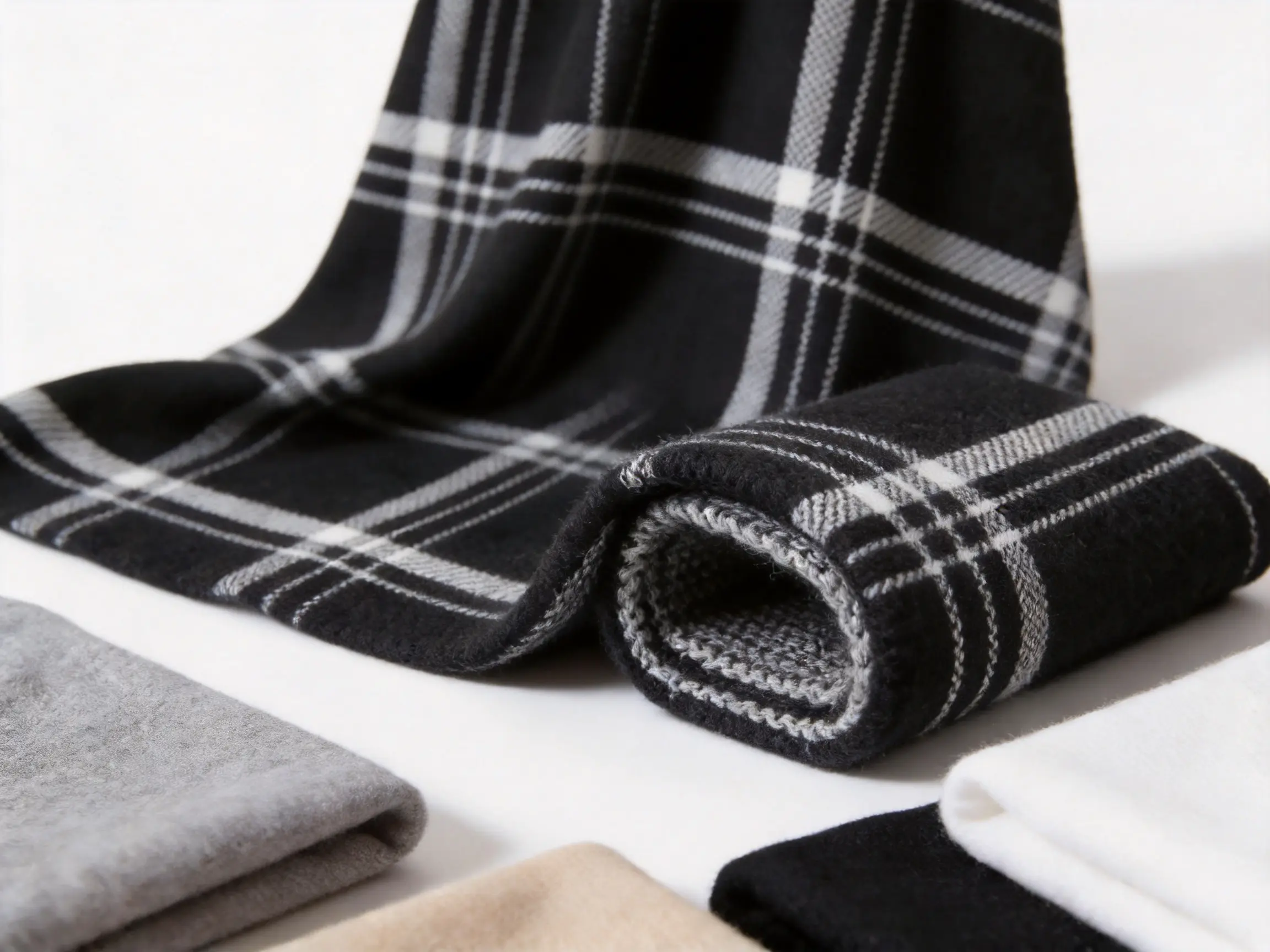
Printed fabric remains useful for many applications, but jacquard black and white grid fabric offers a different value proposition. The pattern is generated through yarn and loop arrangement, which can create a more tactile and substantial appearance. This makes it appropriate for products where texture and construction are part of the visual appeal.
The pattern is not merely a thin layer of color on the surface. As a result, the fabric may retain its design character more effectively during normal use than some surface-printed alternatives. Actual durability still depends on fiber selection, dyeing, finishing, washing, and wear conditions, but the structural nature of the pattern is a significant advantage for designers seeking a premium appearance.
Jacquard fabrics can also provide a more luxurious impression. The interaction of contrasting yarns, knitted loops, and surface relief creates a material that looks and feels more developed than a basic single-color jersey with a printed grid. This can help brands create products with a stronger perceived value.
3.2 Advantages over plain knitted fabric
Plain knitted fabric is often selected for its simplicity, comfort, and efficient production. However, it may require printing, embroidery, applique, or other treatments to achieve a distinctive appearance. Jacquard black and white grid fabric has built-in design interest, reducing the need for additional decorative work in many applications.
The patterned structure can also help designers create a more recognizable product range. A black and white grid is easy to identify and can become part of a seasonal collection or coordinated product family. This is useful for apparel makers who want visual consistency across dresses, tops, skirts, cardigans, scarves, and accessories.
3.3 Advantages over some woven grid fabrics
Woven grid fabrics can provide excellent stability and a crisp appearance, but they may not offer the same degree of softness, flexibility, and body movement as a knitted alternative. Knitted jacquard is often more comfortable for garments that need to follow the body or accommodate active movement.
The knitted structure can also simplify the design of products that benefit from drape and pliability. It may be suitable for relaxed jackets, dresses, pullovers, skirts, tops, and fashion accessories. Nevertheless, the best choice depends on the intended product. A buyer who needs a very rigid textile, a highly tailored suit fabric, or a specific woven construction should compare samples before selecting the material.
3.4 Advantages of a neutral contrast palette
Black and white are commercially practical colors because they coordinate with a wide range of wardrobes and interior schemes. The fabric can be styled with black, white, gray, beige, red, blue, green, and metallic tones. It may therefore remain useful across multiple seasons rather than being limited to a short-lived color trend.
The contrast also makes the grid easy to see in product photography, retail displays, and finished garments. A clearly visible structure can help communicate product quality to customers who may not be able to touch the material before purchase.
4. Fiber and Yarn Considerations
Although the product is identified as jacquard black and white grid fabric, the precise fiber composition should be confirmed for each specification. The company manufactures and processes blended fabrics such as polyester and spandex, and also produces and processes draw textured polyester yarn. These capabilities are relevant because yarn selection directly affects appearance, stretch, recovery, abrasion resistance, moisture behavior, and care requirements.
Polyester is widely used in commercial textiles because it can provide strength, dimensional stability, color retention, and resistance to everyday wear. It is also compatible with a variety of yarn and finishing processes. When used in a knitted jacquard structure, polyester can help support a stable pattern and a durable surface.
Spandex may be incorporated when additional elasticity and recovery are required. A polyester-spandex blend can be useful for close-fitting garments, active-inspired fashion, fitted skirts, stretch tops, and products that need to return to their original shape after movement. The proportion of spandex and the knitting construction will determine the actual stretch behavior, so the buyer should request verified test information rather than relying on general fiber assumptions.
Polyester rayon combinations can offer a different balance of performance and hand feel. Rayon is often associated with a soft, smooth, and comfortable touch, while polyester can contribute strength and dimensional stability. A blended fabric may therefore provide a useful compromise between comfort, appearance, and serviceability. The final result depends on the ratio of fibers, yarn engineering, dyeing, and finishing.
Draw textured yarn, commonly known as DTY, is produced by modifying filament yarn to create texture, bulk, and a more flexible surface. The company's product range includes slightly intermingled draw textured yarn. Such yarn expertise can support better understanding of yarn behavior during knitting and help coordinate yarn selection with the required fabric appearance.
For buyers, the most important considerations include fiber content, yarn type, yarn fineness, color consistency, stretch and recovery, pilling resistance, shrinkage, and washing performance. These details should be documented in the technical specification and verified through sample testing.
| Evaluation Item | Why It Matters | Recommended Buyer Action |
|---|---|---|
| Fiber composition | Influences comfort, strength, stretch, care, and price | Request the exact percentage of each fiber |
| Fabric width | Affects cutting efficiency and material consumption | Confirm usable width after finishing |
| Fabric weight | Influences drape, warmth, opacity, and garment structure | Request the measured weight and tolerance |
| Stretch and recovery | Determines comfort and shape retention | Test lengthwise and crosswise performance |
| Pattern repeat | Influences cutting, matching, and visual continuity | Confirm repeat dimensions and alignment tolerance |
| Colorfastness | Important for washing, rubbing, and long-term appearance | Request applicable test results or approve a sample |
| Shrinkage | Affects finished garment dimensions | Conduct laundering or relaxation tests before cutting |
| Pilling resistance | Influences surface appearance during use | Evaluate under the intended wear conditions |
5. Manufacturing Process and Quality Control
The performance of knitted jacquard fabric begins long before the finished roll reaches the customer. Every stage, from yarn preparation to final inspection, can influence the clarity of the grid, the stability of the fabric, and the consistency between production batches.
5.1 Product planning and technical preparation
Production normally begins with a review of the desired design and technical requirements. The manufacturer must establish the grid repeat, color arrangement, fabric structure, target width, target weight, composition, stretch behavior, and finishing objectives. A clear technical specification helps prevent misunderstandings between the customer, development team, knitting department, dyeing department, and finishing department.
For a black and white grid, pattern clarity is especially important. The contrast between the two colors means that small alignment errors can be visible. Pattern scale and repeat must therefore be considered during development, particularly when the fabric will be used for garments requiring matching at seams or across panels.
5.2 Yarn preparation
Yarn preparation includes selecting suitable yarn types, checking yarn quality, preparing packages, and controlling tension. If yarn tension varies significantly, the finished knitted fabric may show irregular loops, uneven density, or changes in pattern definition. Proper preparation helps the knitting machine operate smoothly and supports a more uniform surface.
The company's experience with polyester yarn and draw textured yarn provides a foundation for managing yarn-related variables. DTY yarn can contribute texture and flexibility, but it must be handled under appropriate conditions to maintain consistent knitting performance. Yarn cleanliness, package condition, moisture control, and tension stability all deserve attention.
5.3 Jacquard knitting
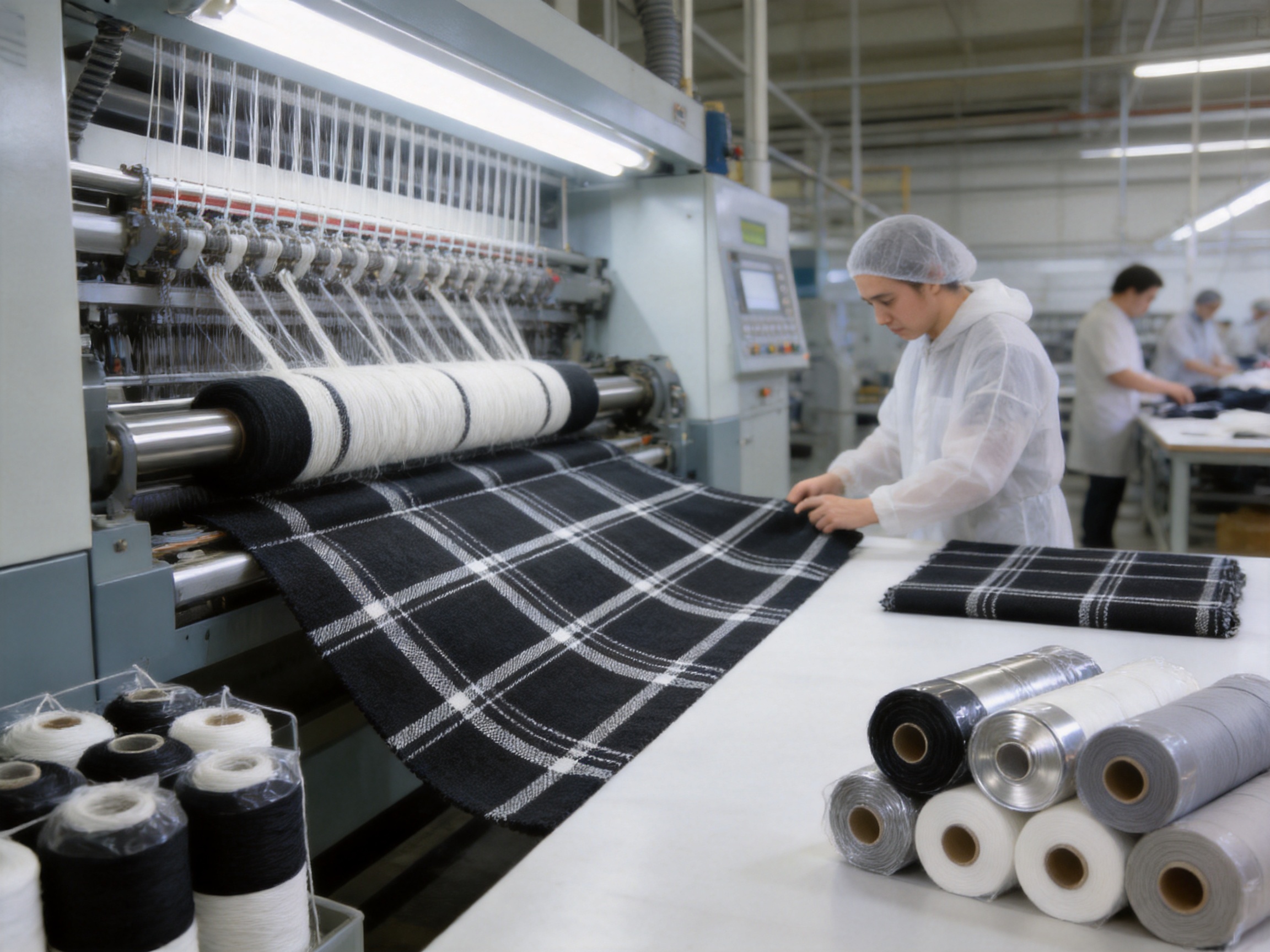
During jacquard knitting, the machine controls the arrangement of yarns and loops to produce the selected pattern. The technical team must monitor machine settings, yarn feed, needle condition, fabric take-up, and pattern registration. The objective is to create a grid that is visually accurate while maintaining an even and usable fabric structure.
Knitting parameters influence the final hand feel and dimensional behavior. A tighter construction may provide greater body and opacity, while a more open structure may improve lightness and flexibility. The appropriate setting depends on the intended end use. Garments, accessories, and home sewing items may require different balances of drape, thickness, and stability.
Regular inspection during knitting can identify broken yarns, dropped stitches, needle lines, oil marks, incorrect color placement, and pattern distortion. Early correction is more efficient than attempting to repair a problem after dyeing or finishing.
5.4 Dyeing and color management
Color management is particularly important for black and white fabric because the two shades must remain clean and distinct. Black should achieve the intended depth without unwanted gray or uneven areas, while white sections should remain clear and free from contamination. The dyeing method depends on the fiber composition and the product's construction.
Post-dyeing processes may include washing, neutralization, softening, drying, and other treatments designed to stabilize the fabric and achieve the required handle. The sequence must be controlled carefully because excessive heat, tension, or mechanical action can affect width, stretch, shrinkage, and pattern alignment.
5.5 Finishing
Finishing determines much of the fabric's final commercial character. It may be used to improve softness, control width, reduce residual shrinkage, stabilize the surface, or create a particular hand feel. A professional finishing process should support the original jacquard design rather than flattening or distorting it.
For knitted material, relaxation is often important. Fabric may change dimensions after knitting because internal tension remains in the loops. Allowing the fabric to relax under controlled conditions can improve measurement accuracy and reduce unexpected changes during garment production.
5.6 Inspection and packing
Final inspection should address both appearance and measurable performance. Inspectors may check pattern continuity, color uniformity, surface defects, width, weight, stretch, stains, holes, and roll presentation. Defects should be recorded according to an agreed quality standard.
Proper packing protects the fabric during storage and transportation. Rolls should be handled in a way that avoids crushing, contamination, moisture exposure, and unnecessary tension. Clear labeling can identify color, lot, width, composition, quantity, and production information, helping the customer manage inventory and cutting operations.
6. Integrated Manufacturing Strengths
Hangzhou Jinfeng Textile Co., Ltd. operates as an integrated textile enterprise covering research and development, production, processing, post-dyeing, finishing, and sales. This structure is valuable because fabric quality is influenced by the connection between each stage. When development and production are separated by too many independent parties, technical communication can become slower and corrective action more difficult.
The company is located in Jingjiang Street Industrial Park, Xiaoshan District, Hangzhou City, Zhejiang Province. It covers approximately 32.6 acres and has a plant area of about 18,000 square meters. This physical production base supports organized manufacturing, processing, storage, and management activities.
Its product scope includes blended fabrics such as polyester and spandex, DTY polyester yarn, polyester rayon fabric, knitted jacquard fabric, NTR knitted fabric, and NR knitted fabric. This combination gives the company experience across both yarn and fabric categories. Such knowledge can be useful when a customer needs a fabric that combines a specific visual design with particular elasticity, softness, durability, or yarn performance.
The company's production and processing capabilities also support communication about practical manufacturing concerns. These may include fabric construction, dyeing behavior, finishing requirements, cutting performance, and application suitability. A supplier that understands both yarn and fabric can often respond more effectively to questions about how a material will behave during garment production.
As a self-employed export company integrating research and development, production, and sales, the business serves customers in domestic and international markets. Export-oriented experience can help with order communication, documentation, packaging expectations, production scheduling, and customer service. Buyers should still establish detailed specifications, inspection standards, delivery terms, and approval procedures for every order.
7. Apparel Applications
7.1 Dresses and skirts
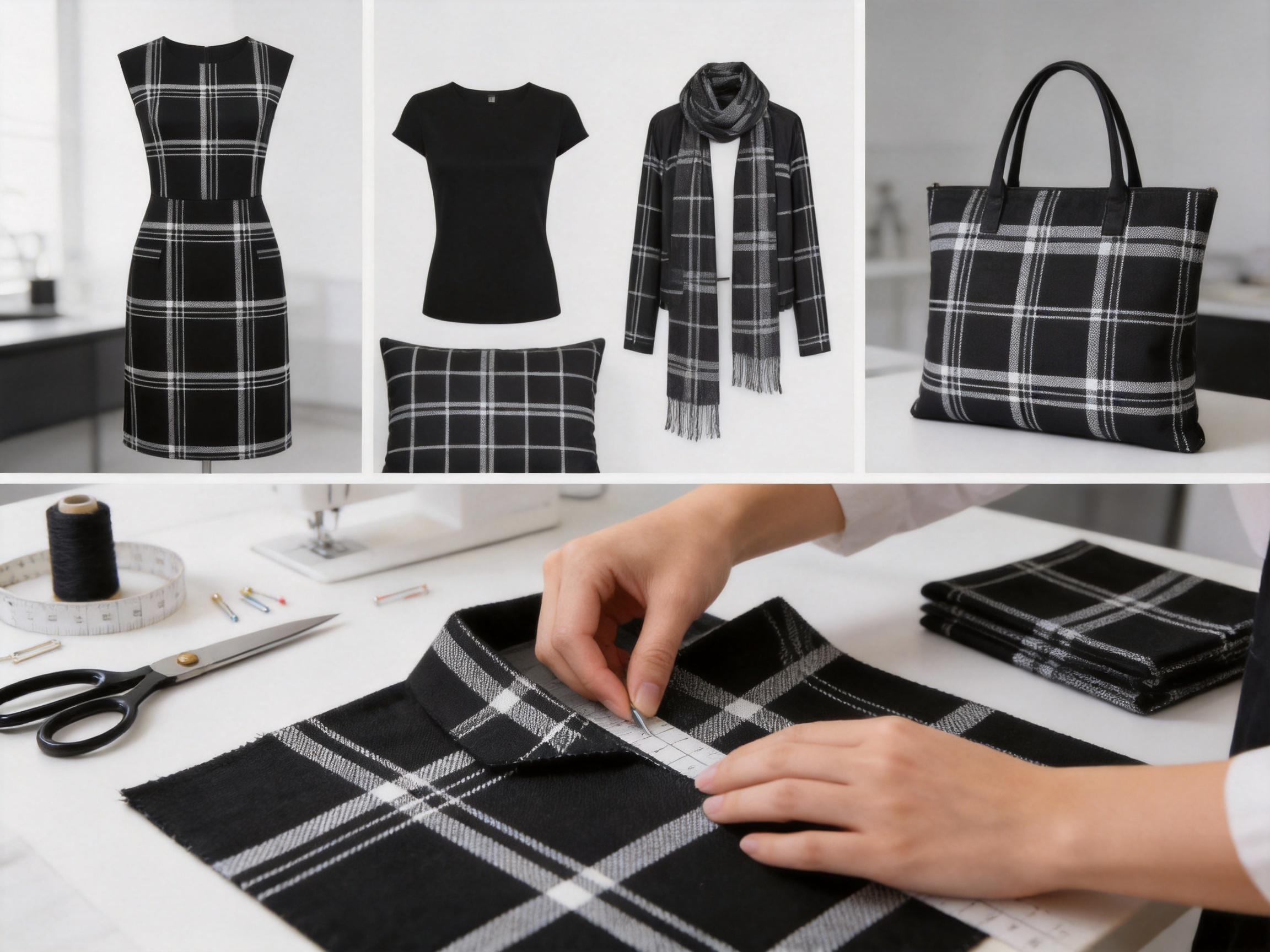
Black and white grid fabric can give dresses and skirts a clear geometric character. A simple silhouette allows the fabric to remain the visual focus, while a more tailored style can emphasize the regularity of the pattern. Depending on weight and stretch, it may be considered for casual dresses, fitted dresses, A-line skirts, pleated designs, or panel constructions.
When cutting a garment with a visible grid, pattern matching should be planned before production. The manufacturer should account for the repeat direction, seam allowance, and placement of the most prominent lines. Matching is particularly important at center fronts, side seams, pockets, collars, and waistbands.
7.2 Tops and blouses
Knitted jacquard can provide visual interest for tops without requiring complex surface decoration. It may be used for long-sleeved tops, short-sleeved shirts, relaxed pullovers, and structured blouses. If the material includes stretch, it may offer improved comfort in close-fitting designs.
Designers should assess whether the fabric is sufficiently opaque for the intended garment and whether the grid scale complements the size and shape of the wearer. A small repeat can create a subtle texture, while a large repeat may require more careful placement around the bust, shoulders, and sleeves.
7.3 Jackets, cardigans, and lightweight outer layers
A denser jacquard construction may be appropriate for cardigans, fashion jackets, vests, and lightweight outer layers. The fabric can add structure without the need for a separate printed treatment. Lining, interfacing, and seam finishing should be selected after evaluating the fabric's thickness, stretch, and tendency to curl.
7.4 Accessories
Smaller fabric pieces can be used for scarves, headbands, bags, belts, decorative collars, cuffs, and other accessories. Accessories provide an opportunity to showcase the grid pattern in a concentrated form. They can also use leftover fabric from garment production, improving material utilization.
8. Home-Based Sewing and Interior Uses
Jacquard fabric is not limited to industrial garment manufacturing. Its range of colors, textures, and patterns makes it suitable for many home-based sewing projects. The black and white grid can complement contemporary, minimalist, monochrome, and graphic interior styles.
Possible home projects include cushion covers, decorative panels, table accents, storage baskets, placemats, fabric organizers, and selected lightweight furnishing items. The specific suitability depends on the fabric's weight, abrasion resistance, stretch, and care instructions. Not every apparel-weight knitted jacquard should be used for heavy upholstery or high-contact furniture.
Home sewers should pretest the material before beginning a major project. A small piece can reveal whether the fabric curls at the edges, stretches during cutting, frays, changes dimensions after washing, or requires a particular needle and stitch setting. A test seam can also show whether the grid remains aligned after stitching.
Because the grid is directional and repetitive, cutting layout is important. Marking the grain or primary direction, matching repeats, and placing pattern pieces carefully can improve the finished appearance. A rotary cutter, sharp fabric scissors, suitable pins or clips, and a stable cutting surface may help reduce distortion.
9. Cutting, Sewing, and Care Recommendations
Before cutting, the fabric should be inspected for width, visible defects, pattern direction, and relaxation. If washing or steam treatment is part of the intended care routine, pre-treatment should be considered before cutting. The customer should follow the supplier's confirmed care recommendation because fiber blends and finishing treatments can behave differently.
For sewing, the needle type and thread should correspond to the fabric construction. A ballpoint or stretch-compatible needle may be appropriate for some knitted structures, while a standard needle may be suitable for others. Test stitching should be used to determine whether the seam remains flexible and whether skipped stitches occur.
Seam allowance should reflect the fabric's stretch and thickness. A seam that is too narrow may be unstable, while an unnecessarily wide seam can add bulk. For stretch garments, the stitch or seam should accommodate movement without breaking. Overlocking, zigzag stitching, cover stitching, or other methods may be considered according to the design and equipment available.
Pressing should be performed with care. Excessive heat or pressure can alter the texture, flatten surface relief, or create shine. A pressing cloth and a test area may help protect the fabric. The grid should not be dragged out of alignment during pressing or handling.
Care instructions should be determined by the actual fiber composition and finishing treatment. Possible considerations include gentle washing, controlled water temperature, low mechanical agitation, avoidance of chlorine bleach, careful drying, and low-temperature pressing. Buyers should not publish care labels until the finished fabric has been tested under the intended conditions.
10. Quality and Sustainability Considerations
Responsible textile purchasing involves more than visual inspection. Buyers increasingly evaluate product life, material efficiency, production consistency, chemical management, packaging, and supplier transparency. A durable fabric that retains its appearance can support longer garment use and reduce the frequency of replacement.
Integrated production may help reduce unnecessary transportation between multiple stages, although the actual environmental impact depends on energy sources, water management, chemicals, waste treatment, and logistics. Customers with specific sustainability requirements should request relevant information and certifications where applicable.
Material efficiency is also important. A well-planned grid repeat can reduce cutting waste when pattern pieces are arranged thoughtfully. However, strict pattern matching may increase consumption. The balance between visual continuity and material utilization should be considered during product development.
Quality control supports sustainability by reducing rejected rolls, remakes, and unnecessary disposal. Consistent yarn preparation, knitting, dyeing, and finishing can improve first-pass yield and make production planning more efficient. Customers can contribute by providing clear specifications, approving laboratory dips or samples promptly, and using realistic tolerance standards.
11. Selecting the Right Specification
The best jacquard black and white grid fabric is not simply the one with the most attractive pattern. It is the fabric whose structure, weight, stretch, hand feel, and care performance match the intended product. Buyers should begin by defining the end use and then identify the technical properties needed for that application.
For fitted apparel, stretch and recovery may be more important than heavy weight. For a jacket or structured skirt, body and dimensional stability may have greater importance. For home sewing, ease of cutting, seam behavior, and washing performance may influence the decision. For accessories, surface appearance and abrasion resistance may receive greater attention.
Color approval should be based on a physical sample under suitable lighting. Digital screens cannot always reproduce black depth, white clarity, surface texture, or contrast accurately. Where production involves multiple lots, the customer should agree on acceptable color variation and pattern alignment tolerance in advance.
Buyers should also ask about minimum order quantities, available development samples, production lead times, packing methods, inspection procedures, and technical documents. Clear communication at the beginning of an order helps protect both the supplier and the customer from avoidable disputes.
12. Why Work with an Experienced Textile Manufacturer?
An experienced textile manufacturer contributes more than production capacity. It contributes knowledge about how yarn, knitting, dyeing, finishing, and end use interact. This knowledge is especially important for patterned knitted fabrics, where visual defects can be obvious and where dimensional behavior affects garment construction.
Hangzhou Jinfeng Textile Co., Ltd. emphasizes cooperation, mutual benefit, and service to customers at home and abroad. Its integrated business model allows customers to discuss fabric needs with a supplier involved in research and development, manufacturing, post-dyeing, finishing, and sales. This can create a more direct communication path from concept to finished product.
The company's location and production base in Hangzhou provide a foundation for handling fabric and yarn orders, while its range of polyester, rayon, spandex, and DTY-related products supports varied customer requirements. Customers seeking a black and white grid fabric can discuss whether a particular composition, knitted construction, or finishing method is best suited to their target market.
A strong supplier relationship should include transparent communication, sample approval, measurable quality standards, responsive problem solving, and realistic delivery planning. These factors are as important as the initial appearance of the material because they determine whether the product can be reproduced reliably at commercial scale.
13. Frequently Asked Questions
Q1: What is jacquard black and white grid fabric?
It is a knitted fabric featuring a black and white grid or check pattern formed through the arrangement of yarns and loops during jacquard knitting. The pattern is integrated into the fabric structure rather than applied only as a surface print.
Q2: Is the fabric suitable for clothing?
Yes. Its most common potential applications include dresses, skirts, tops, blouses, cardigans, lightweight jackets, vests, and accessories. The final suitability depends on the specific composition, weight, stretch, opacity, and finishing.
Q3: How does jacquard fabric differ from printed fabric?
Printed fabric receives its design on the surface after the base material has been produced. Jacquard fabric creates the design through yarn and loop arrangement during knitting. This can provide greater visual depth and a more textured appearance, although each construction has its own performance advantages.
Q4: Does the fabric stretch?
Some knitted jacquard fabrics stretch because of their loop structure, and additional stretch may be available when spandex is included. The actual stretch and recovery must be confirmed through a product sample or technical test because they vary according to composition and construction.
Q5: Can the fabric be used for home sewing?
Yes. It may be used for garments, accessories, cushion covers, decorative panels, organizers, and other projects. The fabric should be tested first for shrinkage, edge behavior, seam performance, and care requirements.
Q6: Is the black and white pattern easy to match during cutting?
The pattern is visually clear, but matching may require careful planning. The buyer or garment maker should identify the repeat direction, align major seams, and allow enough material for matching at center fronts, side seams, pockets, and other prominent locations.
Q7: What fiber compositions are available?
Composition depends on the product specification. The manufacturer works with polyester, rayon, spandex, and related blended fabrics, as well as polyester draw textured yarn. Customers should request the exact composition for the selected jacquard fabric.
Q8: Can the fabric be customized?
Customization may be possible in areas such as pattern scale, composition, color arrangement, weight, width, stretch, and finishing. Feasibility depends on order volume, machinery, yarn availability, and technical requirements. A development sample should be approved before bulk production.
Q9: How should quality be evaluated?
Quality evaluation should include appearance, pattern clarity, color consistency, width, weight, stretch, recovery, shrinkage, pilling, colorfastness, surface defects, and seam behavior. The exact tests should reflect the intended end use.
Q10: What information should be included in an order inquiry?
An inquiry should state the intended application, desired composition, pattern preference, target weight, width, stretch requirement, estimated quantity, color standard, finishing expectations, packaging needs, delivery location, and any required testing or certification.
Q11: Can the fabric be used for heavy upholstery?
Not necessarily. The suitability of an apparel-weight knitted jacquard for upholstery depends on abrasion resistance, weight, construction, and performance testing. Customers should not use it for demanding furnishing applications without confirming the relevant technical properties.
Q12: What makes an integrated supplier valuable?
An integrated supplier can connect yarn selection, knitting, dyeing, finishing, quality control, and customer communication more efficiently. This may help improve consistency and speed up technical problem solving, especially for fabrics with complex patterns or blended compositions.
14. Conclusion
Jacquard black and white grid fabric offers a distinctive combination of geometric style, knitted comfort, structural texture, and application flexibility. Its pattern is integrated into the fabric through jacquard knitting, giving it a more dimensional and developed appearance than many ordinary printed alternatives. The neutral black and white palette supports broad coordination across apparel, accessories, and selected home sewing projects.
The fabric's commercial value depends on more than its appearance. Yarn selection, fiber composition, knitting accuracy, dyeing, finishing, relaxation, inspection, and packing all influence the result. Polyester, rayon, spandex, and draw textured yarn capabilities provide a foundation for developing different balances of softness, strength, elasticity, stability, and texture.
Hangzhou Jinfeng Textile Co., Ltd. brings together research and development, production and processing, post-dyeing, finishing, and sales in an integrated textile operation. Its manufacturing base in Xiaoshan District, Hangzhou, and its wider product range support customers looking for blended fabrics, knitted jacquard materials, and DTY polyester yarn solutions.
For buyers, the best approach is to begin with the final application, request a representative sample, confirm the technical specification, and establish measurable quality standards before bulk production. With appropriate product selection and controlled manufacturing, jacquard black and white grid fabric can become a reliable material for fashion collections, commercial garments, creative accessories, and carefully selected home-based sewing projects.
References
1. Company-provided product information for Jacquard Black and White Grid Fabric, including product category, application description, and image records.
2. Company-provided corporate information for Hangzhou Jinfeng Textile Co., Ltd., including production scope, facility information, location, and business philosophy.
3. Textile terminology reference materials concerning jacquard construction, knitted fabric structures, blended fibers, and draw textured yarn.
4. General textile quality-control principles covering fabric inspection, color consistency, dimensional stability, stretch recovery, pilling, and colorfastness.
5. General apparel manufacturing references concerning pattern matching, cutting efficiency, seam construction, pressing, laundering, and garment care.
