
Houndstooth Knitted Jacquard Fabric: Structure, Comfort, Design Value, and Manufacturing Excellence

Houndstooth knitted jacquard fabric combines a recognizable heritage pattern with the comfort, elasticity, and versatility of modern knitted textiles. Its repeating two-tone motif creates a strong visual identity, while the knitted construction gives the material a softer hand, greater flexibility, and improved wearability than many traditional woven patterned fabrics. This balance makes it suitable for fashion garments, accessories, interior decoration, and other applications that require both decorative impact and practical performance.
The fabric described in this article is produced with imported computerized jacquard knitting equipment. The manufacturing method allows the pattern to be formed directly within the fabric structure rather than simply printed onto its surface. As a result, the houndstooth design has a dimensional appearance, consistent definition, and a more integrated visual effect. The combination of advanced machinery, carefully selected blended yarns, controlled knitting, post-dyeing, finishing, and inspection helps create a fabric that can meet the needs of apparel brands, garment manufacturers, wholesalers, interior specialists, and international buyers.
With its classic houndstooth motif, soft touch, elastic comfort, customizable pattern scale, and adaptable thickness, this knitted jacquard fabric offers a practical alternative to conventional houndstooth materials. It can support both timeless collections and contemporary product development, allowing designers to use a familiar pattern in new silhouettes, color combinations, and end-use environments.
1. Understanding Houndstooth Knitted Jacquard Fabric
Houndstooth is one of the most recognizable geometric textile patterns. It is generally formed by repeated broken checks that resemble pointed teeth or abstract canine teeth. Traditional versions commonly use black and white, but modern textile design can reinterpret the pattern through muted neutrals, bright contrasts, tonal combinations, or mixed-color arrangements. The repeat may be large and dramatic or small and refined, depending on the intended product.
In a knitted jacquard construction, the motif is created through the selective arrangement of yarns during the knitting process. Computerized jacquard technology controls the placement of different colors or yarn paths to build the design directly into the textile. This produces a patterned surface with a distinctive three-dimensional impression. The pattern is not merely a flat image; it becomes part of the fabric structure.
Knitted construction also changes the way the fabric behaves. Unlike many rigid woven materials, knitted fabric is made from interconnected loops. These loops provide natural flexibility and allow the material to move with the body. Depending on the yarn composition, stitch structure, and finishing treatment, the fabric can provide stretch, recovery, drape, warmth, softness, and a comfortable fit.
The product is categorized as knitted jacquard fabric and can be developed in association with blended textile production, polyester-based yarns, spandex-containing constructions, and other performance-oriented textile materials. This manufacturing background is valuable because the final quality of a jacquard fabric depends not only on the knitting machine but also on yarn preparation, fiber selection, dyeing, finishing, and process control.
2. Main Product Features
2.1 Classic Houndstooth Pattern
The principal feature of this fabric is its classic houndstooth design. The pattern has a strong connection with tailoring, outerwear, formal clothing, and premium fashion. At the same time, its geometric structure makes it suitable for modern casualwear, accessories, and interior products. It can communicate sophistication without requiring additional printed graphics, embroidery, or complicated surface decoration.
The repeated motif also creates visual rhythm. On coats and jackets, it can emphasize the overall silhouette. On skirts, trousers, and dresses, it can add a structured appearance while retaining the comfort of knitted material. On bags and soft furnishings, the pattern can provide an immediate decorative focus. Because houndstooth is widely recognized, finished products can achieve a distinctive appearance even when the design uses a simple cut or uncomplicated construction.
2.2 Three-Dimensional Visual Effect
The jacquard knitting process gives the pattern a three-dimensional character. Differences in yarn arrangement, stitch formation, and surface height can create subtle depth between the contrasting areas. This effect makes the fabric appear richer and more tactile than a conventional printed houndstooth textile.
A dimensional surface is especially valuable for premium garments and interior products. It can catch light differently as the fabric moves, creating a changing visual impression. In fashion, this can help a relatively traditional motif appear more current. In interiors, the texture can make drapes, upholstery, rugs, or decorative panels feel more substantial and visually engaging.
2.3 Soft and Comfortable Hand
Comfort is an important advantage of knitted jacquard fabric. The looped structure generally provides a softer hand and more flexible movement than many tightly constructed woven alternatives. When suitable polyester, rayon, spandex, or other blended yarns are selected, the fabric can provide a pleasant surface touch while maintaining practical durability.
Softness is particularly important for garments that are worn directly against the body or used for extended periods. Dresses, skirts, trousers, lightweight coats, and fashion tops can benefit from a fabric that looks structured but does not feel unnecessarily stiff. A soft hand can also enhance the perceived value of the final product, supporting the needs of brands that position their collections around comfort and quality.
2.4 Elasticity and Ease of Movement
The fabric is described as having elasticity, which is one of the most useful properties of knitted construction. Stretch allows a garment to accommodate body movement and can improve wearing comfort. It may also help a finished item retain a smoother appearance during movement, provided that the fabric is properly designed and finished.
Elasticity is beneficial for fitted jackets, dresses, skirts, trousers, and fashion pieces that need to follow the body without becoming restrictive. It can reduce the need for excessive ease in garment patterns and may support more contemporary silhouettes. For manufacturers, a fabric with built-in flexibility can provide more design options while maintaining a recognizable structured appearance.
2.5 Customizable Pattern and Thickness
Pattern and thickness can be customized to suit the requirements of different applications. Pattern scale is an important design variable. A small houndstooth repeat can appear refined and subtle, making it appropriate for office clothing, shirts, accessories, or elegant dresses. A large repeat can create a bolder fashion statement for coats, jackets, statement skirts, or decorative interior products.
Thickness can also influence the final product. A lighter construction may be appropriate for dresses, tops, scarves, or transitional-season garments. A heavier construction may be better suited to coats, structured jackets, upholstery, rugs, or other products that require greater body and warmth. Customization enables buyers to select a construction that aligns with climate, use conditions, garment design, and target market positioning.
3. Why Knitted Jacquard Can Outperform Conventional Alternatives
Houndstooth fabric is available in many constructions, including woven, printed, embroidered, and bonded formats. Each has useful properties, but knitted jacquard offers a distinctive combination of pattern integration, comfort, flexibility, and design adaptability.
3.1 Integrated Pattern Construction
Because the design is created during knitting, the houndstooth pattern is integrated into the textile structure. This can provide a more authentic textile appearance than a surface print. The motif follows the fabric rather than appearing as an independent image placed on top of it.
An integrated pattern can also create a richer surface effect. The use of different yarn arrangements and stitch structures gives the textile depth and texture. This is a key advantage for products where tactile quality and visual refinement are important. The fabric can look finished and decorative without requiring extra printing or embellishment operations.
3.2 Better Comfort Than Many Rigid Woven Fabrics
Traditional houndstooth tailoring fabrics can provide a crisp appearance, but some may feel firm or restrictive, particularly when used in close-fitting garments. Knitted jacquard offers a softer and more flexible alternative. It can retain the visual authority of a classic tailored pattern while improving movement and everyday comfort.
This balance is valuable in current fashion markets, where consumers often expect garments to combine elegance with practicality. A jacket may need to look formal but feel comfortable during commuting. A dress may require a structured surface but still permit natural movement. A pair of trousers may benefit from pattern clarity without sacrificing ease. Knitted jacquard can support these requirements.
3.3 Stronger Design Versatility
Woven houndstooth is often associated with coats, suits, and formal tailoring. Knitted jacquard extends the pattern into a wider product range. Its elasticity and softer drape make it suitable for dresses, skirts, leggings, fitted pants, fashion tops, and other garments that are difficult to produce comfortably from rigid materials.
The same fabric concept can also be adapted for bags, cushions, drapes, roman blinds, rugs, and furniture upholstery. This cross-category potential helps manufacturers and designers develop coordinated collections. A fashion label might use the material for a coat and matching bag, while an interior brand could apply the design to curtains, chairs, and accent cushions.
3.4 Greater Opportunities for Custom Development
Computerized jacquard equipment supports the development of different pattern scales, color combinations, and fabric weights. Buyers do not need to limit themselves to one standard version of houndstooth. They can explore tonal designs, seasonal colors, enlarged repeats, miniature motifs, or alternative arrangements that preserve the identity of the pattern while creating a distinct product direction.
Customization is especially important for wholesalers and private-label manufacturers. It allows a buyer to differentiate a collection from competitors while maintaining the commercial advantages of a well-known pattern. A carefully selected color palette can transform houndstooth from a traditional black-and-white textile into a soft neutral, luxury, sportswear, or contemporary interior material.
4. Advanced Manufacturing Process
The performance and appearance of knitted jacquard fabric depend on a sequence of carefully managed manufacturing stages. Advanced equipment provides the technical foundation, but consistent results require coordination between yarn preparation, machine programming, knitting, dyeing, finishing, inspection, and packing.
4.1 Fiber and Yarn Selection
The production process begins with the selection of suitable yarns. Polyester is widely used in blended textile production because it offers strength, dimensional stability, color retention, and practical care performance. Rayon can contribute softness, fluidity, and a more natural hand. Spandex may be introduced when additional stretch and recovery are required.
The correct yarn combination depends on the desired fabric weight, surface feel, elasticity, drape, color effect, and end use. A coat fabric may require greater body and warmth, while a dress fabric may prioritize softness and movement. Interior applications may require a different balance of abrasion resistance, stability, and visual texture.
Drawn textured yarn, including DTY polyester yarn, can also play a role in developing flexible and textured fabric constructions. Textured yarns can improve bulk, softness, and surface character. Consistent yarn quality is essential because variations in yarn size, tension, color, or elasticity can affect pattern definition and fabric uniformity.
4.2 Computerized Jacquard Programming
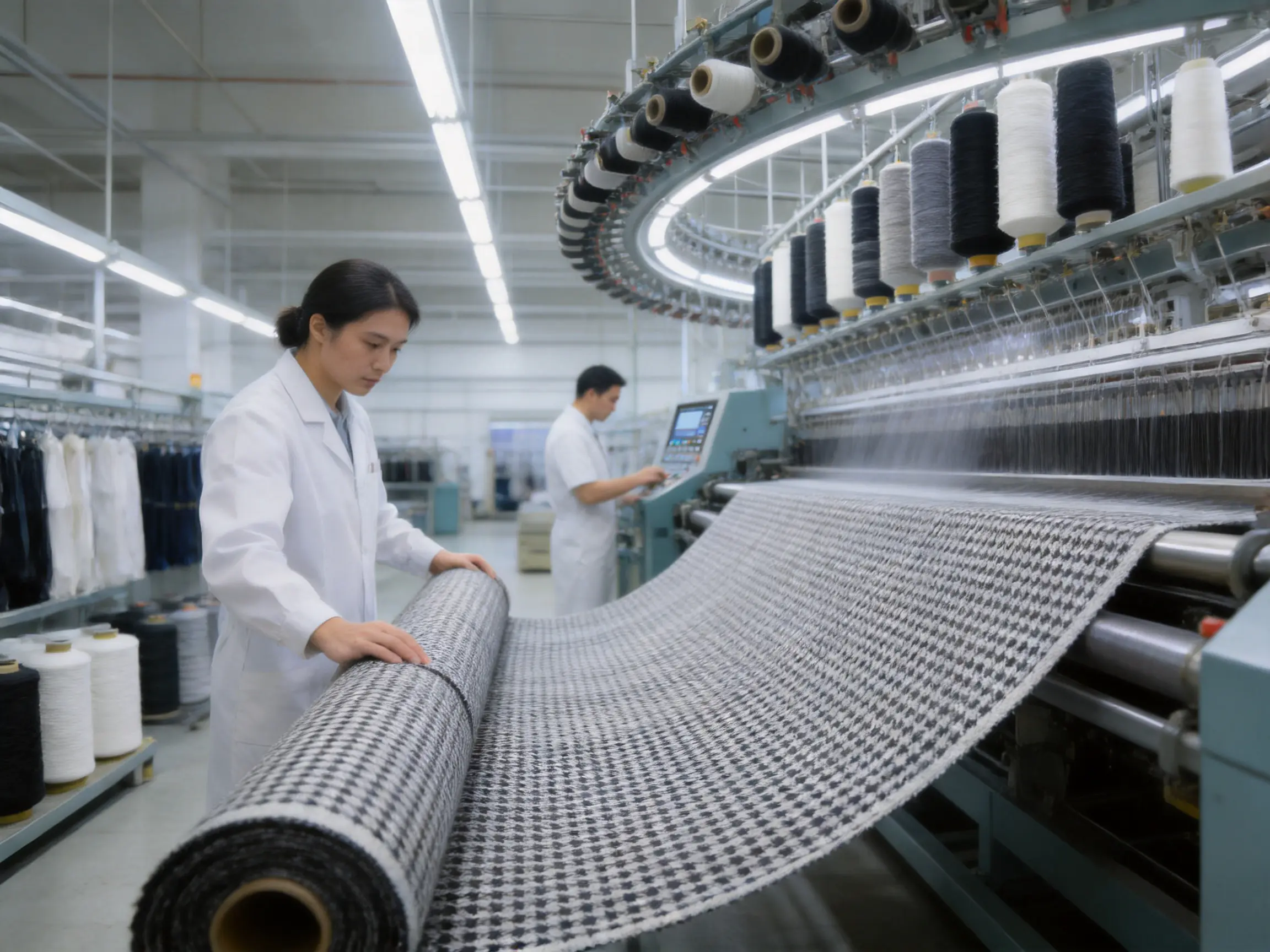
Imported computerized jacquard knitting machines are used to create the repeating houndstooth pattern. Before production begins, the design is translated into a machine-readable knitting program. The program controls the arrangement of yarns and stitches across the width and length of the fabric.
Computerized control provides a high level of repeat accuracy. It also makes it easier to adjust pattern scale, color placement, repeat length, and structural details. This is important when customers request customized versions. The production team can develop the pattern digitally, review the expected arrangement, and refine the parameters before committing to a full production run.
Machine programming also helps maintain consistency between batches. When the same technical parameters are stored and properly managed, the manufacturer can reproduce a design with a lower risk of manual variation. This supports the needs of apparel manufacturers and international buyers who require stable quality across repeated orders.
4.3 Knitting and Pattern Formation
During knitting, the machine forms interlocking loops while controlling the placement of the pattern yarns. The houndstooth motif emerges through the relationship between the contrasting areas. The technical settings influence stitch density, surface height, flexibility, thickness, and pattern clarity.
Careful control of yarn tension is particularly important. Excessive or uneven tension can distort the repeat, create irregular edges, or affect the fabric width. Insufficient control can lead to loose areas, unwanted openings, or inconsistent surface appearance. Advanced equipment and trained operators help maintain stable conditions throughout production.
Knitting speed, take-down tension, needle condition, and machine cleanliness can also affect quality. Preventive maintenance is therefore an essential part of manufacturing strength. A well-maintained machine is more likely to produce a clean surface, consistent repeat, and stable fabric structure.
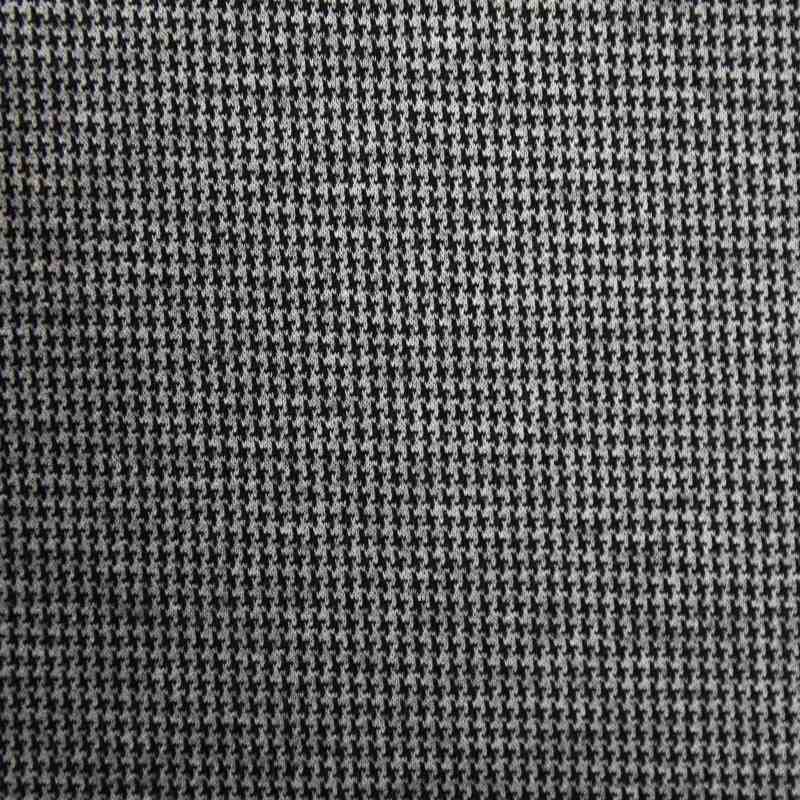
Houndstooth Design Jacquard Fabric
4.4 Dyeing and Color Management
After knitting, the fabric may undergo dyeing or other color treatment according to the product specification. Color management is especially important for houndstooth because the contrast between pattern areas defines the visual impact of the design. Even a small difference in shade can change the appearance of the repeat.
Color approval should consider the intended lighting environment, garment application, and customer requirements. Neutral black-and-white houndstooth may require strong contrast, while tonal versions depend on subtle differences between related shades. For fashion collections, the fabric may be matched to seasonal color standards or coordinated with other materials.
Stable dyeing conditions help support color uniformity from one roll to another. The manufacturer must consider dye compatibility, fiber composition, temperature, treatment time, and finishing requirements. Proper process control reduces the risk of uneven shade, color migration, or differences between production lots.
4.5 Finishing and Fabric Stabilization
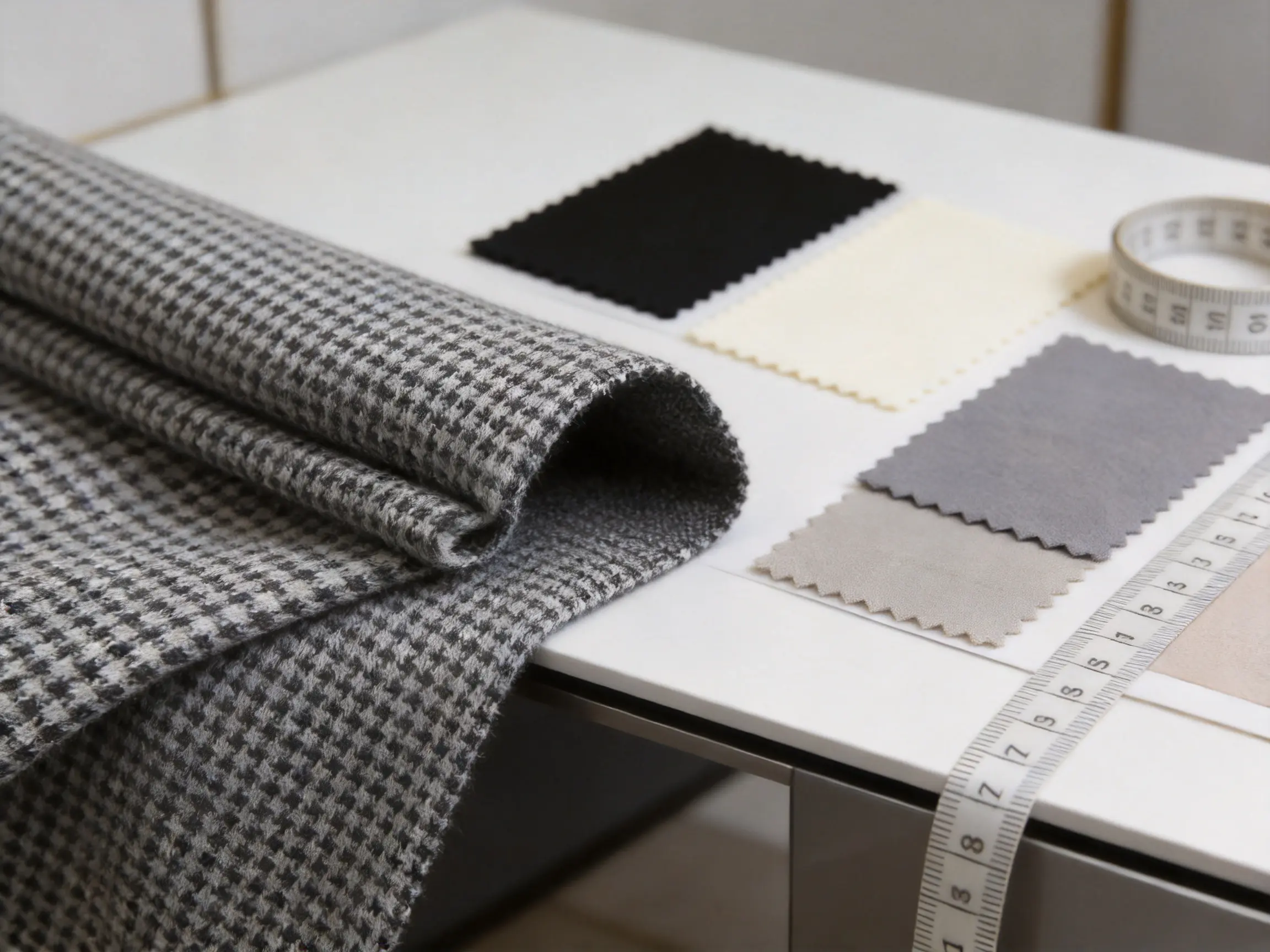
Finishing gives the knitted fabric its final hand, appearance, width, weight, and dimensional behavior. Depending on the specification, finishing may include washing, drying, heat setting, softening, compacting, brushing, or other treatments. The appropriate process depends on the fiber blend and intended application.
Heat setting can help stabilize fabrics containing synthetic fibers and improve dimensional consistency. Softening can enhance touch and drape. Compacting may help control shrinkage and improve surface uniformity. Finishing must be carefully balanced because excessive treatment can reduce elasticity, flatten the texture, or alter the visual definition of the houndstooth design.
For fabric intended for garment manufacturing, dimensional stability is an important consideration. Buyers need the material to behave predictably during cutting, sewing, pressing, and laundering. A stable finished fabric can reduce production difficulties and help finished garments retain their intended proportions.
4.6 Inspection and Quality Control
Inspection is carried out to identify problems such as holes, broken yarns, uneven pattern repeats, stains, color variation, width inconsistency, excessive distortion, or abnormal stretch. Quality control may be performed during knitting, after dyeing, during finishing, and before shipment.
Pattern clarity is a central quality factor. The points and broken checks of houndstooth should be sufficiently defined to create the intended visual effect. The repeat should remain consistent across the fabric width and length. Surface defects can be particularly visible in geometric designs, so careful inspection adds significant value.
Quality control may also evaluate weight, width, stretch, recovery, color fastness, pilling resistance, shrinkage, and hand feel. The exact testing program should be adapted to the final application. A fabric for upholstery may require more emphasis on abrasion performance, while a fabric for dresses may prioritize softness, drape, and comfort.
5. Manufacturing Strengths and Production Capability
The manufacturer behind this product operates an integrated textile business covering production, processing, post-dyeing, finishing, sales, and research and development. This integrated structure is a significant advantage because it allows multiple stages of the fabric journey to be coordinated within one business system.
The company operates in an industrial park in Xiaoshan District, Hangzhou, Zhejiang Province. Its stated facilities cover approximately 32.6 acres, with a plant area of about 18,000 square meters. This scale provides a substantial production base for blended fabric and DTY polyester yarn activities. It also supports the organization of specialized areas for manufacturing, processing, finishing, storage, and quality management.
Production integration can shorten communication paths between departments. When a customer requests a change to pattern, thickness, yarn composition, color, or finish, the technical and commercial teams can coordinate more efficiently. This is valuable for customized orders, where small adjustments may affect several stages of production.
The company also produces, processes, and sells DTY polyester yarn. This capability is relevant to knitted fabric development because yarn quality directly affects fabric quality. In-house experience with textured yarn and blended materials can help the production team understand how yarn characteristics influence softness, bulk, elasticity, surface appearance, and knitting performance.
Research and development further strengthens the product offering. Houndstooth is a classic motif, but the material can be continuously updated through new yarn combinations, alternative colorways, modified thickness, different pattern scales, and new finishing effects. Development capability allows the manufacturer to respond to changes in fashion, interior design, and customer specifications.
The company also identifies itself as a self-operated export enterprise. Experience with international sales can help support overseas customers in areas such as product communication, sample development, order coordination, packaging, documentation, and shipment planning. For international buyers, dependable communication is often as important as the fabric itself.
6. Technical Advantages for Apparel Manufacturers
For apparel manufacturers, the most important advantage of this material is its ability to combine a decorative surface with wearable comfort. The fabric can make a garment visually distinctive without requiring complicated design details. A relatively simple pattern can achieve a premium effect because the houndstooth motif and jacquard texture provide built-in character.
The elastic knitted structure can also simplify fit development. It may accommodate moderate variations in body movement and support comfortable silhouettes. This does not eliminate the need for accurate pattern making, but it can give designers more flexibility when creating fitted garments or garments with shaped panels.
Pattern placement should be considered during cutting. Because houndstooth is a directional and repeating design, garment panels may need to be aligned carefully. The manufacturer can provide technical information about repeat size, width, stretch direction, and fabric behavior to help buyers plan cutting layouts and reduce material waste.
The fabric can support multiple garment categories, including coats, pants, suits, dresses, skirts, jackets, and fashion accessories. A single material platform can therefore be used across a collection. Designers may choose a heavier version for outerwear and a lighter version for dresses or skirts while maintaining a consistent pattern identity.
It is also suitable for coordinated products. A brand can create a houndstooth coat with a matching skirt, bag, scarf, or belt. This increases merchandising possibilities and allows the same visual language to appear across several product groups.
7. Applications in Fashion and Apparel
7.1 Coats and Jackets
Houndstooth is historically associated with outerwear, and knitted jacquard provides a softer interpretation of the classic coat fabric. A medium or heavy construction can give a coat sufficient body while retaining flexibility. The three-dimensional pattern can make a simple coat silhouette appear more luxurious and detailed.
For jackets, the fabric can be used in tailored, cropped, oversized, or relaxed designs. Its elasticity may improve comfort around the shoulders, arms, and waist. Designers can combine it with solid-color knitted panels, leather details, smooth lining, or contrasting trims.
7.2 Pants and Trousers
Houndstooth trousers can make a strong fashion statement, particularly when the pattern is balanced with a simple cut. Knitted elasticity is helpful for fitted trousers, tapered pants, pull-on styles, and contemporary tailoring. A softer construction can reduce the stiffness sometimes associated with patterned suiting materials.
Pattern scale should be selected carefully for trousers. Small repeats can create a refined and slimming visual effect, while large repeats can emphasize the shape and become the main feature of the outfit. Buyers may also consider the recovery performance of the fabric when selecting a construction for close-fitting trousers.
7.3 Dresses and Skirts
In dresses and skirts, houndstooth jacquard can deliver a combination of pattern, structure, and comfort. The fabric may be used for fitted dresses, straight skirts, pleated designs, A-line silhouettes, or layered fashion pieces. Its flexibility can support movement, while its texture can provide enough visual substance for a polished appearance.
Designers can use panel placement to create contrast or direction. For example, a garment may combine horizontal and vertical pattern orientations, although the effect should be tested carefully to preserve a balanced appearance. Solid inserts can also be used to frame the jacquard sections.
7.4 Suits and Coordinated Sets
Knitted jacquard can offer a more comfortable alternative to certain traditional suit materials. It may be used for coordinated jackets and trousers, skirt suits, or modern matching sets. The houndstooth design communicates formality, while the knitted structure supports easier movement.
For professional apparel, subdued color combinations and smaller pattern repeats may be preferred. For fashion-led collections, larger repeats and bold color contrasts can create a more expressive result. The ability to customize pattern and thickness allows manufacturers to address both segments.
7.5 Accessories
Bags, scarves, hats, gloves, and decorative footwear panels can all benefit from the strong identity of houndstooth. Accessories often require a fabric with a clear surface design because the available product area is limited. A recognizable jacquard motif can make a small accessory immediately visible.
When used for bags or structured accessories, the fabric may be laminated, backed, or combined with a supporting material. The suitability of such treatments should be tested to ensure that the jacquard surface remains attractive and that the final product achieves the required stability.
8. Applications in Interiors
Houndstooth is not limited to fashion. Its geometric structure translates effectively into interior design, where it can add rhythm, contrast, and a tailored appearance. The fabric can be considered for drapes, roman blinds, rugs, cushions, upholstered furniture, decorative panels, and other soft furnishings.
8.1 Drapes and Roman Blinds
In window treatments, houndstooth can become a strong decorative element. A smaller repeat may create a subtle textile background, while a larger repeat can make the window a focal point. The final result will depend on fabric weight, lining, light conditions, and the desired level of drape.
For roman blinds, pattern alignment is especially important. The repeat should be considered in relation to the folded sections so that the design remains visually organized when the blind is raised or lowered. Custom pattern scale and fabric width can help interior specialists plan more effectively.
8.2 Rugs and Decorative Textiles
The geometric repeat of houndstooth can work well in rugs and floor coverings. It can introduce contrast without relying on complex imagery. However, the material specification for rugs should be selected according to traffic level, abrasion requirements, backing method, and cleaning conditions.
Decorative cushions and throws offer a lower-risk way to introduce houndstooth into an interior. A single accent cushion can add pattern to a neutral room, while a coordinated group can create a more deliberate design theme. The fabric can also be paired with solid-color textiles to prevent excessive visual repetition.
8.3 Furniture Upholstery
Houndstooth upholstery can give chairs, benches, ottomans, and selected sofa panels a tailored appearance. The pattern can evoke classic interiors while remaining suitable for contemporary spaces. For upholstery, buyers should review abrasion resistance, seam behavior, pilling, color fastness, and cleaning requirements before approving a final specification.
Using the pattern on accent furniture rather than every upholstered surface can create a balanced result. It allows the fabric to serve as a focal point and demonstrates the value of its three-dimensional texture without overwhelming the room.
9. Product Selection and Customization Considerations
When selecting this knitted jacquard fabric, buyers should begin by defining the final application. The requirements for a coat, dress, upholstery panel, or curtain are not identical. The intended use will influence the preferred thickness, weight, stretch, hand feel, finishing method, color, and performance testing.
Pattern scale is another major consideration. Small houndstooth repeats can be easier to use in narrow garment panels and accessories. Large repeats may require wider fabric layouts and more careful matching at seams. Buyers should request sample lengths that are large enough to evaluate the complete repeat rather than relying only on a small swatch.
Color contrast should be assessed under the lighting conditions where the finished product will be displayed or worn. Strong contrast can create a dramatic effect, while low contrast can produce a more sophisticated and understated appearance. Custom color development may be appropriate when the fabric needs to coordinate with a specific seasonal collection or interior palette.
Stretch and recovery should be considered together. A fabric may stretch significantly but recover less effectively, or it may provide controlled stretch with better shape retention. The appropriate balance depends on the garment design and expected wearing conditions. Testing should include both lengthwise and widthwise behavior where relevant.
Buyers should also evaluate shrinkage and dimensional stability before bulk production. Pre-production testing can help determine whether the fabric requires special cutting, washing, pressing, or garment-care instructions. Clear technical communication reduces the risk of problems after manufacturing.
| Evaluation Area | Why It Matters | Recommended Buyer Consideration |
|---|---|---|
| Pattern scale | Influences visual impact, cutting layout, and seam matching | Choose a repeat suitable for the product size and design direction |
| Fabric thickness | Affects warmth, body, drape, and structural appearance | Select a lighter, medium, or heavier construction according to end use |
| Stretch and recovery | Influences comfort, fit, and shape retention | Test movement and recovery in both relevant directions |
| Hand feel | Contributes to comfort and perceived quality | Approve samples after considering contact with skin and intended use |
| Color contrast | Defines the visibility and character of the houndstooth motif | Review under relevant lighting and compare with collection standards |
| Dimensional stability | Supports accurate cutting and finished-product consistency | Check shrinkage, width stability, and behavior after care testing |
| Surface durability | Determines suitability for frequent wear or interior use | Consider pilling, abrasion, snagging, and cleaning conditions |
| Finishing requirements | Influences softness, drape, texture, and appearance | Confirm the required finish before bulk production |
10. Sustainability and Resource Efficiency Considerations
Textile sustainability depends on many factors, including fiber selection, production efficiency, product life, care requirements, waste management, and end-of-life options. A durable fabric that remains attractive and functional for a long period can reduce the need for frequent replacement. The classic nature of houndstooth may support long-term use because the design is not limited to a single short-lived trend.
Computerized knitting can also support efficient design development. Digital pattern programming allows manufacturers to review and adjust a design before production, which may reduce trial-and-error waste. Accurate control of pattern repeats can help minimize defects and improve material utilization.
Blended fabrics require careful consideration because different fibers may have different recycling characteristics. Buyers should evaluate the intended product life, care instructions, and available recovery systems when choosing polyester, rayon, spandex, or other combinations. Responsible sourcing and clear product information can help brands make more informed decisions.
Production efficiency can be improved through coordinated processes, preventive equipment maintenance, accurate dyeing control, and effective inspection. These measures may reduce reprocessing, rejected goods, and unnecessary resource consumption. The integrated manufacturing model of the supplier provides a basis for managing these factors across several stages.
11. Packaging, Export, and Customer Cooperation
For international customers, product quality must be supported by dependable order coordination. Fabric width, roll length, packaging method, labeling, color references, inspection requirements, and delivery schedules should be clarified before production begins. Clear specifications reduce misunderstandings and help both parties manage expectations.
Sample approval is an important part of cooperation. A customer should review the pattern, color, hand feel, thickness, stretch, and finish before confirming bulk production. If the fabric is intended for a specific garment or interior product, a prototype or trial sample can provide additional information about sewing, drape, cutting, and appearance.
Technical communication should also address the direction of the pattern, usable width, repeat size, and any limitations related to matching. This information can help the buyer plan production more accurately and reduce waste during cutting.
As an export-oriented textile enterprise, the supplier is positioned to work with customers in domestic and overseas markets. Its cooperation principle emphasizes service, mutual benefit, and long-term business relationships. These values are particularly relevant when developing customized textiles, where communication continues from initial inquiry through sampling, bulk manufacturing, inspection, and repeat ordering.
12. How the Fabric Creates Competitive Product Value
The competitive value of houndstooth knitted jacquard fabric comes from the combination of recognizable design and practical textile performance. A printed fabric may reproduce the motif, but knitted jacquard adds structure and texture. A rigid woven fabric may provide tailoring authority, but knitted construction can add softness and movement. A plain knitted fabric may be comfortable, but houndstooth jacquard provides stronger visual identity.
This combination allows brands to create products that are visually distinctive without becoming impractical. The fabric can support a premium appearance while remaining suitable for modern lifestyles. Consumers can enjoy the heritage character of houndstooth together with the comfort expected from contemporary knitwear.
Customization further increases competitive value. Manufacturers can develop a material that is close to a customer’s precise requirements rather than forcing the customer to select from a narrow standard range. Adjustments to pattern scale, thickness, color, yarn blend, and finishing can create a differentiated product with a clear market position.
The supplier’s integrated capabilities also provide a competitive advantage. Experience with DTY polyester yarn, blended fabric production, post-dyeing, finishing, and export service creates a more complete development platform. Customers can communicate with one manufacturing partner across several related textile requirements, which may improve efficiency and consistency.
13. Recommended Development Workflow
13.1 Define the End Use
Begin by identifying whether the fabric will be used for coats, pants, suits, dresses, accessories, drapes, blinds, rugs, or upholstery. Define the expected level of wear, desired appearance, climate, care conditions, and target price range.
13.2 Select the Visual Direction
Choose the houndstooth scale, color contrast, repeat orientation, and overall visual character. Decide whether the design should appear traditional, understated, bold, luxurious, casual, or contemporary.
13.3 Confirm the Technical Specification
Discuss fiber composition, yarn type, fabric width, thickness, weight, stretch, recovery, surface hand, and finishing. If the product requires specific tests, identify them before sampling.
13.4 Review Samples
Evaluate the sample in natural and artificial light. Touch the fabric, stretch it in relevant directions, examine the pattern repeat, and consider how it behaves when folded, draped, stitched, or pressed.
13.5 Test in the Intended Product
Whenever possible, make a garment or interior prototype. This will reveal issues that may not be visible in a flat swatch, including seam matching, pattern alignment, drape, bulk, recovery, and compatibility with linings or support materials.
13.6 Approve Bulk Production
Once the sample is approved, confirm the color standard, technical specification, packaging, inspection method, and delivery requirements. Maintaining a reference sample can help compare future production lots and support consistency during repeat orders.
14. Frequently Asked Questions
Q1: What is houndstooth knitted jacquard fabric?
It is a knitted textile that forms a repeating houndstooth motif through a jacquard knitting process. The design becomes part of the fabric structure, creating a patterned and textured surface rather than a simple printed image.
Q2: Is this fabric suitable for clothing?
Yes. It can be used for coats, jackets, pants, suits, dresses, skirts, and other fashion products. Its soft hand and elasticity make it suitable for garments that require both a structured appearance and comfortable movement.
Q3: Can the pattern be customized?
Yes. The pattern scale, color combination, and thickness can be customized according to the customer’s requirements. Buyers should confirm the repeat size and technical details during the sampling stage.
Q4: What makes knitted jacquard different from printed houndstooth fabric?
Knitted jacquard forms the pattern within the fabric structure. This can create greater surface depth, texture, and visual integration. Printed fabric places the image on the surface and may have a flatter appearance.
Q5: Is the fabric stretchy?
The product is described as elastic, but the exact stretch and recovery depend on the yarn composition, stitch structure, thickness, and finishing process. Buyers should request technical test results or evaluate a sample for the intended application.
Q6: Can the fabric be used for interior products?
Yes. Potential interior applications include drapes, roman blinds, rugs, cushions, decorative panels, and furniture upholstery. The selected construction should be tested for abrasion, pilling, color fastness, cleaning, and other requirements specific to the project.
Q7: What types of yarn may be used in this fabric?
Depending on the specification, the construction may involve polyester, rayon, spandex, textured polyester yarn, or other blended yarns. The appropriate combination depends on the desired softness, stretch, durability, drape, thickness, and appearance.
Q8: Why is imported computerized jacquard equipment important?
Computerized jacquard machinery provides precise control over pattern placement, repeat size, stitch arrangement, and production consistency. It also supports customization and helps reproduce approved designs more accurately across production runs.
Q9: How should buyers choose the correct thickness?
The choice should be based on the final application. Lightweight fabric may be appropriate for dresses, skirts, scarves, and transitional garments. Medium or heavy constructions may be better for coats, jackets, upholstery, or products requiring greater body and warmth.
Q10: What should be checked before placing a bulk order?
Buyers should confirm pattern scale, color, usable width, weight, thickness, stretch, recovery, hand feel, shrinkage, dimensional stability, surface durability, finishing, packaging, and inspection requirements. A pre-production sample should be approved before bulk manufacturing.
Q11: Can the fabric be used for coordinated collections?
Yes. Different weights, colors, or pattern scales can be developed for coats, dresses, pants, bags, cushions, and other products. This allows a brand or interior supplier to create a unified collection based on the same houndstooth design language.
Q12: What is the advantage of working with an integrated textile supplier?
An integrated supplier can coordinate yarn production or sourcing, knitting, dyeing, finishing, quality control, and sales support. This may improve communication, simplify development, and help maintain consistency across different production stages.
15. Conclusion
Houndstooth knitted jacquard fabric offers a strong combination of timeless design and modern textile performance. Its classic motif provides immediate visual recognition, while computerized jacquard knitting creates a more dimensional, integrated, and tactile surface. The knitted construction adds softness, elasticity, flexibility, and comfort, making the material suitable for a wider range of products than many traditional houndstooth fabrics.
The fabric can be customized in pattern scale, thickness, color, and construction to support different fashion and interior requirements. It can be developed for coats, pants, suits, dresses, skirts, accessories, drapes, roman blinds, rugs, cushions, and furniture upholstery. Its versatility allows designers to use a familiar motif in both traditional and contemporary product directions.
Manufacturing strength is supported by imported computerized jacquard machinery, blended textile production, DTY polyester yarn capability, post-dyeing, finishing, inspection, research and development, and export experience. An integrated production system helps coordinate the technical details required to turn an approved design into a consistent commercial textile.
For buyers seeking a fabric that combines heritage appeal, comfortable knitted performance, customizable design, and professional manufacturing support, houndstooth knitted jacquard fabric is a practical and visually compelling choice. With accurate specification, careful sample approval, and application-specific testing, it can provide reliable value across fashion, accessories, and interior design markets.
References
1. Textile Institute, Textile Terms and Definitions, standard terminology for textile fibers, structures, and manufacturing processes.
2. Spencer, D. J., Knitting Technology: A Comprehensive Handbook and Practical Guide, technical principles of weft knitting and jacquard structures.
3. Kadolph, S. J., Textiles, fundamentals of fiber properties, yarn formation, fabric construction, dyeing, finishing, and care.
4. Sinclair, R., Textiles and Fashion: Materials, Design and Technology, discussion of textile materials, design development, and apparel applications.
5. Udale, J., Textiles and Fashion, overview of textile surfaces, pattern, structure, and product design applications.
6. Standard textile quality-control practices for fabric width, weight, dimensional stability, color fastness, stretch, recovery, pilling, and abrasion performance.
