
Floral-Patterned Knitted Jacquard for Elegant Dressmaking
Floral-patterned knitted jacquard fabric has become one of the most attractive materials for modern dressmaking because it combines visual refinement, tactile comfort, and practical performance in one textile. Unlike printed fabrics, where the design is applied only to the surface, jacquard patterns are created directly through the knitting structure. This gives the fabric depth, texture, and a more premium appearance while preserving the flexibility and softness expected from a high-quality knit. For brands producing women’s dresses, coordinated sets, refined children’s apparel, and lightweight fashion jackets, this type of fabric offers a strong balance between beauty and wearability.
The featured floral-patterned knitted jacquard is a medium-weight fabric made with 60% viscose, 35% nylon, and 5% spandex. With a weight of 240 g/m² and a width of 145 cm, it is designed to support elegant garment silhouettes without feeling heavy or stiff. The viscose component provides softness, fluid drape, and a subtle sheen. Nylon strengthens the fabric, supports dimensional stability, and enhances durability. Spandex adds controlled stretch, improving comfort and movement for daily wear. Together, these fibers create a fabric that looks decorative and sophisticated while remaining practical for commercial apparel production.
In today’s apparel market, consumers expect more than attractive patterns. They want clothing that feels pleasant against the skin, retains color after washing, resists distortion during wear, and supports comfortable movement. Fashion buyers and garment manufacturers also need stable supply, reliable quality, flexible minimum order quantities, efficient sampling, and clear support for export documentation. This knitted jacquard fabric responds to these requirements by combining refined design with a manufacturing system built around consistency, inspection, dyeing control, and customer-oriented service.
Hangzhou Jinfeng Textile Co., Ltd. supports this product with integrated textile capabilities that include research and development, production, processing, post-dyeing, finishing, and export sales. Located in Xiaoshan District, Hangzhou, the company operates within a manufacturing environment known for textile expertise and industrial supply-chain efficiency. Its experience in blended fabrics, polyester-related products, spandex fabrics, and DTY polyester yarn production gives it a broad technical foundation. This background is especially valuable for knitted jacquard development, where yarn selection, knitting parameters, dyeing behavior, finishing methods, and inspection standards must work together to produce a stable and commercially successful fabric.
A Fabric Designed for Decorative Depth and Everyday Comfort
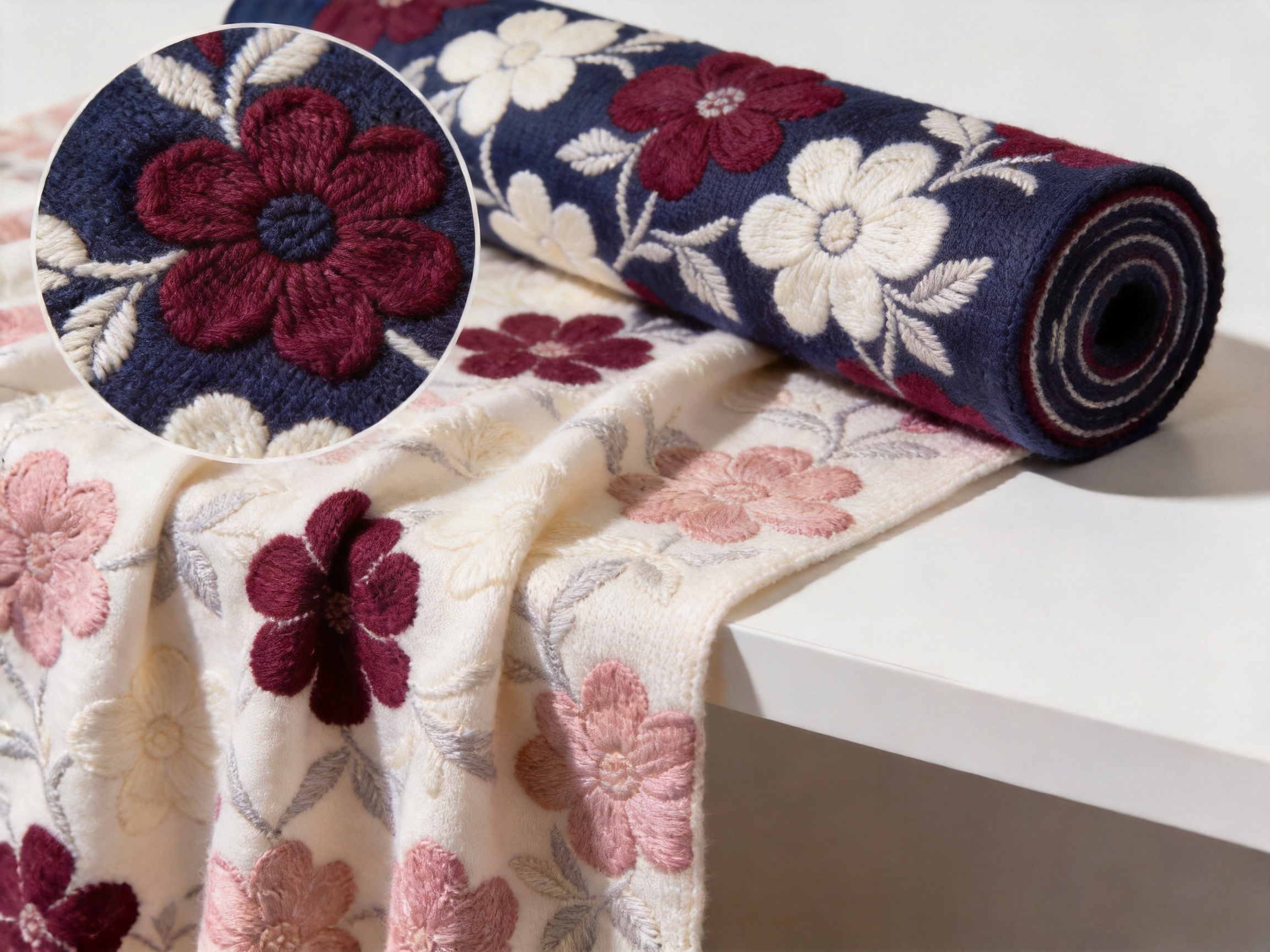
The defining feature of this fabric is its floral jacquard structure. Floral motifs have long been associated with elegance, femininity, and seasonal versatility. However, ordinary floral prints can sometimes appear flat, and embroidered fabrics may be expensive, heavy, or less comfortable for everyday garments. Knitted jacquard offers a practical alternative. It gives the impression of intricate detailing while maintaining the elasticity, soft hand, and drape of a knit. The result is a fabric that can create elevated apparel without sacrificing comfort.
Because the floral pattern is knitted into the fabric rather than printed on top, the design has natural structural dimension. The face side displays the pattern clearly, while the reverse side remains neat and controlled. This gives designers confidence when using the material for dresses, skirts, tops, and light jackets where interior finishing and garment movement matter. While the standard version is not reversible, the back side is clean enough to support quality garment construction. Double-sided jacquard options may also be produced upon request, offering additional possibilities for premium collections.
The fabric’s 240 g/m² medium weight is particularly suitable for dressmaking. Lightweight fabrics may lack structure and reveal too much of the body line, while overly heavy jacquards can reduce comfort and movement. This medium-weight specification provides enough substance for refined silhouettes while still allowing graceful drape. It works well for elegant day dresses, semi-formal office dresses, fit-and-flare styles, A-line shapes, coordinated skirt and top sets, and sophisticated children’s garments where softness and flexibility are important.
The 145 cm width supports efficient cutting and pattern layout in garment factories. Wider fabric can reduce material waste, improve marker efficiency, and support better cost control in bulk production. For brands that monitor fabric consumption closely, this width offers practical advantages. It helps manufacturers achieve attractive garments while maintaining production efficiency, which is especially important for competitive apparel lines and seasonal collections.
Fiber Composition and Performance Balance
The performance of any fabric begins with fiber composition. This floral knitted jacquard uses 60% viscose, 35% nylon, and 5% spandex, a blend designed to combine comfort, durability, and elasticity. Each fiber contributes a specific function, and the balance between them is central to the fabric’s appeal.
Viscose is valued for its soft touch, fluid drape, moisture absorbency, and elegant luster. In this fabric, the high viscose content gives the jacquard a natural, comfortable feel that is suitable for garments worn close to the skin. Viscose also supports graceful movement, allowing dresses to fall smoothly rather than appearing rigid. This is especially important for floral jacquard designs, because the beauty of the pattern is enhanced when the fabric moves naturally with the wearer.
Nylon improves the fabric’s strength and resilience. In knitted fabrics, dimensional stability and abrasion resistance are important, particularly for garments that will be worn repeatedly. Nylon helps the fabric maintain its integrity during sewing, wearing, and laundering. It also supports sharper pattern definition in the jacquard structure, contributing to a more refined surface appearance. Compared with viscose-only knits, the addition of nylon helps reduce fragility and supports longer garment life.
Spandex provides stretch and recovery. A 5% spandex content is enough to improve wearer comfort without making the fabric overly elastic or difficult to sew. Dresses made from this fabric can move with the body, making them more suitable for daily activities, travel, work environments, and social occasions. Stretch also helps improve garment fit across different body shapes, which is valuable for apparel brands seeking better customer satisfaction and fewer fit complaints.
This three-fiber blend is one of the reasons the fabric stands out from many competing decorative fabrics. Some jacquards look luxurious but feel stiff. Some printed knits are comfortable but lack dimensional elegance. Some embroidered fabrics are attractive but may be heavy, expensive, or difficult to care for. This product offers a balanced solution: visual richness, soft hand, stretch comfort, color performance, and commercial practicality.
Key Specifications and Application Overview
| Item | Specification | Commercial Benefit |
|---|---|---|
| Fabric Type | Floral-patterned knitted jacquard | Creates decorative depth without heavy embroidery |
| Composition | 60% viscose, 35% nylon, 5% spandex | Balances softness, strength, drape, and stretch |
| Weight | 240 g/m² | Medium weight suitable for dresses and structured knit apparel |
| Width | 145 cm / 57 inches | Supports efficient cutting and reduced production waste |
| Primary Features | Soft hand, excellent drape, vibrant color retention | Improves wearer comfort and garment presentation |
| Certification | OEKO-TEX Standard 100 | Supports skin-contact safety and buyer compliance requirements |
| Typical Applications | Dresses, skirt sets, lightweight jackets, children’s wear | Provides flexibility for multiple fashion categories |
| Sampling Support | Digital sampling for new designs within 7 days | Shortens product development timelines |
| Trial Order Support | Flexible MOQ from 500 meters for new design testing | Reduces launch risk for brands and importers |
Advantages Over Ordinary Printed Floral Fabrics
Printed floral fabrics are widely available and often cost-effective, but they do not always deliver the same sense of depth and luxury as knitted jacquard. In printed textiles, the floral image sits on the surface. Depending on the base fabric, the print can lose clarity when stretched, and repeated washing may gradually reduce vibrancy. In contrast, jacquard patterns are formed as part of the knitting process, giving the design a more integrated and dimensional appearance.
The floral motifs in this knitted jacquard appear more substantial than a flat print. The structure interacts with light and shadow, creating subtle texture and sophistication. This makes the fabric especially suitable for brands that want to position garments above basic printed apparel. A dress made from jacquard can appear more refined at retail, helping justify stronger visual merchandising and potentially higher perceived value.
Another advantage is stretch compatibility. Printed designs on stretch fabrics can sometimes distort when the garment is worn, particularly across areas of tension. Because the jacquard pattern is built into the knit structure, it is better integrated with the fabric’s movement. While all patterned stretch fabrics require careful design and cutting, knitted jacquard generally offers a more stable relationship between decoration and elasticity than surface print alone.
The fabric also supports a more premium hand feel. Printed fabrics often require surface treatments, pigments, or coatings that may affect softness. This jacquard relies on structural patterning and controlled dyeing, allowing the soft viscose-rich blend to remain central to the wearing experience. For customers who touch garments before purchasing, this softness can be a strong selling point.
Advantages Over Embroidered Fabrics
Embroidery can create beautiful effects, but it often introduces weight, stiffness, production complexity, and higher cost. Embroidered fabrics may also have thread ends, backing materials, or uneven surfaces on the reverse side, which can affect comfort and garment construction. This floral knitted jacquard offers a luxury-inspired alternative by creating decorative richness through knitting rather than added embroidery.
The jacquard construction keeps the fabric more flexible. Dresses made from embroidered fabric can sometimes feel formal but less comfortable for long wear. By contrast, this knitted jacquard remains soft, elastic, and fluid. It is suitable for elegant daywear, office fashion, travel-friendly apparel, and semi-formal designs that require both beauty and comfort.
From a manufacturing perspective, jacquard can also simplify garment production. There is no need to manage embroidery placement, thread breakage, added backing removal, or special seam handling around heavy embroidered areas. The design is continuous across the fabric, allowing garment factories to cut according to pattern requirements with greater efficiency. This can reduce production complexity and support faster order fulfillment.
The fabric also avoids the excessive weight that sometimes occurs with dense embroidery. At 240 g/m², it maintains an appropriate medium weight for dresses and coordinated sets. This makes it easier for designers to create garments that look refined but still feel wearable in everyday settings.
Advantages Over Basic Knitted Fabrics
Basic knitted fabrics are comfortable and versatile, but they may lack distinctive visual identity. In competitive fashion markets, plain knits often require additional design features such as printing, trims, pleats, or embellishments to stand out. Floral knitted jacquard provides built-in design value. The fabric itself becomes a key feature of the garment, reducing the need for excessive decoration.
This is particularly valuable for brands seeking efficient product development. A well-designed jacquard fabric can transform a simple dress silhouette into a premium-looking garment. Designers can use clean lines and minimal trims because the textile already delivers visual interest. This can simplify sampling, reduce accessory costs, and create a more cohesive finished product.
Compared with many basic knits, this product also provides a more refined balance of drape and structure. The medium weight allows it to hang beautifully while maintaining enough body for polished silhouettes. The floral pattern adds texture without making the fabric bulky. As a result, garments can feel comfortable while still looking dressed and intentional.
The blend of viscose, nylon, and spandex also gives it broader appeal than many simple single-fiber knits. It offers softness, strength, stretch, and color retention in one fabric. For buyers comparing options, this combination can reduce the need to choose between comfort and durability.
Manufacturing Strength Behind the Fabric
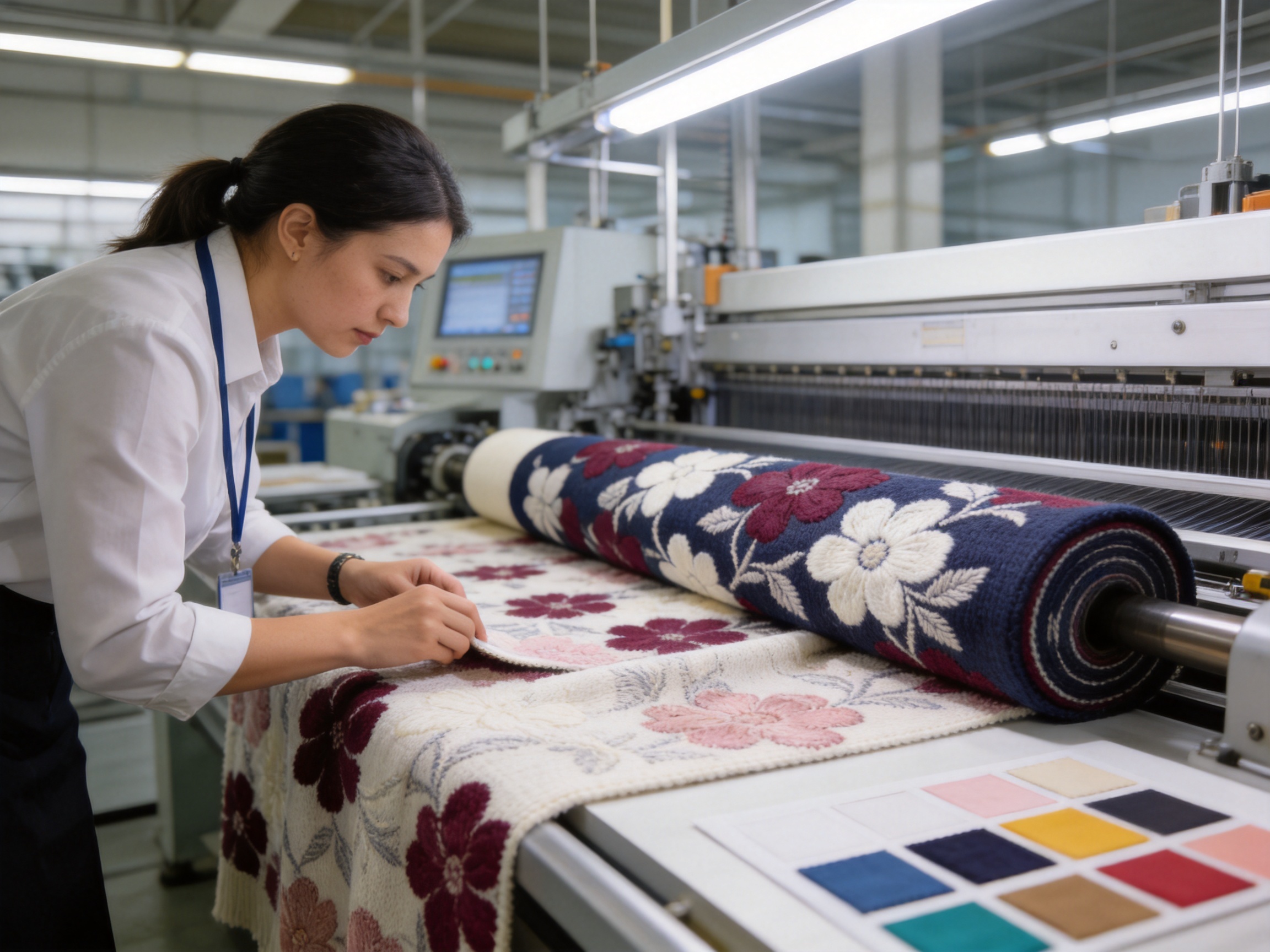
High-quality knitted jacquard depends on more than attractive design. It requires precise yarn selection, controlled knitting, careful dyeing, finishing expertise, and consistent inspection. Hangzhou Jinfeng Textile Co., Ltd. supports these requirements through its integrated manufacturing capabilities. The company’s experience in blended fabrics, polyester, spandex, and DTY polyester yarn production provides a solid technical platform for developing stable knitted fabrics.
The company operates with a production model that combines research, manufacturing, post-dyeing, finishing, and sales. This integration is important because fabric quality is influenced at every stage. If yarn properties are inconsistent, the jacquard pattern may lack clarity. If knitting tension is poorly controlled, the fabric may distort. If dyeing is unstable, color differences may occur between lots. If finishing is excessive, the hand feel may be damaged. By managing multiple stages of production, the company can better coordinate technical decisions and respond quickly to customer requirements.
Continuous in-line inspection during the knitting process is a key strength. Fabric defects are easier to control when problems are detected early rather than after full production is completed. In-line inspection helps identify issues such as needle defects, yarn irregularities, pattern errors, holes, or uneven tension. This supports the goal of reducing defects and delivering stable quality to buyers. For garment manufacturers, fewer fabric defects mean better cutting efficiency, fewer rejected panels, and more predictable production schedules.
The company’s manufacturing base in Hangzhou’s textile region also provides supply-chain advantages. Access to skilled technicians, dyeing resources, yarn suppliers, machinery maintenance, and export logistics can improve response speed and production reliability. In fashion supply chains, speed and dependability often matter as much as fabric aesthetics. A beautiful fabric must also arrive on time, match approved samples, and perform consistently during cutting and sewing.
Jacquard Development and Digital Sampling
One of the most important services for fashion brands is rapid sampling. New collections depend on quick decision-making, and buyers often need to test colorways, pattern scales, and garment prototypes before committing to bulk production. This fabric program supports digital sampling for new designs within 7 days, helping brands shorten development cycles.
Digital sampling allows floral patterns to be reviewed and adjusted before full-scale production. Designers can refine motif size, repeat structure, visual density, and color direction. This is especially valuable for floral jacquard because small changes in scale or contrast can significantly affect the final garment. A delicate floral pattern may suit elegant dresses and children’s wear, while a bolder floral layout may be better for statement jackets or seasonal capsule collections.
Fast sampling also helps importers and wholesalers respond to market opportunities. If a buyer identifies a trend in floral texture, soft dressing, or comfortable luxury apparel, the ability to develop and test fabric quickly can create a competitive advantage. Instead of waiting weeks for conventional development, brands can move from concept to sample review more efficiently.
The flexible minimum order quantity of 500 meters for new design tests further supports product innovation. Many textile suppliers require high minimums, which can discourage smaller brands or prevent established brands from testing new patterns. A lower trial order quantity reduces risk. It allows customers to evaluate market response, produce limited collections, or confirm garment performance before scaling to larger orders.
Advanced Dyeing for Color Fastness and Visual Appeal
Color is central to floral jacquard. The pattern must appear clear, vibrant, and harmonious, while the base fabric must retain its beauty through normal wear and care. This fabric uses low-temperature reactive dyes to support superior color fastness and preserve vibrant color. Controlled dyeing is especially important for viscose-rich blends, as viscose absorbs dye well but requires careful handling to maintain hand feel and dimensional stability.
Low-temperature dyeing can help reduce stress on fibers and support a softer final touch. Excessive heat or harsh processing may damage the fabric’s drape or lead to unwanted shrinkage. By controlling dyeing conditions, the manufacturer helps maintain the balance between color performance and comfort. This is particularly important for dress fabrics, where the wearer expects softness, fluid movement, and a pleasant hand.
Vibrant color retention is a clear commercial advantage. Apparel customers may reject garments that fade quickly, bleed during washing, or lose their original appearance after only a few wears. For brands, poor color performance can lead to returns, complaints, and damage to reputation. A dyeing process focused on color fastness helps protect both the garment’s appearance and the brand’s credibility.
Color consistency across production lots is also essential. Garment factories often cut multiple rolls for a single order, and shade variation can create visible differences between panels. Strong dyeing control, lot management, and inspection procedures help reduce this risk. For buyers placing large orders, this stability is a practical advantage over less controlled suppliers.
Finishing for Softness, Drape, and Stability
After knitting and dyeing, finishing determines much of the fabric’s final hand feel and performance. A knitted jacquard dress fabric must be soft enough for comfort, stable enough for cutting, and fluid enough for elegant drape. The finishing process must enhance these qualities without flattening the jacquard texture or reducing elasticity.
The fabric’s soft hand is one of its most important selling points. Customers often judge apparel quality by touch. A dress may attract attention visually, but softness influences the decision to purchase and the desire to wear the garment repeatedly. The viscose-rich blend naturally supports softness, while finishing helps refine the surface and improve comfort.
Drape is equally important. Floral jacquard patterns can look heavy if the fabric does not move well. This product is designed to offer a fluid drape that supports elegant dress silhouettes. The fabric can fall smoothly from the shoulders, waist, or hips, making it suitable for feminine designs and refined apparel lines. Its drape helps create movement, which enhances the floral pattern as the garment is worn.
Stability during cutting and sewing is another key consideration. Knit fabrics with stretch can sometimes curl, distort, or shift during production. A well-finished medium-weight jacquard provides better handling for garment factories. This can improve sewing efficiency, reduce defects, and support better finished measurements. For buyers sourcing fabric internationally, production stability is a major factor in supplier selection.
OEKO-TEX Certification and Buyer Confidence
The fabric is certified to OEKO-TEX Standard 100, which supports confidence in skin-contact safety. This certification is increasingly important for brands selling in markets where consumers and retailers expect responsible chemical management. It is especially relevant for dresses, children’s wear, tops, and other garments worn directly against the skin.
OEKO-TEX certification can simplify buyer evaluation because it provides an independent framework for restricted substances. For importers, wholesalers, and apparel brands, certified materials help support compliance documentation and reduce uncertainty. While design and price remain important, safety and compliance have become essential purchasing criteria in many international markets.
Environmental and human-safety considerations also influence brand image. Consumers increasingly prefer products made with attention to responsible production. A fabric that combines decorative beauty with certified safety can help brands communicate quality and care. This is particularly valuable for children’s apparel and premium women’s fashion, where comfort, trust, and skin safety are priorities.
Compared with uncertified alternatives, an OEKO-TEX-certified jacquard fabric offers stronger assurance for buyers. It reduces the risk of chemical compliance issues and supports smoother approval processes with retailers or private-label customers. This is one reason the fabric is well suited for export-oriented apparel programs.
Design Opportunities for Women’s Dresses
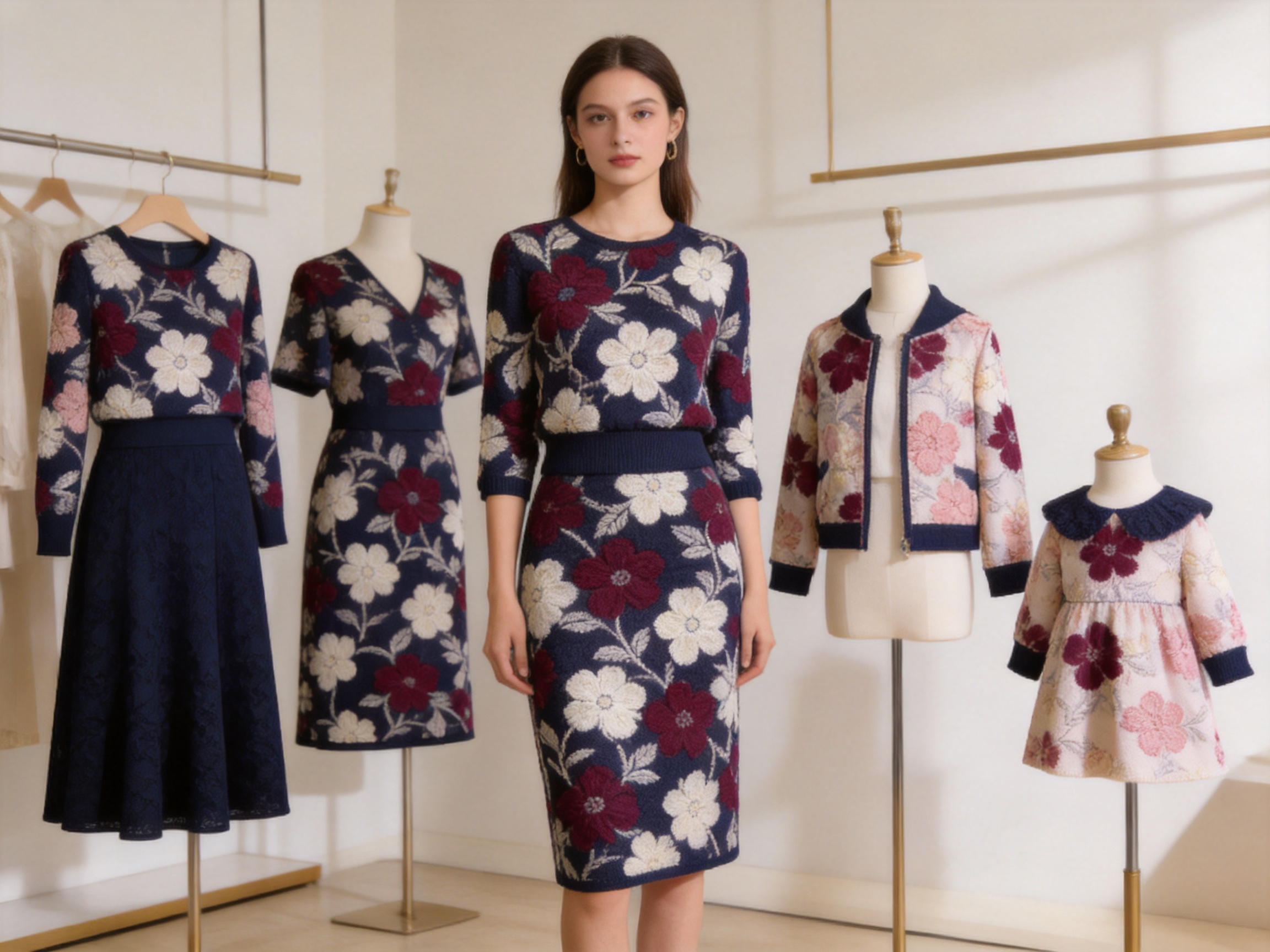
Women’s dresses are the primary application for this floral knitted jacquard. The fabric supports a broad range of styles, from refined day dresses to soft occasionwear. Its floral pattern gives garments a decorative identity, while its stretch and drape make them comfortable enough for repeated wear.
For elegant day dresses, the fabric works well in simple silhouettes. A clean sheath, wrap-inspired dress, A-line dress, or fit-and-flare style can benefit from the jacquard pattern without requiring heavy trims. The medium weight provides coverage and structure, while the spandex content improves fit. This balance is ideal for office-to-evening garments and polished casual fashion.
For seasonal collections, the floral jacquard can be adapted through color selection. Soft neutrals and muted pastels may support spring and summer collections, while deeper tones such as wine, navy, forest green, charcoal, or warm brown can suit fall and winter lines. Because the fabric has a subtle sheen and dimensional texture, colors can appear richer than on plain flat knits.
The fabric is also suitable for travel-friendly dresses. Stretch, softness, and wrinkle-conscious packing are important for consumers who want garments that look elegant after movement or storage. While all viscose blends require appropriate care, this fabric’s knit construction and medium weight can support better comfort during travel than rigid woven jacquards.
Applications in Coordinated Sets and Lightweight Jackets
Coordinated skirt and top sets are another strong application. Matching sets are popular because they offer styling flexibility. Consumers can wear the pieces together for a complete look or separately with other garments. Floral knitted jacquard adds visual cohesion to such sets while maintaining comfort.
A jacquard top made from this fabric can pair with a matching skirt, solid trousers, or denim. A skirt can be designed in pencil, A-line, flared, or soft pleated forms depending on the desired market. The fabric’s medium weight helps skirts maintain shape without becoming too rigid. Its stretch improves comfort at the waist and hips, which is important for customer satisfaction.
Lightweight fall jackets are also possible. The fabric can be used for soft cardigans, unstructured jackets, bomber-inspired silhouettes, or cropped layering pieces. The floral jacquard pattern gives these garments a more decorative look than plain knit outer layers. Because the fabric is not overly heavy, it works best for lightweight layering rather than heavy outerwear.
For luxury children’s wear, softness and safety are essential. The OEKO-TEX certification supports confidence, while the floral pattern creates a charming appearance. Dresses, coordinated sets, and soft jackets for children can benefit from the fabric’s stretch and comfortable hand. Designers should consider age-appropriate garment construction and care requirements, but the fabric’s qualities make it a strong candidate for elevated children’s collections.
Garment Construction Considerations
To achieve the best results, garment manufacturers should treat this fabric as a premium stretch jacquard knit. Pattern placement, seam selection, cutting stability, and care labeling should all be considered. Because the floral pattern has a distinct face and back, cutting teams should ensure consistent face-side orientation throughout production.
Needle selection is important when sewing viscose-nylon-spandex knits. Ballpoint or stretch needles are generally recommended to avoid damaging the knit structure. Stitch types should allow stretch where needed, especially at side seams, waist seams, sleeve openings, and necklines. Overlock and coverstitch machinery can be suitable depending on garment design.
Seam reinforcement may be useful in areas that experience stress, such as shoulder seams or waistlines. Lightweight stabilizing tape can help maintain shape without reducing comfort. Designers should test seam performance during sampling to ensure that stretch, recovery, and drape meet expectations.
Care labeling should reflect the viscose blend. Gentle machine washing or dry cleaning is recommended to maintain drape and reduce pilling risk. Customers should avoid harsh washing, high heat drying, or aggressive wringing. Clear care instructions help preserve the garment’s appearance and reduce post-purchase complaints.
Quality Control and Defect Prevention
Quality control is a major advantage of this fabric program. Continuous in-line inspection during knitting helps detect defects early. For jacquard fabrics, this is especially important because pattern errors may be more visible than in plain fabrics. A missed needle, incorrect tension, yarn inconsistency, or knitting fault can interrupt the floral design and reduce fabric usability.
By inspecting during production, the manufacturer can respond before defects accumulate. This reduces waste and improves the chance of delivering rolls that meet buyer expectations. For garment factories, defect-free fabric improves cutting yield. Every defect in fabric may require panel replacement, marker adjustment, or garment rejection. Reducing defects therefore has direct economic value.
Quality control also includes attention to weight, width, hand feel, color consistency, and finishing stability. A buyer expects bulk production to match the approved sample. If the fabric varies too much, garment fit and appearance may be affected. Consistent GSM, width, and stretch behavior help garment factories maintain standard measurements and production efficiency.
This focus on quality gives the product an advantage over suppliers that compete only on price. Lower-cost fabric may appear attractive at first, but if defects, shade variation, shrinkage, or poor color fastness occur, the total cost can become much higher. A stable fabric from a technically capable manufacturer supports lower risk and better long-term value.
Export Support, Logistics, and Documentation
For international buyers, fabric quality is only one part of successful sourcing. Export documentation, packaging, logistics coordination, and customs support also matter. This fabric program includes buyer-focused support for large orders, including container consolidation and optimized packaging to reduce wrinkles and freight costs.
Container consolidation can be valuable when buyers source multiple fabrics or yarn products. Combining shipments efficiently may reduce logistics complexity and improve cost control. Optimized packaging helps protect fabric during transport and storage. For knitted jacquard, careful rolling and packing can reduce creasing, distortion, and handling damage.
Customs documentation support is another practical benefit. Harmonized System codes, such as 6006.32 for certain knitted fabrics of synthetic fibers, may assist with classification depending on final composition and destination requirements. Certificates of Origin, including Form A, Form E, or Form F where applicable, can support smoother customs clearance and preferential trade arrangements when valid.
These services are important for importers and apparel manufacturers who need predictable delivery. A supplier that understands export requirements can help reduce delays, communication errors, and documentation issues. This adds value beyond the fabric itself and strengthens the reliability of the sourcing relationship.
Why This Fabric Is a Strong Choice for Competitive Apparel Brands
Fashion brands operate in a demanding environment. They must develop attractive products quickly, control costs, comply with safety expectations, and deliver garments that consumers enjoy wearing. This floral knitted jacquard supports those goals by offering a combination of style, comfort, performance, and supply-chain practicality.
The fabric’s decorative floral structure creates immediate visual appeal. It allows brands to produce garments that stand out from basic knits and flat prints. At the same time, the viscose-rich blend provides a soft hand and elegant drape that consumers can feel. The nylon and spandex content support durability and comfort, helping garments perform during daily wear.
The medium weight makes the fabric versatile. It is substantial enough for dresses and coordinated sets but not too heavy for comfortable movement. The width supports efficient production. The OEKO-TEX certification supports compliance and consumer trust. The dyeing process supports color retention. The sampling and MOQ structure support innovation and market testing.
Compared with many competitors, the product’s strength lies in balance. It is not merely decorative, not merely comfortable, and not merely easy to source. It brings these qualities together. For buyers, this balance reduces compromise. For designers, it expands creative options. For garment factories, it supports production efficiency. For end consumers, it delivers wearable elegance.
Company Strength and Textile Expertise
Hangzhou Jinfeng Textile Co., Ltd. is located in Jingjiang Street Industrial Park, Xiaoshan District, Hangzhou, Zhejiang Province. The company covers an area of 32.6 acres and operates a plant area of approximately 18,000 square meters. Its business includes production and processing, post-dyeing, finishing, and sales of blended fabrics such as polyester and spandex fabrics, as well as DTY polyester yarn production, processing, and sales.
This broad textile foundation supports product development in several ways. Experience with blended fabrics helps the company understand how different fibers behave during knitting, dyeing, and finishing. Experience with spandex-containing fabrics supports stretch control and recovery performance. Knowledge of DTY polyester yarn and related yarn processing contributes to broader technical awareness of yarn structure, texture, and fabric behavior.
The company operates as a self-managed export enterprise integrating research and development, production, and sales. This structure is valuable for international buyers because it supports direct communication, faster response, and better coordination between development and production teams. When buyers request new colors, design adjustments, sampling, or technical clarification, integrated operations can reduce delays.
The business philosophy emphasizes cooperation and mutual benefit. In practical sourcing terms, this means supporting customers not only with products but also with sampling, order flexibility, logistics, and documentation. For long-term textile partnerships, responsiveness and problem-solving are as important as machinery and capacity. A supplier that understands buyer needs can contribute to smoother production planning and stronger commercial results.
Sustainability and Responsible Production Considerations
Sustainability in textiles is a broad topic that includes chemical safety, efficient production, waste reduction, durability, and responsible supply-chain practices. This floral knitted jacquard supports responsible sourcing in several ways. OEKO-TEX certification addresses restricted substances and skin-contact safety. Controlled dyeing helps support color fastness, reducing the chance that garments will be discarded early due to fading. Quality inspection reduces waste caused by defects.
Durability is also part of sustainability. A garment that remains attractive after repeated wear provides better value and may reduce unnecessary replacement. The nylon component strengthens the fabric, while spandex improves comfort and fit. When consumers enjoy wearing a garment and it maintains its appearance, the product has a longer useful life.
Efficient sampling and flexible MOQ can also reduce waste in product development. Instead of committing immediately to large quantities, brands can test designs in smaller runs. This helps prevent overproduction of unsuccessful styles. In fashion, where demand can shift quickly, the ability to test and scale responsibly is increasingly important.
Packaging and logistics optimization also contribute to more efficient supply chains. Reduced wrinkles can lower the need for excessive reprocessing, while container consolidation can improve shipping efficiency. These practical steps support both cost control and more responsible resource use.
Market Positioning and Retail Value
In retail environments, fabric choice strongly influences perceived garment value. Consumers may not always know the technical name of a knitted jacquard, but they can see texture, feel softness, and recognize quality. A floral-patterned jacquard dress can appear more premium than a basic printed knit dress because the design has structural depth.
This fabric is well positioned for mid-range to premium casual fashion, elegant office wear, boutique collections, women’s lifestyle brands, and refined children’s apparel. It can also support private-label programs for retailers seeking differentiated fabrics without extremely high development barriers. The ability to sample new designs quickly makes it suitable for seasonal and capsule collections.
Brands can market garments made from this fabric around comfort, elegance, stretch, softness, and floral texture. The OEKO-TEX certification can support product descriptions related to skin-contact safety. Care instructions should be clearly communicated to preserve the garment’s hand and drape. With appropriate styling and photography, the fabric can deliver strong visual impact online and in physical stores.
Because the fabric is decorative on its own, garment designers can keep construction clean and modern. This supports contemporary fashion preferences for pieces that look polished but are easy to wear. Consumers increasingly seek garments that feel comfortable like casualwear but look refined enough for work, dining, travel, or social events. This knitted jacquard aligns well with that demand.
Care and Maintenance Guidance
Proper care helps maintain the fabric’s drape, softness, and appearance. A gentle machine wash or dry cleaning is recommended. If machine washing is used, garments should be washed on a gentle cycle with mild detergent. Washing with similar colors is recommended, particularly for deeper shades. High heat should be avoided because it may affect viscose fibers and spandex elasticity.
Garments should not be aggressively wrung. Excess water can be gently removed, and the garment can be laid flat or hung carefully depending on its construction. Tumble drying at high heat is not recommended. Low heat or air drying is preferable. Ironing, if needed, should be done at a low temperature with care, and a pressing cloth may be used to protect the jacquard surface.
Pilling risk can be reduced by gentle washing and avoiding abrasion. As with many soft viscose blends, repeated friction from bags, rough surfaces, or harsh laundering may affect the surface over time. Clear consumer care instructions can help preserve garment quality and reduce complaints.
For garment manufacturers, pre-production testing is recommended. Shrinkage, color fastness, seam performance, and fit recovery should be checked according to the target market’s standards. This ensures that the final garment performs as expected and that care labels are accurate.
Q&A Section
Q1: What makes this floral knitted jacquard different from printed floral fabric?
The floral design is created through the knitted jacquard structure rather than being printed only on the surface. This gives the fabric more depth, texture, and premium visual appeal. It also helps the pattern integrate naturally with the stretch and movement of the knit.
Q2: Is the fabric suitable for women’s dresses?
Yes. The 240 g/m² medium weight, soft hand, fluid drape, and stretch comfort make it especially suitable for women’s elegant day dresses, office dresses, fit-and-flare styles, A-line dresses, and coordinated fashion sets.
Q3: Is the floral pattern reversible?
The standard floral jacquard has a distinct face and back side, so it is not fully reversible. However, the back side has a neat knit structure suitable for quality garment construction. Double-sided jacquard versions can be developed upon request.
Q4: What are the benefits of the viscose, nylon, and spandex blend?
Viscose provides softness, drape, and subtle sheen. Nylon improves strength, resilience, and durability. Spandex adds stretch and recovery for better comfort and fit. The combination creates a fabric that is decorative, comfortable, and practical for commercial apparel.
Q5: Can this fabric be used for children’s wear?
Yes. Its soft touch, stretch comfort, and OEKO-TEX Standard 100 certification make it suitable for luxury children’s wear, provided that the garment design and care requirements are appropriate for the intended age group.
Q6: How should garments made from this fabric be cared for?
Gentle machine washing or dry cleaning is recommended. Avoid harsh detergents, high heat drying, and aggressive wringing. Proper care helps maintain the fabric’s drape, softness, and appearance while reducing the risk of pilling.
Q7: What minimum order quantity is available for new design testing?
Trial orders of 500 meters are supported for new design tests. This flexible MOQ helps brands evaluate market response before committing to larger production quantities.
Q8: How quickly can new design samples be developed?
Digital sampling for new designs can be completed within 7 days, helping designers, buyers, and importers accelerate product development and seasonal decision-making.
Q9: What quality control measures support the fabric?
Continuous in-line inspection during knitting helps identify defects early and supports stable fabric quality. Additional attention to dyeing, finishing, color consistency, width, GSM, and hand feel helps ensure that bulk production matches buyer expectations.
Q10: What export support is available?
For large orders, logistics support may include container consolidation and optimized packaging. HS code guidance and Certificates of Origin, such as Form A, Form E, or Form F when applicable, can also be provided to support customs clearance.
Conclusion
Floral-patterned knitted jacquard fabric offers an effective solution for apparel brands that want to combine elegance, comfort, and commercial practicality. Its knitted floral structure delivers visual depth beyond ordinary printing, while its viscose-rich blend provides softness and graceful drape. Nylon strengthens the fabric, and spandex adds the stretch needed for modern comfort. With a medium weight of 240 g/m² and a practical width of 145 cm, it is well suited for dresses, coordinated sets, lightweight jackets, and refined children’s wear.
The product’s advantages extend beyond appearance. Advanced dyeing supports vibrant color retention, finishing enhances softness and drape, and continuous in-line inspection helps reduce defects. OEKO-TEX certification supports buyer confidence and skin-contact safety. Fast digital sampling and flexible trial orders help brands develop new designs with lower risk. Export documentation and logistics support make the product more practical for international sourcing.
Backed by the manufacturing capabilities of Hangzhou Jinfeng Textile Co., Ltd., this fabric represents a strong choice for buyers seeking decorative knit textiles with stable quality and reliable service. It is not simply a floral fabric; it is a balanced textile solution for contemporary fashion. For brands looking to create garments that feel comfortable, look refined, and perform well in production, this floral-patterned knitted jacquard provides a compelling foundation.
References
1. Kadolph, S. J. Textiles. Pearson Education.
2. Spencer, D. J. Knitting Technology: A Comprehensive Handbook and Practical Guide. Woodhead Publishing.
3. Elsasser, V. H. Textiles: Concepts and Principles. Fairchild Books.
4. Saville, B. P. Physical Testing of Textiles. Woodhead Publishing.
5. OEKO-TEX Association. Standard 100 by OEKO-TEX: General and Special Conditions.
6. Collier, B. J., and Epps, H. H. Textile Testing and Analysis. Pearson.
