
Black Slight Intermingled DTY: Performance, Manufacturing Quality, and Textile Applications
Black Slight Intermingled Draw Textured Yarn, commonly known as black slight intermingled DTY, is a versatile polyester yarn designed for manufacturers seeking a balanced combination of softness, elasticity, dimensional stability, visual uniformity, and efficient processing. It is produced by drawing and texturing polyester filaments and then applying a controlled level of intermingling to improve filament cohesion. The result is a yarn that can be knitted or woven into fabrics with an attractive appearance, dependable structure, and practical performance across fashion, home textile, sportswear, lining, and industrial applications.
Compared with ordinary flat polyester yarn, textured yarn provides greater bulk, improved cover, and a more comfortable hand feel. Compared with heavily intermingled yarn, slight intermingled DTY offers a more moderate network structure. This balance is important for textile producers that want sufficient filament cohesion without creating an overly dense or visibly harsh network effect on the finished fabric. The black color also provides strong visual depth, dependable coverage, and convenient suitability for dark garments and textile products.
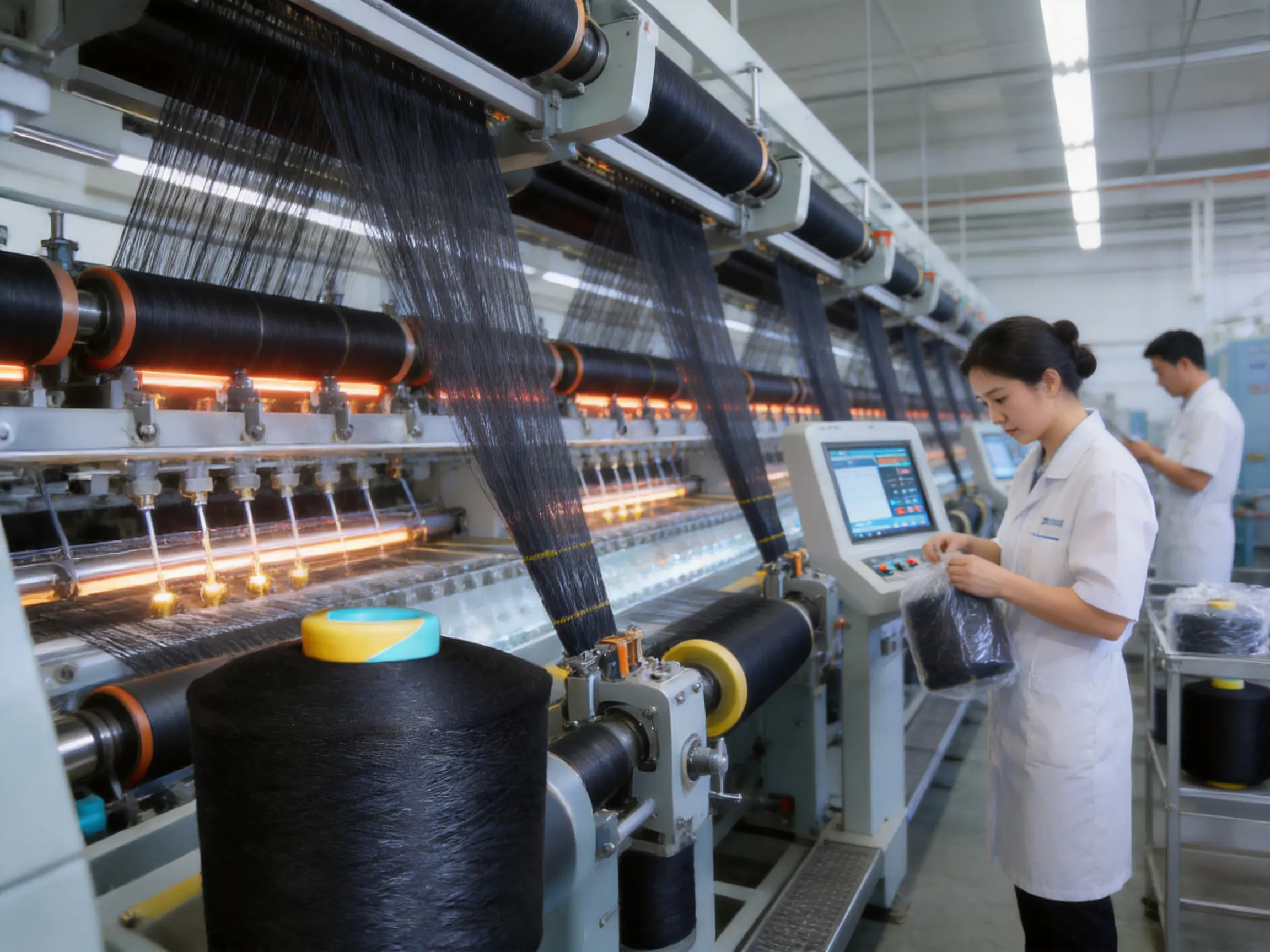
The yarn is manufactured by a controlled process involving filament drawing, heating, false twisting or texturing, cooling, winding, and intermingling. Each stage affects the final yarn performance. Drawing influences strength and elongation. Texturing creates bulk and stretch recovery. Heating stabilizes the textured form. Intermingling improves cohesion between individual filaments. Winding affects package quality and downstream unwinding. For this reason, consistent production management is essential to achieving reliable results from one lot to another.
Hangzhou Jinfeng Textile Co., Ltd. specializes in the production, processing, finishing, and sales of blended fabrics and DTY polyester yarn. Its operations include polyester and spandex-related textile products, post-dyeing, finishing, and export-oriented sales. With a production site in the Jingjiang Street Industrial Park of Xiaoshan District, Hangzhou, the company combines manufacturing, product development, quality management, and customer service in one business structure.
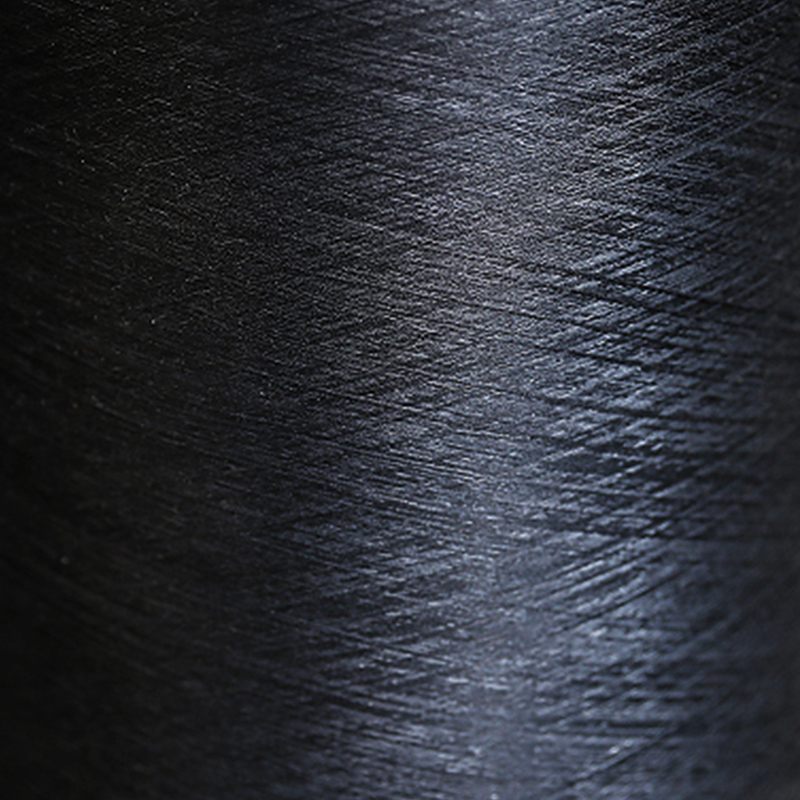
Black Slight Intermingled DTY
Understanding Black Slight Intermingled DTY
DTY stands for Drawn Textured Yarn. It is produced from partially oriented polyester yarn that is drawn to develop the required molecular orientation and then textured to give the filaments a more voluminous and flexible form. During texturing, the filaments are transformed from a relatively smooth configuration into a yarn with controlled crimp, bulk, and extensibility. This makes DTY more suitable for many knitted and woven fabric constructions than untextured filament yarn.
Intermingling is an additional process used to create small points of cohesion among the individual filaments. Air jets cause the filaments to cross and entangle at controlled intervals. These points help hold the yarn together during winding, transport, knitting, weaving, and other processing stages. A slight intermingled yarn contains a moderate number of network points per meter. The exact number is influenced by air pressure, machine speed, yarn tension, nozzle condition, and other operating parameters.
The term “slight” does not mean weak or poorly formed. It describes the level of filament interlacing. A slight network is often selected when the fabric producer needs a smooth appearance and flexible hand while still requiring enough cohesion for efficient processing. It is particularly useful for fabrics where a heavy mesh could create visible network spots or a rougher surface effect.
Black DTY is created by incorporating a black color into the polyester material or by applying a controlled coloration process according to the product specification. A stable black shade supports the production of dark fabrics without requiring excessive additional coloration. It can also provide excellent visual coverage in knitted structures, helping reduce the prominence of gaps between loops or filaments.
How Intermingling Influences Yarn Behavior
The number of network points per meter is an important quality characteristic. When the number is too low, the filaments may separate more easily during processing, especially under tension or at high machine speeds. When the number is too high, the yarn can become excessively compact, and the network points may become more visible on the fabric surface. The correct level depends on yarn specification, fabric construction, machine type, and the intended end use.
Air pressure is one of the principal controls in the intermingling process. Higher pressure generally produces more pronounced network formation, although the final result also depends on the nozzle design, yarn speed, and material properties. Texturing machine speed can affect the residence time and stability of the process. A well-managed production line therefore needs coordinated control rather than adjustment of a single parameter.
For black slight intermingled DTY, process balance is especially important because the dark color can emphasize irregularities, streaks, or inconsistent network marks. Uniform filament formation and stable winding help the finished fabric maintain a clean and consistent appearance. This is valuable for fashion fabrics, sportswear, hosiery, and other products in which surface quality is highly visible.
Key Advantages of Black Slight Intermingled DTY
Balanced Filament Cohesion
The most direct advantage of slight intermingling is the balance between filament cohesion and fabric softness. The yarn remains sufficiently integrated for efficient knitting and weaving, while avoiding the excessive compactness associated with heavy intermingling. This balance helps reduce filament separation, yarn snagging, and processing interruptions.
For fabric manufacturers, stable cohesion can improve production efficiency. A yarn that unwinds evenly and maintains its structure is easier to guide through feeders, needles, guides, and tension systems. It also reduces the likelihood of localized filament spreading that can contribute to fabric bars, uneven loops, or appearance defects.
Soft and Flexible Hand Feel
Textured polyester yarn has greater bulk and a more flexible surface than flat filament yarn. The textured structure allows the yarn to occupy more volume in the fabric, contributing to a softer hand and improved cover. This is beneficial in garments that are worn directly against the skin or products that require a comfortable, supple touch.
Black slight intermingled DTY can be used in fabrics intended to feel smooth without becoming excessively rigid. Its moderate network structure supports the natural movement of the textured filaments. When processed correctly, the yarn can contribute to fabrics with a pleasant drape and a refined surface.
Good Coverage and Visual Depth
Polyester DTY provides useful coverage because its textured filaments occupy more space than smooth filaments of the same nominal size. In black fabrics, this coverage can create a rich and deep appearance. It is suitable for dark apparel, fashion knitwear, leggings, sports garments, linings, and decorative textile materials.
Good coverage may also help manufacturers manage fabric weight and construction efficiency. Depending on the target product, the producer may achieve the desired opacity, fullness, or visual body without using an excessively dense fabric structure. The final result depends on yarn count, knitting or weaving parameters, fabric density, finishing, and dyeing conditions.
Elasticity and Recovery
The crimp introduced during texturing gives DTY a degree of stretch and recovery. Although the actual performance depends on yarn specification and fabric construction, textured polyester can contribute to comfortable movement and improved fit. This makes it useful for sportswear, casualwear, fitted garments, socks, underwear, and stretch-oriented knitted fabrics.
Black slight intermingled DTY can also be combined with elastane or spandex in blended structures. In these constructions, the polyester DTY contributes color, bulk, surface appearance, and durability, while the elastomeric component provides additional stretch. Proper tension control during knitting is important to preserve the intended balance between the two materials.
Dimensional Stability
Polyester is valued for its resistance to deformation and its ability to retain its form after repeated use. A properly textured and heat-set yarn can help fabrics maintain their dimensions during wear and care. This is particularly useful for garments and home textiles that must retain shape after washing or extended use.
Dimensional stability is influenced by many factors, including draw ratio, heat treatment, crimp development, fabric construction, dyeing temperature, and finishing conditions. Consistent production at the yarn stage gives downstream manufacturers a stronger foundation for controlling the final fabric dimensions.
Efficient Processing
A controlled level of intermingling can improve yarn handling during knitting and weaving. The network points help maintain filament unity, while the textured structure provides the flexibility needed to pass through textile machinery. Consistent package winding further supports smooth unwinding and steady yarn delivery.
Efficient processing can reduce downtime, material waste, and the frequency of machine adjustments. This is especially important for large-scale textile production, where small variations can become significant across thousands of kilograms of yarn or many rolls of fabric.
Versatile End-Use Potential
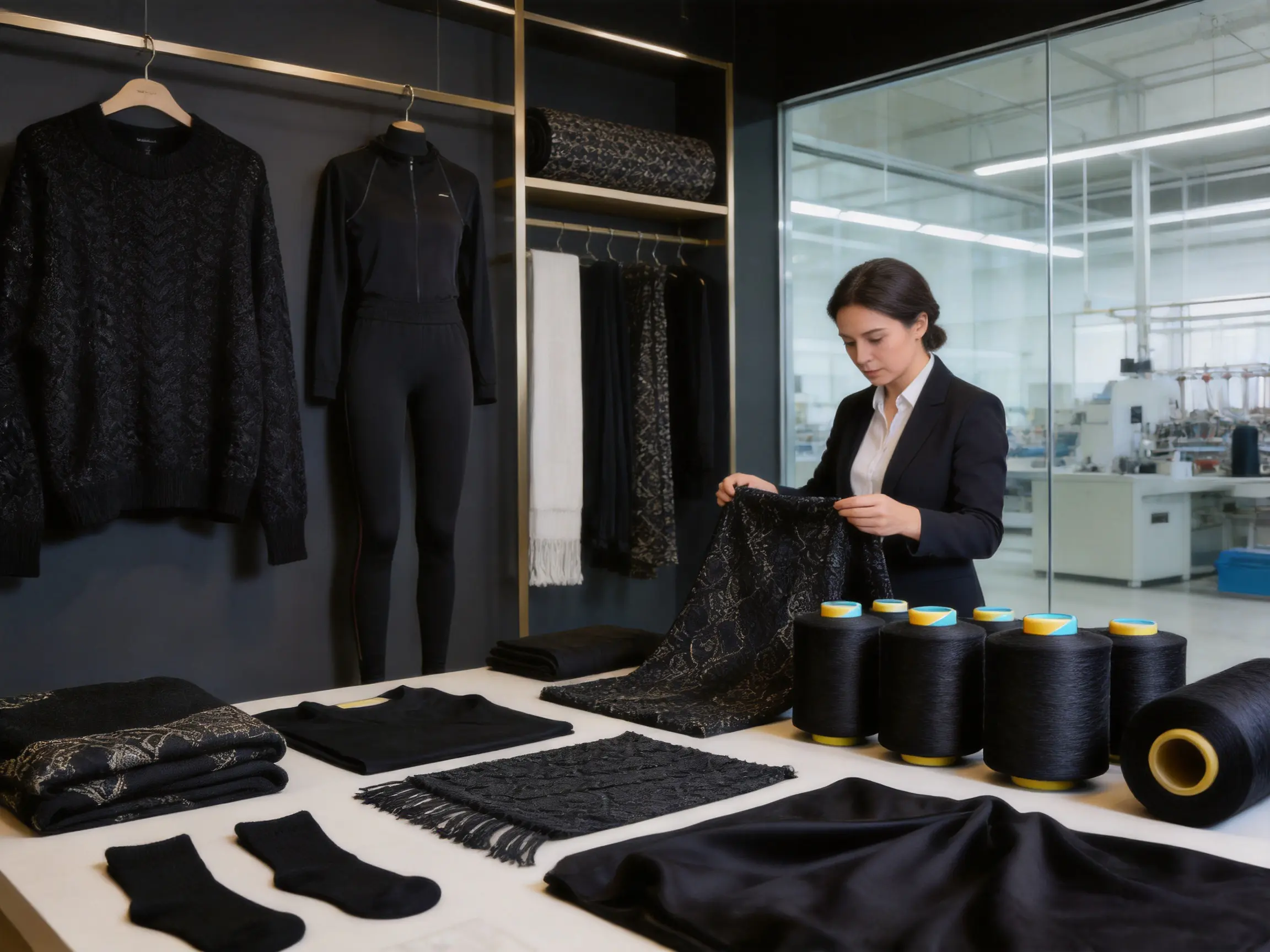
The yarn can be used in a broad range of textile products. Typical applications include knitted jacquard fabrics, polyester-rayon blended fabrics, NTR knitted fabrics, NR knitted fabrics, fashion fabrics, sportswear, casualwear, lining materials, scarves, socks, home textiles, and selected technical textile constructions.
The versatility of the yarn allows fabric developers to explore different knitting structures, surface effects, weights, and finishing methods. It can be used alone or combined with other yarns to produce contrasting textures, improved stretch, enhanced drape, or special visual effects.
Comparison with Competing Yarn Options
Textile producers often compare slight intermingled DTY with flat polyester filament, heavily intermingled DTY, spun polyester yarn, and blended yarns. Each option has its own advantages, but black slight intermingled DTY offers a practical middle position between smoothness, cohesion, volume, and processing stability.
| Yarn Type | Typical Structure | Main Strength | Potential Limitation | Position of Slight Intermingled DTY |
|---|---|---|---|---|
| Flat polyester filament | Smooth and relatively compact | Uniform appearance and high filament continuity | Lower bulk and less textured hand | Provides greater volume, softness, and surface fullness |
| Heavily intermingled DTY | Dense network points | Strong filament cohesion | May create visible network marks or a firmer hand | Offers cohesion with a softer and cleaner surface effect |
| Spun polyester yarn | Short fibers spun into yarn | Natural-looking surface and familiar handling | Higher hairiness and possible pilling concerns | Provides filament continuity and a smoother textured appearance |
| Untextured black filament | Smooth continuous filament | Clean, sleek surface | Less bulk and lower stretch potential | Adds crimp, body, and comfort to the fabric |
| Polyester-elastane blend | Polyester combined with elastomeric fiber | Enhanced stretch and recovery | More complex processing and cost considerations | Can serve as the polyester component in stretch constructions |
Advantages over Flat Filament Yarn
Flat filament yarn can create a smooth and bright fabric surface, but it may not provide the same level of bulk, softness, or visual depth as DTY. For garments requiring comfort and a fuller appearance, textured yarn is often more suitable. The crimped structure can improve fabric cover and contribute to a more flexible hand.
Black slight intermingled DTY also has an advantage when a manufacturer wants to avoid a completely slick or overly reflective surface. Texturing diffuses the appearance of the filaments and can create a more sophisticated, fabric-like effect. This is useful in fashion textiles where surface character is important.
Advantages over Heavy Intermingling
Heavy intermingling can deliver strong filament cohesion, but the dense network points may produce visible spots or a firmer surface. The product information for slight intermingled DTY emphasizes that a heavy mesh can create network spots on the surface of the fabric. For applications requiring a clean appearance and soft handle, a controlled slight network may provide a better result.
The choice should be based on fabric construction and production requirements. Heavy intermingling may be appropriate for certain high-speed or demanding processes, while slight intermingling is often advantageous where surface appearance, softness, and flexible drape are priorities.
Advantages over Spun Polyester
Spun polyester yarn can offer a familiar textile hand and a natural-looking surface, but it is made from staple fibers and therefore has a different structure from continuous filament DTY. Spun yarn may have more hairiness and may require different process controls. Continuous filament DTY can provide a smoother appearance, consistent filament continuity, and useful textured bulk.
For black fabrics, the continuous filament structure can help create a more uniform color field and reduce the irregular surface effects associated with staple fiber hairiness. The final result still depends on the selected count, knitting structure, finishing process, and fabric quality standards.
Manufacturing Process and Quality Control
Raw Material Preparation
Stable raw material quality is the foundation of consistent DTY production. Polyester feed yarn must have suitable uniformity, strength, elongation, moisture condition, and package quality. Variations at the feed stage can affect drawing behavior, texturing stability, network formation, and winding performance.
For black products, color consistency and material dispersion are also important. The black shade must remain stable across packages and production lots. If the coloration is uneven, the difference may become visible after knitting, weaving, dyeing, or finishing. Material preparation and incoming inspection therefore form an important part of quality management.
Drawing and Orientation
Drawing stretches the polyester filaments under controlled conditions. This process develops molecular orientation and adjusts the balance between strength and elongation. The draw ratio must be selected according to the intended yarn specification. Excessive drawing can reduce elongation or create brittle behavior, while insufficient drawing may result in inadequate strength and unstable texturing.
Temperature, yarn tension, roller speed, and contact conditions all influence the drawing stage. Consistent machine settings help ensure that the yarn maintains a stable physical profile along its length. This stability supports even texturing and reduces the risk of periodic defects.
Texturing and Crimp Formation
Texturing introduces controlled crimp into the polyester filaments. Heat and mechanical action allow the filaments to adopt a more voluminous configuration. The process gives the yarn bulk, flexibility, and a textured surface. The desired crimp level depends on the yarn count, machine design, speed, heater temperature, and downstream application.
Texturing must be carefully controlled because excessive or insufficient crimp can affect fabric appearance and performance. Too little crimp may produce a yarn that lacks fullness, while excessive crimp can create irregularity, excessive shrinkage, or an overly bulky fabric. Production personnel must therefore balance temperature, tension, and speed to meet the target specification.
Cooling and Stabilization
After heating and texturing, the yarn must be cooled in a controlled manner so that the crimp structure can stabilize. Cooling conditions influence the durability of the textured form and the uniformity of the final yarn. Inadequate stabilization may lead to variation in bulk, shrinkage, or recovery behavior.
Stable cooling also helps prepare the yarn for the intermingling stage. A yarn with an inconsistent temperature or unstable texture may respond unevenly to the air jet, causing variation in network points or filament cohesion.
Controlled Intermingling
The intermingling stage applies air pressure through a specialized nozzle to create network points. The purpose is not simply to maximize the number of entanglements. Instead, the process must achieve a suitable distribution and intensity of network points for the intended fabric application.
Air pressure is adjusted according to product requirements. Machine speed also affects the number of networks per meter, as the time and conditions under which the yarn passes through the air jet change with speed. Nozzle cleanliness, alignment, yarn tension, and airflow stability must be monitored to maintain consistent results.
A slight intermingled product is especially dependent on accurate control because the operating window may be narrower than that of a heavily intermingled yarn. Small changes in pressure or speed can alter the visible network pattern. Careful process records and regular testing help maintain product uniformity.
Winding and Package Formation
After texturing and intermingling, the yarn is wound onto packages suitable for storage and downstream processing. Package density, shape, edge quality, and winding tension influence how the yarn unwinds on knitting and weaving machines.
Uneven winding can cause tension fluctuations, yarn breaks, and feeding problems. A well-formed package supports smooth delivery and helps maintain consistent fabric quality. Winding equipment must therefore be adjusted to the yarn characteristics rather than relying on a single setting for every product.
Inspection and Testing
Quality inspection may include checks for yarn count, strength, elongation, crimp, shrinkage, intermingling level, package appearance, color consistency, and unwinding behavior. The exact test program depends on customer requirements and product standards.
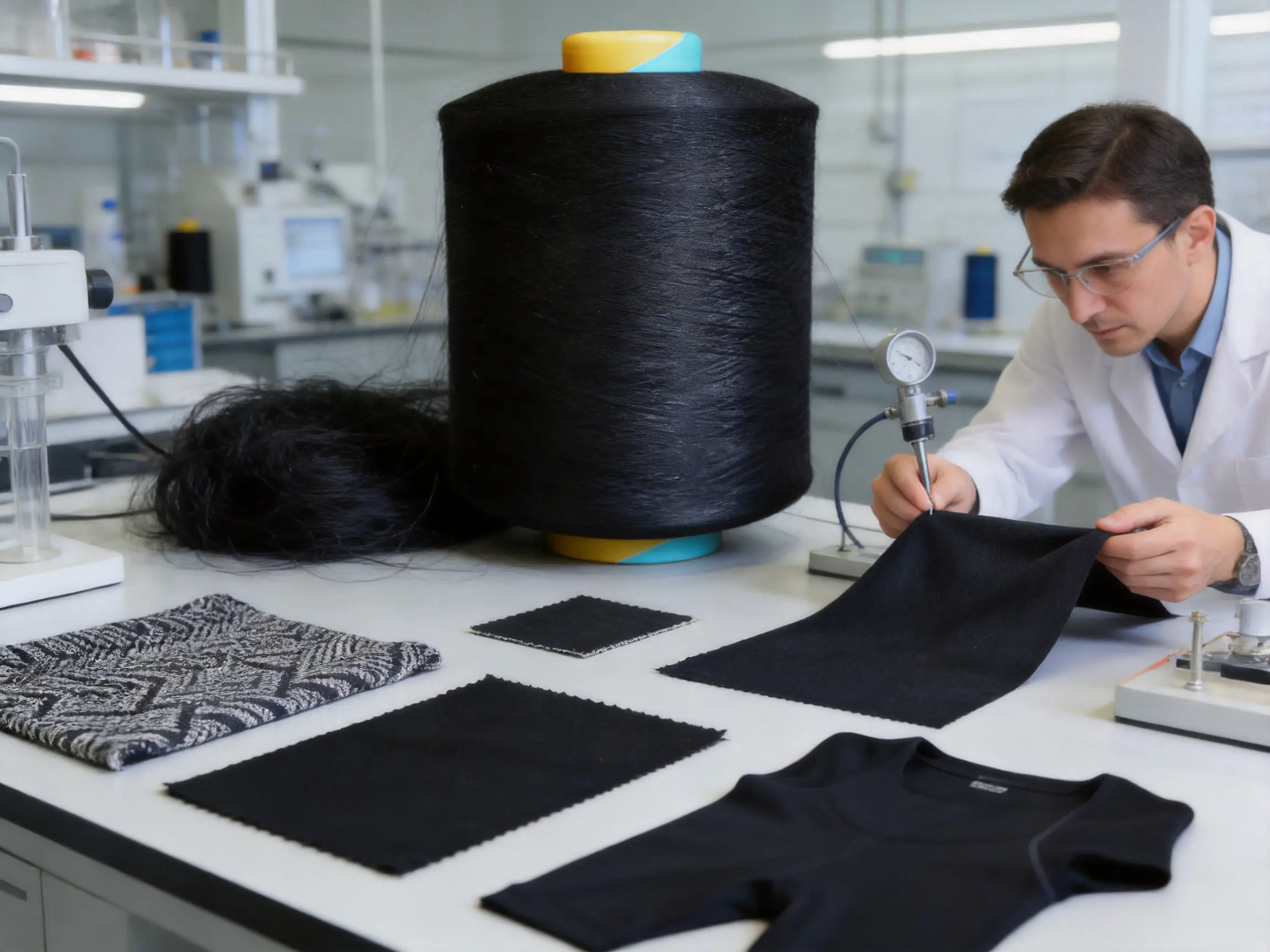
Visual inspection is particularly valuable for black slight intermingled DTY because surface irregularities may become more visible in dark fabric. Samples can be knitted or woven to evaluate appearance, hand feel, coverage, network visibility, and processing performance. This fabric-level evaluation complements laboratory testing and provides a more realistic understanding of end-use behavior.
Manufacturing Strengths and Company Capabilities
Hangzhou Jinfeng Textile Co., Ltd. operates as a textile manufacturer and export-oriented enterprise integrating research and development, production, processing, finishing, and sales. This integrated structure supports communication between technical teams, production staff, and customers. It also enables the company to respond to product requirements involving both yarn and fabric.
The company is located in the Jingjiang Street Industrial Park, Xiaoshan District, Hangzhou City, Zhejiang Province. Its facilities cover approximately 32.6 acres, with a plant area of about 18,000 square meters. This physical base provides space for production operations, processing activities, storage, management, and related textile services.
The company’s business scope includes DTY polyester yarn production, processing, and sales, as well as the production and finishing of blended fabrics such as polyester and spandex constructions. This combination is valuable for buyers that need more than a basic yarn supply. A customer may require a particular yarn for a knitted fabric, a polyester-rayon blend, a jacquard structure, or a stretch textile. Experience across both yarn and fabric helps support more practical product recommendations.
Integrated Production and Fabric Knowledge
Yarn performance cannot be separated from fabric construction. A yarn that performs well in one knitting structure may require different settings in another. Fabric density, needle selection, machine gauge, take-down tension, dyeing conditions, and finishing all influence the final result.
Because the company is involved in blended fabric production, post-dyeing, and finishing, it can evaluate DTY from a fabric manufacturer’s perspective. This broader knowledge helps identify how intermingling, texture, color, and filament behavior affect real textile products. It also supports communication with buyers who are developing finished fabrics rather than purchasing yarn solely on the basis of a laboratory specification.
Research, Development, and Customization
Different customers may require different levels of bulk, stretch, network formation, color depth, or fabric compatibility. A flexible development approach allows yarn specifications to be matched more closely to the intended application. Product development may involve adjustments to yarn count, texturing conditions, intermingling level, package format, or blending recommendations.
Customization should be managed through clear technical communication. Buyers should provide the intended end use, machine type, fabric construction, target weight, desired hand feel, color requirements, and applicable quality standards. These details help production teams select appropriate process parameters and reduce the risk of a mismatch between yarn characteristics and downstream operations.
Production Experience in Polyester and Stretch Textiles
Polyester remains one of the most widely used synthetic fibers because of its strength, stability, processability, and broad application range. Experience in polyester yarn and polyester-based fabrics gives manufacturers a practical understanding of thermal behavior, dyeing response, shrinkage, and finishing.
Experience with spandex-related textiles adds further value for customers developing stretch fabrics. Black slight intermingled DTY can be paired with elastomeric yarns to build fabrics that combine color depth, textured surface, polyester stability, and stretch comfort. Such combinations require suitable feeding ratios and tension control, but they can provide strong commercial potential in activewear, fashionwear, and fitted garments.
Export and Customer Service Orientation
An export-oriented company must manage product communication, packing, documentation, delivery coordination, and after-sales support in addition to manufacturing. Clear technical documents and consistent product identification help customers place repeat orders and maintain stable production.
Customer service is especially important for yarn products because a buyer’s success depends on how the yarn performs in actual machinery. Technical support may include guidance on storage, unwinding, knitting settings, blending ratios, sample development, and fabric evaluation. Responsive communication can shorten development cycles and help resolve production issues more efficiently.
Applications in Knitted and Woven Fabrics
Knitted Jacquard Fabric
Knitted jacquard fabrics use programmed needle selection to create patterns, textures, or color effects. Black slight intermingled DTY can contribute a smooth textured base, visual depth, and a comfortable hand. Its moderate network structure can help the yarn move through the knitting system while preserving an attractive surface.
In jacquard constructions, fabric appearance is influenced by loop formation, yarn tension, pattern scale, and the interaction of different yarns. Black DTY can be used as a ground color, a contrast element, or part of a tonal design. The deep color may enhance pattern definition and provide a sophisticated look for apparel and decorative products.
Polyester-Rayon Blended Fabrics
Polyester-rayon blends combine the stability and durability of polyester with the soft, natural-feeling characteristics of rayon. Black slight intermingled DTY can be used in selected blended structures to add bulk, color, resilience, or surface texture.
Blending requires attention to fiber compatibility, dyeing behavior, shrinkage, and finishing. Polyester and rayon may respond differently to heat and moisture, so process conditions must be selected carefully. When properly managed, the resulting fabric can offer a balanced combination of comfort, appearance, and wear performance.
NTR and NR Knitted Fabrics
NTR and NR knitted fabrics can be developed in a variety of constructions and may be used in fashion, casualwear, and other textile applications. The performance of the final fabric depends on the exact composition and manufacturing method, but DTY can provide a useful source of textured polyester content.
In knitted fabrics, the yarn’s elongation and recovery influence loop formation and fabric stretch. Its bulk affects cover and thickness, while its intermingling influences processing stability. These characteristics make slight intermingled DTY suitable for development work where manufacturers need a flexible polyester yarn with a controlled surface effect.
Sportswear and Activewear
Sportswear requires comfort, freedom of movement, durability, and an attractive appearance. Textured polyester yarn can contribute to lightweight bulk, stretch potential, and rapid-drying behavior associated with polyester fabrics. When combined with spandex, it can support fitted garments that require enhanced elasticity.
Black is a commercially important color in activewear because it is versatile, visually slimming, and easy to coordinate with other shades. A stable black yarn can simplify color planning and support the production of consistent dark panels, trims, or complete garments.
Casualwear and Fashion Garments
For casualwear, buyers often seek fabrics that combine easy care, comfort, attractive drape, and reliable color. Black slight intermingled DTY can contribute to a soft textured surface and a fuller appearance. It can be used in tops, dresses, skirts, trousers, jackets, and accessories depending on the fabric construction.
Fashion designers may also use it in tonal designs where the contrast comes from texture rather than color. Different knitting structures, finishing methods, or yarn combinations can create matte and glossy effects, raised surfaces, ribbed areas, or patterned sections.
Home Textiles
Polyester DTY can also be considered for selected home textile products, including decorative fabrics, cushion covers, throws, lightweight curtains, and other items requiring color stability and easy maintenance. The appropriate yarn specification depends on abrasion requirements, fabric weight, drape, and care conditions.
Black and other dark colors can provide a modern appearance in interior products. The textured construction may add visual richness while maintaining the practical advantages associated with polyester.
Guidelines for Buyers and Fabric Manufacturers
Define the Intended End Use
Before selecting a yarn, buyers should identify the final product and its performance requirements. A yarn for lightweight jersey may require different characteristics from a yarn for jacquard knitwear, stretch leggings, or home decoration. End-use definition helps determine the appropriate count, intermingling level, texture, package size, and color standard.
Evaluate the Fabric, Not Only the Yarn
Laboratory yarn data is important, but fabric trials are essential. A sample should be knitted or woven under representative conditions and evaluated for appearance, hand feel, cover, stretch, recovery, shrinkage, and color. This is the best way to determine whether the yarn matches the intended product.
For black slight intermingled DTY, fabric evaluation should include an inspection for visible network spots, streaks, uneven dye uptake, loop irregularity, and surface consistency. A yarn that appears acceptable on a package may produce a different result under specific fabric conditions, so trial production is recommended.
Control Machine Settings
Knitting and weaving settings influence how the yarn performs. Feed tension, machine speed, needle condition, guide alignment, take-down, and fabric density should be controlled carefully. Excessive tension may suppress the yarn’s texture, while insufficient control may cause loops, snarls, or uneven feeding.
When changing from another yarn type to slight intermingled DTY, the machine may require adjustment. Buyers should record the successful settings used during sampling so that repeat production can be standardized.
Store the Yarn Properly
Yarn packages should be stored in a clean, dry environment protected from excessive heat, moisture, dust, and direct sunlight. Packages should remain in their original protective packaging until needed. Proper storage helps preserve unwinding performance and reduces contamination or package damage.
Before use, the yarn should be conditioned to the production environment when appropriate. Sudden changes in temperature and humidity can affect processing behavior, particularly in facilities with significant climate differences.
Confirm Color and Lot Requirements
Black may appear simple, but dark shades can vary in depth, undertone, and surface reflection. Buyers should confirm color standards, lot requirements, and acceptable variation before mass production. If the yarn will be dyed again, the buyer should also confirm the relevant dyeing process and compatibility.
For repeat orders, retaining a reference sample and documenting the approved lot can help maintain consistency. This is particularly important when black yarn is used alongside other black materials from different suppliers.
Sustainability and Responsible Production Considerations
Polyester textiles can contribute to long product life because of their strength, dimensional stability, and resistance to repeated use. Longer-lasting textile products may reduce replacement frequency and associated resource consumption. However, responsible production also requires attention to energy, water, waste, chemical management, and end-of-life considerations.
Efficient manufacturing can reduce waste by maintaining stable process parameters and minimizing defective packages or fabric rolls. Consistent intermingling and winding help reduce downstream breaks and rejected material. Accurate production planning also supports better material utilization.
Recycling considerations are becoming increasingly important in the polyester industry. The feasibility of recycling depends on fiber composition, dyes, finishes, blends, and collection systems. Products made from mono-material polyester may be easier to recycle than complex blends, while polyester-spandex or polyester-rayon fabrics may require more specialized approaches.
Manufacturers and buyers can improve responsible sourcing by discussing material origin, production controls, packaging, waste reduction, and applicable compliance requirements. Documentation and transparent communication help customers make informed decisions about their textile supply chains.
Why Controlled Slight Intermingling Matters
The main value of slight intermingling lies in its controlled nature. The product is not defined merely by having network points; it is defined by achieving an appropriate number and distribution of points for the desired fabric. This requires attention to air pressure, machine speed, yarn tension, nozzle condition, and texturing stability.
A heavy mesh can leave noticeable network spots on fabric surfaces. Such marks may be acceptable or desirable in some technical constructions, but they can be undesirable in smooth fashion fabrics. A slight network can reduce this visual risk while retaining enough cohesion for practical processing.
The correct balance also supports product development. Fabric designers can use the yarn in different structures without being limited by an excessively rigid or visibly marked yarn surface. The yarn can therefore serve as a flexible base for knitted jacquards, blended constructions, stretch fabrics, and tonal fashion materials.
Quality and Commercial Value
For buyers, product value is determined by more than the nominal yarn price. A reliable yarn can reduce machine stoppages, fabric defects, rework, and sorting costs. Stable packages and consistent network formation may improve the overall economics of production, even when the initial purchase price is not the only consideration.
Black slight intermingled DTY provides commercial value through versatility. One yarn type may be suitable for multiple product lines, allowing manufacturers to simplify inventory and develop new fabrics more efficiently. Its compatibility with polyester and spandex constructions also supports a broad range of apparel and textile applications.
Supplier capability is another part of commercial value. A manufacturer with experience in yarn, blended fabric, post-dyeing, and finishing can help customers address issues that extend beyond yarn production. This integrated knowledge can shorten sampling time, improve communication, and support more dependable repeat orders.
Hangzhou Jinfeng Textile Co., Ltd. combines its DTY polyester yarn business with blended fabric production and finishing services. Its manufacturing base, development experience, export orientation, and integrated textile focus provide a practical foundation for customers seeking black slight intermingled DTY and related fabric solutions.
Frequently Asked Questions
What does DTY mean?
DTY means Drawn Textured Yarn. It is a polyester filament yarn that has been drawn and textured to develop bulk, crimp, flexibility, and a softer hand than flat filament yarn.
What is slight intermingling?
Slight intermingling is a controlled process that creates a moderate number of cohesion points among the individual filaments. It helps keep the yarn together during processing without producing the dense network structure associated with heavy intermingling.
How is the number of network points controlled?
The number of network points per meter is mainly influenced by air pressure and the speed of the texturing machine. Yarn tension, nozzle condition, machine settings, and material characteristics also affect the final result.
What happens if the yarn has too many network points?
Excessive network formation can make the yarn more compact and may create visible network spots on the fabric surface. It can also affect hand feel, drape, and the appearance of smooth knitted structures.
What happens if the yarn has too few network points?
If the network level is too low, the individual filaments may separate more easily during winding, knitting, or weaving. This can lead to feeding instability, yarn breaks, or uneven fabric formation.
What are the main benefits of black DTY?
Black DTY offers textured bulk, good coverage, visual depth, flexible hand feel, and suitability for dark textile products. It can also be combined with other yarns, including elastomeric yarns, for stretch fabrics.
Can black slight intermingled DTY be used for knitted fabric?
Yes. It can be used for knitted jacquard fabrics, NTR and NR knitted fabrics, fashion knits, sportswear, casualwear, and other knitted constructions. The final performance depends on yarn specification and machine settings.
Can it be used with spandex?
Yes. Black slight intermingled DTY can serve as the polyester component in polyester-spandex constructions. The knitting process should be adjusted to control the feeding ratio and tension of both yarns.
Is it suitable for woven fabric?
It can be used in selected woven constructions where textured polyester filament, bulk, and controlled cohesion are desired. Weaving conditions should be tested because tension and loom speed influence yarn behavior.
How should buyers evaluate the product?
Buyers should review technical specifications, inspect package quality, conduct yarn tests, and produce representative fabric samples. The sample should be evaluated for appearance, hand feel, cover, stretch, recovery, shrinkage, and processing performance.
What information should be provided when requesting a quotation?
Buyers should provide the desired color, yarn count, application, fabric construction, package requirement, estimated quantity, delivery destination, quality standards, and any special requirements related to stretch, hand feel, or intermingling.
What is the role of the supplier’s fabric experience?
Fabric experience helps the supplier understand how yarn characteristics affect knitting, weaving, dyeing, finishing, and final appearance. This can improve product recommendations and make technical communication more useful during development.
Where is the manufacturing company located?
Hangzhou Jinfeng Textile Co., Ltd. is located in Jingjiang Street Industrial Park, Xiaoshan District, Hangzhou City, Zhejiang Province. Its reported plant area is approximately 18,000 square meters.
Does the company provide more than DTY yarn?
Yes. Its business includes DTY polyester yarn production, processing, and sales, along with blended fabric production, post-dyeing, finishing, and related textile services.
Why is package quality important?
Package quality affects unwinding, yarn tension, machine feeding, and production stability. A properly formed package can reduce breaks and help maintain uniform fabric quality.
Can the product be customized?
Customization may be possible according to yarn count, color, intermingling level, package format, and application requirements. Buyers should communicate their technical needs before sampling or mass production.
Conclusion
Black Slight Intermingled DTY is a practical polyester yarn for textile manufacturers seeking a balanced combination of textured bulk, softness, cohesion, coverage, and visual uniformity. Its controlled network structure helps maintain filament integrity during production while avoiding the excessive surface marking that can result from heavy intermingling. The black color provides strong commercial versatility for apparel, sportswear, blended fabrics, knitted jacquards, and other dark textile products.
The performance of the yarn depends on disciplined control throughout drawing, texturing, cooling, intermingling, winding, and inspection. Air pressure and machine speed are especially important in determining network formation, while raw material quality, tension, temperature, and package construction influence the overall consistency of the product.
Hangzhou Jinfeng Textile Co., Ltd. supports this product with experience in DTY polyester yarn, polyester and spandex-related textiles, blended fabric production, post-dyeing, finishing, research and development, and export sales. Its integrated manufacturing structure can help customers evaluate yarn not only as an isolated raw material but also as a component of a finished fabric system.
For buyers, the best results come from matching the yarn to the intended application, conducting representative fabric trials, confirming color and lot requirements, and maintaining suitable machine and storage conditions. When these factors are managed carefully, black slight intermingled DTY can provide a dependable foundation for attractive, comfortable, and commercially valuable textile products.
References
1. Textile Institute, Textile Terms and Definitions, terminology relating to textured yarns, filament yarns, and textile processing.
2. International Organization for Standardization, guidance on textile fiber testing, yarn linear density, tensile properties, and dimensional performance.
3. ASTM International, textile test methods for yarn strength, elongation, package evaluation, and fabric performance.
4. Technical literature on polyester filament drawing, false-twist texturing, heat setting, and intermingling processes.
5. Technical literature on knitted fabric construction, jacquard structures, polyester-spandex blends, and textile finishing.
6. Manufacturer-provided product information for black slight intermingled Draw Textured Yarn and related blended fabric products.
