
Black and White Jacquard Pattern Fabric for Structured Modern Apparel
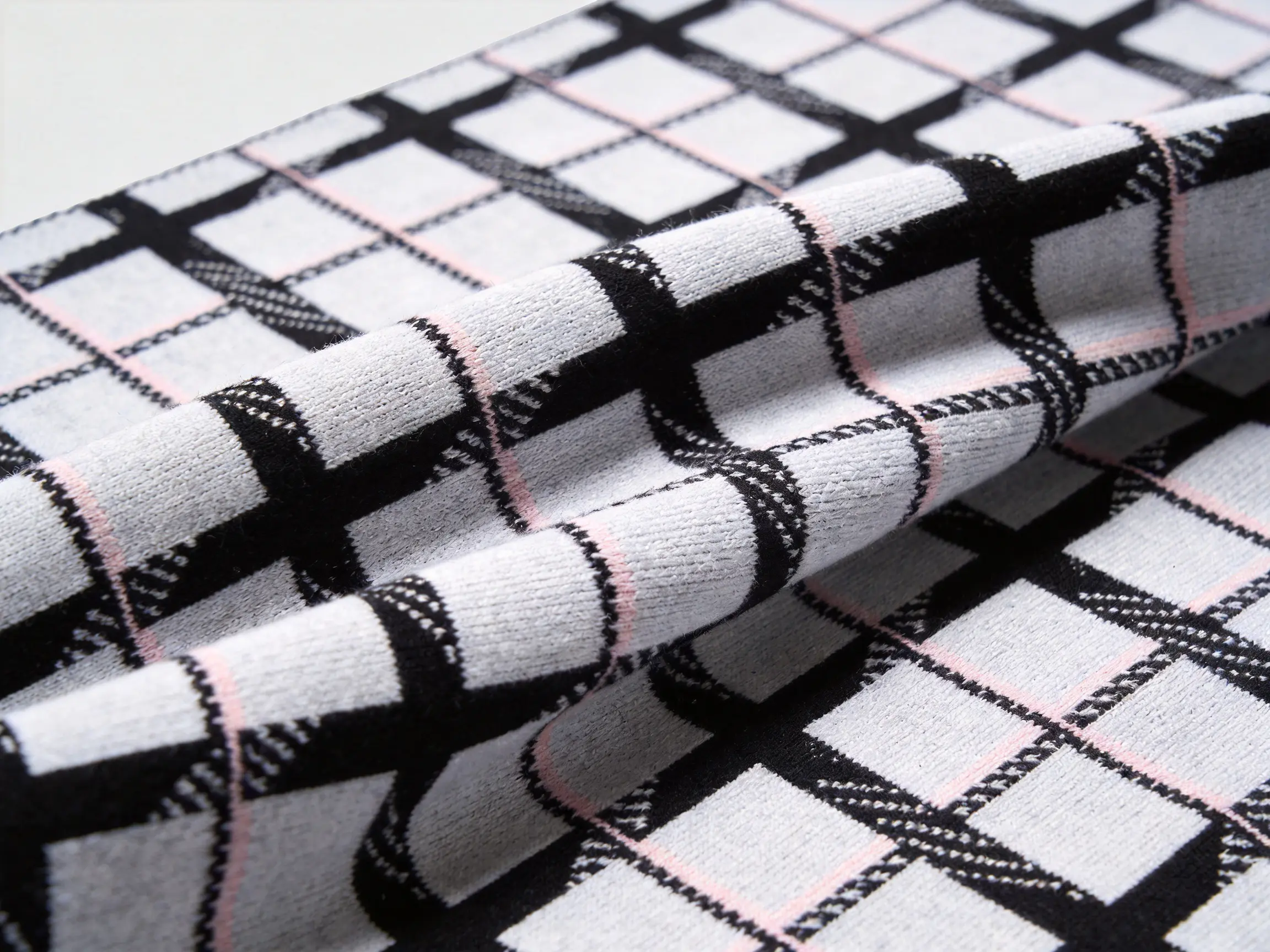
Black and white jacquard pattern fabric is a refined knitted textile designed for apparel creators who want visual contrast, dimensional texture, reliable opacity, and a polished hand feel in one material. The fabric combines viscose, polyamide or polyester, and spandex to achieve a balanced performance profile: softness from the cellulosic component, resilience and shape support from the synthetic component, and comfortable stretch from elastane. Its bold check design uses black lines, pale pink shadowing, a light grey background, and a subtle lustre to create a modern interpretation of a classic monochrome pattern. For designers, garment manufacturers, studios, and fabric buyers, this fabric offers a strong solution for structured dresses, textured skirts, coordinated sets, premium shirting-inspired garments, and fashionable separates that need both elegance and stability.
Unlike ordinary printed check fabrics, this product relies on jacquard knitting to build pattern and surface interest directly into the fabric structure. The pattern is not simply placed on the surface; it is integrated into the textile formation. This creates a richer appearance, a more sophisticated tactile quality, and a stronger sense of craftsmanship. The black and white contrast is timeless, while the pale pink shadow detail adds softness and originality. The light grey ground offers flexibility for both formal and contemporary styling, making the fabric suitable for multiple market segments, from boutique fashion to ready-to-wear production. With a minimum order quantity of 500 g, it is also accessible for sampling, small development projects, capsule collections, and customized garment trials.
Product Overview and Design Identity
The defining feature of this black and white jacquard pattern fabric is its ability to merge classic tailoring language with knitted comfort. A check pattern is one of the most recognizable motifs in apparel, but the jacquard construction upgrades it from a flat visual element to a textured design feature. The black lines provide graphic strength, the pale pink shadow effect adds depth, and the light grey base softens the contrast so that the fabric remains wearable rather than harsh. The result is a fabric that can appear elegant, artistic, or contemporary depending on garment silhouette, trim selection, and finishing details.
The material composition of viscose, polyamide or polyester, and spandex gives the fabric a distinctive combination of comfort and performance. Viscose contributes a smooth touch and improved drape, which helps garments feel pleasant against the skin. Polyamide or polyester contributes durability, recovery, and dimensional stability, supporting the fabric during cutting, sewing, wearing, and care. Spandex provides elasticity, allowing the fabric to adapt to body movement without looking loose or shapeless. This combination is especially useful for structured dressmaking because the fabric can hold form while still offering flexibility.
The fabric is fully opaque, which is a significant advantage for apparel applications. Many lightweight or decorative fabrics require lining because they are translucent or lack body. This jacquard fabric reduces that limitation. Its opacity allows designers to create dresses, skirts, tops, and jackets with improved coverage and a cleaner appearance. Depending on the garment design, a lining may still be selected for comfort, luxury, or construction purposes, but opacity gives buyers more freedom. For manufacturers, fewer lining requirements can simplify production and reduce material complexity.
The slight sheen of the surface gives the fabric a polished, premium impression. It is not overly glossy, so it does not look artificial or exaggerated. Instead, the subtle lustre helps catch light on the raised pattern and background, enhancing the jacquard effect. This makes the textile appropriate for garments intended for offices, events, retail displays, fashion photography, and seasonal collections. The sheen also gives simple silhouettes more visual value, allowing designers to make attractive garments without excessive decoration.
Key Specifications
| Item | Details | Value for Buyers |
|---|---|---|
| Product name | Black and White Jacquard Pattern Fabric | Clear visual identity for modern apparel development |
| Category | Knitted jacquard fabric | Combines pattern texture with knit comfort |
| Material | Viscose plus polyamide or polyester plus spandex | Softness, resilience, elasticity, and dimensional support |
| Design | Black and white check with pale pink shadowing and light grey background | Classic yet contemporary styling potential |
| Appearance | Opaque with slight sheen | Premium look and practical garment coverage |
| Recommended use | Dresses, skirts, structured separates, fashion tops, coordinated sets | Suitable for both boutique and production applications |
| Minimum order quantity | 500 g | Convenient for sampling, trials, and small-batch development |
Advantages Over Ordinary Check and Printed Fabrics
The most important advantage of this fabric over many competitor products is that the pattern is created through jacquard knitting rather than surface printing alone. Printed fabrics can be attractive, but the design often sits on top of the base cloth. Over time, surface prints may fade, crack, or lose clarity depending on dye quality, abrasion, washing conditions, and garment usage. A jacquard pattern, by contrast, is formed as part of the fabric structure. This gives the textile more depth and a more enduring visual character. It also allows the fabric to present a tactile pattern that can be felt as well as seen.
Another advantage is the balance between structure and comfort. Woven jacquards are often beautiful, but they can be stiff, restrictive, or less forgiving on the body. Lightweight knits are comfortable, but many lack the body required for structured apparel. This knitted jacquard fabric sits between those categories. It can support shaped garments while remaining easier to wear than many rigid woven textiles. For customers who want elegance without sacrificing movement, that balance is a major selling point.
The opacity of the fabric also distinguishes it from lighter decorative knits. When a fashion fabric is not fully opaque, the garment maker must consider underlayers, lining, or strategic placement to prevent transparency issues. Those extra steps can increase cost and complicate production. This product’s opacity supports confident garment construction and makes it easier to use in skirts and dresses. It can also improve consumer comfort because the wearer does not have to worry about see-through areas under normal styling conditions.
The visual composition offers another competitive edge. Many black and white checks are predictable: strong contrast, simple lines, and little nuance. This fabric adds pale pink shadowing and a lustrous light grey background, creating an effect that is more layered and design-oriented. The pink shadow is subtle enough not to dominate the palette, but it softens the graphic strength of the black lines. The grey ground prevents the fabric from appearing too stark. This makes the fabric easier to incorporate into modern collections, especially those aimed at customers who appreciate classic motifs with updated detail.
Spandex content improves the wearing experience compared with non-stretch jacquards. Garments made from structured fabrics can sometimes feel restrictive at the shoulders, waist, hips, or knees. The elastic component helps the fabric move with the body, improving comfort in fitted dresses, pencil skirts, slim tops, and officewear. This is particularly valuable for fashion brands that serve consumers who want polished clothing suitable for long hours of wear. The fabric’s recovery also helps garments maintain shape and reduce bagging when correctly engineered and sewn.
Compared with plain knit fabrics, this jacquard product delivers more visual value per square meter. A plain knit may require pleating, embroidery, printing, trim, or complex pattern cutting to create a high-fashion appearance. The jacquard itself already contributes surface interest, contrast, texture, and shine. Designers can therefore create compelling garments with cleaner lines. This can reduce reliance on secondary embellishments and help production teams achieve a premium look with controlled complexity.
Material Performance: Viscose, Synthetic Fiber, and Spandex
The combination of viscose, polyamide or polyester, and spandex reflects a practical understanding of modern apparel needs. Viscose is valued for its soft hand, smooth surface, and comfortable drape. It gives the textile a pleasant feel that is suitable for garments worn close to the body. It also helps the fabric avoid the overly dry or plastic-like hand that some synthetic textiles may have. When used in a jacquard structure, viscose can enhance the fabric’s richness and contribute to a fluid yet substantial handle.
Polyamide or polyester brings strength and stability. These synthetic fibers are widely used in fashion textiles because they improve durability, support color clarity, and help fabrics resist deformation. In a patterned knit, synthetic fiber content can help maintain the definition of the jacquard structure. It can also support better wear performance in garments that experience repeated movement and laundering. For production buyers, this translates into fewer concerns about fragile handling, poor recovery, or rapid deterioration under normal use.
Spandex is essential for elasticity. Even a small amount can significantly improve comfort and fit. In garments made from this fabric, spandex allows the textile to stretch and return, supporting body movement without permanently distorting the garment. This is especially useful in tailored-looking knitwear, where the designer wants a neat silhouette but the consumer expects comfort. When combined with appropriate garment engineering, spandex can help create pieces that look structured while feeling flexible.
The material blend is also useful for different market positions. For a premium boutique, the soft touch and sheen can support a sophisticated collection. For a ready-to-wear manufacturer, the durability and stretch support practical consumer expectations. For a design studio, the accessible minimum order quantity allows experimentation without requiring immediate large-volume commitment. This versatility makes the fabric attractive to a wide range of buyers, from sample developers to wholesalers and garment producers.
Jacquard Knitting and the Value of Structural Pattern
Jacquard knitting is a key reason this fabric stands apart. In jacquard fabric production, the machine controls yarn selection and loop formation to create complex patterns. The design is built into the textile rather than applied after the base cloth is made. This approach enables geometric motifs, checks, shadows, texture shifts, and tonal effects that are difficult to achieve with standard plain knitting. For this product, jacquard knitting creates the black and white check effect with shadowing and surface depth.
The knitted construction gives the fabric a softer, more flexible quality than many woven jacquards. Knitted loops can expand and contract, providing comfort and drape. At the same time, jacquard structures can be engineered to provide body and pattern stability. This dual character is ideal for modern garment design, where consumers expect clothing that looks refined but feels comfortable. The fabric can support structured looks while avoiding the stiffness that sometimes limits woven decorative textiles.
Structural pattern also creates better perceived value. Customers can see and feel that the design is part of the textile itself. In retail environments, tactile quality matters: consumers often touch fabrics before deciding whether a garment feels premium. A jacquard surface communicates craftsmanship, even in simple garment shapes. This helps brands create products that stand out on racks and online, especially when photographed with good lighting that highlights the slight sheen and pattern relief.
Because the check motif is created through the fabric structure, it can interact beautifully with garment seams and silhouettes. Designers can use pattern placement to emphasize waistlines, panels, yokes, or skirt shapes. The check design can be aligned for a clean tailored look or used creatively for directional contrast. While careful cutting and matching may be required for high-end garments, the result can be striking. This makes the textile useful for both commercial fashion and more design-led collections.
Advanced Manufacturing Strengths
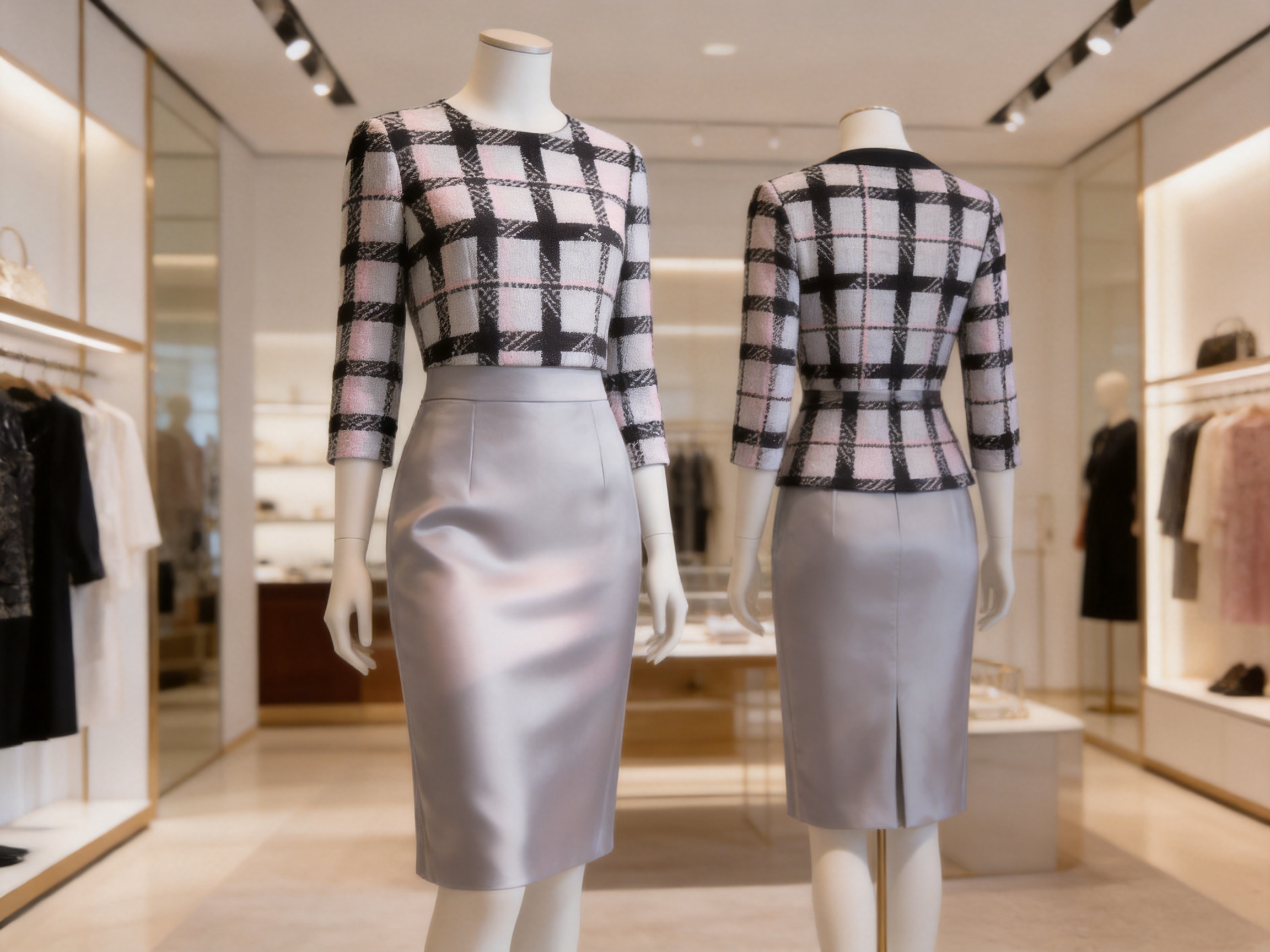
The fabric is supplied by Hangzhou Jinfeng Textile Co., Ltd., a textile company located in Jingjiang Street Industrial Park, Xiaoshan District, Hangzhou City, Zhejiang Province. The company operates with a substantial industrial base, covering 32.6 acres with a plant area of approximately 18,000 square meters. This scale supports integrated production, processing, post-dyeing, finishing, and sales. For buyers, such integration matters because it reduces fragmentation in the supply chain and helps maintain consistency from yarn to finished fabric.
The company’s business covers blended fabrics such as polyester and spandex fabrics, as well as DTY polyester yarn production, processing, and sales. This yarn-to-fabric capability supports stronger technical control. When a manufacturer understands yarn behavior, texturing, knitting, dyeing, and finishing together, it can better solve problems related to hand feel, elasticity, shrinkage, color performance, and surface appearance. For jacquard fabrics, where pattern precision and fabric stability are central, this manufacturing knowledge is especially valuable.
Drawn textured yarn, commonly known as DTY, is important in modern textile manufacturing because it gives polyester yarn bulk, elasticity, and improved textile hand. The company’s involvement in DTY polyester yarn production provides a strong foundation for developing fabrics with reliable stretch, texture, and performance. Textured yarns can contribute to softer touch, better coverage, and improved recovery compared with flat filament yarns. In jacquard fabric, yarn quality directly affects pattern clarity, surface evenness, and finished fabric character.
Production and processing facilities allow the company to respond to different customer requirements. Jacquard fabric development often requires coordination between design, yarn selection, machine settings, fabric weight, finishing targets, and sample evaluation. A manufacturer with integrated capabilities can manage these stages more efficiently. This can shorten development cycles and help customers move from concept to sample to bulk order with fewer delays. For international buyers, reliable communication and technical follow-through are important advantages.
Post-dyeing and finishing capabilities are another strength. The appearance of a jacquard fabric depends not only on knitting but also on finishing. Finishing can influence sheen, softness, dimensional stability, shrinkage, surface smoothness, and garment performance. A fabric may be well knitted but fail commercially if it shrinks excessively, feels harsh, or lacks stable width. Integrated finishing helps refine the textile and prepare it for garment production. For this black and white jacquard pattern fabric, finishing contributes to its subtle lustre, opacity, and structured hand.
Quality control is also central to competitive manufacturing. For patterned fabrics, inspection must consider more than basic defects. Teams must evaluate pattern alignment, repeat accuracy, color consistency, surface uniformity, fabric width, weight, hand feel, elasticity, recovery, and visible flaws. A professional manufacturer can apply checks across production stages to identify issues early. This reduces risk for garment factories that depend on predictable cutting yield and consistent finished appearance.
Manufacturing Process from Yarn to Finished Fabric
Yarn Preparation and Texturing
The manufacturing journey begins with the selection and preparation of yarns suitable for jacquard knitting. Viscose, synthetic filament or staple yarns, and spandex must be chosen according to desired fabric weight, stretch, drape, surface texture, and color behavior. Where polyester DTY is used, yarn texturing can improve bulk and elasticity. Textured yarn gives fabric a fuller hand and can improve coverage, which supports the fully opaque nature of the product. Consistent yarn quality is essential because uneven yarn can create streaks, pattern distortion, or inconsistent sheen.
Jacquard Design Development
Before knitting begins, the design must be translated into machine-readable jacquard instructions. The black and white check, pale pink shadow, and light grey background require careful planning so that each color or yarn effect appears in the correct area. The repeat must be balanced for garment applications, avoiding overly large motifs that are difficult to cut or overly small motifs that lose visual impact. Design development also includes technical decisions about stitch structure, yarn tension, and elasticity. These decisions determine the final character of the fabric.
Knitting and Pattern Formation
During jacquard knitting, the machine forms loops while controlling yarn placement to create the check pattern. This stage requires accurate machine settings and stable yarn feeding. Tension control is crucial because spandex and other yarns behave differently under stress. If tension is too high or too low, the fabric may curl, distort, or show uneven pattern lines. Skilled technicians monitor the process to keep the design sharp and the fabric surface even. This technical precision gives the fabric its clean geometric appearance.
Dyeing and Color Management
Color management is essential for a black and white design with subtle supporting tones. Black must appear strong and clean, white or light areas must remain bright, and the pale pink shadow must be delicate rather than overpowering. If dyeing or yarn coloration is not controlled, the pattern may look muddy or inconsistent. The light grey background must also maintain its refined tone. Professional dyeing and finishing procedures help achieve a harmonious palette that works across apparel categories.
Finishing for Hand Feel, Sheen, and Stability
Finishing transforms the knitted fabric into a garment-ready textile. Through controlled processes, the fabric can be stabilized, softened, and refined. The slight sheen is enhanced without making the surface look excessively glossy. Width and dimensional properties are adjusted to support cutting and sewing. Finishing can also improve surface smoothness, reduce unwanted distortion, and help the fabric maintain a polished appearance. The goal is to deliver a fabric that looks premium on the roll and performs reliably after being made into garments.
Inspection and Packaging
Final inspection ensures that the fabric meets buyer expectations before shipment. Inspectors check for visible defects such as broken yarns, stains, holes, mispatterning, uneven color, and surface irregularities. Measurements may include width, weight, stretch, and shrinkage, depending on order requirements. Proper rolling and packaging help protect the fabric during transport. For international buyers, consistent packaging and documentation also support efficient receiving, warehousing, and production planning.
Design and Garment Applications
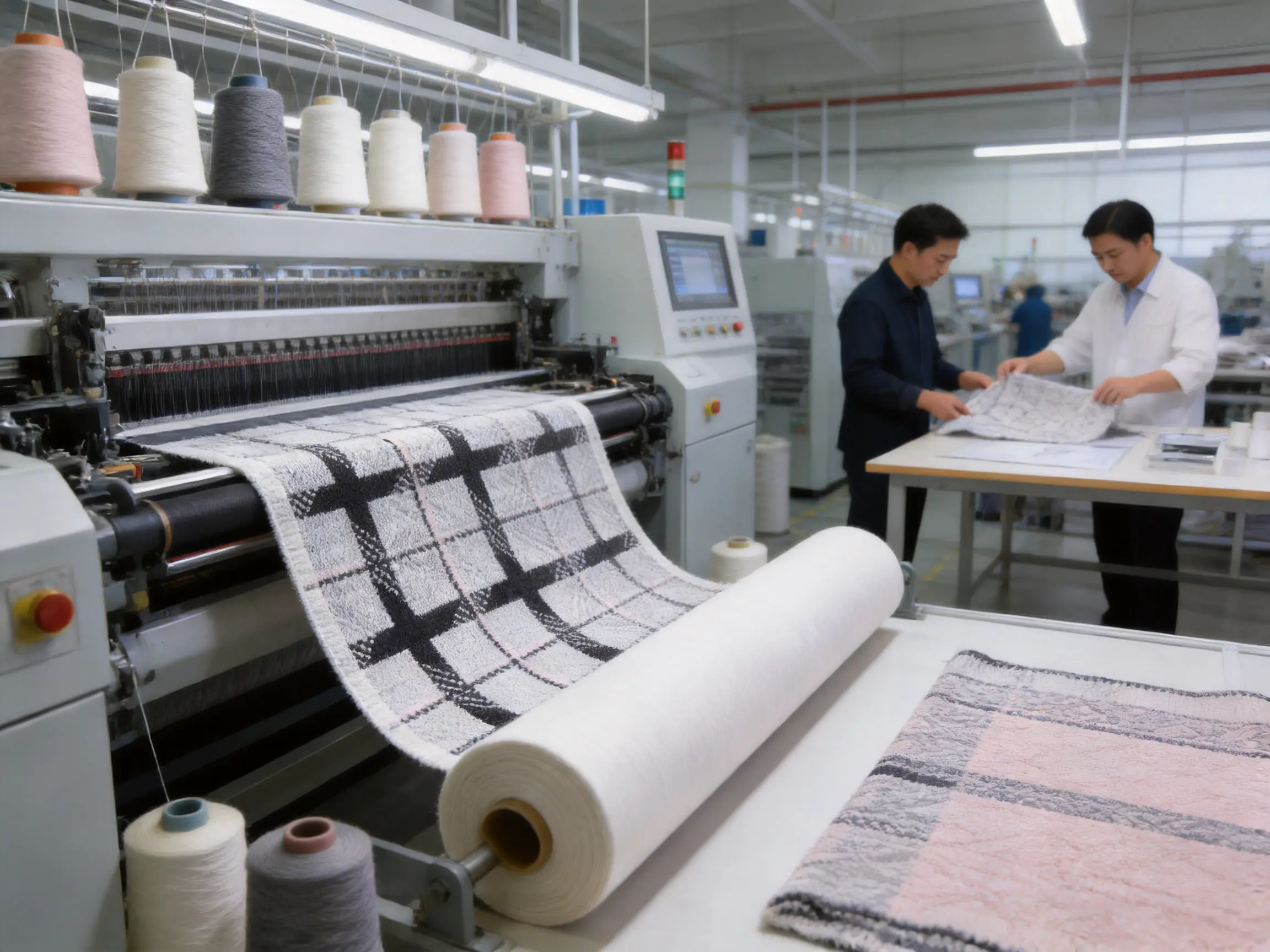
This fabric is particularly well suited for structured dressmaking. A sheath dress, A-line dress, fit-and-flare dress, or panelled office dress can benefit from its opacity, texture, and stretch. The check pattern provides visual architecture, while the knitted construction offers comfort. Designers can use solid trims, contrast collars, black piping, or simple invisible zippers to complete the look. Because the fabric already carries a strong design identity, garment shapes can remain clean and elegant.
Textured skirts are another excellent application. Pencil skirts made with this fabric can look polished while allowing movement, especially when spandex recovery is properly used. A-line or box-pleated skirts can highlight the geometric pattern and create a balanced silhouette. The black and white check can be styled with black knit tops, white shirts, grey sweaters, or pale pink blouses that echo the shadow detail. This styling versatility increases retail appeal.
The fabric can also be used for fashion tops. Structured knit tops, short-sleeve shells, mock-neck tops, and fitted blouses can all benefit from the fabric’s opacity and surface interest. Unlike thin jersey, this jacquard has enough visual weight to stand alone. It can be used for front panels paired with solid backs or sleeves, or it can be used throughout the garment for a bolder statement. Designers can also combine it with plain black or grey fabrics to reduce cost while preserving visual impact.
Coordinated sets are a strong modern opportunity. A matching top and skirt, or a cropped jacket and dress, can use the fabric to create a premium ensemble. The check pattern gives cohesion, while the knit structure keeps the outfit wearable. Such sets are appealing for boutiques, professional wardrobes, and seasonal fashion collections. Because the fabric has a classic base palette, coordinated pieces can be sold together or separately, increasing merchandising flexibility.
Light jackets, cardigan-style toppers, and unstructured blazers may also be developed using the fabric, depending on weight and finishing. The jacquard pattern can give these pieces a tailored appearance without requiring heavy woven construction. For travel-friendly wardrobes, stretch jacquard jackets can be attractive because they look refined yet feel less restrictive. Interfacing, lining, and seam reinforcement should be selected according to garment design and performance requirements.
The fabric’s aesthetic also supports accessories and detail applications. Designers may use it for cuffs, collars, panels, waistbands, pockets, yokes, or decorative inserts. When combined with plain fabrics, it can create a premium accent without making the entire garment bold. This is useful for brands that want to incorporate pattern in a controlled way. The minimum order quantity of 500 g supports such experimentation, especially for sample makers and small studios.
Why Buyers Choose This Fabric
Buyers choose this black and white jacquard pattern fabric because it solves several common product development challenges at once. It provides a ready-made visual story, reducing the need for additional decoration. It offers opacity, reducing transparency concerns. It includes stretch, improving comfort and fit. It has a subtle sheen, raising perceived value. It also comes from a manufacturer with experience in yarn, blended fabrics, dyeing, finishing, and sales, which supports more reliable sourcing.
For fashion brands, the fabric helps create garments that are easy to describe and market. Phrases such as “black and white jacquard,” “structured knit,” “subtle sheen,” and “classic check with modern shadow detail” communicate strong value to consumers. The design is familiar enough to be accessible but distinctive enough to stand out. This is important in competitive apparel markets where buyers want novelty without excessive risk.
For garment factories, the fabric offers practical advantages. The opacity and body can simplify construction. The stretch can support better fit across sizes. The jacquard surface can hide minor body-line imperfections better than flat, thin fabrics. The pattern can enhance simple silhouettes, allowing factories to produce attractive garments without highly complex sewing operations. Of course, pattern matching and cutting direction still require attention, but the fabric’s inherent design value supports efficient product development.
For wholesalers and fabric distributors, the product has broad appeal. It can be positioned for dresses, skirts, tops, separates, and fashion sampling. The black and white base makes it easier to sell across seasons, while the pink and grey details provide a fresh twist. The fabric can attract both conservative buyers who like classic checks and trend-focused buyers who want modern jacquard texture. This dual appeal improves inventory flexibility.
For independent designers and studios, the 500 g minimum order quantity is especially useful. Many creative buyers need small quantities for prototyping before committing to larger production. A low entry quantity supports design exploration, sample garments, photography pieces, and customer testing. If the response is positive, larger orders can be planned. This reduces risk and encourages innovation.
Quality Considerations for Apparel Production
To achieve the best results, garment makers should handle this jacquard fabric with respect for its structure. Cutting should be planned so that the check pattern aligns where visually important, such as center fronts, side seams, waist seams, and hems. For high-end garments, pattern matching can significantly improve perceived quality. If the design is used in asymmetric or creative ways, the placement should be intentional rather than accidental.
Needle selection is important for sewing knitted jacquard fabrics. A ballpoint or stretch needle may help prevent yarn damage, depending on the exact fabric construction. Seam type should allow for the fabric’s elasticity. Overlock seams, coverstitch hems, stretch stitches, or reinforced straight seams may be selected according to garment style. Testing before bulk production is recommended to confirm seam strength, elasticity, and appearance.
Pressing should be controlled. Because the fabric contains synthetic fiber and spandex, excessive heat may affect surface appearance, elasticity, or dimensional stability. A press cloth and moderate temperature are advisable during sample development. Garment factories should test pressing parameters before production. Proper pressing can sharpen seams and improve garment finish without damaging the subtle sheen.
Care labeling should be based on testing. Blended fabrics may respond differently depending on exact fiber percentages, dyeing process, finishing, and garment construction. Testing for shrinkage, colorfastness, stretch recovery, pilling, and dimensional stability helps ensure accurate care recommendations. For many fashion garments, gentle washing or professional care may be selected to preserve shape and appearance. Clear care instructions improve consumer satisfaction and reduce returns.
Pattern direction should also be considered. Jacquard checks may have a preferred orientation, and slight sheen can make directionality visible under light. Cutting all pieces in the same direction helps maintain a consistent appearance. If designers intentionally rotate panels for effect, they should check how light reflects from different angles. Sample garments are the best way to evaluate final visual impact.
Company Capabilities and Customer Support
Hangzhou Jinfeng Textile Co., Ltd. operates as a self-employed export company integrating research and development, production, and sales. This integrated model supports customers who need more than a fabric roll; they need technical communication, sampling support, manufacturing reliability, and export service. The company’s philosophy emphasizes cooperation and mutual benefit, which is valuable for long-term buyer relationships. Textile development often requires adjustment and dialogue, so a cooperative supplier can be a strategic advantage.
The company’s location in Hangzhou, Zhejiang Province, places it within one of China’s active textile and manufacturing regions. Regional industrial experience can support access to skilled labor, textile machinery knowledge, dyeing and finishing resources, logistics, and supply chain coordination. For international buyers, supplier location and infrastructure can affect lead time, communication efficiency, and shipment planning. A company with established production facilities and export experience is better positioned to serve global customers.
Its product categories include polyester rayon fabric, knitted jacquard fabric, NTR knitted fabric, NR knitted fabric, and slight intermingled drawn textured yarn. This product range shows that the company works across yarn and fabric categories, not merely one isolated textile type. Such diversity supports material development and allows customers to discuss related sourcing needs. A buyer interested in this black and white jacquard may also require yarn, blended fabric, or other knitted fabric solutions for future collections.
Manufacturing strength is not only about equipment; it is also about coordination. Successful jacquard fabric production requires communication between design technicians, machine operators, dyeing specialists, finishing teams, inspectors, and sales staff. When those functions are organized under a capable supplier, customers can receive more consistent answers and better problem solving. This is especially important for repeat orders, where buyers need color and quality to remain stable across batches.
The company’s plant area of around 18,000 square meters supports production scale, while its experience in processing and post-dyeing helps refine fabric value. In competitive textile markets, buyers often compare suppliers on price alone, but the lowest price may not deliver the best outcome if quality is unstable. A supplier with broader production control can offer a better balance of cost, performance, and reliability. For jacquard fabrics, that balance is critical because pattern defects and finishing problems can reduce cutting yield and garment value.
Competitive Position in the Fabric Market
In the current apparel market, buyers seek fabrics that can help garments stand out without making production too complicated. This black and white jacquard pattern fabric answers that demand. It offers a recognizable check motif, upgraded by jacquard texture and subtle color shadowing. It provides a premium look suitable for modern fashion, yet remains practical for everyday garments. Compared with many decorative textiles, it is not overly fragile or narrow in use. Compared with plain knits, it offers much higher visual impact.
The fabric can compete effectively against printed polyester checks because it provides structural depth. It can compete against woven jacquards because it offers more comfort and stretch. It can compete against plain viscose blends because it has stronger surface design. It can compete against luxury novelty fabrics because it offers practical minimum order flexibility and broader garment applications. This multi-directional competitiveness makes it a strong choice for buyers seeking both style and function.
Another competitive factor is its color palette. Black, white, and grey are among the easiest colors to style, while pale pink adds a modern softness. This means garments made from the fabric can coordinate with common wardrobe colors, including black, white, grey, blush, charcoal, navy, and silver. Retail customers are more likely to purchase patterned garments when they can imagine wearing them with items they already own. The fabric therefore supports commercial sell-through as well as design appeal.
The fabric also supports sustainability-minded design in an indirect way through versatility and longevity of style. While specific sustainability certifications are not stated in the provided material, a timeless pattern and durable blended construction can help garments remain wearable beyond one short trend cycle. Classic checks are repeatedly revived in fashion, and black and white combinations rarely disappear from the market. A fabric that can be styled across seasons may support better product longevity than highly seasonal novelty prints.
Recommended Development Path for Buyers
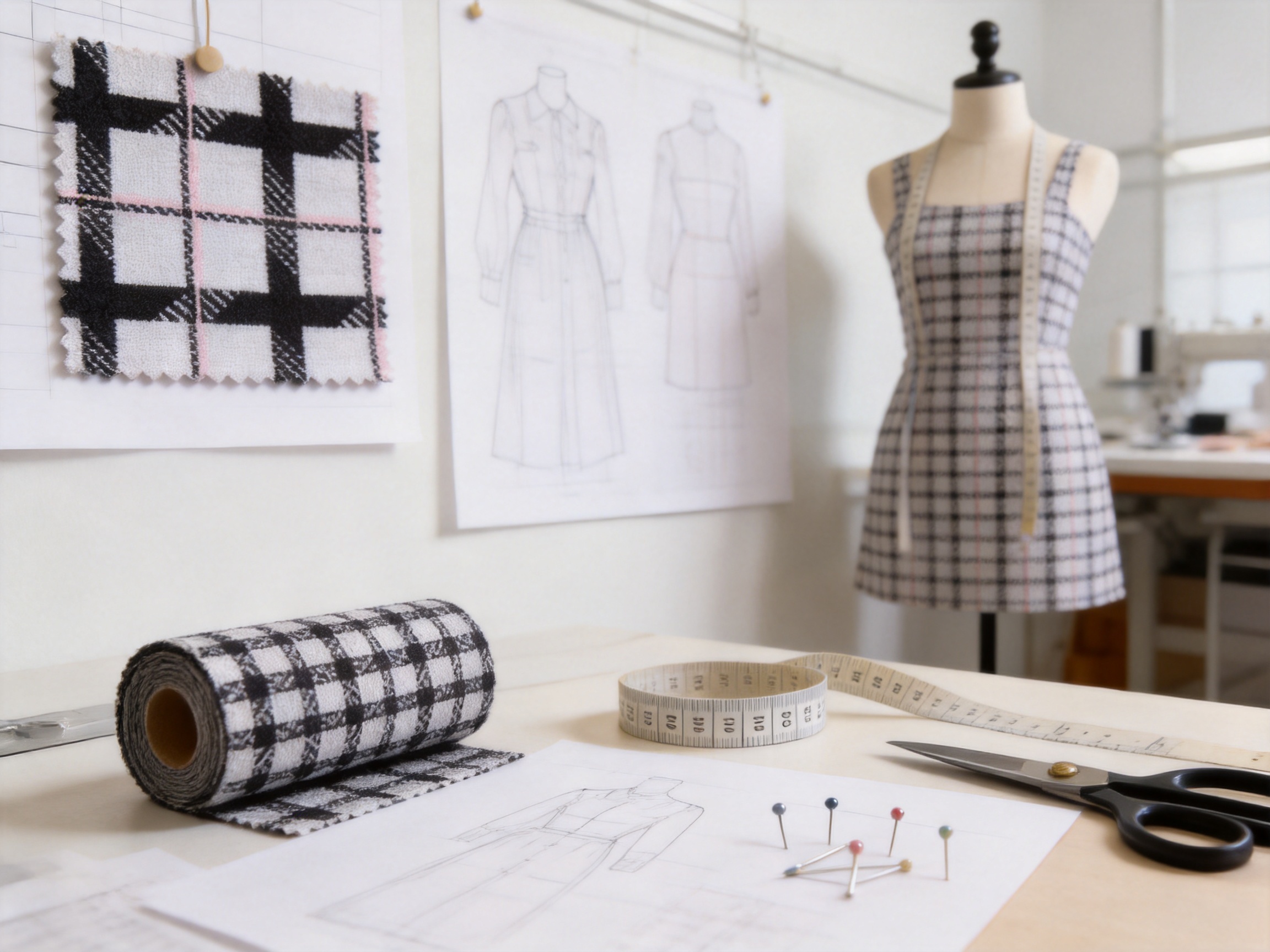
Buyers interested in this fabric may begin with a small sample order, supported by the 500 g minimum order quantity. The first step should be evaluating hand feel, weight, stretch, opacity, sheen, and pattern scale. Designers should drape the fabric on a form and test it in the intended garment category. A fabric that looks excellent flat may behave differently in a fitted dress, skirt, or jacket, so physical sampling is important.
The next step is prototype development. A basic garment sample can reveal how the fabric responds to cutting, sewing, pressing, and wearing. Designers should check seam appearance, pattern alignment, recovery after stretching, comfort against the skin, and overall silhouette. If the product is intended for a commercial range, fit testing on different body types can provide valuable information. The stretch component may improve fit, but garment patterns should still be engineered carefully.
After prototype approval, buyers can discuss bulk requirements, color consistency, packaging, lead time, and quality standards. If a brand plans repeat production, it should define expectations for shade, width, weight tolerance, shrinkage, and inspection criteria. Clear technical communication reduces misunderstanding and supports a smoother production process. For jacquard fabrics, sample approval should include both visual and performance standards.
For brands developing a collection, this fabric can function as a hero textile. A hero textile is a key material that defines the visual story of a group. Designers can build around it with solid black knits, grey suiting fabrics, white shirting, pale pink accents, or textured polyester-rayon blends. This approach creates a coordinated collection with strong merchandising potential. A single jacquard fabric can therefore influence multiple garments and increase collection coherence.
Q&A Section
What is the main feature of this black and white jacquard pattern fabric?
The main feature is its knitted jacquard check pattern with black and white contrast, pale pink shadowing, and a light grey background. The design is built into the fabric structure, giving it more depth and texture than a simple printed check fabric.
What garments is this fabric best suited for?
It is suitable for structured dresses, textured skirts, fashion tops, coordinated sets, light jackets, and decorative garment panels. Its opacity, stretch, subtle sheen, and patterned surface make it especially useful for modern dressmaking and polished separates.
Why is jacquard construction better than surface printing for this product?
Jacquard construction creates the pattern through the fabric structure, while surface printing applies color on top of the cloth. Structural pattern gives richer texture, better tactile value, and a more premium appearance. It also helps the fabric stand out in competitive fashion markets.
Does the fabric have stretch?
Yes. The inclusion of spandex gives the fabric elasticity and comfort. This makes it more suitable for fitted or semi-fitted garments than rigid decorative fabrics. Stretch also helps improve wearer comfort during movement.
Is the fabric transparent?
No. The fabric is described as fully opaque, which makes it practical for dresses, skirts, tops, and other apparel applications where coverage is important. Depending on the garment design, lining may be optional rather than always necessary.
What does the slight sheen add to the fabric?
The slight sheen adds a polished and refined appearance. It helps the jacquard texture catch light and enhances the premium quality of the fabric without making it look excessively glossy.
What is the minimum order quantity?
The minimum order quantity is 500 g. This is convenient for sampling, small-batch development, prototype garments, and independent design projects before larger production orders are placed.
What manufacturing strengths support this fabric?
The supplier has capabilities in DTY polyester yarn production, blended fabric manufacturing, knitting, post-dyeing, finishing, and sales. Its integrated production model supports better control over yarn quality, pattern formation, fabric stability, and final appearance.
How should garment makers handle the fabric during production?
Garment makers should test cutting direction, pattern alignment, needle selection, seam type, pressing temperature, shrinkage, and stretch recovery before bulk production. Careful sample testing helps ensure the best finished garment quality.
Why is this fabric commercially attractive?
It combines classic black and white styling with modern jacquard texture, subtle pink shadow detail, stretch comfort, opacity, and a refined sheen. These qualities make it suitable for both trend-driven and timeless apparel collections.
Conclusion
Black and white jacquard pattern fabric is a compelling textile for designers and buyers who want a balance of visual sophistication, comfort, and production practicality. Its check design is classic, but the pale pink shadowing and light grey lustrous background make it contemporary. Its jacquard construction gives it depth and tactile appeal, while its viscose, synthetic fiber, and spandex blend supports softness, resilience, and stretch. The fabric is opaque, polished, and suitable for a wide range of garments, especially structured dresses and textured skirts.
Compared with ordinary printed checks, plain knits, and rigid woven jacquards, this fabric offers a strong combination of pattern permanence, comfort, surface richness, and wearability. It allows brands to create garments that look refined without sacrificing ease of movement. It also supports efficient development because the fabric itself already provides a strong design statement. For buyers, the 500 g minimum order quantity makes it accessible for sampling and small projects, while the manufacturer’s integrated capabilities support larger production needs.
Supported by Hangzhou Jinfeng Textile Co., Ltd.’s experience in DTY polyester yarn, blended fabrics, knitting, dyeing, finishing, and export sales, this fabric is more than a decorative material. It represents a practical product development solution for modern apparel. Its advantages lie in its structure, appearance, comfort, versatility, and manufacturing foundation. For collections that require a fabric with classic appeal and modern performance, this black and white jacquard pattern fabric is a highly valuable choice.
References
Sinclair, R. Textiles and Fashion: Materials, Design and Technology. Woodhead Publishing.
Spencer, D. J. Knitting Technology: A Comprehensive Handbook and Practical Guide. Woodhead Publishing.
Goswami, B. C., Martindale, J. G., and Scardino, F. L. Textile Yarns: Technology, Structure, and Applications. Wiley-Interscience.
Collier, B. J., and Epps, H. H. Textile Testing and Analysis. Pearson.
Kadolph, S. J. Textiles. Pearson.
Horrocks, A. R., and Anand, S. C. Handbook of Technical Textiles. Woodhead Publishing.
