
Black and White Jacquard Pattern Fabric for Refined Structured Apparel
Black and white jacquard pattern fabric is a refined knitted textile designed for apparel makers, fabric buyers, designers, and sourcing teams that need a visually strong yet practical material for modern dressmaking. With its bold check design, pale pink shadow lines, light grey background, subtle lustre, full opacity, and slight sheen, this fabric combines decorative sophistication with dependable wearability. It belongs to the knitted jacquard fabric category and is made from a blend of viscose, polyamide or polyester, and spandex, giving it a balanced structure that supports comfort, resilience, drape, and shape retention.
This article explores the material qualities, production logic, design advantages, competitive strengths, manufacturing processes, application value, and purchasing considerations of this black and white jacquard pattern fabric. It also explains why an integrated textile producer with capabilities in yarn production, fabric processing, dyeing, finishing, research, and export service can offer meaningful benefits to global buyers seeking consistent quality and stable supply.
Black And White Jacquard Pattern Fabric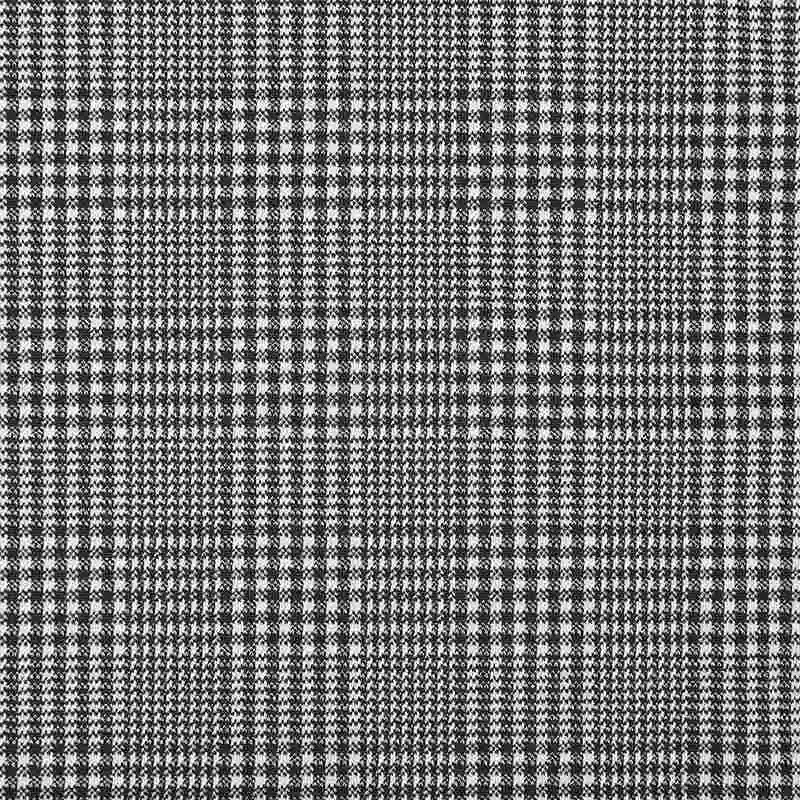
Product Overview
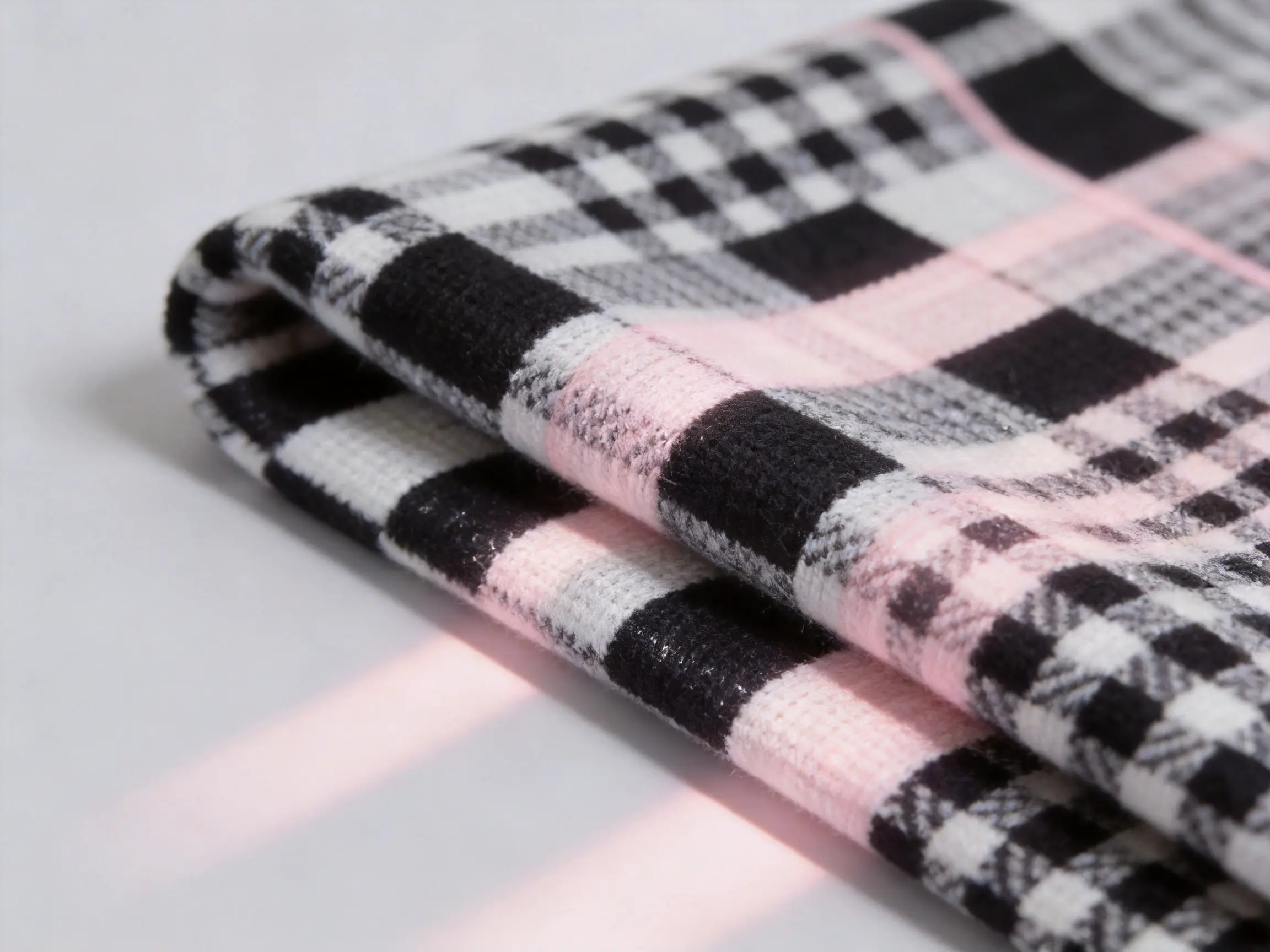
The featured fabric is a black and white jacquard pattern fabric developed for structured fashion garments and stylish textile applications. Its visual character is built around a bold check motif, where black lines are softened by pale pink shadowing and placed over a light grey ground with a delicate sheen. The result is not merely a simple monochrome check, but a layered, dimensional pattern that can appear classic, modern, or quietly luxurious depending on the garment design.
The fabric composition is listed as viscose, polyamide or polyester, and spandex. This combination is important because each fiber contributes a different performance value. Viscose supports a smooth touch and a more elegant drape. Polyamide or polyester contributes strength, stability, durability, and improved resistance to deformation. Spandex adds elasticity, helping the fabric move with the body and recover after stretching. Together, these fibers create a knitted jacquard fabric that is decorative but not fragile, structured but not stiff, and refined but still suitable for practical garment use.
The minimum order quantity is 500g, which is highly attractive for sample development, small-batch experimentation, designer studios, and buyers who need to evaluate material performance before proceeding with larger production. Many competing suppliers impose higher minimum order quantities that can limit flexibility, especially for independent brands or early-stage product development. A lower starting quantity allows designers to test cutting, sewing, lining, washing, pressing, and fit performance with reduced sourcing risk.
Visual Character and Design Appeal
The first strength of this fabric is its distinctive visual identity. Black and white checks are timeless, but this jacquard version adds complexity through pink shadow accents and a lustrous grey background. The pattern therefore avoids the flatness often seen in printed checks. Because the pattern is created through jacquard knitting rather than simply being printed on the surface, the design has more depth, texture, and permanence.
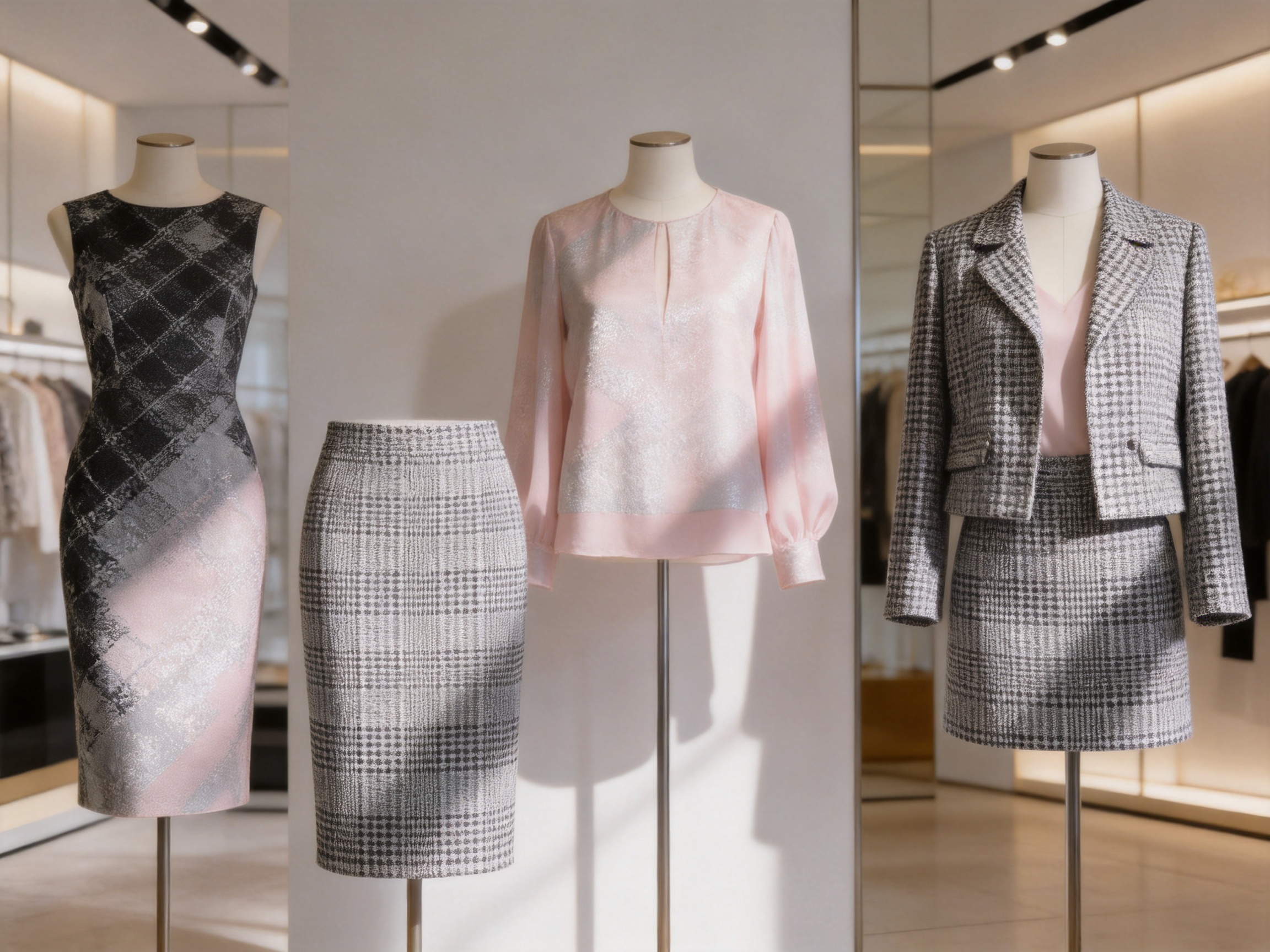
The combination of black, white, pale pink, and light grey gives the fabric broad styling potential. It can be used for garments that feel formal, polished, playful, retro, minimal, or contemporary. A structured skirt made from this fabric may look refined and architectural, while a fitted dress may look elegant with a subtle fashion-forward edge. It can also be used in tailored tops, lightweight jackets, coordinated sets, fashion panels, and decorative apparel details.
The fabric is fully opaque, which is a major advantage for dressmaking. Opacity reduces the need for heavy lining and helps garments look more substantial. It also improves wearer confidence, particularly for fitted silhouettes, skirts, dresses, and office-appropriate clothing. Many lightweight patterned fabrics look attractive at first glance but become less practical because they are translucent, require additional lining, or reveal seam allowances. This jacquard fabric offers more dependable coverage while maintaining a refined surface appearance.
The slight sheen adds another competitive advantage. A gentle lustre can elevate a garment without making it look overly glossy or synthetic. It catches light in movement, enhances the depth of the pattern, and makes finished apparel appear more premium. This balance is especially valuable for brands that need an elegant fabric suitable for both daywear and occasionwear.
Material Composition and Performance
The blend of viscose, polyamide or polyester, and spandex gives this fabric a multi-functional performance profile. Viscose is appreciated for its soft hand, breathable comfort, and natural-looking drape. It helps the textile feel pleasant against the skin and reduces the harshness that can sometimes occur in purely synthetic fabrics. In a jacquard structure, viscose can also support a smoother and more fluid surface effect.
Polyamide or polyester strengthens the fabric and improves dimensional stability. Polyester is widely used in modern textile production because it resists wrinkles, dries quickly, maintains color well, and supports long-term wear. Polyamide offers excellent toughness and abrasion resistance. In either case, the synthetic component helps the jacquard structure remain stable during garment production and everyday use. For brands and manufacturers, this means fewer quality issues related to distortion, excessive shrinkage, or surface fatigue.
Spandex gives the fabric stretch and recovery. This is particularly important in knitted jacquard fabrics because garment comfort often depends on the ability of the textile to adapt to body movement. Even a small percentage of spandex can improve fit, reduce strain at seams, and support silhouettes that are more body-conscious or structured. For dresses and skirts, stretch can improve walking comfort, sitting comfort, and general wearability.
Compared with many woven jacquard fabrics, knitted jacquard with spandex can provide greater flexibility and body comfort. Compared with basic printed knits, it provides richer pattern depth and a more upscale appearance. Compared with plain polyester fabrics, it offers a more refined hand and more complex design value. This balanced profile makes it suitable for brands that want both style and practical performance.
Key Product Specifications
| Feature | Description | Buyer Value |
|---|---|---|
| Product Type | Black and white knitted jacquard pattern fabric | Suitable for fashion apparel and structured dressmaking |
| Category | Knitted jacquard fabric | Offers pattern depth and textile texture beyond basic printed fabric |
| Composition | Viscose, polyamide or polyester, and spandex | Balances softness, durability, stretch, and shape retention |
| Pattern | Bold black and white check with pale pink shadowing | Creates a modern yet classic visual effect |
| Background | Light grey with subtle lustre | Adds elegance and improves perceived quality |
| Opacity | Fully opaque | Reduces lining requirements and supports confident garment use |
| Surface Effect | Slight sheen with textured jacquard character | Enhances premium apparel appearance |
| Minimum Order Quantity | 500g | Friendly for sampling, small development runs, and design testing |
| Recommended Uses | Dresses, skirts, tops, light jackets, panels, coordinated apparel | Supports multiple fashion categories |
Advantages Over Ordinary Printed Fabrics
One of the most important distinctions between jacquard fabric and ordinary printed fabric lies in the way the pattern is produced. In printed fabrics, the design is applied to the surface after the base fabric has already been created. This approach can be cost-effective, but it may lack texture, depth, and durability. The visual effect can sometimes appear flat, and the pattern may be more vulnerable to fading, cracking, or surface abrasion depending on print method and finishing quality.
Jacquard fabric, by contrast, forms the design through the fabric structure itself. In knitted jacquard, the pattern is integrated into the knitting process, creating a more dimensional and tactile effect. This structural patterning gives the black and white check design greater sophistication. The pale pink shadow and grey ground become part of the textile expression rather than a simple surface image.
For garment makers, this can improve the perceived value of finished apparel. Consumers often respond to fabrics that look textured, substantial, and carefully engineered. A jacquard pattern can make a garment appear more expensive even when the silhouette is simple. This allows designers to create high-impact pieces without relying on complicated cutting or excessive trims.
Another advantage is pattern durability. Because the pattern is not merely printed on the top surface, it can better withstand normal wear when properly cared for. The fabric can maintain a more stable decorative effect through cutting, sewing, pressing, and wearing. This is especially valuable for brands that want to reduce customer complaints related to fading or surface damage.
Advantages Over Basic Knitted Fabrics
Basic knitted fabrics are widely used because they are comfortable, flexible, and efficient to produce. However, plain knits may lack visual distinction. For brands competing in a crowded apparel market, fabric identity is often a major selling point. A black and white jacquard pattern fabric provides immediate shelf appeal and visual recognition, helping garments stand out in online product photos, showroom displays, and retail environments.
Compared with simple jersey, rib, or interlock fabrics, this jacquard fabric offers more design structure. The check pattern gives the garment a tailored feeling, while the knitted base maintains comfort and movement. This makes it especially useful for hybrid fashion categories: garments that look polished but feel comfortable, office pieces that stretch, and structured dresses that remain wearable for extended periods.
Another advantage is opacity. Some basic knits can become semi-transparent when stretched, especially lighter colors or thinner constructions. The featured jacquard fabric is described as fully opaque, making it more reliable for skirts, dresses, and fitted garments. This reduces the need for additional fabric layers and helps simplify production decisions.
The slight sheen also differentiates it from standard matte knits. It gives the fabric a subtle elegance that can support premium positioning. For designers, the material becomes a statement element rather than a neutral base.
Advantages Over Traditional Woven Jacquard
Traditional woven jacquard fabrics are known for intricate patterns, decorative richness, and formal beauty. However, woven jacquards may sometimes feel heavier, less elastic, or less comfortable for close-fitting garments. They may also require more careful tailoring, lining, and seam engineering to ensure comfort and mobility.
This knitted jacquard fabric offers an alternative. It keeps the decorative appeal of jacquard design while adding the comfort and stretch associated with knit structures. The inclusion of spandex improves flexibility and recovery, making the fabric more suitable for garments that follow the body. For contemporary fashion, this is a significant advantage because consumers increasingly expect clothing to combine elegance with ease of movement.
Knitted jacquard may also support faster garment development for certain silhouettes. Designers can create dresses, skirts, and tops that need less rigid tailoring than woven pieces. The fabric can provide structure through its surface and pattern while remaining adaptable during wear.
For buyers, this creates a strong commercial proposition: garments can look elevated but still meet modern comfort expectations. In markets where customers want clothing suitable for work, travel, social events, and daily wear, this combination is highly valuable.
Manufacturing Strength Through Integrated Textile Production
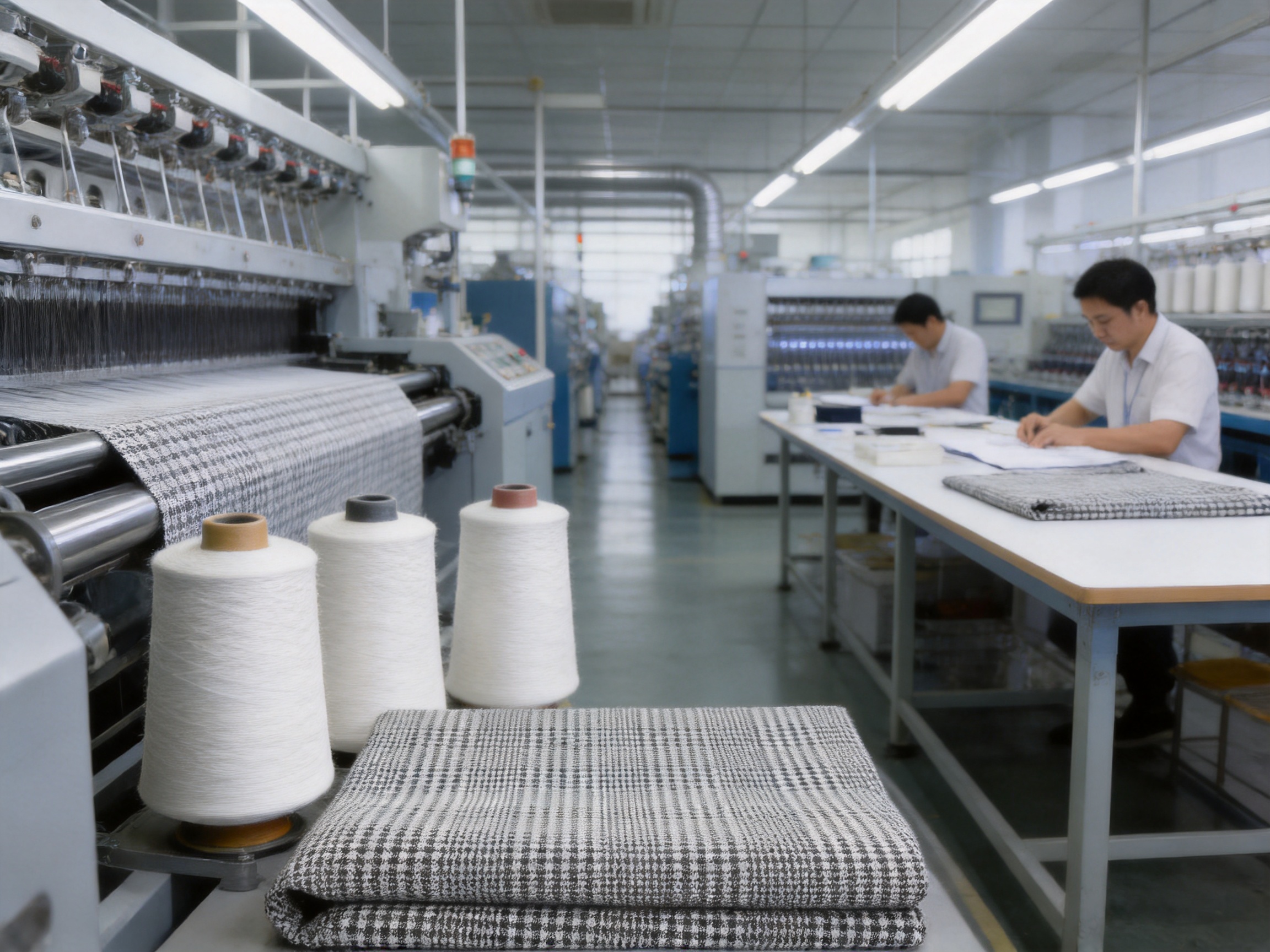
A major factor behind fabric quality is the strength of the manufacturing system. The producer associated with this fabric operates as an integrated textile enterprise with capabilities covering research and development, production, processing, post-dyeing, finishing, and sales. It also has experience in DTY polyester yarn production, processing, and sales. This integrated structure offers advantages that many trading-only suppliers or narrowly specialized factories cannot provide.
When yarn production, fabric manufacturing, dyeing, finishing, and sales coordination are connected within one industrial system, quality control can begin earlier and continue through every stage. Problems can be identified at the yarn level before they become fabric defects. Fabric construction can be adjusted based on end-use requirements. Dyeing and finishing can be aligned with fiber composition and buyer expectations. This reduces inconsistency and improves repeatability.
The production base covers a substantial industrial area with a large plant space, providing capacity for organized processing and stable order fulfillment. A larger manufacturing footprint allows better arrangement of machinery, inspection, storage, and workflow. It also supports the ability to serve both domestic and international customers with more reliable scheduling.
Integrated export capability is another strength. Export-oriented textile suppliers understand documentation, packaging expectations, quality communication, sample development, and buyer service requirements. For overseas customers, this can reduce sourcing friction and improve confidence during order negotiation and production follow-up.
Advanced Yarn and Fabric Control
The performance of a jacquard fabric begins with yarn. If yarn quality is inconsistent, the fabric may show uneven texture, poor elasticity, color variation, weak strength, or unstable shrinkage. Experience in DTY polyester yarn production is therefore an important advantage. Drawn textured yarn, commonly known as DTY, is valued for bulk, elasticity, softness, and suitability for knitted and blended fabrics. Control over DTY processing helps create yarns that support stable knitting, attractive surface texture, and reliable fabric performance.
In the case of black and white jacquard pattern fabric, yarn control affects not only strength but also visual precision. Jacquard checks require clean line definition and balanced color presentation. If yarn tension is unstable, the pattern can distort. If yarn quality varies, the surface may appear inconsistent. If elasticity is poorly controlled, the fabric may stretch unevenly or recover poorly. Advanced yarn management helps prevent these issues.
Knitting control is equally important. Jacquard knitting requires precise machine settings, careful pattern programming, suitable yarn feeding, and stable tension. The structure must maintain the desired check pattern while preserving hand feel and stretch. A manufacturer with experience in knitted jacquard fabric can better balance pattern clarity, fabric density, opacity, weight, elasticity, and surface smoothness.
During production, technicians must consider how viscose, polyester or polyamide, and spandex interact. These fibers behave differently under tension, heat, moisture, and finishing conditions. Proper process control ensures that the final fabric achieves the intended balance of softness, resilience, and dimensional stability.
Dyeing, Finishing, and Surface Enhancement
Dyeing and finishing determine much of the final appearance and hand feel of the fabric. For a black and white jacquard pattern with pale pink shadowing and a light grey lustrous background, color accuracy is critical. The shades must remain clean and balanced. Black lines should appear bold without bleeding into lighter areas. White and grey regions should remain clear, and the pale pink shadow should be subtle rather than overwhelming.
Post-dyeing and finishing processes can improve fabric softness, dimensional stability, sheen, smoothness, and handle. Finishing also helps reduce unwanted distortion and supports better garment-making performance. For a fabric intended for structured dressmaking, finishing must create enough body to support shape while preserving comfort and drape.
The subtle lustre described in the product is an important finishing achievement. Excessive shine could make the fabric look cheap or overly synthetic, while no shine at all might reduce the elegance of the grey ground. A controlled slight sheen gives the fabric a polished appearance. It also makes the jacquard texture more visible under light, helping finished garments photograph well and look more premium in retail settings.
Finishing may also influence shrinkage, pilling resistance, wrinkle behavior, and surface stability. For apparel brands, these qualities are essential because they affect customer satisfaction after purchase. A garment that looks beautiful at first but loses shape quickly can damage brand reputation. A fabric with controlled finishing supports better long-term performance.
Quality Control and Consistency
Consistency is one of the main concerns for textile buyers. A sample may look excellent, but bulk production must match the approved sample in pattern, hand feel, color, width, weight, and performance. Integrated manufacturing helps address this challenge by creating a more traceable production chain.
Quality control for this type of fabric should include yarn inspection, knitting inspection, greige fabric assessment, dyeing control, finishing evaluation, color matching, pattern alignment checks, width and weight measurement, stretch and recovery testing, and visual defect inspection. Because the fabric features a bold check pattern, pattern regularity is especially important. Misalignment, streaking, barre, shade variation, or uneven tension can be more visible than on plain fabrics.
The fully opaque nature of the fabric must also be maintained. If production becomes too light or loose, opacity can suffer. Proper knitting density and finishing control help maintain coverage. For structured garments, consistent weight and body are also necessary so that multiple pieces in a production run behave similarly during cutting and sewing.
Compared with competitors that rely on outsourced production at several unrelated factories, a vertically coordinated textile supplier can respond faster to quality issues. Technical teams can review root causes across yarn, knitting, dyeing, and finishing rather than blaming separate subcontractors. This improves communication and problem resolution.
Application in Structured Dressmaking
The product description specifically notes that this fabric is an excellent choice for structured dressmaking. This is one of its strongest application areas. Structured dressmaking requires a textile that can hold visual shape while still being comfortable enough to wear. The black and white jacquard pattern offers visual architecture, while the knitted base and spandex content provide movement.
A fitted dress made from this fabric can use the check pattern to emphasize lines, panels, and body shape. Designers may align checks vertically for elongation or use pattern placement creatively at seams. The subtle sheen can make the dress suitable for office wear, evening events, or refined casual occasions. Because the fabric is opaque, it can support confident wear without excessive layering.
A structured skirt is another ideal use. The fabric can create a clean A-line skirt, pencil skirt, mini skirt, or panelled skirt. The bold pattern adds design interest even to simple cuts. The stretch component improves comfort when sitting or walking, which is especially important for pencil and fitted skirts.
For tops and blouses, the fabric can create a polished but comfortable garment. Its texture and pattern can make a simple top appear more designed. For light jackets or cardigans, the jacquard effect can provide a refined outer layer suitable for coordinated outfits.
Fashion Styling Possibilities
The black and white check pattern has universal appeal because it works with many color palettes. It can be paired with black, white, grey, pale pink, navy, burgundy, cream, or metallic accessories. The subtle pink shadow gives designers an opportunity to introduce soft accent colors without changing the overall monochrome sophistication.
For classic fashion, the fabric can be used in a simple sheath dress or pencil skirt. For modern styling, it can be cut into asymmetric panels, cropped jackets, or structured tops. For youthful fashion, it can be used in mini skirts, fitted dresses, or coordinated two-piece sets. For sophisticated casualwear, it can appear in pull-on skirts, smart tops, or comfortable tailored separates.
The fabric is also suitable for capsule collections. Because the pattern is distinctive yet versatile, one fabric can support multiple items in a coordinated range. A brand might create a dress, skirt, top, and jacket from the same fabric, allowing customers to mix and match. This can improve collection cohesion and reduce sourcing complexity.
The slight sheen also makes the fabric useful for visual merchandising. Garments made from this material can look attractive under store lighting and in photography. Online fashion depends heavily on image impact, and textured jacquard checks often photograph better than plain fabrics because the surface provides depth and contrast.
Commercial Benefits for Apparel Brands
From a commercial perspective, this fabric offers several advantages. First, it has strong visual value. A garment made from an eye-catching jacquard fabric may justify a higher retail price than a similar garment made from a plain knit. The fabric itself becomes part of the product story.
Second, it supports comfort-driven fashion. Consumers increasingly expect garments to look polished while feeling flexible and wearable. The blend of viscose, polyester or polyamide, and spandex meets this expectation better than many rigid woven alternatives.
Third, the fabric reduces certain production challenges because it is opaque and has structure. Designers may not need heavy linings or complicated layering. This can simplify garment construction and reduce material costs, depending on the design.
Fourth, the minimum order quantity of 500g is useful for development. Buyers can evaluate the fabric without committing to excessive volume. This is particularly valuable in fashion markets where trends change quickly and brands need to test consumer response before scaling.
Fifth, the supplier’s integrated manufacturing capabilities can support more stable repeat orders. For brands building a seasonal or continuing product line, repeatability matters. If a fabric performs well, buyers may want to reorder or develop related patterns. A manufacturer with broad textile capabilities is better positioned to support such growth.
Comparison With Common Competitor Options
Many buyers choose between printed polyester fabric, plain stretch knit, woven jacquard, and blended knitted jacquard. Each option has advantages, but the featured black and white jacquard pattern fabric occupies a strong middle position. It offers more visual depth than printed polyester, more elegance than plain knit, more comfort than many woven jacquards, and more practical opacity than many lightweight fashion fabrics.
Printed polyester may be cheaper, but it often lacks the tactile richness needed for premium garments. Plain stretch knits may be comfortable, but they may not create strong visual differentiation. Woven jacquards may be luxurious, but they can be less flexible and more demanding in garment construction. This knitted jacquard fabric balances all these factors.
The lower minimum order quantity also differentiates it from suppliers that require large-volume commitments. For small brands and sampling departments, this flexibility can be decisive. It helps reduce inventory risk and encourages creative experimentation.
Another competitive advantage comes from the manufacturer’s broader product ecosystem, which includes polyester rayon fabric, knitted jacquard fabric, NTR knitted fabric, NR knitted fabric, and slightly intermingled drawn textured yarn. This range indicates experience across blended fabrics and yarn development. Buyers sourcing multiple materials may benefit from working with a supplier that understands different textile categories rather than only one narrow product type.
Role of Blended Fabric Expertise
Blended fabrics require careful engineering. Each fiber type responds differently to moisture, heat, dye, friction, and mechanical stress. A good blended fabric is not simply a mixture of fibers; it is a balanced system. The manufacturer’s experience in blended fabrics such as polyester, spandex, and related materials supports the development of textiles that combine appearance with function.
In this product, the viscose component improves comfort and elegance. The synthetic component improves strength and stability. The spandex component improves elasticity. If the proportions, yarn selection, knitting tension, or finishing conditions are not well controlled, the fabric could become too limp, too stiff, too unstable, too shiny, or insufficiently elastic. Blending expertise helps avoid these problems.
For buyers, this expertise reduces uncertainty. A supplier familiar with blended knitted fabrics can provide more practical recommendations regarding garment use, care requirements, finishing expectations, and bulk production control. This is especially useful when developing structured apparel from a fabric that must both look good and perform reliably.
Importance of R&D Capability
Research and development is essential in textile manufacturing because fashion and performance requirements continue to change. Buyers may request new weights, different colorways, adjusted stretch, improved hand feel, special finishing, or related patterns. A manufacturer with R&D capability can respond to these needs more effectively.
For jacquard fabric, R&D may involve pattern development, yarn trials, machine setting adjustments, shrinkage control, finish optimization, and color matching. Even small changes in yarn count or knitting density can significantly affect the final fabric. Technical testing and iterative sampling help produce a fabric that meets buyer expectations.
This black and white jacquard pattern fabric demonstrates the value of such development. Its design is not a generic check; it includes layered color effects, opacity, subtle sheen, and a blend composition that supports structured dressmaking. These qualities require coordination between design thinking and production engineering.
R&D strength also supports future customization. Buyers may wish to adapt the check scale, adjust the background shade, increase or reduce sheen, modify the hand feel, or develop companion fabrics. A supplier with technical depth can explore these possibilities with greater confidence.
Production Capacity and Industrial Organization
A textile producer with a large industrial area and substantial plant space has practical advantages for buyers. Production is not only about machines; it is also about workflow, storage, inspection, scheduling, and logistics. Organized industrial space supports better separation of production stages, safer material handling, and more efficient movement from yarn to finished fabric.
Capacity is especially important for repeat orders and seasonal production. Fashion brands often work under strict timelines. Delays in fabric delivery can delay cutting, sewing, shipping, and retail launch. A manufacturer with established production and processing facilities can better manage order timelines and adapt to changing demand.
Post-dyeing and finishing capacity is another advantage. If these processes are outsourced without strong control, fabric quality can vary from lot to lot. Integrated or closely managed finishing helps maintain consistency. For patterned fabrics with delicate color relationships, this is particularly important.
The company’s role as a self-operated export enterprise also supports global business. Export experience helps ensure that communication, packaging, documentation, and delivery coordination align with international buyer expectations. This can make the purchasing process smoother and more professional.
Garment Manufacturing Considerations
When working with black and white jacquard pattern fabric, garment factories should consider pattern placement. Checks can be visually sensitive, so cutting layout matters. For premium garments, designers may align pattern lines at center fronts, side seams, and key design points where possible. Careful marker planning can improve the finished appearance.
Because the fabric contains spandex, sewing methods should allow stretch. Suitable needles, thread, seam types, and machine tension should be selected to prevent skipped stitches, seam puckering, or restricted elasticity. Trial sewing is recommended before bulk production, especially for fitted garments.
Pressing should be controlled to protect the fabric’s surface and stretch recovery. Excessive heat may affect synthetic fibers or spandex, while improper pressure can alter texture or sheen. Using a press cloth and testing conditions on fabric scraps can help avoid damage.
For skirts and dresses, interfacing and lining decisions depend on the desired structure. Since the fabric is opaque and has body, some designs may require minimal lining, while others may use lightweight lining for comfort or finishing. Designers should evaluate the final garment purpose, season, and target price point.
Care and Longevity
Proper care helps maintain the beauty and performance of jacquard fabric. Although specific care instructions should be confirmed through testing and supplier guidance, blended fabrics with viscose, polyester or polyamide, and spandex generally benefit from gentle washing, moderate temperatures, mild detergent, and avoidance of harsh bleaching. Excessive heat should be avoided to protect elasticity and surface finish.
Garments made from this fabric should be dried and stored in ways that preserve shape. Heavy stretching while wet may distort knitted structures, so careful handling is recommended. Ironing or steaming should be tested at a suitable low to medium temperature depending on the final confirmed composition and finishing.
For consumers, the fabric’s durability and opacity are practical benefits. For brands, clear care labeling helps reduce after-sales problems. A well-made jacquard garment can retain its visual appeal when cared for properly, especially when the fabric has been manufactured and finished with stable quality control.
Sustainability and Responsible Material Use
Modern textile buyers increasingly consider sustainability, efficiency, and responsible production. Blended fabrics can contribute to responsible product design when they improve garment longevity, reduce premature disposal, and support durable wear. A fabric that remains attractive and functional over time may be more sustainable than a lower-quality alternative that quickly loses shape or surface appeal.
Opacity can also reduce material waste in garment design by limiting the need for additional lining in some applications. A versatile fabric that can be used across several garment types may also help brands streamline sourcing and reduce leftover stock.
Integrated manufacturing can support better process monitoring. When production stages are coordinated, it is easier to track quality, reduce rework, and improve efficiency. R&D capability can also help develop fabrics that meet evolving buyer expectations for comfort, durability, and responsible use.
While sustainability claims should always be supported by verified data and testing, the practical durability and multi-use potential of this jacquard fabric give it a strong foundation for more thoughtful apparel development.
Why This Fabric Is Suitable for International Buyers
International buyers need more than attractive fabric. They need clear communication, reliable sampling, consistent production, export knowledge, and technical support. This black and white jacquard pattern fabric is supported by a manufacturing background that includes production, processing, dyeing, finishing, yarn development, sales, and export operation. These capabilities reduce sourcing complexity.
For small and medium fashion brands, the 500g minimum order quantity is especially useful. It allows designers to create samples, evaluate market response, and conduct garment tests without excessive inventory commitment. For larger brands, the manufacturer’s industrial capacity and integrated processes can support scaling once a design is approved.
The product itself also suits global fashion preferences. Black and white patterns are widely accepted across markets. The pale pink shadow gives the design a softer and more distinctive identity without limiting its commercial versatility. The fabric can be adapted to European, North American, Asian, and international fashion styles.
Because the fabric is suitable for structured apparel, it has strong value in product categories that often command better margins, such as dresses, skirts, refined tops, and coordinated sets. Its visual appeal can help brands build stronger product photography and online presentation, both of which are crucial in international e-commerce.
Q&A Section
What type of fabric is this product?
It is a black and white knitted jacquard pattern fabric. The design is built into the textile structure, giving it more depth and texture than many ordinary printed fabrics.
What is the fabric made from?
The material is described as a blend of viscose, polyamide or polyester, and spandex. This blend supports softness, durability, elasticity, and shape retention.
What makes the design special?
The fabric features a bold black and white check pattern, pale pink shadow lines, a light grey background, full opacity, and a subtle sheen. These details create a refined and dimensional appearance suitable for modern fashion.
Is the fabric suitable for dresses?
Yes. It is especially suitable for structured dressmaking. The fabric has enough visual body for elegant silhouettes while the knitted structure and spandex content support comfort and movement.
Can it be used for skirts?
Yes. It is an excellent option for pencil skirts, A-line skirts, mini skirts, panelled skirts, and coordinated fashion sets. Its opacity and pattern make it practical and stylish.
How does it compare with printed check fabric?
Compared with printed check fabric, jacquard fabric generally provides more texture, depth, and premium appearance. The pattern is integrated into the fabric structure rather than only applied to the surface.
How does it compare with woven jacquard?
Compared with many woven jacquards, this knitted jacquard fabric offers greater comfort and flexibility. The spandex content helps garments move with the body, making it suitable for fitted and wearable fashion pieces.
Is the fabric opaque?
Yes. The product is described as fully opaque, which is a major advantage for dresses, skirts, and other garments where coverage is important.
What is the minimum order quantity?
The minimum order quantity is 500g. This is convenient for sample making, design testing, and small development orders.
Why is integrated manufacturing important?
Integrated manufacturing allows better control over yarn, knitting, dyeing, finishing, inspection, and delivery. This helps improve consistency, reduce defects, and support reliable repeat production.
A manufacturer with R&D, yarn production, fabric processing, dyeing, and finishing capability is generally better positioned to support customization, new patterns, adjusted hand feel, and related product development.
Conclusion
Black and white jacquard pattern fabric is a strong choice for apparel brands and designers seeking a textile that combines visual sophistication, comfort, structure, and practical performance. Its bold check design, pale pink shadow detail, light grey lustrous background, full opacity, and subtle sheen create a distinctive fabric suitable for dresses, skirts, tops, light jackets, and coordinated fashion pieces.
The blend of viscose, polyamide or polyester, and spandex gives the fabric a balanced performance profile. It offers softness, durability, elasticity, and shape stability, making it more versatile than many basic printed fabrics, plain knits, or rigid woven jacquards. The jacquard structure provides depth and premium appeal, while the knitted base supports modern comfort expectations.
Its competitive advantages are strengthened by the manufacturer’s integrated textile capabilities, including research and development, production, processing, post-dyeing, finishing, sales, DTY polyester yarn expertise, and export service. These strengths help support quality control, consistency, sampling flexibility, and reliable production. For international buyers, the low minimum order quantity of 500g adds further value by reducing development risk and supporting creative testing.
In a fashion market where consumers want garments that look refined but feel comfortable, this knitted jacquard fabric offers a compelling solution. It is not simply a decorative textile; it is a carefully balanced material designed to help brands create polished, wearable, and commercially attractive apparel.
References
Textile Institute. Textile Terms and Definitions.
Goswami, B. C., Anandjiwala, R. D., and Hall, D. M. Textile Sizing.
Spencer, D. J. Knitting Technology: A Comprehensive Handbook and Practical Guide.
Adanur, S. Handbook of Weaving.
Sinclair, R. Textiles and Fashion: Materials, Design and Technology.
Horrocks, A. R., and Anand, S. C. Handbook of Technical Textiles.
Cook, J. G. Handbook of Textile Fibres.
