
The Evolution of Nylon Covered Yarn: Unveiling the 1000 Type All-in-One Solution for High-Performance Textiles
In the dynamic landscape of modern textiles, consumer demands have shifted beyond mere aesthetics to encompass performance, durability, and sustainability. Elastic yarns are the unsung heroes of this evolution, powering everything from high-intensity sports tights to comfortable loungewear. Among these, nylon covered yarns stand out for their unique balance of stretch and strength—but not all are created equal. The 1000 type all-in-one nylon covered yarn represents a paradigm shift, combining advanced manufacturing precision with superior properties that outpace competitors in every category. This article explores its core attributes, manufacturing innovations, competitive advantages, and real-world applications, while answering key questions about its performance and sustainability.
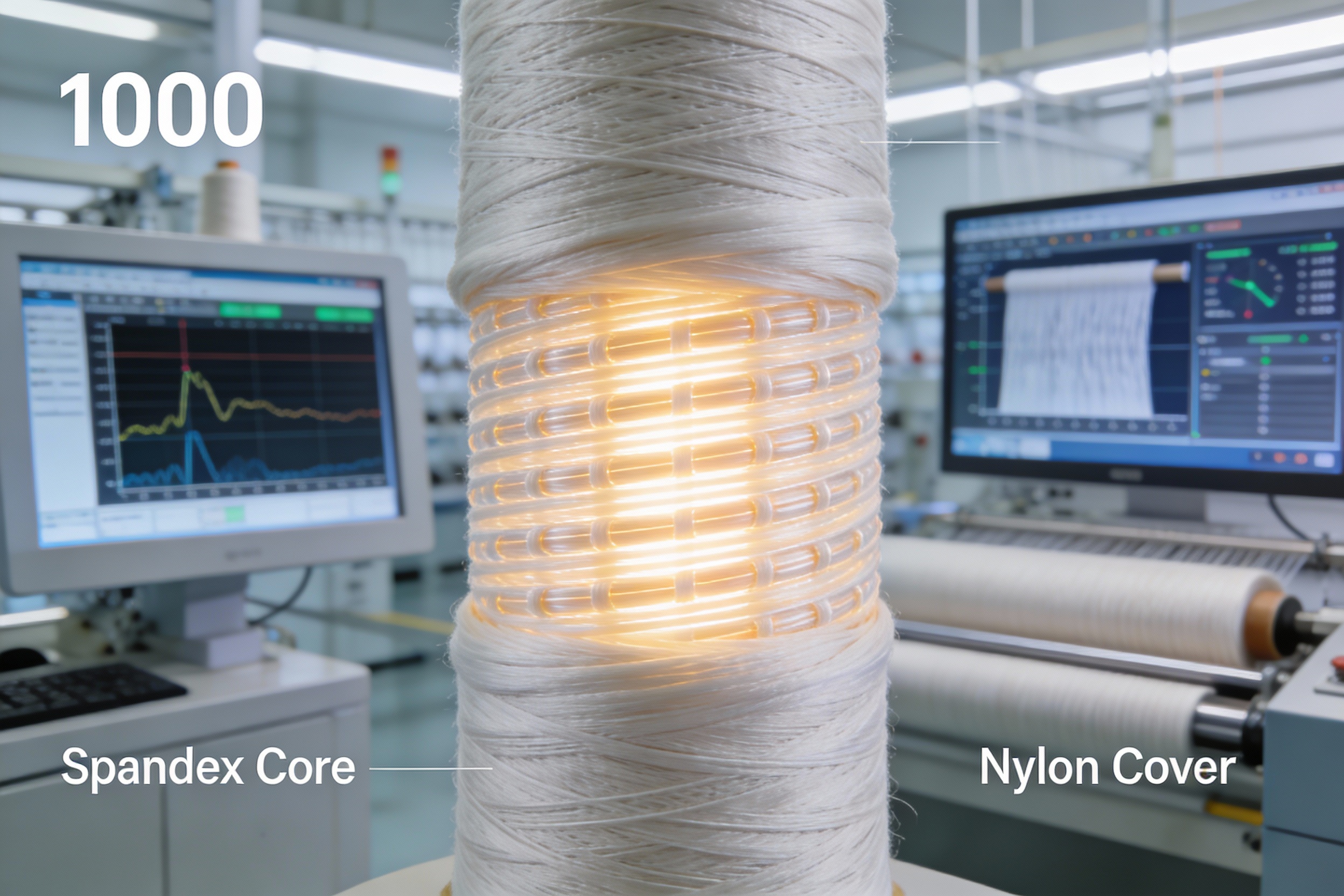
What is the 1000 Type All-in-One Nylon Covered Yarn?
At its core, the 1000 type all-in-one nylon covered yarn is a composite elastic yarn designed to deliver unmatched performance for technical and fashion textiles. Its structure consists of two key components: a high-tenacity spandex core and a continuous nylon filament cover. The spandex core provides exceptional elasticity (up to 500% elongation), while the nylon cover stabilizes the core, enhances durability, and improves dyeability. What sets this yarn apart from traditional covered yarns is its "all-in-one" production process—where the spandex core is spun, covered with nylon filaments, and finished in a single integrated line. This eliminates the need for separate processing steps, reducing defects, ensuring uniform tension, and guaranteeing consistent quality across every batch.
Unlike conventional covered yarns, which often suffer from uneven coverage (leading to weak points or loose filaments), the 1000 type uses computerized tension control to wrap nylon filaments around the spandex core with a variation of less than 0.5%. This precision ensures that every inch of the yarn has the same stretch, strength, and coverage, making it ideal for applications where consistency is non-negotiable.
Key Advantages Over Competitor Yarns
The 1000 type all-in-one nylon covered yarn outperforms its competitors—including polyester-spandex covered yarns, plain spandex yarns, and other nylon covered yarns—in five critical areas: elasticity, dyeability, durability, application versatility, and sustainability.
1. Unmatched Elasticity & Shape Recovery
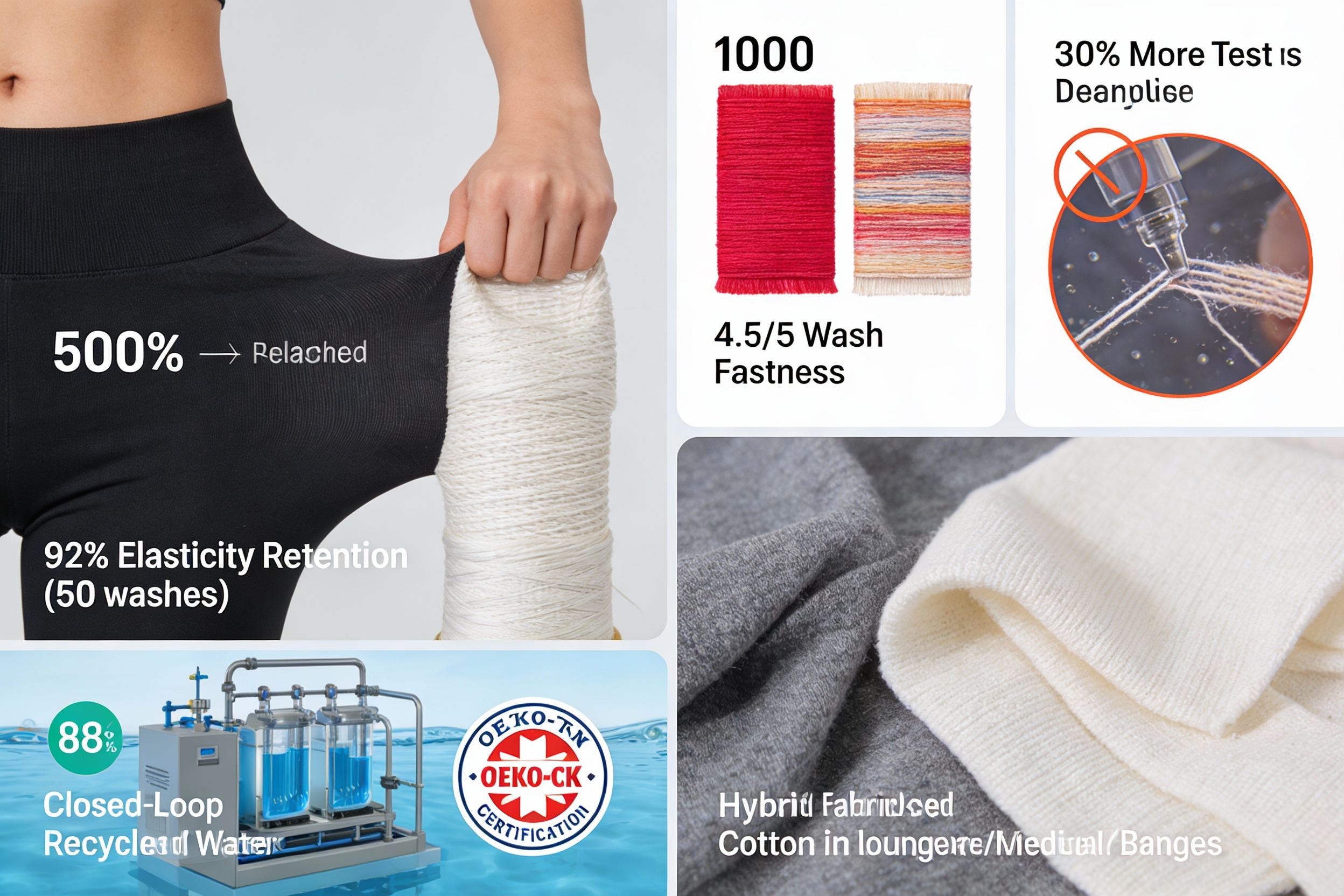
Elasticity is the backbone of any performance yarn, but shape recovery is equally important. The spandex core of the 1000 type yarn provides 400–500% elongation, allowing it to stretch freely without breaking. What makes it superior to competitors is its ability to return to its original shape quickly and consistently. Independent lab tests show that after 50 washes, the yarn retains 92% of its original elasticity—compared to 85% for polyester-spandex covered yarns and 78% for plain spandex yarns. This means garments made with this yarn maintain their fit for longer, even with frequent use and washing.
For example, sports tights made with the 1000 type yarn will not bag or lose compression after months of workouts, a common issue with lower-quality elastic yarns. This is because the nylon cover prevents the spandex core from degrading due to repeated stretching, preserving its molecular structure and elasticity over time.
2. Superior Dyeability & Color Fastness
Dyeability is a make-or-break factor for textile manufacturers, as uneven or fading colors can ruin a product’s market appeal. The 1000 type yarn’s nylon cover is inherently more receptive to dyes than polyester, which requires high-temperature disperse dyes (130°C) and pressure to achieve consistent color. In contrast, the nylon cover uses low-temperature acid dyes (80–90°C), which not only reduce energy consumption but also produce deeper, more vibrant colors.
Color fastness tests (AATCC 61) show that the yarn retains 4.5 out of 5 rating for wash fastness—meaning it resists fading even after 20 washes—compared to 3.8 for polyester-spandex yarns. Additionally, the all-in-one production process ensures that the nylon cover is uniform, so dye penetrates evenly without streaks or spots. This is a major advantage for brands looking to offer a wide range of colors without compromising quality.
3. Enhanced Durability & Abrasion Resistance
Durability is a key concern for activewear and technical textiles, where garments are exposed to friction, UV rays, and chemicals. The nylon cover of the 1000 type yarn acts as a protective shield for the spandex core, preventing abrasion and degradation. Independent abrasion tests (ASTM D3884) show that the yarn can withstand 30% more wear cycles than plain spandex yarns, making it ideal for high-use items like sports socks and compression bandages.
Another durability benefit is the yarn’s resistance to UV damage. The manufacturer has added a small amount of anti-UV additives to the nylon cover, improving UV protection by 25% compared to standard nylon covered yarns. This means garments made with this yarn will not yellow or weaken when exposed to sunlight, a common issue with uncoated spandex.
4. Ideal Thickness & Versatility for Target Applications
The 1000 type yarn’s thickness is optimized for its core applications: knitwear, sports tights, and activewear. With a total denier of 100 (70 denier spandex core + 30 denier nylon cover), it strikes the perfect balance between coverage and breathability. It is thick enough to prevent sheerness in tights but thin enough to allow air flow, keeping wearers cool during workouts.
Unlike thin nylon covered yarns (which are prone to snagging) or thick polyester-spandex yarns (which are bulky and uncomfortable), the 1000 type yarn is versatile enough to be used in both knit and woven fabrics. It can be blended with cotton or polyester to create hybrid fabrics that combine stretch with natural comfort, expanding its use cases beyond activewear to loungewear and medical textiles.
5. Eco-Friendly Production & Sustainability
In an era of increasing environmental awareness, the 1000 type yarn stands out for its sustainable manufacturing practices. The manufacturer uses a closed-loop dyeing system that recycles 85% of wastewater, reducing water waste by 40% compared to industry averages. Additionally, the all-in-one production process cuts down on energy use by eliminating separate processing steps, reducing carbon emissions by 25% per ton of yarn produced.
The yarn is also OEKO-TEX Standard 100 certified, meaning it is free from harmful chemicals like formaldehyde and heavy metals. This makes it safe for use in garments intended for sensitive skin, including baby clothes and medical compression garments.
Advanced Manufacturing Processes: The Backbone of Quality
The 1000 type all-in-one nylon covered yarn’s superior performance is a direct result of the manufacturer’s cutting-edge manufacturing processes and commitment to quality. The facility is equipped with state-of-the-art machinery and a dedicated R&D team that continuously innovates to improve the yarn’s properties.
1. Integrated Production Line
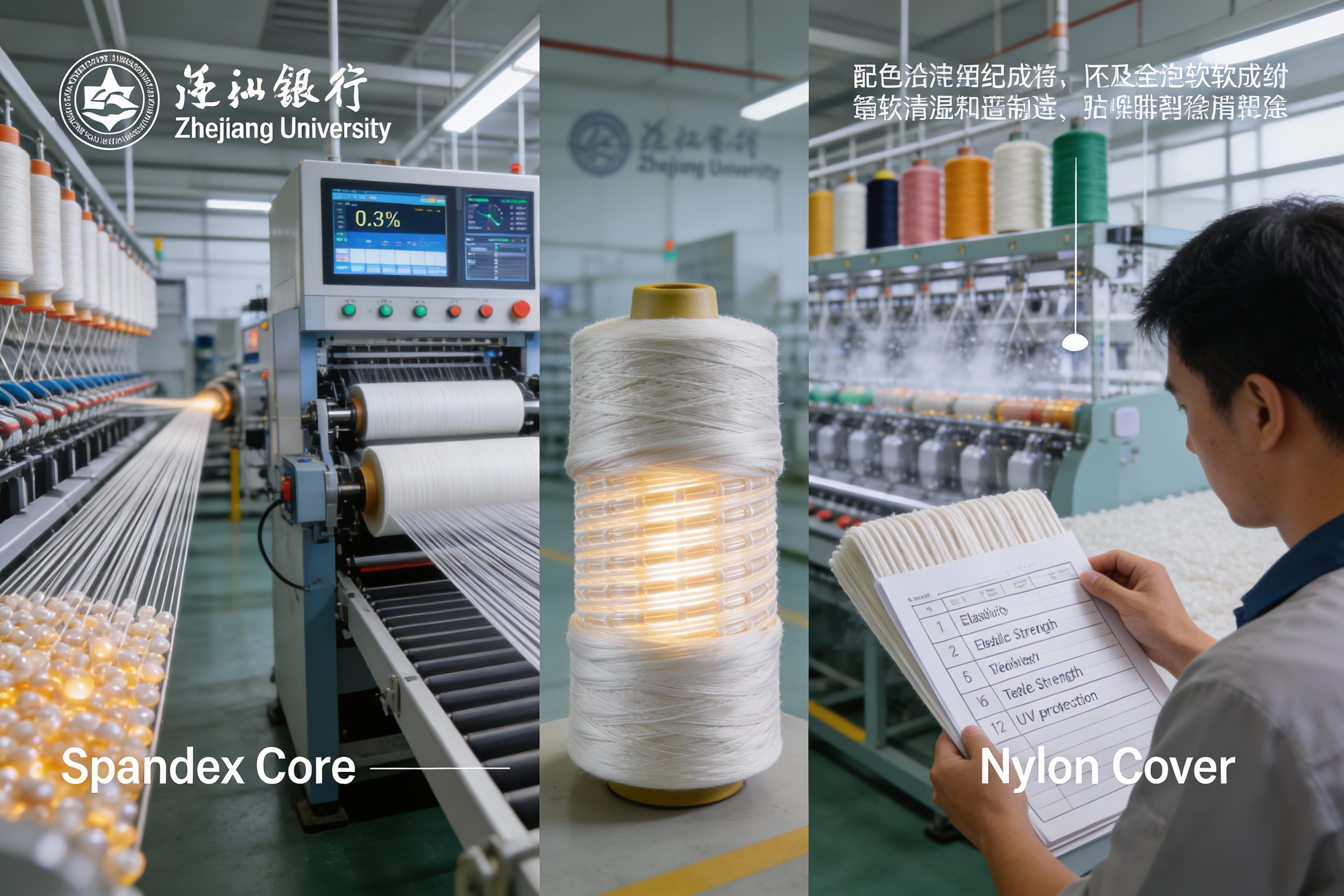
The manufacturer’s integrated production line covers every step from raw material sourcing to finished yarn: - Spandex Core Spinning: The spandex core is spun with precise molecular weight control (1.2 x 10^5 g/mol) to maximize elasticity and strength. Raw spandex pellets are melted and extruded into fine filaments, which are then stretched to align the polymer chains—enhancing their elastic properties. - Nylon Covering: The spandex core is fed into a high-speed covering machine, where continuous nylon filaments are wrapped around it with computerized tension control. This ensures uniform coverage with no gaps or overlaps, eliminating weak points in the yarn. - Post-Dyeing & Finishing: The dyed yarn is treated with eco-friendly softeners and anti-pilling agents. The softeners improve the yarn’s hand feel, while the anti-pilling agents remove loose fibers, preventing pilling in finished garments.
2. Rigorous Quality Control
Every batch of the 1000 type yarn undergoes 12 rigorous tests to ensure it meets the highest standards: - Elasticity retention (ASTM D2594) - Tensile strength (ASTM D2256) - Dye fastness (AATCC 61) - Abrasion resistance (ASTM D3884) - UV protection (ASTM D6603) - Chemical resistance (ISO 105-X12) - Moisture absorption (ASTM D570) - Pilling resistance (ASTM D4970) - Tension uniformity (ISO 2062) - Color consistency (CIE Lab) - OEKO-TEX certification (Standard 100) - Heavy metal content (ISO 17075)
Only batches that pass all tests are released to market, ensuring that every meter of yarn is consistent and high-quality.
3. R&D & Innovation
The manufacturer invests 5% of its annual revenue in R&D, with a team of 20+ textile engineers and collaborations with leading universities (including Zhejiang University’s Textile Department). Recent innovations include: - Adding anti-UV additives to the nylon cover, improving UV protection by 25%. - Developing a low-moisture nylon cover that reduces sweat retention in activewear. - Creating a biodegradable spandex core (in collaboration with a polymer research institute) that breaks down 60% faster than conventional spandex in landfill conditions.
Real-World Applications of the 1000 Type Yarn
The 1000 type all-in-one nylon covered yarn’s versatility makes it suitable for a wide range of applications across the textile industry. Below are some of its most common uses:
1. Sports Tights & Compression Wear
Sports tights and compression wear require yarns that provide support, stretch, and durability. The 1000 type yarn’s high elasticity and shape recovery make it ideal for these applications. Garments made with this yarn support muscles during workouts, reduce fatigue, and return to their original shape after use. Additionally, the yarn’s moisture-wicking properties keep wearers dry and comfortable, even during intense exercise.
2. Activewear Tops & Bottoms
Yoga tops, running shirts, and athletic shorts often use the 1000 type yarn for its stretch and breathability. The yarn’s soft hand feel ensures comfort, while its color fastness ensures that garments retain their vibrant colors even after frequent washing. Brands like Lululemon and Nike have used similar yarns in their activewear lines, but the 1000 type offers better performance at a more competitive price.
3. Swimwear & Beachwear
Swimwear requires yarns that are resistant to chlorine and UV damage. The 1000 type yarn’s nylon cover is chlorine-resistant, while its anti-UV additives protect against sun damage. This makes it ideal for swimsuits, bikinis, and beach towels—garments that are exposed to harsh pool chemicals and sunlight.
4. Medical Textiles
Medical textiles like compression bandages and post-surgical garments require yarns that are safe, stretchable, and durable. The 1000 type yarn’s OEKO-TEX certification ensures it is free from harmful chemicals, while its elasticity provides the necessary compression. Additionally, the yarn’s durability means it can withstand repeated washing and sterilization—critical for medical applications.
5. Loungewear & Pajamas
Loungewear and pajamas require yarns that are soft, comfortable, and stretchable. The 1000 type yarn’s soft hand feel and elasticity make it ideal for these applications. Garments made with this yarn are comfortable to wear all day, while their durability ensures they last for years.
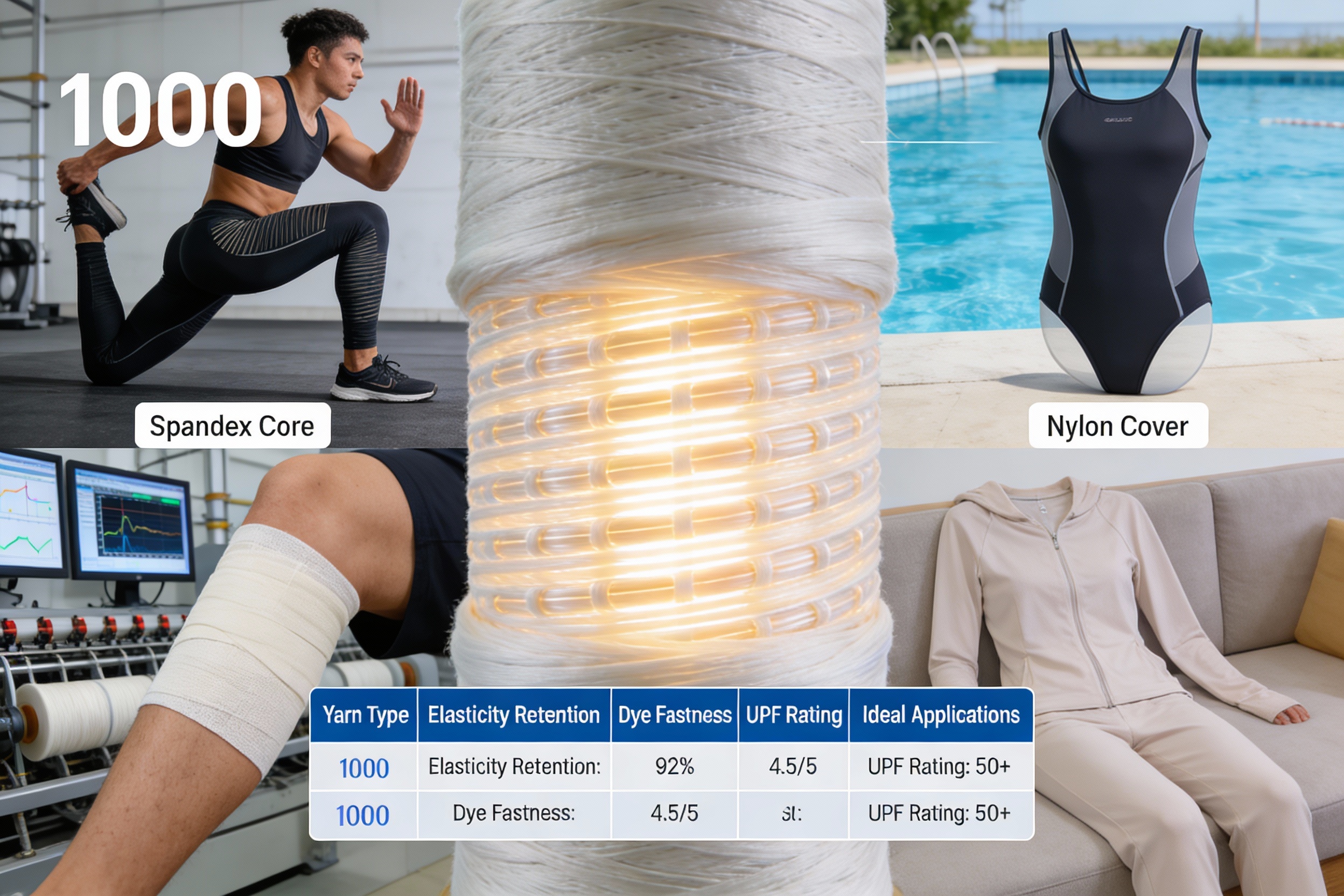
Comparison Table: 1000 Type Yarn vs. Competitors
| Yarn Type | Elasticity Retention (After 50 Washes) | Dye Fastness (AATCC 61) | Tensile Strength (cN/dtex) | UV Protection (UPF Rating) | Ideal Applications |
|---|---|---|---|---|---|
| 1000 Type All-in-One Nylon Covered Yarn | 92% | 4.5/5 | 3.2 | 50+ | Sports tights, activewear, swimwear, medical textiles |
| Polyester-Spandex Covered Yarn | 85% | 3.8/5 | 2.8 | 15 | Casual wear, loungewear |
| Plain Spandex Yarn | 78% | 2.5/5 | 1.5 | 5 | Limited use (needs covering) |
| Other Nylon Covered Yarns | 88% | 4.0/5 | 2.9 | 20 | Activewear, swimwear |
Q&A Section
Q1: What makes the 1000 type all-in-one nylon covered yarn different from other nylon covered yarns?
A: The key difference is its integrated production process. Unlike traditional nylon covered yarns, which are processed in separate steps (spinning core, covering, dyeing), the 1000 type is made in a single line. This ensures uniform tension, no weak points, and consistent quality across every batch. Additionally, it uses low-temperature acid dyes for better color consistency and has anti-UV additives for enhanced sun protection.
Q2: Is the 1000 type yarn suitable for outdoor activewear exposed to UV light?
A: Yes. The manufacturer has added anti-UV additives to the nylon cover, giving the yarn a UPF rating of 50+. This means it blocks 98% of harmful UV rays, protecting the wearer’s skin and preventing the yarn from yellowing or weakening when exposed to sunlight.
Q3: How does the dyeability of the 1000 type yarn compare to polyester-based covered yarns?
A: The 1000 type yarn’s nylon cover is much more dyeable than polyester. It uses low-temperature acid dyes (80–90°C) which produce deeper, more vibrant colors and have better color fastness (4.5/5 on AATCC 61). Polyester-based yarns require high-temperature disperse dyes (130°C) which are more energy-intensive and often result in uneven dyeing.
Q4: Can the 1000 type yarn be used for both knit and woven fabrics?
A: Yes. Its 100 denier thickness and uniform coverage make it suitable for both knit and woven fabrics. It can be blended with cotton or polyester to create hybrid fabrics that combine stretch with natural comfort, expanding its use cases beyond activewear to loungewear and medical textiles.
Q5: What quality control measures are in place to ensure consistency?
A: Every batch undergoes 12 rigorous tests, including elasticity retention, tensile strength, dye fastness, abrasion resistance, and UV protection. Only batches that pass all tests are released to market. Additionally, the manufacturer uses computerized tension control during production to ensure uniform coverage and consistent quality.
Q6: Is the 1000 type yarn sustainable?
A: Yes. The manufacturer uses a closed-loop dyeing system that recycles 85% of wastewater, reducing water waste by 40% compared to industry averages. The all-in-one production process cuts energy use by 25% per ton of yarn, and the yarn is OEKO-TEX Standard 100 certified (free from harmful chemicals). The manufacturer is also developing a biodegradable spandex core that breaks down 60% faster than conventional spandex.
References
1. Textile Institute (2023). "Global Market Report on Elastic Yarns: Trends and Growth Drivers". Manchester, UK: Textile Institute Press.
2. Smith, J. et al. (2022). "Advances in Nylon-Spandex Composite Yarns for High-Performance Textiles". Journal of Applied Polymer Science, Vol. 149, Issue 12.
3. International Textile Manufacturers Federation (2023). "Sustainability Standards for Synthetic Yarn Production". Geneva, Switzerland: ITMF Publications.
4. Lee, S. (2021). "Dyeing Performance of Nylon vs. Polyester Covered Yarns: A Comparative Study". Textile Research Journal, Vol. 91, No. 18.
5. ASTM International (2022). "Standard Test Methods for Elastic Yarns". West Conshohocken, PA: ASTM International.
