
Jacquard Houndstooth Fabric: Soft Structure, Lasting Style, and Versatile Performance
Jacquard houndstooth fabric is a distinctive knitted textile designed for makers, designers, apparel brands, upholstery specialists, and distributors who need a fabric that combines a timeless visual identity with practical performance. The product belongs to the knitted jacquard fabric category, and it brings together the recognizable houndstooth pattern, a soft hand feel, a thick and robust structure, and two-direction stretch that expands its usability across fashion and interior applications. Unlike printed houndstooth fabrics, where the motif is applied only to the surface, jacquard houndstooth fabric is created through controlled knitting construction, giving the pattern a more integrated, dimensional, and durable appearance.
For coats, blazers, cushions, curtains, sofa covers, caravan interiors, chairs, and decorative furnishing projects, this fabric offers a rare balance of design appeal and functional comfort. It is not merely a decorative material; it is a versatile textile platform that can support structured garments, soft home furnishings, and high-visibility decorative products. Its thick yet soft composition gives it a premium touch, while the two-way stretch allows improved fit, shaping, and handling during cutting, sewing, and installation.
Hangzhou Jinfeng Textile Co., Ltd. supports this product with integrated textile manufacturing capabilities, including DTY polyester yarn production, blended fabric production and processing, post-dyeing, finishing, and sales. The company is located in Xiaoshan District, Hangzhou, Zhejiang Province, in an industrial setting with a plant area of approximately 18,000 square meters. This production background is important because a knitted jacquard fabric depends not only on design but also on yarn quality, knitting control, finishing consistency, and supply reliability. When these factors are managed within an experienced textile production system, customers receive a fabric that is more consistent, more scalable, and better suited for wholesale and professional use.
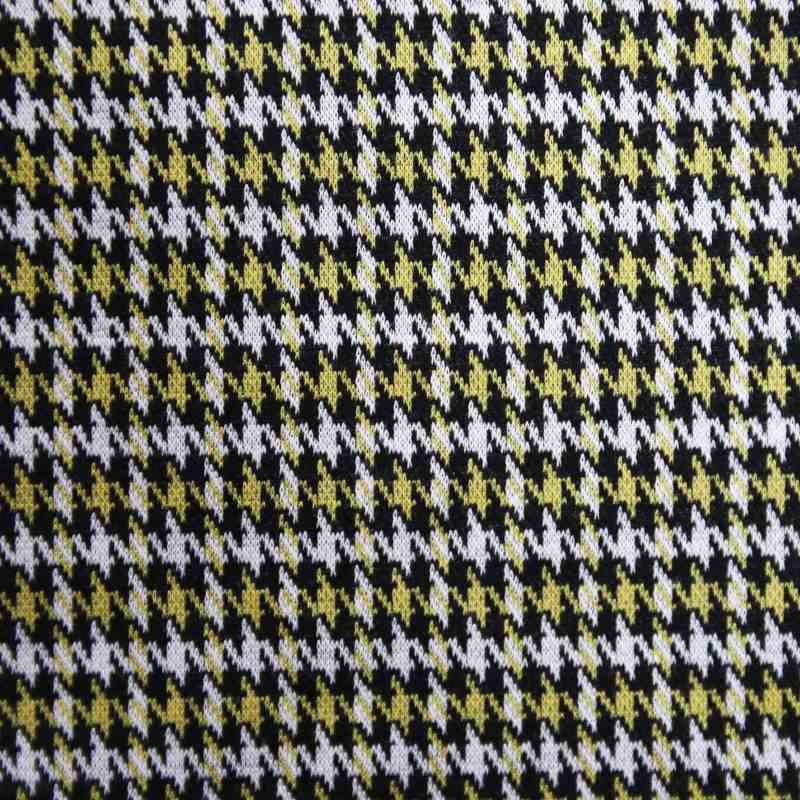
Product Overview: What Makes Jacquard Houndstooth Fabric Different
Jacquard houndstooth fabric combines two textile ideas: the classic houndstooth pattern and the jacquard knitting process. Houndstooth is one of the most recognizable geometric textile patterns in fashion history. It is often associated with coats, tailored garments, luxury outerwear, formal styling, and sophisticated interiors. The pattern uses repeated broken-check shapes that create movement and contrast. In a knitted jacquard fabric, this effect is not simply drawn or printed on top; it is engineered into the fabric structure by controlling yarn placement and knitting formation.
The result is a more refined and stable visual effect. The fabric can appear richer than flat printed alternatives because the jacquard construction gives the design depth and definition. This makes it attractive for apparel designers who want a high-value look and for upholstery or home décor producers who need a pattern that remains expressive even across larger surfaces such as curtains, cushions, sofa backs, or chair panels.
The fabric is described as beautiful, soft, thick, and robust. These qualities are especially important because many decorative fabrics look appealing but fail to deliver comfort or structural reliability. A thick fabric can provide body, shape, and presence, while a soft hand feel helps it remain pleasant against the skin and comfortable in living spaces. Robustness also matters in applications that experience regular contact, folding, draping, or seating pressure. For this reason, jacquard houndstooth fabric can serve both visual and functional roles.
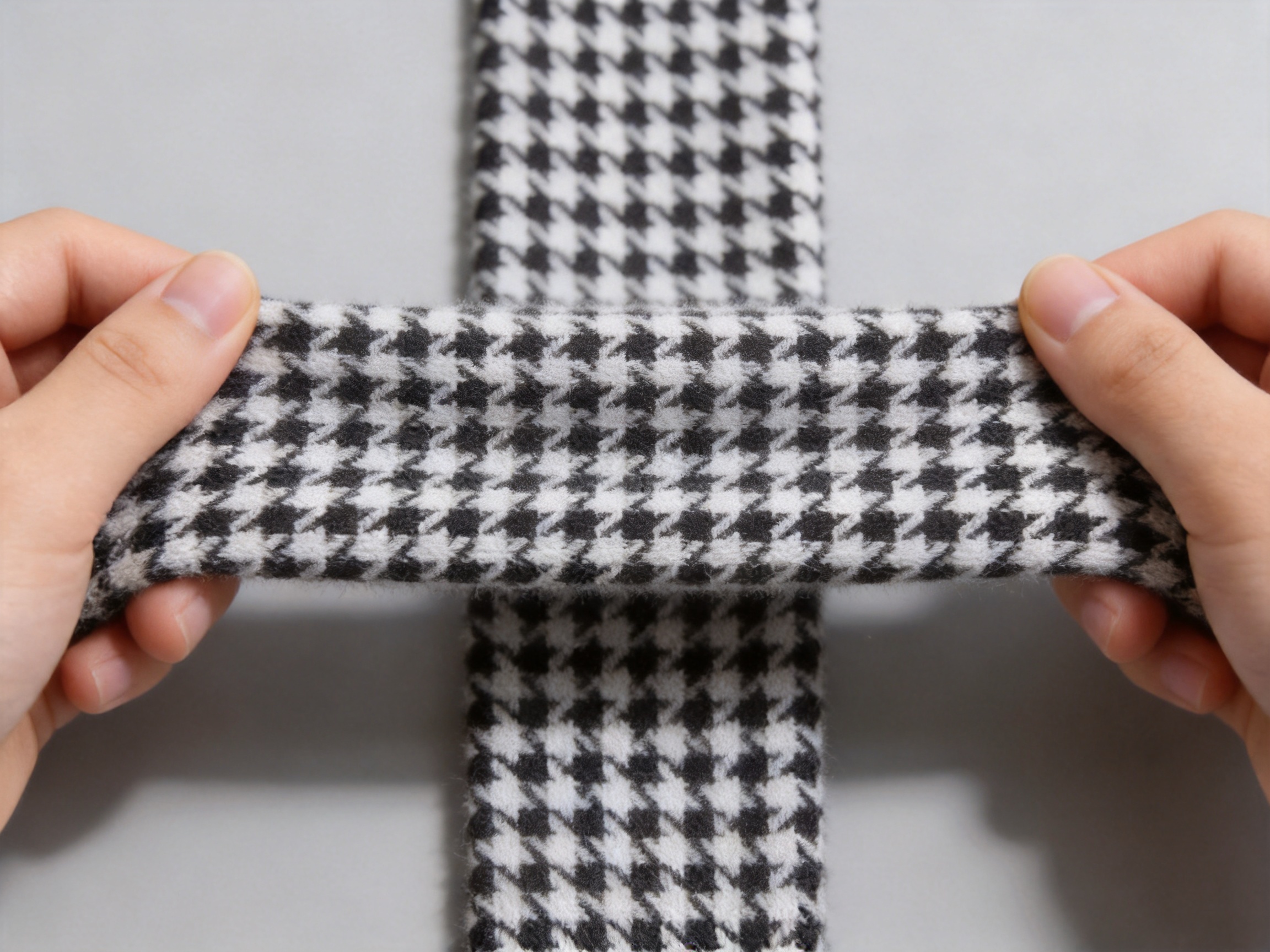
Another key feature is two-direction stretch. Stretch gives the fabric more flexibility during design and use. In fashion apparel, it can improve comfort and movement, especially in coats, blazers, jackets, cardigans, skirts, and structured casualwear. In upholstery and interior applications, stretch can assist fitting over curves, padded surfaces, and shaped furniture. This is an advantage over many rigid woven houndstooth materials, which may look elegant but can be harder to manipulate around complex shapes.
Core Product Advantages
The major advantage of jacquard houndstooth fabric is its combination of classic style and modern practicality. Houndstooth has remained relevant for decades because it bridges traditional tailoring and contemporary design. It can look formal, vintage, bold, minimalist, or fashion-forward depending on color, scale, and application. This gives buyers flexibility: the same fabric can be positioned for premium fashion apparel, boutique interiors, soft furnishing collections, or creative DIY projects.
Compared with ordinary printed polyester fabric, knitted jacquard houndstooth fabric offers a more integrated pattern effect. Printing can fade, crack, or visually flatten over time depending on process quality and usage conditions. A jacquard pattern, by contrast, is formed as part of the textile structure. This gives the design a stronger material identity and can make the surface appear more sophisticated.
Compared with heavy woven houndstooth fabrics, this knitted version provides improved flexibility. Traditional woven houndstooth can be elegant but may feel stiff, especially in upholstery weights or winter coat materials. Knitted jacquard construction introduces elasticity, making the fabric more adaptable for body movement, cushion shaping, furniture coverage, and other uses where slight stretch improves performance.
Compared with very lightweight decorative knits, this product has a thicker and more robust character. That thickness makes it more suitable for applications requiring presence and structure. A flimsy fabric may not hold shape in a blazer, may not drape attractively as a curtain, and may not provide satisfying coverage on cushions or chairs. A thicker jacquard houndstooth fabric gives makers confidence when creating products that must look substantial and last through regular handling.
The softness of the material is another competitive strength. Some durable fabrics feel harsh, and some soft fabrics lack strength. This product aims to balance both qualities. A soft surface supports comfort in garments and home environments, while a robust structure helps extend use potential. That balance is valuable for businesses that do not want to maintain separate fabric inventories for fashion and interior categories.
Applications in Fashion Apparel
Jacquard houndstooth fabric is especially suitable for fashion apparel because it offers recognizable design value without requiring excessive garment complexity. A simple coat, blazer, jacket, vest, or cape can look distinctive when made from a strong houndstooth pattern. This allows designers to create impactful garments with clean silhouettes and controlled production costs.
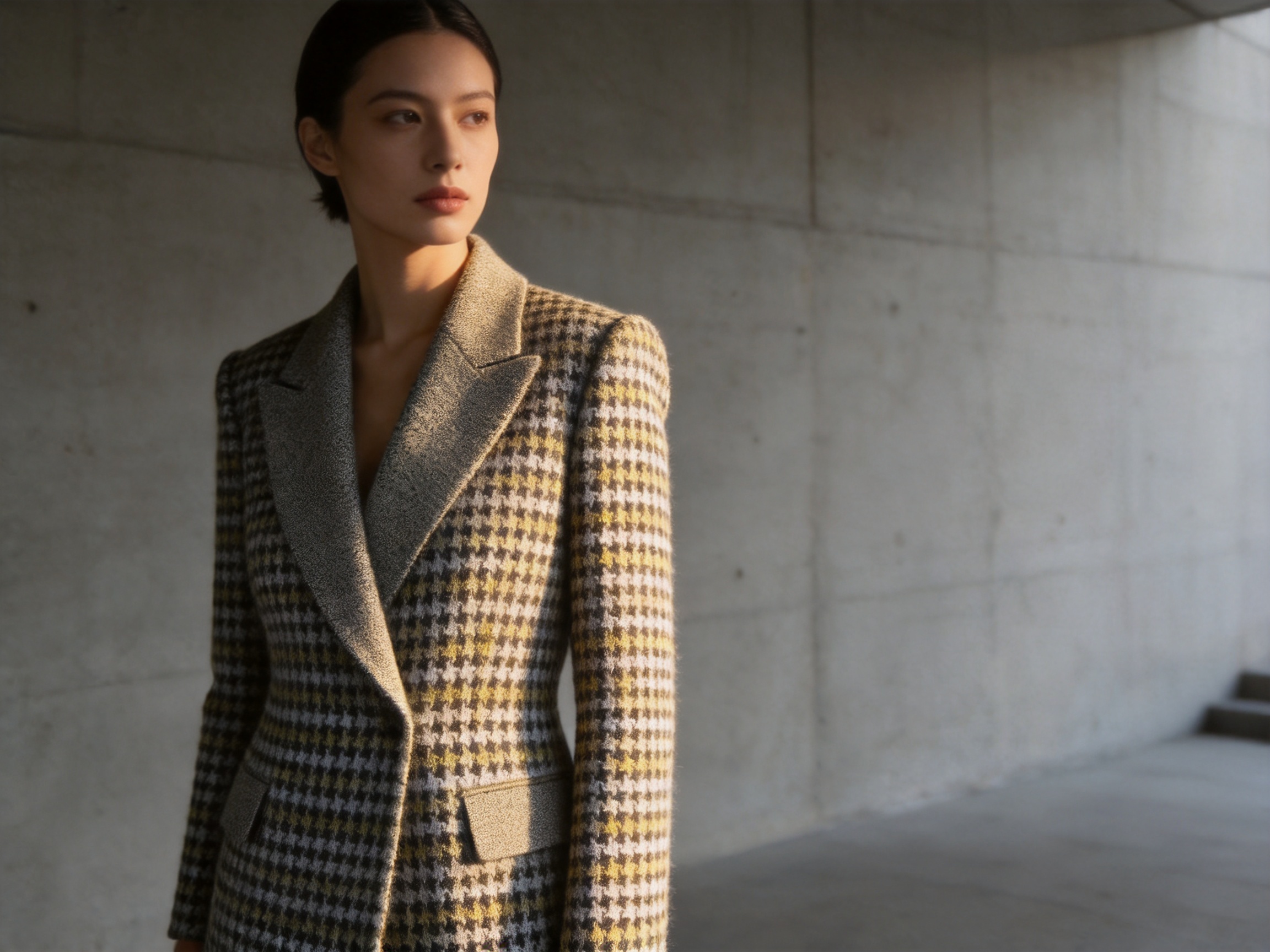
For coats, the fabric’s thickness and soft touch provide both visual structure and comfort. A coat must hold shape while remaining wearable over layers, and the two-direction stretch can contribute to ease of movement. The houndstooth pattern gives the coat an established fashion language, making it suitable for autumn and winter collections, urban outerwear, and tailored casual garments.
For blazers, the fabric can create a refined but approachable look. Traditional blazers often rely on woven suiting fabrics, but knitted jacquard options can provide greater comfort and flexibility. This is valuable in modern fashion, where customers increasingly want garments that look polished but feel relaxed. A houndstooth knitted blazer can serve office, travel, casual business, and lifestyle markets.
For skirts, dresses, and coordinated sets, the fabric can deliver strong visual identity. Designers may use it as an all-over material or combine it with solid fabrics for contrast panels, trims, collars, cuffs, pockets, or waistbands. Because houndstooth has high visual recognition, even small fabric accents can increase garment appeal.
For boutique fashion brands, the fabric provides an efficient way to build collection cohesion. A brand can use the same houndstooth jacquard across several garment types, producing a capsule collection that includes a jacket, skirt, bag, scarf, and decorative accessories. This improves material utilization and creates a coordinated story for retail presentation.
Applications in Upholstery and Interior Decoration
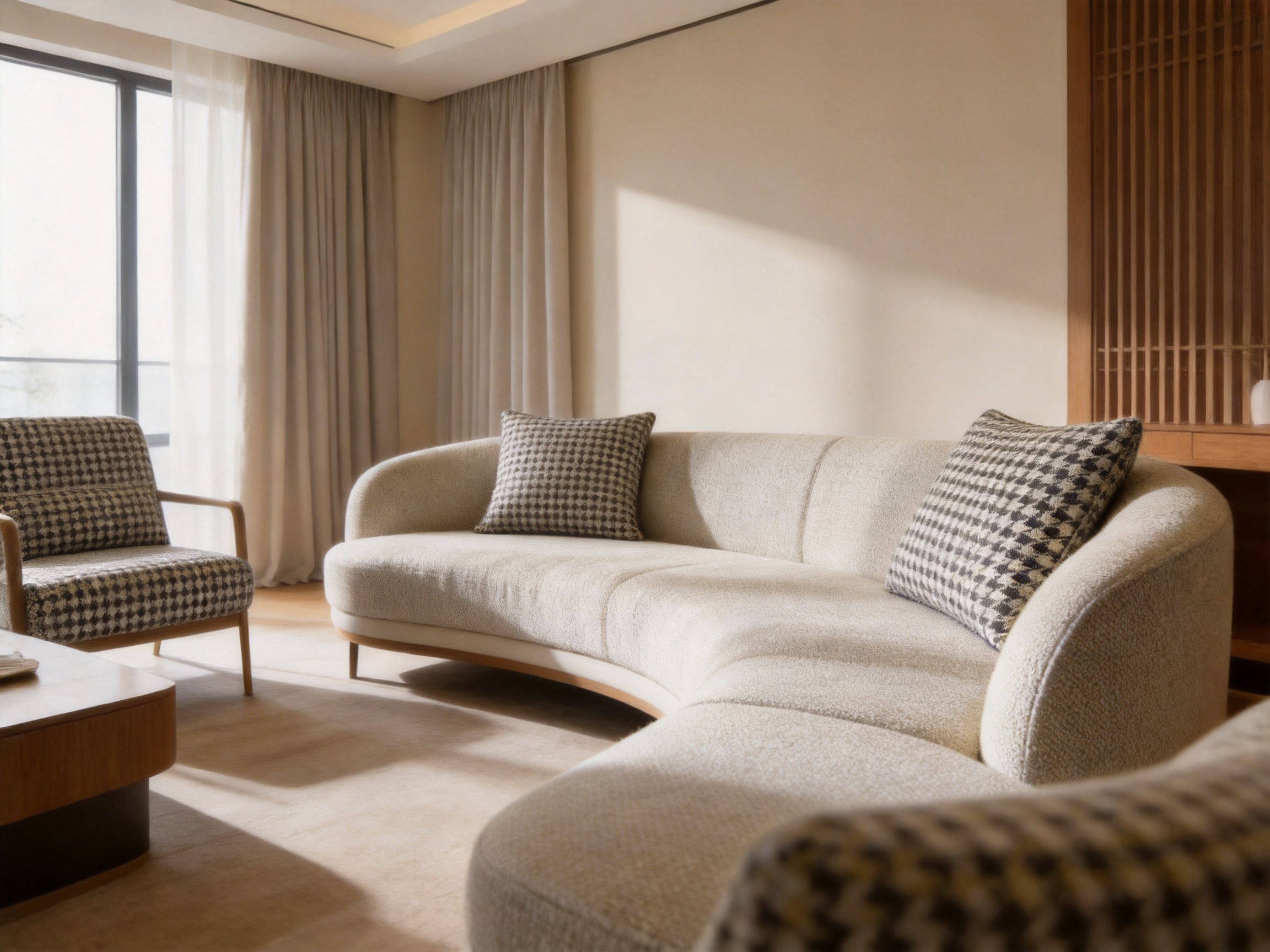
In home décor and upholstery, jacquard houndstooth fabric provides a stylish alternative to plain fabrics and simple printed patterns. The houndstooth design has enough structure to create a sophisticated interior statement, yet it remains versatile enough to work with minimalist, modern, classic, retro, and eclectic spaces.
For cushions, the fabric’s thickness and softness are highly useful. Cushions require fabric that feels pleasant when touched, holds shape after filling, and looks attractive from different angles. A houndstooth jacquard cushion can function as a feature piece on sofas, beds, chairs, caravans, and lounge areas. It can be paired with solid-color cushions for balance or used in multiple sizes for a bolder design.
For curtains, the fabric can add texture and visual interest. While very heavy upholstery fabrics may not always hang well, a knitted jacquard with controlled thickness can provide a full, decorative drape. The pattern may help frame windows, define interior zones, or create a boutique hospitality atmosphere. The fabric’s soft character also supports a warmer, more welcoming interior impression.
For sofas and chairs, the two-direction stretch can support smoother fitting across curves and corners. Upholstery projects often require fabric to bend, pull, wrap, and conform to padded shapes. A degree of stretch can help reduce tension points and improve installation flexibility. This is particularly helpful for caravan interiors, accent chairs, decorative panels, and soft seating where surfaces are not perfectly flat.
For caravans and mobile interiors, the material’s combination of comfort, style, and flexibility is beneficial. Caravan spaces need fabrics that can make compact interiors feel designed and comfortable. Houndstooth offers a strong decorative theme without requiring complicated construction. It can be used for seat covers, curtains, cushion covers, wall panels, or coordinated soft furnishings.
Why Knitted Jacquard Construction Matters
The jacquard process allows patterns to be built into the fabric rather than merely applied after fabric formation. In knitted jacquard fabric, different yarns or stitch structures are controlled to create the pattern. This enables detailed geometric effects such as houndstooth, while maintaining the flexibility associated with knitted textiles.
Knitted jacquard construction improves design durability because the pattern is part of the fabric architecture. The motif does not depend solely on surface pigment. This is particularly valuable for garments and interiors that experience regular rubbing, folding, stretching, and handling. While all fabrics require suitable care, a structural pattern can maintain its visual identity more naturally than many surface-only decorative effects.
The knitting process also contributes to two-way stretch. The loops in knitted fabric can extend and recover more readily than the interlaced structure of woven fabric. This stretch makes the material easier to use in comfort-focused fashion and shaped upholstery applications. It also helps the fabric feel less restrictive in garments.
Jacquard knitting requires precision. The houndstooth pattern must remain clear, balanced, and consistent across the fabric width and length. If the machine control, yarn tension, or finishing process is inconsistent, the pattern can distort. For this reason, manufacturing capability is central to product quality. A reliable producer must manage yarn selection, knitting parameters, dyeing, finishing, inspection, rolling, and packing with attention to detail.
Manufacturing Strengths Behind the Fabric
Hangzhou Jinfeng Textile Co., Ltd. has a production foundation that supports quality knitted jacquard fabric. The company’s operations include production and processing, post-dyeing, finishing, and sales of blended fabrics such as polyester and spandex, as well as DTY polyester yarn production, processing, and sales. This integration is important because fabric quality begins before knitting. It begins with yarn properties.
DTY polyester yarn, also known as drawn textured yarn, is widely used in knitted fabrics because it can provide bulk, elasticity, softness, and stable processing behavior. When a manufacturer understands DTY yarn production and textile processing, it can better control the relationship between yarn characteristics and finished fabric performance. Yarn texture, intermingling level, denier selection, filament behavior, and dyeing response all influence the final fabric.
The company’s experience in blended fabrics also supports material development. Modern knitted jacquard fabrics often use polyester, rayon, spandex, or blended compositions depending on desired hand feel, stretch, dyeing result, and application. Knowledge of polyester-rayon blends, knitted jacquard fabrics, NTR knitted fabric, NR knitted fabric, and slight intermingled DTY yarn allows the production team to respond to different customer requirements.
Post-dyeing and finishing are equally important. A fabric may be well knitted but still require finishing to achieve the desired softness, thickness, appearance, stability, and handle. Finishing can influence surface feel, dimensional behavior, drape, and fabric presentation. For jacquard houndstooth fabric, finishing must enhance comfort without weakening pattern definition. A balanced finishing process helps the material remain soft, smooth, and visually clear.
The company operates as an export-oriented enterprise integrating research and development, production, and sales. This structure benefits international buyers who need consistent communication, scalable supply, and a manufacturer capable of supporting both fabric production and commercial coordination. For wholesale customers, the ability to receive fabric in continuous pieces is especially valuable because it reduces cutting waste and improves project efficiency.
Quality Control and Consistency
Consistency is one of the most important factors in jacquard fabric sourcing. A buyer may approve a sample because the pattern, hand feel, and weight look excellent, but bulk fabric must match that sample closely. Variations in yarn, machine tension, dyeing conditions, or finishing treatment can change the appearance and performance of the final material. Therefore, quality control must cover each stage of production.
In yarn preparation, the goal is to maintain uniform texture and strength. Uneven yarn can create defects, streaks, or irregular surface effects. In knitting, machine settings must be carefully controlled to maintain pattern clarity and fabric stability. In dyeing, color consistency and penetration are essential, especially when houndstooth designs rely on contrast. In finishing, the fabric must achieve the target softness and thickness without excessive shrinkage or distortion.
Fabric inspection helps identify issues such as pattern misalignment, holes, oil marks, uneven dyeing, edge curling, tension marks, and finishing inconsistencies. Proper rolling and packing also matter because jacquard fabric should be protected from crushing, staining, moisture, and unnecessary distortion during storage and transportation.
For professional customers, continuous-piece supply is a significant benefit. Receiving fabric in one continuous piece supports efficient cutting for apparel production, upholstery panels, curtains, and large decorative projects. It minimizes joining, reduces waste, and allows designers to control pattern placement more effectively.
| Feature | Benefit for Apparel | Benefit for Interiors |
|---|---|---|
| Knitted jacquard houndstooth pattern | Creates a premium, tailored, recognizable fashion look | Adds classic geometric style to cushions, curtains, chairs, and sofas |
| Soft hand feel | Improves wearing comfort for coats, blazers, and jackets | Provides pleasant touch for cushions, seating, and decorative panels |
| Thick and robust structure | Supports garment shape and stronger visual presence | Improves coverage, body, and durability in furnishing projects |
| Two-direction stretch | Enhances mobility and fit in modern apparel | Helps fabric conform to curved furniture and upholstered surfaces |
| Continuous-piece supply | Reduces cutting waste and supports production efficiency | Supports larger curtains, sofa panels, and coordinated décor projects |
Advantages Over Common Competitor Fabrics
Many competing houndstooth fabrics fall into three general categories: printed fabrics, rigid woven fabrics, and lightweight decorative knits. Each can serve certain needs, but jacquard houndstooth knitted fabric offers a stronger balance for customers who need both style and usability.
Printed houndstooth fabrics are often cost-effective and can be produced in many colors. However, they may lack the depth and tactile richness of jacquard construction. The pattern is generally on the surface, so the fabric can look flatter. In projects where the material is viewed up close or touched frequently, jacquard fabric provides a more substantial impression.
Rigid woven houndstooth fabrics are classic and may be appropriate for traditional tailoring. However, they can be less forgiving during movement and fitting. In modern fashion, comfort is increasingly important. A knitted jacquard houndstooth fabric can deliver a similar classic visual language while offering greater flexibility. For upholstery, the stretch can also help with fitting over padded or curved shapes.
Lightweight decorative knits may be soft and flexible, but they can lack the body needed for structured garments or upholstery projects. Jacquard houndstooth fabric with a thick and robust structure is more versatile because it can handle applications requiring presence and coverage. It is suitable not only for apparel but also for cushions, curtains, caravans, sofas, and chairs.
Another advantage is the manufacturer’s broader textile capability. A supplier involved in DTY yarn, blended fabrics, dyeing, finishing, and export sales can support customers more effectively than a trader with limited production control. Integrated knowledge improves problem-solving, customization, sample development, and bulk consistency.
Material Comfort and Hand Feel
Softness is a key selling point of this jacquard houndstooth fabric. In apparel, comfort strongly affects whether customers repeatedly wear a garment. A blazer may look beautiful on a hanger, but if the fabric feels rough or restrictive, it will not become a wardrobe favorite. A soft knitted jacquard improves the wearing experience while still allowing the garment to look structured and intentional.
In home textiles, hand feel is equally important. Cushions and sofa fabrics are touched repeatedly. Curtains may be handled during opening, closing, cleaning, and installation. Chair coverings come into contact with clothing and skin. A soft surface creates a more comfortable environment and increases perceived quality.
The fabric’s thickness enhances this perception. Thin fabrics may feel economical, while thicker fabrics often feel more premium and reliable. The challenge is to create thickness without stiffness. This product’s appeal lies in its ability to be robust while remaining soft, supporting both durability and comfort.
Design Flexibility and Pattern Value
Houndstooth is valuable because it is both traditional and adaptable. In black and white, it creates a classic tailored effect. In neutral tones, it can become subtle and refined. In high-contrast colors, it can look bold and contemporary. In smaller scale, it is elegant and detailed; in larger scale, it becomes graphic and dramatic.
For apparel designers, this means the fabric can serve different market segments. A classic houndstooth coat may appeal to professional customers, while an oversized houndstooth jacket can appeal to younger fashion markets. A fitted blazer may serve office wear, while a soft houndstooth cardigan can serve casual lifestyle clothing.
For interiors, houndstooth can be used as a statement or accent. A full sofa in houndstooth becomes a focal point. Cushions in houndstooth add energy to plain furniture. Curtains in houndstooth can frame a room with personality. Caravan interiors can use houndstooth to create a compact but stylish identity.
The fabric also works well in mixed-material design. It can be combined with plain polyester-rayon fabrics, solid knits, faux leather, wool-like textiles, velvet-like surfaces, or textured upholstery materials. This makes it useful for designers who want both contrast and harmony.
Production Scalability for Wholesale Buyers
Wholesale buyers need more than attractive fabric. They need production reliability, repeatability, communication, and supply capacity. A fabric that looks excellent but cannot be delivered consistently can create risk for apparel brands, interior producers, online fabric retailers, and distributors.
Hangzhou Jinfeng Textile Co., Ltd. operates with a plant area of about 18,000 square meters and engages in textile production, processing, dyeing-related finishing, and sales. This manufacturing base supports larger order handling and ongoing development. The company’s export orientation also indicates experience serving customers beyond the domestic market.
For wholesalers, continuous-piece delivery is particularly important. It allows fabric shops and production houses to cut lengths according to customer or project requirements. It also supports large panels for curtains, upholstery, and garment production. When fabric is supplied in multiple short pieces, customers may experience increased waste, pattern mismatch, and production inconvenience. Continuous supply improves efficiency and customer satisfaction.
Scalability also matters for brand development. If a fashion company builds a successful houndstooth blazer or coat line, it needs confidence that additional yardage can be supplied for repeat production. If an interior brand develops a cushion or caravan collection, it needs consistent fabric appearance across batches. A capable manufacturer can support this kind of business continuity.
Advanced Process Understanding: From Yarn to Finished Fabric
The performance of jacquard houndstooth fabric is shaped by a chain of technical decisions. First, yarn selection determines softness, elasticity, bulk, dyeing behavior, and fabric weight. DTY polyester yarn can contribute texture and stretch-friendly behavior. Blended yarns or fabric structures may adjust comfort and surface quality. If spandex is included in a fabric concept, stretch and recovery can be further enhanced.
Second, knitting design determines the jacquard pattern, thickness, density, and stretch direction. A houndstooth pattern must be engineered so the broken-check geometry remains visible and balanced. The knitting machine must be set to achieve repeat consistency, avoid distortion, and produce stable fabric.
Third, dyeing and color management influence final appearance. Houndstooth depends heavily on contrast and pattern clarity. Even slight shade variation can affect visual quality. Controlled dyeing processes help create consistent color tone and balanced appearance.
Fourth, finishing determines the final hand feel and dimensional performance. Finishing can soften the surface, improve drape, control width, stabilize the fabric, and enhance visual presentation. For a thick jacquard fabric, finishing must avoid making the fabric too stiff or too loose. The goal is a balanced hand: soft enough for comfort, robust enough for use.
Fifth, inspection and packaging protect the finished value. Professional customers expect clean fabric, clear patterning, proper rolling, and reliable shipment preparation. Good packaging reduces the risk of moisture, dirt, creasing, and abrasion during transport.
Sustainability and Responsible Material Use
Modern textile buyers increasingly consider responsible material use, production efficiency, and product longevity. While every fabric has an environmental footprint, durable and versatile materials can support more responsible consumption by extending product life and reducing waste. A robust jacquard fabric that can be used in apparel and interiors allows designers to make long-lasting items with high visual value.
Continuous-piece supply can also help reduce waste. When customers receive fabric in usable lengths, they can plan cutting more efficiently. This is especially important for patterned textiles, where matching motifs may require careful layout. A stable fabric with consistent pattern repeat allows better marker planning and less rejected material.
Integrated manufacturing knowledge can contribute to process efficiency. When a company understands yarn production, fabric processing, dyeing, and finishing, it is better positioned to improve production planning, reduce avoidable defects, and support quality consistency. Reducing defects is one of the most practical forms of sustainability because it prevents unnecessary rework, waste, and rejected goods.
Buying Considerations for Professional Customers
When evaluating jacquard houndstooth fabric, buyers should consider application, weight, stretch, color, pattern scale, hand feel, and finishing. A fabric intended for coats may require different performance priorities from fabric intended for curtains or sofa cushions. The advantage of this product is that it is versatile, but professional selection should still match the end use.
For apparel, buyers should test drape, sewing behavior, seam stability, stretch recovery, lining compatibility, and comfort. Coats and blazers may require interlining or lining depending on design. Pattern placement should be planned carefully, especially at front openings, lapels, pockets, and side seams.
For upholstery, buyers should evaluate abrasion expectations, backing requirements, seam strength, foam compatibility, and cleaning instructions. While the fabric is robust and suitable for decorative upholstery projects, each end product has its own performance demands. Commercial seating may require different testing from decorative cushions or residential chairs.
For curtains, buyers should consider drape, opacity, weight, hanging system, and panel width. Houndstooth curtains can look impressive, but pattern alignment between panels should be planned. Continuous-piece supply helps support this.
For retail fabric sellers, presentation is important. The fabric should be displayed in a way that shows both close-up texture and full pattern effect. Customers often need to understand how houndstooth looks at garment scale or cushion scale. Sample cards, swatches, and finished product photos can help communicate value.
Care, Handling, and Sewing Guidance
Proper care helps preserve the appearance and performance of jacquard houndstooth fabric. Because fabric compositions and finishing treatments can vary by production specification, buyers should confirm final care instructions for their specific order. In general, knitted jacquard fabrics benefit from gentle handling, controlled washing or cleaning methods, and avoidance of excessive heat or harsh mechanical stress.
Before cutting, fabric should be relaxed if necessary, especially for production runs. Knitted fabrics may shift slightly after being unrolled. Allowing the fabric to settle can improve cutting accuracy. Pattern direction should be checked, and all panels should be cut consistently to maintain visual alignment.
During sewing, needle choice and stitch type matter. A ballpoint or stretch needle may be suitable for many knitted fabrics, while seam construction should allow some flexibility. For garments, test seams before bulk production. For upholstery, stronger seams and reinforcement may be necessary depending on use.
Pressing should be done carefully. Excessive heat can affect synthetic fibers or finishing effects. A pressing cloth and moderate temperature are often safer than direct high heat. For production environments, pressing tests should be conducted before final garment or furnishing assembly.
Storage should protect the fabric from moisture, dust, direct sunlight, and crushing. Rolls should be kept clean and stable. Because houndstooth is a patterned fabric, avoiding distortion during storage helps preserve cutting and layout efficiency.
Company Strengths Supporting Long-Term Cooperation
Hangzhou Jinfeng Textile Co., Ltd. is located in Jingjiang Street Industrial Park, Xiaoshan District, Hangzhou City, Zhejiang Province. The company covers approximately 32.6 acres and operates with a plant area of about 18,000 square meters. This scale supports a production environment suitable for textile development, processing, and supply.
The company’s business covers production and processing, post-dyeing, finishing, and sales of blended fabrics, including polyester and spandex-related materials, as well as DTY polyester yarn production, processing, and sales. This combination gives the company a practical understanding of the full textile chain. For customers, this means better technical communication and stronger ability to respond to fabric requirements.
As a self-operated export company integrating research and development, production, and sales, the company is positioned to support both domestic and international customers. Export customers often require clear product information, stable packing, consistent quality, and communication throughout sampling, ordering, production, and delivery. A manufacturer with export experience is better prepared to meet those expectations.
The company emphasizes cooperation and win-win business philosophy. In textile sourcing, partnership matters. Customers may need sample adjustments, repeat orders, new pattern development, fabric testing, or coordinated shipment timing. A cooperative manufacturer can help reduce sourcing friction and support long-term product planning.
Market Potential of Jacquard Houndstooth Fabric
The market potential for jacquard houndstooth fabric is strong because it serves multiple sectors. In fashion, classic patterns regularly return in seasonal collections. Houndstooth remains especially popular in autumn and winter, tailored outerwear, office-inspired fashion, and retro-modern collections. The knitted construction makes it suitable for consumers who prefer comfort and flexibility.
In interiors, patterned textiles are often used to refresh spaces without replacing large furniture items. Cushions, curtains, chair covers, and decorative panels can change the mood of a room quickly. Houndstooth offers a recognizable design that can look high-end when paired with neutral walls, leather furniture, wood finishes, or contemporary metal details.
In the DIY and craft market, a soft, thick, flexible houndstooth fabric is attractive because it can be used for many projects. Customers may create bags, cushion covers, pet beds, clothing accessories, small curtains, bench pads, or decorative upholstery panels. Continuous-piece supply allows buyers to order the amount they need for custom projects.
In hospitality and boutique commercial spaces, houndstooth can help create a memorable interior identity. Small hotels, cafés, salons, studios, and retail shops may use patterned fabrics on seating or decorative elements to create visual differentiation. A robust knitted jacquard fabric can support such design concepts while remaining comfortable and inviting.
Q&A Section
What is jacquard houndstooth fabric?
Jacquard houndstooth fabric is a patterned knitted textile in which the houndstooth motif is created through jacquard construction rather than simple surface printing. This gives the fabric a more integrated design effect, better texture, and a premium visual appearance.
What are the main uses of this fabric?
The fabric is suitable for fashion apparel such as coats, blazers, jackets, skirts, and coordinated garments. It is also suitable for upholstery and interior projects, including curtains, cushions, caravan interiors, sofas, chairs, and decorative panels.
Why is two-direction stretch important?
Two-direction stretch improves flexibility. In garments, it supports comfort and movement. In upholstery or interior projects, it helps the fabric conform to curved or padded surfaces more easily than many rigid woven fabrics.
How is this fabric different from printed houndstooth fabric?
Printed houndstooth fabric has the design applied to the surface, while jacquard houndstooth fabric forms the design through the fabric structure. This can create a richer appearance, stronger texture, and a more substantial feel.
Is the fabric suitable for both apparel and upholstery?
Yes. Its soft hand feel, thick structure, robust character, and stretch make it versatile for both clothing and interior decoration. However, buyers should always confirm performance requirements for specific end uses, especially for heavy-duty upholstery.
Can the fabric be supplied in one continuous piece?
Yes. Continuous-piece supply is an important benefit because it supports efficient cutting, reduces waste, and helps maintain pattern placement across larger projects such as curtains, sofa panels, and garment production runs.
What manufacturing strengths support this product?
The manufacturer has capabilities in DTY polyester yarn production, blended fabric production and processing, post-dyeing, finishing, research and development, production, and sales. This integrated structure supports quality control, product consistency, and wholesale supply.
Why is DTY polyester yarn relevant?
DTY polyester yarn can contribute softness, texture, bulk, and processing stability in knitted fabrics. A manufacturer experienced in DTY yarn can better manage the relationship between yarn properties and finished fabric performance.
How should buyers evaluate the fabric before production?
Buyers should check hand feel, stretch, thickness, pattern clarity, color consistency, sewing behavior, drape, and suitability for the intended application. Apparel buyers should test garment construction, while upholstery buyers should evaluate fitting and durability needs.
What makes this fabric competitive for wholesale customers?
It combines classic houndstooth design, knitted jacquard texture, soft comfort, thick structure, two-way stretch, continuous-piece availability, and manufacturer-backed production capability. This balance helps wholesalers serve multiple markets with one versatile product.
Conclusion
Jacquard houndstooth fabric is a valuable textile for customers who want classic design, soft comfort, structural presence, and multi-application flexibility. Its knitted jacquard construction gives the houndstooth pattern a more integrated and premium character than many printed alternatives, while its two-direction stretch makes it more adaptable than many rigid woven fabrics. The thick and robust feel supports coats, blazers, cushions, curtains, sofas, chairs, caravan interiors, and other creative projects.
The product’s advantages are strengthened by the manufacturing background of Hangzhou Jinfeng Textile Co., Ltd. With capabilities in DTY polyester yarn, blended fabric production, post-dyeing, finishing, research and development, production, and sales, the company offers more than a decorative fabric. It offers a production-supported textile solution for fashion brands, interior suppliers, wholesalers, fabric retailers, and project-based buyers.
In a market where customers increasingly demand style, comfort, durability, and supply reliability, jacquard houndstooth fabric stands out as a practical and attractive choice. It provides the visual confidence of a timeless pattern, the comfort of knitted structure, the usefulness of stretch, and the professional reliability of integrated textile manufacturing. For designers and buyers seeking a fabric that can move easily between apparel and interiors, this knitted jacquard houndstooth fabric offers a compelling and versatile solution.
References
Spencer, D. J. Knitting Technology: A Comprehensive Handbook and Practical Guide. Woodhead Publishing.
Goswami, B. C., Anandjiwala, R. D., and Hall, D. M. Textile Sizing. Marcel Dekker.
Sinclair, R. Textiles and Fashion: Materials, Design and Technology. Woodhead Publishing.
Collier, B. J., and Epps, H. H. Textile Testing and Analysis. Pearson.
Kadolph, S. J. Textiles. Pearson Education.
Braddock Clarke, S. E., and O’Mahony, M. Techno Textiles: Revolutionary Fabrics for Fashion and Design. Thames & Hudson.