
Jacquard Black and White Grid Fabric for Modern Apparel and Interior Design
Jacquard black and white grid fabric brings together graphic clarity, textile depth, and practical durability in a way that few decorative fabrics can match. Built on a knitted jacquard structure, this fabric offers more than a printed surface pattern: the grid is created through the construction of the fabric itself, giving it a refined visual effect, stable pattern definition, and a tactile quality that supports both fashion and home sewing applications. For designers, garment manufacturers, retailers, and fabric buyers, it provides a balanced combination of style, comfort, versatility, and production reliability.
In contemporary textile markets, black and white grid designs remain consistently popular because they are clean, adaptable, and easy to coordinate. The contrast between black and white creates a strong visual identity, while the grid pattern introduces order, rhythm, and modernity. When this design is produced with jacquard knitting technology, the result is a fabric that feels more premium than simple printed checks or surface-treated patterns. The design is integrated into the textile structure, improving both appearance and long-term performance.
Jacquard black and white grid fabric is especially suitable for garment-making, where visual distinction and wearing comfort are both essential. It can be used for dresses, skirts, cardigans, lightweight jackets, fashion tops, coordinated sets, and decorative apparel panels. At the same time, because knitted jacquard fabric can be durable and versatile, it also performs well in selected home-based sewing projects, such as cushion covers, decorative throws, craft accessories, soft furnishings, and creative interior accents. Its combination of pattern stability and flexible hand feel makes it attractive for a wide range of end uses.
As a product category, knitted jacquard fabric has clear advantages over many ordinary woven, printed, or plain knitted materials. It provides richer texture, more dimensional design expression, better stretch adaptability, and strong creative flexibility. When manufactured by an experienced textile producer with integrated capabilities in yarn processing, fabric production, dyeing, finishing, research, and export service, the product becomes even more competitive. Advanced manufacturing control ensures that each batch can meet expectations for color consistency, dimensional stability, hand feel, and usability.
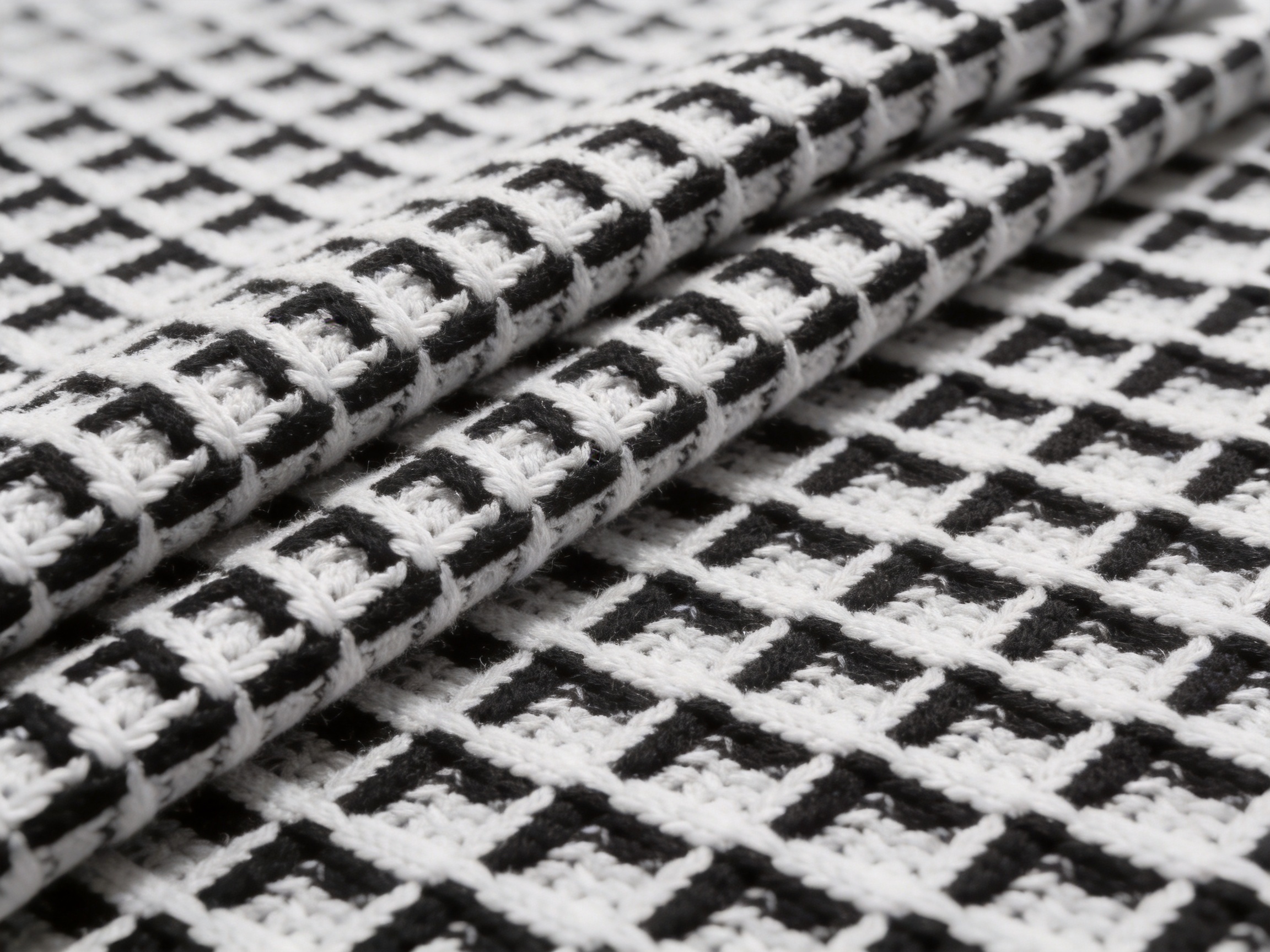
Understanding the Fabric: What Makes Jacquard Grid Fabric Distinctive
Jacquard fabric is defined by the way its pattern is produced. Instead of relying only on printing, coating, or post-production decoration, jacquard technology creates patterns by controlling the movement and arrangement of yarns during textile formation. In knitted jacquard fabric, this control allows complex designs, repeated motifs, geometric patterns, color contrasts, and texture changes to be formed as part of the fabric structure. This structural patterning is one of the main reasons jacquard fabric is regarded as more refined and durable than many surface-printed alternatives.
The black and white grid design is a particularly strong expression of jacquard capability. A grid may appear simple at first glance, but precision is essential. Lines must remain straight, intersections must be clean, color contrast must be stable, and the repeated pattern must not distort easily during cutting, sewing, wearing, or washing. Knitted jacquard production makes it possible to manage these requirements while maintaining flexibility and comfort. The design becomes part of the fabric’s body, not merely an added decoration.
The visual effect of black and white is timeless. Black gives depth, contrast, and sophistication, while white contributes brightness, balance, and clarity. Together they create a neutral yet expressive palette that can be styled in minimalist, classic, retro, casual, formal, or contemporary directions. A grid pattern adds structure without excessive ornamentation, making the fabric suitable for both bold fashion statements and understated everyday pieces.
Compared with floral jacquards or abstract decorative motifs, grid jacquards are easier to match with other materials and garment components. They can be paired with solid black fabrics, white trims, neutral linings, denim, leather-like materials, ribbed cuffs, plain polyester blends, rayon blends, or stretch materials. This coordination value makes black and white grid jacquard fabric especially useful for manufacturers who want to create multiple product lines from a single strong fabric concept.
Key Advantages Over Competitor Fabrics
The first major advantage of jacquard black and white grid fabric is its integrated pattern structure. Many competing grid fabrics are created through printing. While printed fabrics can be cost-effective and colorful, the pattern sits mainly on the surface. With repeated use, washing, abrasion, or stretching, printed designs may fade, crack, blur, or lose their original sharpness. A knitted jacquard grid, by contrast, is formed through yarn placement and fabric construction. This gives the pattern improved depth and a more stable appearance over time.
The second advantage is texture. Printed grid fabrics can sometimes look flat, especially when viewed up close. Jacquard fabric provides a more dimensional and premium surface because the pattern interacts with the fabric structure. Depending on yarn selection and knitting technique, the grid may show subtle raised or recessed effects, giving the textile a richer hand and more refined visual character. This is valuable for apparel brands that want a fabric to feel distinctive without relying on heavy embellishment.
The third advantage is versatility. Some decorative fabrics are attractive but difficult to use. They may be too stiff, too delicate, too heavy, or too limited in application. Knitted jacquard fabric can balance decorative appearance with practical wearability. It can support movement, drape naturally, and adapt to different garment silhouettes. For home sewing and soft furnishing projects, it also provides enough visual interest to stand alone without requiring complicated construction.
The fourth advantage is comfort. Since this product belongs to the knitted jacquard fabric category, it can offer more flexibility than many rigid woven decorative fabrics. Knitted structures generally provide better stretch and body adaptability, which is helpful in garments such as tops, skirts, dresses, cardigans, and fitted panels. When blended yarns such as polyester, rayon, or spandex-containing materials are used in related production systems, the fabric can be engineered for improved softness, elasticity, recovery, and comfort.
The fifth advantage is production consistency. A professional manufacturer with integrated processes can control yarn quality, knitting parameters, dyeing behavior, finishing performance, and final inspection. This helps reduce common problems such as pattern skewing, uneven shrinkage, shade variation, surface defects, and unstable fabric width. For buyers, consistency is not just a technical advantage; it affects cutting efficiency, sewing productivity, product appearance, return rates, and customer satisfaction.
Product Applications in Garment-Making
Garment-making remains one of the most popular uses for jacquard patterns, and black and white grid fabric is especially effective in fashion design. Its graphic character provides immediate visual appeal, while its neutral color combination makes it highly adaptable. Designers can use it as the primary fabric for a full garment or as a contrast element in panels, collars, sleeves, pockets, hems, or decorative trims.
For dresses, the fabric can create a polished and modern look. A simple silhouette becomes more expressive when made with a structured grid pattern. The contrast between black and white can visually shape the garment, while the knitted jacquard construction supports comfortable movement. Depending on weight and finishing, the fabric can work for casual dresses, office-style dresses, fashion-forward streetwear designs, or seasonal collections.
For skirts, jacquard grid fabric offers strong design flexibility. It can be used in straight skirts, A-line skirts, pleated-inspired styles, wrap skirts, and coordinated sets. The grid pattern provides geometric balance, making it suitable for minimalist fashion as well as retro-inspired styling. Because the design is not overly seasonal, it can remain relevant across multiple collections.
For tops and cardigans, the fabric gives everyday garments a more refined character. A black and white grid top can be paired easily with solid trousers, denim, skirts, or tailored pieces. Cardigans made from knitted jacquard grid fabric can feel both comfortable and visually structured. This combination is useful for brands that want garments to be wearable but not plain.
For lightweight jackets and outer layers, the grid design can create a clean statement without excessive decoration. The fabric may be used for casual jackets, fashion overshirts, zip-up styles, or hybrid knitwear pieces. When combined with appropriate linings or trims, it can deliver a distinctive appearance suitable for urban casualwear and contemporary women’s fashion.
For coordinated fashion sets, the black and white grid is particularly useful. A matching top and skirt, jacket and dress, cardigan and trousers, or two-piece lounge-inspired set can create a cohesive look. Because the pattern is neutral and graphic, it photographs well and displays clearly in retail presentations, catalogues, and online product pages.
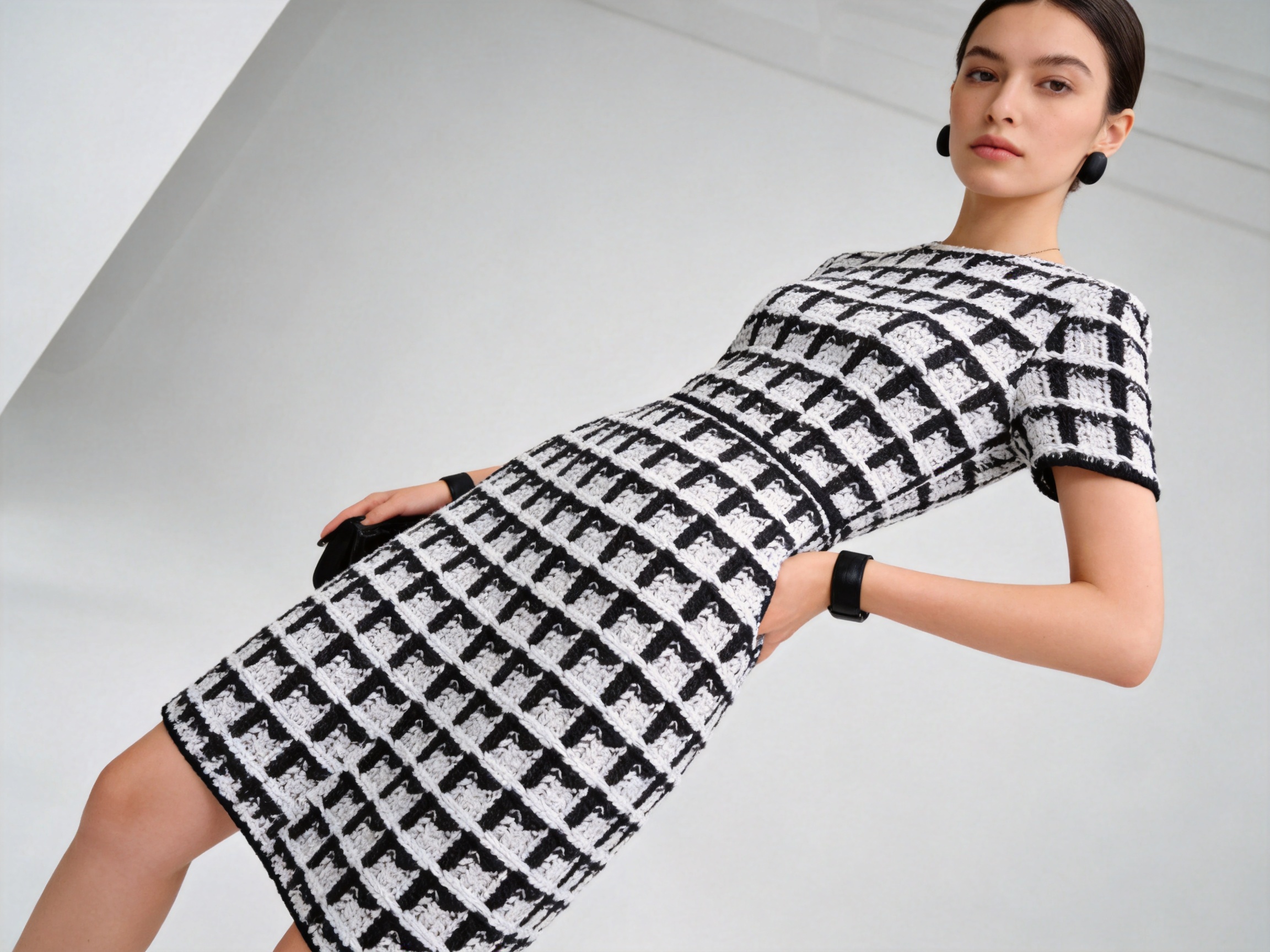
Applications in Home Sewing and Interior Projects
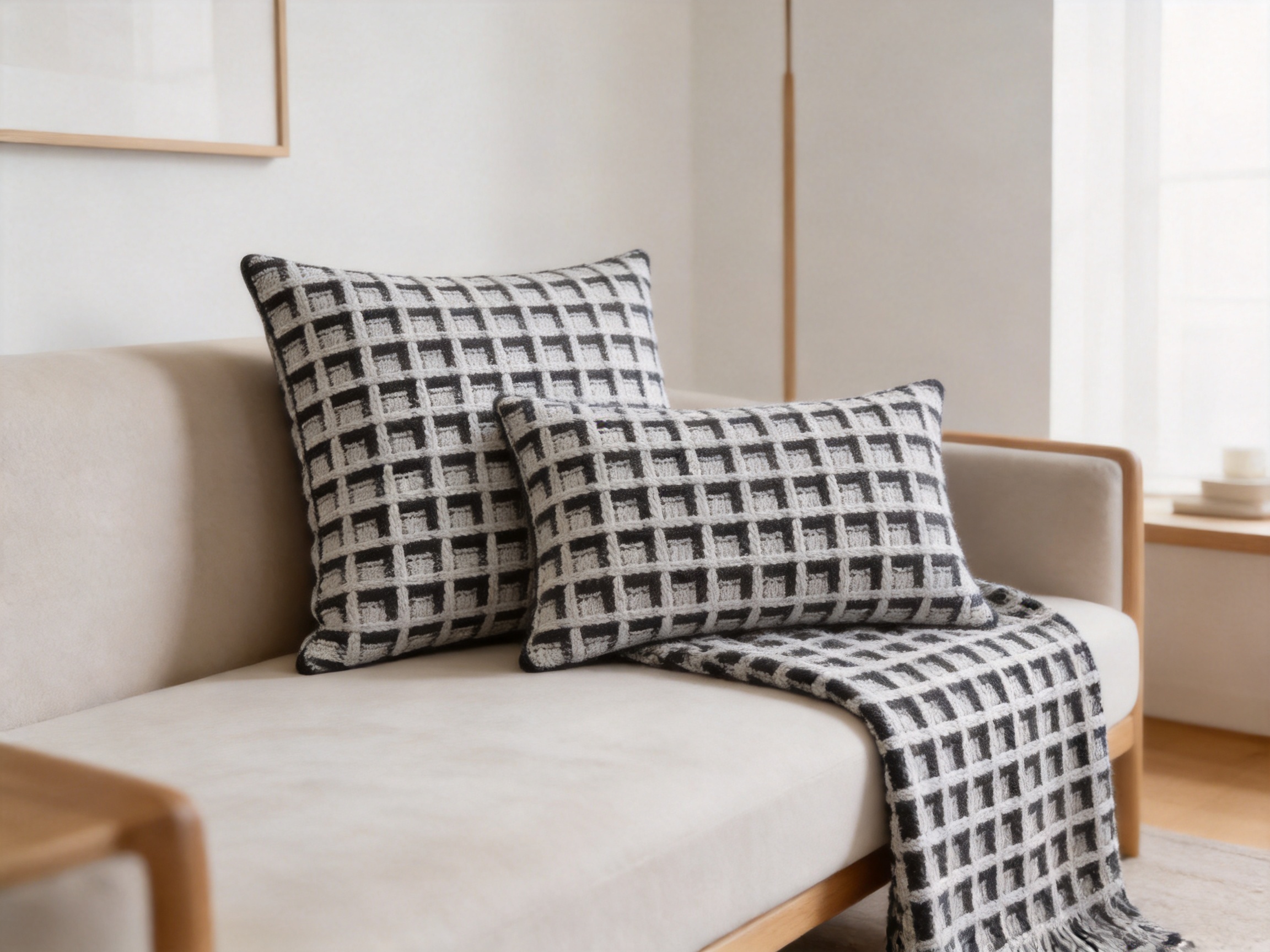
Although jacquard grid fabric is widely used in apparel, its durability and decorative qualities also make it suitable for home-based sewing projects. Many home creators and small-batch makers look for fabrics that are easy to match with existing interiors while still offering personality. The black and white grid pattern meets this need because it works with modern, Scandinavian, minimalist, industrial, monochrome, and eclectic interior styles.
Cushion covers are one of the most practical home applications. The grid pattern can add structure to a sofa, chair, bed, or reading corner. Because black and white pairs well with many colors, the fabric can be combined with grey, beige, natural wood tones, metallic accents, or bold accent colors such as red, green, yellow, or blue. A few jacquard grid cushions can update an interior without requiring major decoration changes.
Decorative throws and fabric panels can also benefit from the jacquard structure. The tactile quality of the fabric adds comfort, while the geometric pattern contributes a clean visual rhythm. In smaller craft projects, the fabric can be used for bags, pouches, table accents, storage covers, wall-hanging textile pieces, and patchwork-style designs. Its pattern can help small objects look more finished and intentional.
For home sewing enthusiasts, jacquard fabric provides a satisfying balance between beauty and practicality. It is decorative enough to make simple projects look polished, yet versatile enough to be used creatively. The fact that jacquard fabrics are available in a range of colors and textures further supports project variety. The black and white grid version is especially useful because it can act as a neutral base or as a bold design feature depending on how it is used.
Material Performance and User Experience
Textile value is not determined by appearance alone. A fabric must also perform well during cutting, sewing, wearing, cleaning, and long-term use. Jacquard black and white grid fabric is designed to provide a strong user experience by combining visual appeal with structural performance. The knitted jacquard construction supports flexibility, while the patterning process helps maintain a clear and distinctive design.
One important performance feature is dimensional behavior. Grid fabrics require careful control because any distortion is immediately visible. If a grid twists, shrinks unevenly, or stretches out of shape, the finished garment can look unbalanced. Advanced knitting control, suitable yarn selection, and proper finishing help reduce these risks. A capable manufacturer pays attention to fabric width, weight, shrinkage, spirality, and pattern alignment so that buyers can process the fabric more efficiently.
Another key feature is hand feel. A fabric may look attractive, but if it feels rough, overly stiff, or uncomfortable, its application becomes limited. Knitted jacquard fabric can be engineered for a softer and more flexible touch. With appropriate finishing, it can provide a comfortable surface for garments and a pleasant texture for home projects. This makes it more attractive than some rigid decorative fabrics that are beautiful but difficult to wear.
Color contrast is also essential. Black and white grid fabric depends on clean contrast. If the black appears dull, the white appears greyed, or the boundary between colors lacks clarity, the visual impact is weakened. Professional dyeing and finishing control helps ensure that the color presentation remains sharp and commercially appealing. Careful production management also helps reduce shade variation between batches, which is especially important for repeat orders.
Durability is another advantage. Because the pattern is formed through jacquard construction rather than only surface printing, the design can retain a more integrated appearance during use. While care conditions must always be matched to the specific fiber composition and finishing, jacquard structure generally provides better design permanence than many simple printed alternatives. For customers, this means garments and projects can maintain their intended look for longer.
Manufacturing Strength: Integrated Textile Production
A major factor behind the competitiveness of this fabric is the manufacturer’s integrated production strength. Hangzhou Jinfeng Textile Co., Ltd. operates with capabilities that include research and development, production, processing, post-dyeing, finishing, and sales. The company is located in Xiaoshan District, Hangzhou, an area with a strong textile industry foundation and supply chain resources. Its production base covers a significant area and supports fabric and yarn-related operations, allowing close coordination across multiple stages of textile manufacturing.
The company’s business covers blended fabrics such as polyester and spandex-related textiles, as well as DTY polyester yarn production, processing, and sales. This background is important because jacquard fabric quality begins before knitting. Yarn consistency, texture, strength, elongation, dyeing behavior, and intermingling all influence the final fabric. A company with experience in DTY polyester yarn and blended fabric production can better understand how yarn decisions affect fabric appearance and performance.
Integrated production offers several advantages over fragmented sourcing. When yarn, knitting, dyeing, finishing, and inspection are managed within a coordinated system, communication is faster and technical adjustments are easier. If a fabric requires improved softness, better elasticity, sharper grid definition, or more stable shrinkage, the production team can review multiple variables instead of treating each process as an isolated step. This improves both development speed and quality control.
The company’s self-operated export experience also supports international buyers. Export customers often require clear communication, reliable specifications, consistent quality, timely delivery, and documentation support. A manufacturer that integrates production and sales can respond more directly to buyer needs, whether the order involves garment fabric, home textile fabric, blended textile development, or yarn-related supply.
Advanced Yarn Foundation: DTY and Blended Fabric Expertise
Drawn textured yarn, commonly known as DTY, plays an important role in many modern knitted fabrics. DTY polyester yarn is produced by texturing partially oriented yarn to create a yarn with crimp, bulk, elasticity, and improved textile usability. This type of yarn is widely used in knitting and weaving because it can contribute softness, stretch, resilience, and stable processing performance. A manufacturer with DTY expertise has a strong technical foundation for producing knitted jacquard fabrics with consistent quality.
Slight intermingled drawn textured yarn is especially relevant in fabric production because intermingling affects yarn cohesion and processing stability. Slight intermingling can help yarns run more smoothly in knitting operations while retaining desirable bulk and texture. For jacquard fabrics, stable yarn feeding is important because pattern formation depends on precise control. Uneven yarn behavior can cause defects, missed stitches, irregular pattern edges, or inconsistent fabric surfaces.
Polyester and rayon blended fabric knowledge also supports product development. Polyester contributes strength, durability, wrinkle resistance, and dimensional stability, while rayon can add softness, drape, and comfort. When the appropriate blend is selected, the fabric can achieve a better balance of performance and hand feel than single-fiber fabrics. Spandex-related experience can further support elasticity and recovery when stretch properties are required.
Competitor fabrics may be made from low-grade yarns or inconsistent raw materials, resulting in unstable quality. By contrast, a producer with yarn processing and fabric manufacturing capabilities can pay attention to yarn count, filament behavior, texturing quality, intermingling level, color absorption, and compatibility with knitting machinery. This technical depth helps create a fabric that is not only attractive but also suitable for efficient industrial use.
Knitted Jacquard Production Process
The production of jacquard black and white grid fabric begins with design planning. The grid must be translated into a knitting program that controls pattern repeat, color placement, line width, and fabric structure. Designers and technicians evaluate how the grid will appear after knitting, dyeing, finishing, relaxation, cutting, and sewing. Because knitted fabrics can stretch and recover, the design must account for fabric behavior rather than simply copying a flat graphic.
Yarn selection is the next key stage. Yarn must be chosen according to required fabric weight, stretch, softness, opacity, durability, and color performance. Polyester DTY may be selected for stability and resilience, while blended yarns may be used to improve touch or drape. If the fabric requires additional elasticity, spandex-related structures may be considered. The black and white effect may be achieved through yarn-dyed components, controlled dyeing methods, or other production approaches depending on specification.
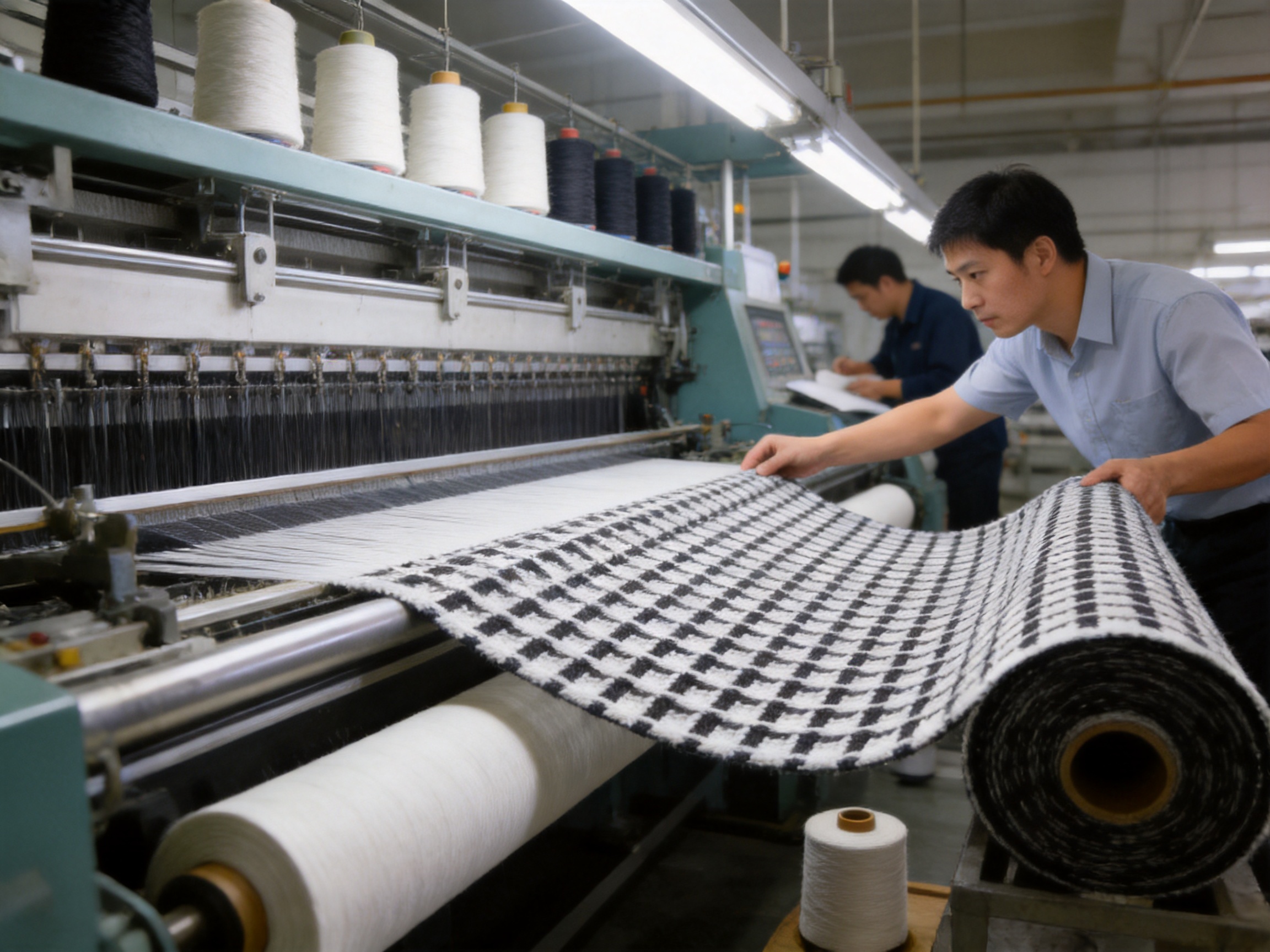
During knitting, jacquard machinery controls yarn placement to form the grid pattern. Machine settings must be carefully managed, including gauge, tension, feeding, take-down, stitch formation, and pattern programming. Small variations can affect the clarity of the grid. Professional operators monitor production to identify defects early, such as broken yarns, irregular loops, misalignment, contamination, or inconsistent pattern formation.
After knitting, the greige fabric may undergo inspection and preparation for dyeing or finishing. If dyeing is required, process control is essential to achieve consistent black and white contrast or to maintain color stability in yarn-dyed structures. Dyeing conditions, temperature control, chemical selection, washing, and fixation all influence final quality. In black and white fabrics, preventing staining, shade contamination, or dullness is particularly important.
Finishing gives the fabric its final hand, width, weight, shrinkage behavior, and surface character. Finishing may include washing, softening, heat setting, drying, calendaring, compacting, or other treatments depending on the fabric specification. Heat setting can be important for polyester-containing fabrics because it helps stabilize dimensions. Soft finishing can improve comfort and garment appeal. Final inspection ensures that the fabric meets requirements before packing and shipment.
Quality Control for Commercial Reliability
Quality control is one of the strongest differentiators between a professional jacquard fabric supplier and ordinary fabric producers. For buyers, the visible beauty of a sample is only the starting point. The fabric must also perform consistently across production lots. Commercial garment factories need fabric that cuts cleanly, sews predictably, and maintains appearance after finishing and packaging. Retailers need products that look consistent from piece to piece. End users need garments and home items that remain attractive during use.
Important quality control points include yarn inspection, greige fabric inspection, pattern verification, width and weight testing, color evaluation, shrinkage testing, surface defect review, hand-feel assessment, and packing inspection. For grid fabric, pattern alignment is especially important. The grid must not appear skewed or irregular. Even minor deviations can be visible in finished garments, particularly at seams, hems, and center-front areas.
Color control is also critical. The black should be rich and stable, while the white should remain clean and bright. If the fabric is produced in repeat orders, shade matching becomes an important part of supplier reliability. Buyers often require consistency so that garments from different batches can be sold together without visible difference. A strong manufacturer maintains production records and technical controls to support repeatability.
Physical performance testing can include dimensional change after washing, pilling resistance, fabric strength, elasticity and recovery, colorfastness, and appearance retention. The exact testing requirements depend on the buyer’s market and application. For apparel, comfort and care performance may be prioritized. For home sewing projects, durability and appearance stability may be especially important. The ability to adapt quality control to different customer needs is a sign of manufacturing maturity.
Comparison With Common Alternatives
When evaluating jacquard black and white grid fabric, it is helpful to compare it with several common alternatives. These include printed grid knit fabric, plain dyed knit fabric, woven check fabric, and low-grade decorative jacquard fabric. Each has its place, but knitted jacquard grid fabric offers a distinctive balance of design depth, comfort, and commercial practicality.
| Fabric Type | Main Strength | Common Limitation | Advantage of Jacquard Black and White Grid Fabric |
|---|---|---|---|
| Printed grid knit fabric | Cost-effective and easy to produce in many designs | Surface print may fade, crack, or lose sharpness | Pattern is integrated into the fabric structure for a richer and more durable appearance |
| Plain dyed knit fabric | Simple, comfortable, and versatile | Lacks visual distinction without added decoration | Provides built-in graphic design while retaining knitted comfort |
| Woven check fabric | Stable structure and classic appearance | May feel less flexible and less comfortable for stretch garments | Offers geometric style with better knit adaptability and movement |
| Low-grade jacquard fabric | Decorative surface and low initial cost | May suffer from poor yarn quality, unstable pattern, and uneven finishing | Benefits from integrated manufacturing, yarn expertise, and quality control |
| Heavy upholstery fabric | Strong and decorative for interiors | Often too stiff or heavy for apparel | Suitable for garments and selected home projects due to balanced hand and flexibility |
This comparison shows why jacquard black and white grid fabric is an effective choice for buyers who want both design and practicality. It is more expressive than plain fabric, more structurally refined than printed grid fabric, more flexible than many woven checks, and more comfortable than heavy decorative textiles. Its value lies in balance: it can serve fashion, casualwear, craft, and home projects without being limited to a single narrow use.
Design Value for Fashion Brands
Fashion brands need fabrics that communicate style quickly. In retail environments, whether online or offline, customers often make first judgments based on visual impact. A black and white grid is instantly readable. It creates a modern, confident impression and can be styled in multiple directions. This makes the fabric valuable for product development teams that need reliable design themes.
For minimalist collections, the grid can be used with clean silhouettes and simple trims. For retro collections, it can reference classic checks and mod-inspired geometry. For streetwear, it can be paired with oversized cuts, contrast zippers, ribbed details, or bold accessories. For office-inspired fashion, it can support structured skirts, dresses, or cardigans with a polished appearance. This adaptability reduces design risk because one fabric can support many product concepts.
The black and white palette also supports inventory flexibility. Fabrics in strong seasonal colors may become outdated quickly, but monochrome patterns remain relevant. Brands can carry them across seasons by changing garment design, trim, styling, or collection story. This helps improve fabric utilization and reduces the risk of unsold material.
Another design advantage is photographability. Online retail depends heavily on images. A well-defined black and white grid can display clearly in product photos, helping customers understand texture, pattern, and garment shape. The jacquard structure may also provide close-up detail shots that communicate quality. This is useful for e-commerce, lookbooks, social media campaigns, and wholesale catalogues.
Benefits for Garment Manufacturers
Garment manufacturers benefit from fabric that performs predictably on the cutting table and sewing line. A stable jacquard grid fabric can improve production efficiency because workers can better align patterns, manage seams, and maintain garment consistency. When fabric width, weight, and shrinkage are controlled, marker planning becomes easier and waste can be reduced.
Pattern matching is important for grid garments. Although perfect matching depends on garment design and cutting method, a fabric with a stable repeat gives manufacturers a better starting point. If the grid is inconsistent, matching becomes difficult or impossible. Professional jacquard production helps maintain repeat regularity and visual order.
Sewing performance is also important. Knitted jacquard fabric should be compatible with suitable needles, thread, seam types, and machine settings. A balanced fabric structure reduces problems such as seam puckering, skipped stitches, stretching at seams, or edge distortion. Proper finishing can also improve fabric handling during garment assembly.
For brands and factories working under delivery deadlines, supplier reliability matters. Integrated manufacturing and export service help ensure clearer communication and faster problem-solving. If technical questions arise regarding fabric weight, finishing, shrinkage, or color matching, a capable supplier can coordinate internally rather than relying on disconnected external partners.
Sustainability and Responsible Production Considerations
Modern textile buyers increasingly consider sustainability, resource efficiency, and responsible production. While specific sustainability claims must always be verified through actual certifications, test reports, or buyer audits, integrated manufacturing can support more responsible process management. When production stages are coordinated, it becomes easier to monitor material use, reduce waste, improve first-pass quality, and avoid unnecessary reprocessing.
Durability is also connected to sustainability. A fabric that maintains its appearance longer can reduce premature disposal. Jacquard construction contributes to design longevity because the pattern is part of the fabric rather than a fragile surface effect. If garments and home projects remain attractive through repeated use, consumers may keep them longer, supporting more responsible consumption.
Quality consistency also reduces waste in garment production. Fabric defects, shade variation, unstable shrinkage, and poor finishing can lead to cutting loss, rejected garments, returns, and unsold stock. A manufacturer with strong quality control helps reduce these risks. In this sense, technical reliability is not only a commercial advantage but also a practical contribution to resource efficiency.
Material selection can further support responsible development. Polyester, rayon, spandex, and blended fibers each have different performance and environmental considerations. Experienced textile producers can help buyers select materials according to durability, care performance, comfort, cost, and market expectations. Thoughtful product engineering can improve the balance between performance and resource use.
Customization and Product Development Potential
Although the black and white grid design is already a strong product concept, knitted jacquard technology allows further development. Buyers may request changes in grid size, fabric weight, yarn composition, hand feel, stretch level, finishing style, or color arrangement. The same design principle can be adapted for different markets, such as women’s fashion, youth fashion, casualwear, boutique sewing, craft material, or home textile projects.
Grid size has a major influence on the final style. A small grid can appear refined, neat, and suitable for classic garments. A medium grid can balance visibility and wearability. A large grid can create a bold graphic statement for fashion-forward designs. Jacquard programming makes these variations possible when supported by suitable machinery and technical development.
Fabric weight can also be adjusted according to season and application. Lighter versions may suit tops, dresses, and layering garments. Medium-weight versions may suit skirts, cardigans, jackets, and structured fashion pieces. Heavier versions may be considered for decorative home projects or outerwear-inspired designs. Finishing can further modify drape, softness, fullness, or compactness.
Color customization is another development direction. While black and white is the most classic and versatile version, the grid concept can be extended to navy and white, grey and black, beige and brown, red and black, or other combinations. However, the black and white version remains particularly valuable because it is easy to coordinate and has broad commercial appeal.
Why This Fabric Stands Out in the Market
Jacquard black and white grid fabric stands out because it combines several market needs in one product. It is visually distinctive but not overly complicated. It is decorative but practical. It supports garment-making while also serving selected home sewing projects. It has a timeless color combination and a structured pattern that remains relevant across seasons. These characteristics give it broader value than many trend-dependent fabrics.
Its structural jacquard pattern offers a premium alternative to printed checks. Its knitted construction gives it comfort and flexibility that many woven decorative fabrics cannot provide. Its black and white palette makes it easy for designers, retailers, and consumers to coordinate. Its production through an experienced textile manufacturer adds reliability that buyers need for repeat orders and commercial programs.
The manufacturing background behind the fabric is also a major advantage. Hangzhou Jinfeng Textile Co., Ltd. combines experience in DTY polyester yarn, blended fabric production, post-dyeing, finishing, and export sales. This integrated capability supports fabric quality from yarn to finished textile. For buyers, this means more than purchasing a fabric; it means working with a supplier that understands the technical chain behind fabric performance.
In competitive markets, fabric buyers often compare price first. However, the lowest initial price does not always deliver the best value. If a cheaper fabric has unstable pattern alignment, poor hand feel, inconsistent shade, weak durability, or high cutting waste, the total cost becomes higher. A well-produced jacquard grid fabric can offer better value by improving garment quality, reducing production problems, and enhancing final product appeal.
Care, Handling, and Sewing Recommendations
Proper care and handling help preserve the quality of jacquard black and white grid fabric. The exact instructions should always be based on the final fiber composition, dyeing method, and finishing process, but several general recommendations apply to many knitted jacquard fabrics. Before bulk garment production or home sewing, it is advisable to test washing, drying, ironing, and shrinkage behavior. This helps prevent surprises after the finished product is made.
For cutting, the fabric should be relaxed before spreading, especially if it contains stretch or has been rolled under tension. Relaxation allows the fabric to return closer to its natural dimensions. When cutting grid patterns, careful alignment is important. The grid can be used as a visual guide, but cutters should avoid stretching or pulling the fabric during layout. Sharp cutting tools help maintain clean edges.
For sewing, suitable needles and threads should be selected according to fabric weight and composition. Ballpoint or stretch needles may be appropriate for knitted structures, while thread should provide adequate strength and flexibility. Seam types should support movement, especially for fitted garments. Testing seams before full production helps determine the best machine settings and avoid puckering or skipped stitches.
For garment care, gentle washing and appropriate drying methods can help maintain shape and appearance. Excessive heat may affect some fibers or finishes, so care labels should be developed based on testing. Black and white contrast fabrics should also be evaluated for colorfastness to washing and rubbing. Professional suppliers can support buyers with test data and technical recommendations when required.
Company Strength and Customer Service
Hangzhou Jinfeng Textile Co., Ltd. is positioned as a textile enterprise integrating research and development, production, and sales. The company’s facility in Xiaoshan District, Hangzhou, supports operations related to blended fabrics and DTY polyester yarn. Its production and processing capabilities include post-dyeing and finishing, which are essential for developing commercially reliable fabrics. This integrated structure allows the company to serve customers at home and abroad with a practical and cooperative approach.
The company’s experience with polyester, spandex, and related blended fabrics gives it a strong foundation for developing fabrics that require durability, flexibility, and comfort. Its work with DTY polyester yarn further supports quality control at the yarn level. This is important because many fabric defects originate from yarn inconsistency. By understanding yarn production and fabric construction together, the company can create more stable textile solutions.
Customer service is also supported by the company’s export orientation. International buyers often require product consultation, sampling, specification confirmation, production scheduling, inspection coordination, and shipping communication. A supplier with direct sales and production communication can help reduce misunderstandings and improve project efficiency. The company’s business philosophy emphasizes cooperation and mutual benefit, which aligns with long-term textile partnerships.
For buyers seeking jacquard black and white grid fabric, the company can provide not only a product but also manufacturing support. This includes advice on fabric application, potential customization, order planning, and quality expectations. In textile sourcing, such support can be as important as the fabric itself, especially when developing new garments or entering repeat production.
Q&A: Common Questions About Jacquard Black and White Grid Fabric
What is jacquard black and white grid fabric?
It is a knitted jacquard fabric featuring a black and white grid pattern formed through fabric construction rather than relying only on surface printing. The jacquard method gives the fabric a richer texture, stronger pattern integration, and a more premium appearance.
Why is jacquard grid fabric better than printed grid fabric?
Printed grid fabric can be attractive, but the design is mainly applied to the surface. Over time, prints may fade, crack, or lose sharpness. Jacquard grid fabric integrates the pattern into the textile structure, helping the design look more dimensional and durable.
What garments can be made from this fabric?
It can be used for dresses, skirts, tops, cardigans, lightweight jackets, coordinated sets, decorative panels, and fashion accessories. Its black and white palette makes it easy to coordinate with other fabrics and trims.
Can this fabric be used for home sewing projects?
Yes. It is suitable for selected home-based projects such as cushion covers, decorative throws, fabric panels, bags, pouches, and craft accessories. Its grid pattern works well in modern and minimalist interiors.
Is knitted jacquard fabric comfortable to wear?
Knitted jacquard fabric can offer good flexibility and comfort compared with many rigid woven decorative fabrics. The final comfort level depends on yarn composition, fabric weight, and finishing, but the knitted structure is generally favorable for wearable garments.
How does the manufacturer support quality consistency?
Quality consistency is supported through integrated production, yarn expertise, knitting control, dyeing and finishing management, and final inspection. Important factors include pattern alignment, color contrast, width, weight, shrinkage, surface quality, and hand feel.
Can the grid size or fabric weight be customized?
In many cases, jacquard fabric can be developed with different grid sizes, weights, hand feels, and color combinations. Customization depends on order requirements, machinery capability, yarn selection, and production feasibility.
What makes black and white such a useful color combination?
Black and white is timeless, versatile, and easy to coordinate. It works across casualwear, office-style fashion, retro looks, streetwear, and home decoration. The high contrast also helps the grid pattern remain visually clear.
Why is DTY polyester yarn expertise important?
DTY polyester yarn contributes bulk, resilience, texture, and processing stability. A manufacturer experienced in DTY yarn can better control yarn quality, which helps improve jacquard fabric performance and consistency.
What should buyers consider before bulk production?
Buyers should confirm fabric composition, weight, width, pattern repeat, shrinkage, colorfastness, hand feel, finishing, care requirements, and intended application. Testing and sample approval are recommended before bulk garment production.
Conclusion
Jacquard black and white grid fabric is a strong textile choice for modern apparel and creative home projects because it offers a rare combination of visual clarity, structural texture, comfort, and versatility. Its grid pattern is clean and timeless, while its jacquard construction gives the design depth and durability beyond many printed alternatives. For garment designers, it provides immediate style value. For manufacturers, it offers practical processing potential. For home sewing creators, it brings decorative impact without excessive complexity.
The fabric’s market advantage is strengthened by advanced manufacturing processes and integrated production capability. From DTY polyester yarn knowledge to blended fabric development, knitting, dyeing, finishing, and export service, Hangzhou Jinfeng Textile Co., Ltd. brings technical depth to the product. This matters because fabric quality depends on every stage of production, not just the final appearance. A beautiful sample must be supported by repeatable quality, stable performance, and responsive service.
Compared with competitor fabrics such as printed grids, plain knits, woven checks, or low-grade jacquards, this product delivers a balanced value proposition. It is more dimensional than printing, more expressive than plain fabric, more flexible than many woven checks, and more reliable when produced under strong quality control. Its broad application range makes it useful for fashion collections, sewing projects, and interior accents.
For buyers seeking a fabric that combines classic style with modern textile engineering, jacquard black and white grid fabric is a compelling option. It provides the visual confidence of a graphic pattern, the tactile richness of jacquard construction, and the commercial practicality required for today’s textile market. With professional manufacturing support, it can become a dependable foundation for products that are attractive, comfortable, and competitive.
References
Grosicki, Z. Watson’s Textile Design and Colour: Elementary Weaves and Figured Fabrics. Woodhead Publishing.
Spencer, D. J. Knitting Technology: A Comprehensive Handbook and Practical Guide. Woodhead Publishing.
Sinclair, R. Textiles and Fashion: Materials, Design and Technology. Woodhead Publishing.
Kadolph, S. J. Textiles. Pearson Education.
Collier, B. J., and Epps, H. H. Textile Testing and Analysis. Pearson Prentice Hall.
Cook, J. G. Handbook of Textile Fibres: Man-Made Fibres. Woodhead Publishing.