
Floral-Patterned Knitted Jacquard Fabric for Elegant, Comfortable Apparel
Floral-patterned knitted jacquard fabric brings together decorative textile design, soft comfort, stretch performance, and practical wearability. Unlike many woven jacquards that can feel rigid or heavy, this medium-weight knitted fabric is developed for garments that need movement, drape, and a refined visual surface. Its delicate floral pattern gives dresses, coordinated separates, jackets, and children’s garments a premium appearance while its viscose, nylon, and spandex composition supports softness, resilience, and everyday comfort.
For fashion brands, garment manufacturers, and fabric buyers, the value of a knitted jacquard depends on more than its appearance. The fabric must maintain a stable construction, hold color after repeated care, provide a consistent width, and perform reliably during cutting and sewing. It must also offer a commercially practical balance between design appeal, minimum order quantity, sampling speed, certification, and production support.
This floral-patterned knitted jacquard has been designed with those requirements in mind. It combines a 60% viscose, 35% nylon, and 5% spandex blend with a 240g/m² construction and a 145cm usable width. The result is a soft-touch fabric with excellent drape, subtle sheen, vibrant color retention, and comfortable stretch. It is suitable for elegant day dresses, skirt-and-top sets, lightweight fall jackets, and luxury children’s wear.
Manufactured by Hangzhou Jinfeng Textile Co., Ltd., the fabric is supported by integrated capabilities in textile research and development, knitting, dyeing, finishing, quality inspection, and export service. The company also produces and processes polyester DTY yarn and handles blended fabric production, giving it a broader understanding of yarn behavior, fabric construction, and downstream garment requirements.
What Is Floral-Patterned Knitted Jacquard?
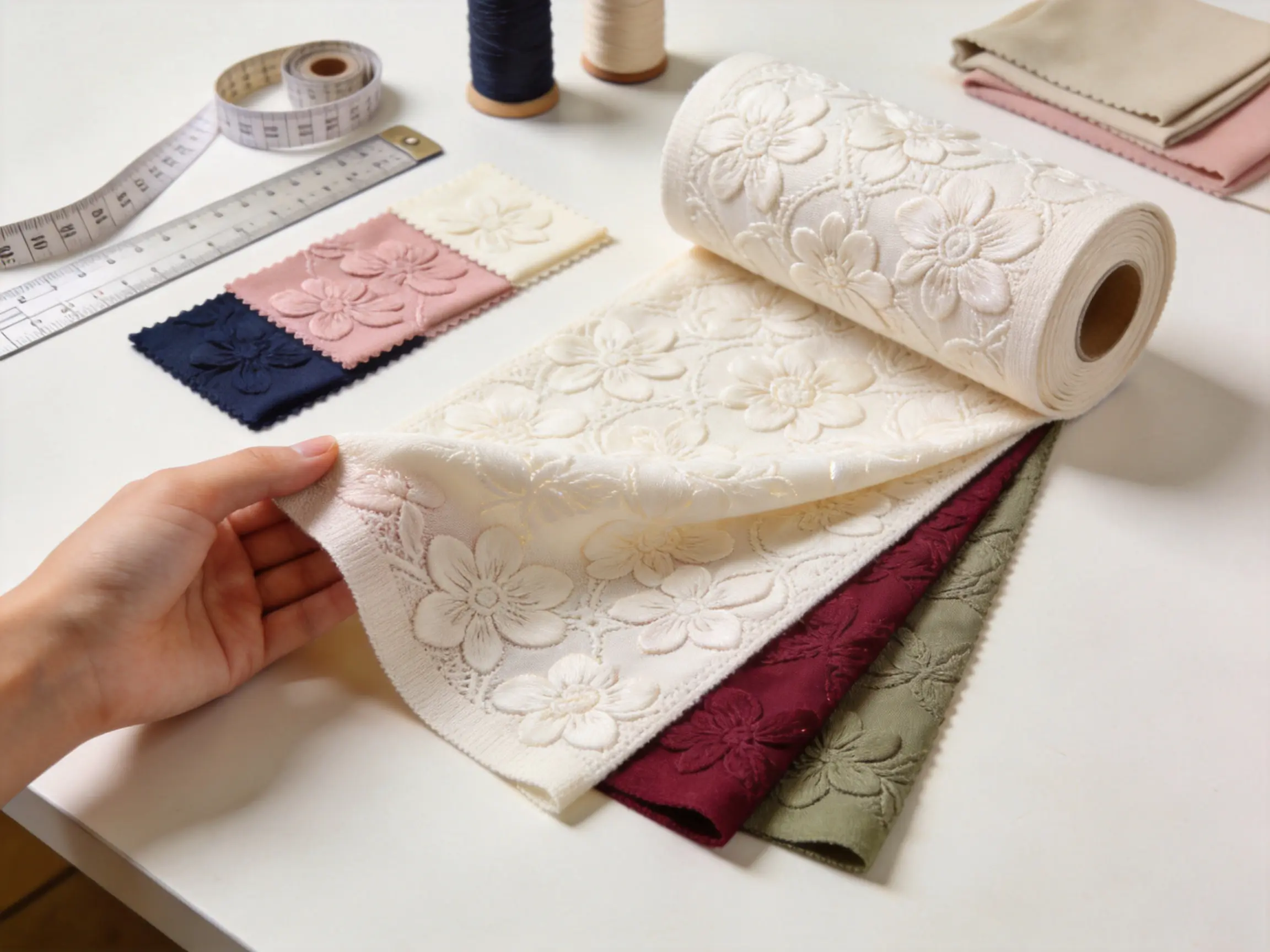
Knitted jacquard is a patterned textile produced by controlling the arrangement of knitted loops and yarns during the knitting process. Instead of relying only on surface printing, the design is incorporated into the fabric structure. This creates a more dimensional appearance and can give the pattern greater visual depth than a simple printed surface.
In this floral version, the jacquard construction forms delicate flower-inspired motifs across the face of the material. The pattern is intended to look intricate and refined without making the fabric excessively heavy. The floral surface can be used as the primary design feature of a garment or paired with solid fabrics, smooth trims, and understated accessories.
Because the material is knitted rather than traditionally woven, it can provide a more flexible hand and more comfortable movement. The addition of 5% spandex further improves stretch and recovery. This makes the fabric particularly useful for fitted dresses, gently shaped tops, coordinated sets, and garments where the wearer expects ease during sitting, walking, and daily activities.
The fabric has a distinct face and back side. The face presents the principal floral jacquard effect, while the back has a neat and clean knitted structure. This construction allows designers to create garments with a clear visual direction and a polished interior finish. Double-sided jacquard versions can also be developed for applications that require pattern visibility on both sides.
Technical Specifications at a Glance
The following specifications summarize the standard construction of the floral-patterned knitted jacquard fabric.
| Specification | Standard Detail | Benefit for Buyers |
|---|---|---|
| Fabric category | Knitted jacquard fabric | Dimensional pattern with flexible knitted comfort |
| Composition | 60% viscose, 35% nylon, 5% spandex | Soft hand, strength, stretch, and fluid drape |
| Weight | 240g/m² | Medium-weight structure suitable for fashion garments |
| Width | 145cm or approximately 57 inches | Practical cutting width for many apparel patterns |
| Surface | Floral-patterned jacquard face | Decorative appearance without depending exclusively on printing |
| Handle | Soft touch | Improved comfort for garments worn close to the skin |
| Drape | Excellent drape | Supports flowing silhouettes and elegant garment movement |
| Color performance | Vibrant color retention | Helps preserve the original appearance during normal use |
| Certification | OEKO-TEX Standard 100 | Supports safer skin-contact applications |
| Sampling | Digital sampling within 7 days for new designs | Shortens the product development cycle |
| Trial order support | MOQ from 500 meters for new design tests | Reduces risk during initial market validation |
Composition and Performance
Viscose for Softness and Fluid Drape
Viscose contributes a smooth, soft hand and a naturally fluid drape. These characteristics are valuable in women’s apparel because they allow the garment to fall gracefully rather than standing away from the body. Viscose also provides a comfortable touch that can make a medium-weight fabric feel more refined and wearable.
For floral dresses, viscose helps the pattern move naturally with the silhouette. It can create soft gathers, flowing skirts, draped bodices, and relaxed sleeves without producing an overly stiff appearance. In coordinated skirt and top sets, the viscose content helps the pieces maintain a polished appearance while remaining suitable for regular wear.
Nylon for Strength and Wear Resistance
Nylon supports the durability of the blend. It contributes tensile strength, abrasion resistance, and dimensional support, helping the fabric withstand the practical demands of cutting, sewing, pressing, wearing, and care. In a jacquard fabric, this strength is particularly useful because the patterned structure must remain stable through manufacturing and repeated use.
The nylon component also helps balance the softer character of viscose. Without sufficient structural support, a soft fabric may lose shape or show excessive wear in high-contact areas. The blended construction is intended to provide a more dependable performance while retaining a comfortable surface.
Spandex for Stretch and Recovery
The 5% spandex content provides comfortable stretch and helps the fabric recover after movement. This is useful for fitted or semi-fitted garments, where a fabric must accommodate the body without feeling restrictive. Stretch also helps improve ease of movement in sleeves, waist areas, and seated positions.
Spandex is not used to make the fabric excessively elastic. Instead, the percentage is balanced to support comfort while preserving the medium-weight hand and floral jacquard appearance. Designers can therefore create garments with shape and structure without sacrificing wearability.
Why Choose Knitted Jacquard Instead of Conventional Printed Fabric?
Printed fabric and knitted jacquard each have their own applications, but knitted jacquard offers several advantages when the buyer wants a more integrated, dimensional appearance. The floral design is formed through the knitting construction, allowing the surface to have greater textural interest than a flat printed graphic.
A printed surface may gradually lose visual intensity as the outer surface is exposed to washing, abrasion, and daily wear. While final color performance depends on the complete dyeing and finishing process, a jacquard structure does not rely solely on a surface print to create its visual identity. This can give the garment a more substantial and premium appearance.
Knitted jacquard can also provide a more comfortable hand than many decorative woven materials. Traditional woven jacquard may be attractive but can feel firm, bulky, or less adaptable to close-fitting designs. The knitted construction provides flexibility, and the spandex content adds further comfort for movement.
Compared with embroidered fabric, knitted jacquard can reduce the need for separate decorative operations. Embroidery can add visual richness, but it may also increase production time, weight, stiffness, and cost. A knitted jacquard forms the pattern during fabric production, offering an efficient way to achieve decorative detail across the full width of the material.
Advantages Over Competing Materials
Balanced Weight for Multiple Seasons
At 240g/m², the fabric is positioned in the medium-weight range. It is substantial enough to support a quality garment silhouette but not so heavy that it becomes unsuitable for dresses or coordinated separates. This balance makes it useful for transitional seasons, indoor events, daywear, and layered styling.
Very lightweight fabrics may be prone to transparency, cling, or insufficient body. Very heavy fabrics can restrict movement and limit seasonal versatility. The 240g/m² construction offers a practical middle ground for buyers seeking one fabric that can serve more than one product category.
Decorative Appearance with Everyday Comfort
Some highly decorative fabrics prioritize appearance at the expense of comfort. They may have a rough surface, rigid backing, or excessive weight. This knitted jacquard is developed to provide a soft hand alongside its floral pattern, allowing brands to create garments that look special but remain comfortable for extended wear.
This combination is especially important in contemporary fashion, where customers often expect occasion-inspired design to remain practical. A floral jacquard dress can be styled for a daytime event, workplace setting, dinner, or social occasion without the wearer feeling constrained by the fabric.
Reliable Drape for Garment Development
Excellent drape helps designers translate fabric from the roll into a finished garment. A fabric with controlled fluidity can support pleats, gathers, A-line skirts, wrap details, soft collars, and relaxed sleeves. It can also create more elegant movement when the wearer walks.
For pattern makers, drape affects the choice of seam placement, lining, hem treatment, and ease allowance. The fluid characteristics of this viscose-blend knitted jacquard provide a useful foundation for designs that depend on graceful movement rather than rigid tailoring.
Stretch for Fit Flexibility
The combination of knitted construction and spandex gives designers more flexibility when developing close-fitting or gently fitted garments. Stretch can support a broader range of body movement and may reduce the need for excessive ease in certain styles.
Stretch performance must always be evaluated with the specific garment pattern, sewing method, and direction of stretch. However, the presence of spandex gives the material an advantage over non-stretch woven jacquards when comfort, movement, and contemporary silhouettes are priorities.
Commercially Practical Sampling and MOQ
New textile designs carry development risk. A brand may need to test a floral motif, evaluate consumer response, or confirm the fabric’s behavior in a particular garment before placing a large order. Digital sampling within 7 days helps shorten this evaluation stage.
A trial order of 500 meters for new design testing also provides greater flexibility than suppliers that only accept very large initial quantities. This can be valuable for independent labels, capsule collections, seasonal launches, and buyers entering a new market. Once the design has been approved and sales potential confirmed, production can be planned for larger quantities.
Applications in Women’s Apparel
Elegant Day Dresses
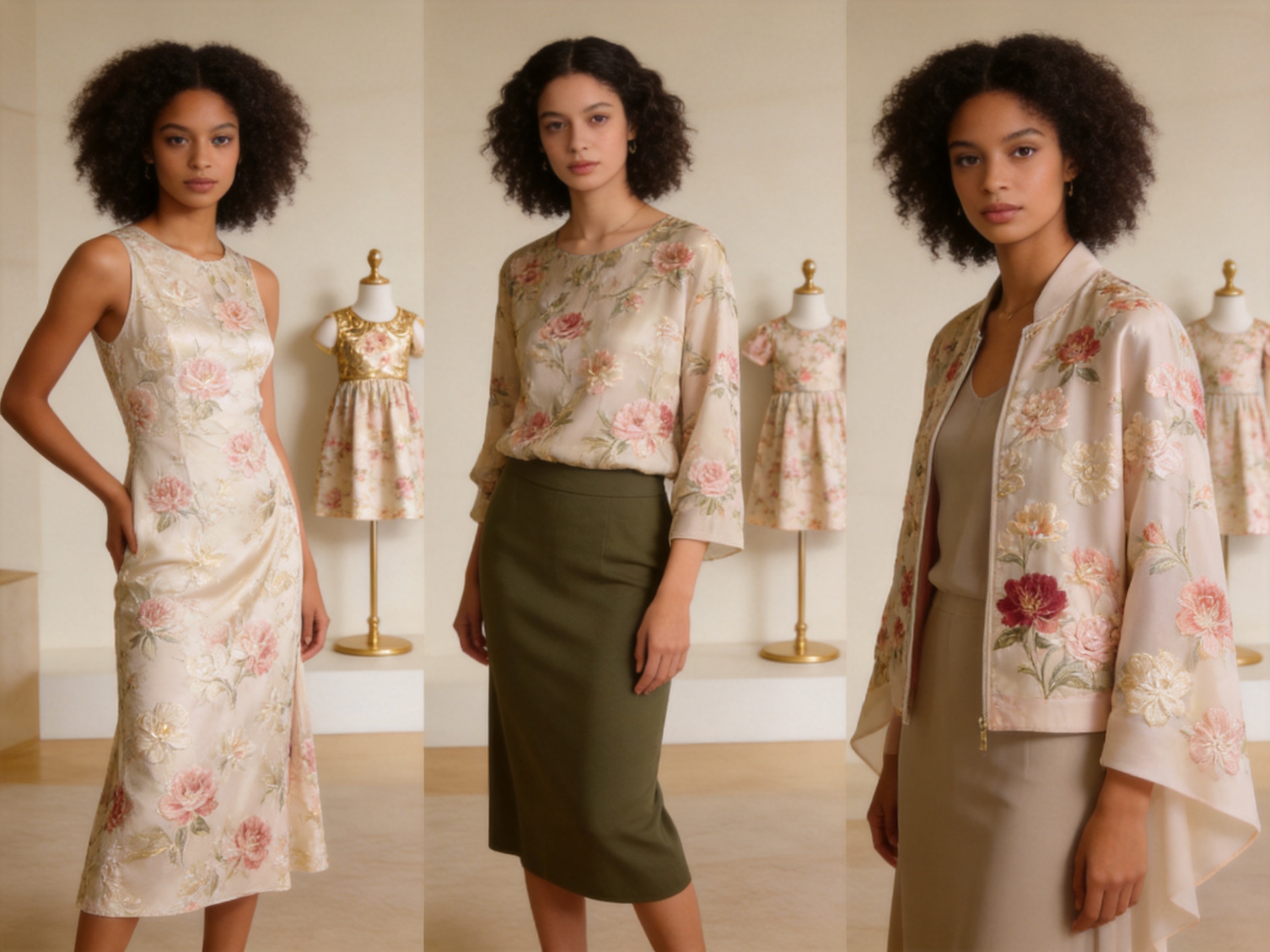
The primary application for this fabric is women’s elegant daywear. The floral pattern provides a finished decorative effect, while the soft hand and fluid drape create a comfortable silhouette. Designers can use it for fit-and-flare dresses, shirt dresses, wrap dresses, midi dresses, and softly structured styles.
The medium weight provides enough body for a clean outline, while the stretch helps the garment move with the wearer. Depending on the design and colorway, the fabric can support romantic, contemporary, feminine, or sophisticated brand directions.
Coordinated Skirt and Top Sets
Matching separates are a strong application because the jacquard pattern can unify a complete outfit. A skirt and top made from the same fabric create a coordinated appearance, while each item can also be sold and worn separately.
For skirts, the fabric can support straight, flared, gathered, or gently pleated silhouettes. For tops, it can be used in fitted blouses, peplum shapes, relaxed shells, and long-sleeved designs. The stretch component helps make coordinated sets more comfortable across different body positions.
Lightweight Fall Jackets
Although the fabric is not positioned as a heavy outerwear textile, its medium weight and decorative surface make it suitable for lightweight fall jackets, cropped jackets, soft blazers, and fashion cardigans. It can be used as a statement layer over a plain dress or paired with solid trousers and skirts.
For jacket construction, designers should evaluate seam stability, lining requirements, edge finishing, and the amount of stretch needed for the intended style. A structured pattern can give the fabric additional shape, while an unlined design can highlight its soft knitted character.
Luxury Children’s Wear
The soft hand and OEKO-TEX Standard 100 certification make the fabric suitable for selected children’s wear applications, subject to the requirements of the target market and final product. Floral dresses, occasion outfits, special-event skirts, and comfortable coordinated pieces can benefit from the fabric’s decorative appearance.
Children’s garments must allow movement, and the knitted construction can help provide that flexibility. Designers should also consider age-specific safety requirements, seam comfort, accessory placement, and care instructions when developing the final garment.
Manufacturing Capabilities and Process Control
Integrated Textile Production
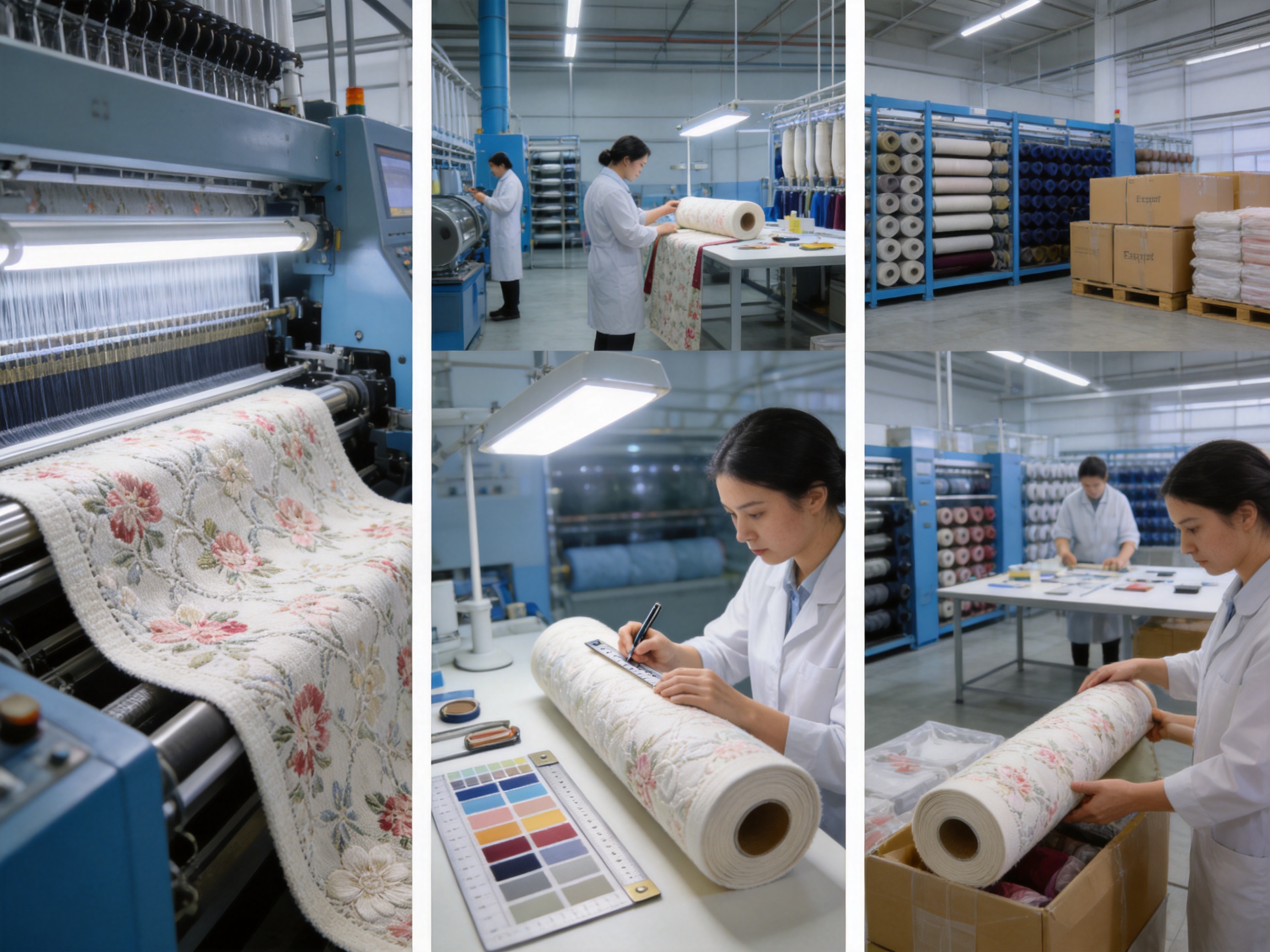
Hangzhou Jinfeng Textile Co., Ltd. operates as an integrated textile enterprise involved in research and development, production, processing, post-dyeing, finishing, and sales. Its product scope includes polyester and spandex blended fabrics, knitted fabric categories, and DTY polyester yarn production and processing.
This integrated structure gives the manufacturer a broad view of the textile chain. Yarn selection affects knitting performance; knitting affects dye absorption and dimensional stability; dyeing affects color fastness and hand; finishing affects drape, touch, width, and appearance. Managing these relationships is essential for producing a consistent jacquard fabric.
Controlled Knitting for Pattern Accuracy
Knitted jacquard requires precise control of yarn feeding, loop formation, pattern programming, machine settings, and fabric tension. Small variations can affect motif clarity, repeat alignment, width, weight, and surface appearance. Controlled knitting helps ensure that the floral design remains consistent across the production length.
The company uses continuous in-line inspection during knitting to identify fabric defects as early as possible. Early inspection is important because defects found at the knitting stage can be addressed before dyeing and finishing add further value to the material. This approach supports the stated objective of maintaining zero fabric defects in finished production.
Color Development and Low-Temperature Reactive Dyeing
Color is an important part of floral jacquard design. A delicate motif can lose its intended character if the ground shade is uneven or if the colors lack sufficient depth. The production process uses low-temperature reactive dyes to support vibrant color retention and improved color fastness.
Low-temperature dyeing can help achieve effective color development while supporting a controlled processing environment. Dyeing results depend on fiber composition, recipe design, preparation, temperature control, time, rinsing, and finishing. For blended fabrics containing viscose, nylon, and spandex, close process management is particularly important because different fibers respond differently to dyes and heat.
Color approval should be conducted against an agreed standard before bulk production. Buyers may request laboratory dips, strike-offs, or sample panels to assess the shade under relevant lighting conditions. A defined approval process helps reduce shade disputes and supports consistent production between sampling and bulk orders.
Post-Dyeing and Finishing
Finishing influences the final hand, drape, width, surface appearance, and dimensional behavior of knitted fabric. The process must be balanced carefully. Excessive heat or tension may affect spandex performance, while insufficient finishing may leave the fabric unstable or uneven.
Post-dyeing and finishing operations are therefore treated as part of the product’s performance development rather than merely cosmetic steps. The target is a fabric that combines a clean appearance with a soft touch, controlled width, comfortable stretch, and suitable drape for apparel production.
Inspection from Production to Shipment
Quality control is most effective when it occurs at multiple stages. Incoming yarns, knitting parameters, greige fabric, dyed fabric, finished rolls, width, weight, color, appearance, and packing condition can all be evaluated according to the order requirements.
Continuous in-line inspection during knitting helps identify problems early. Additional inspection after dyeing and finishing helps confirm that the fabric meets the required appearance and performance standard. Roll identification and production records can also support traceability and communication with buyers.
Quality Benefits for International Buyers
International buyers often need more than a visually attractive sample. They require dependable documentation, predictable shipment planning, responsive communication, and assistance with customs procedures. The supplier provides support for Harmonized System codes and Certificates of Origin, including Form A, Form E, and Form F where applicable to the transaction and destination requirements.
Customs documentation should always be confirmed with the buyer’s customs broker and the relevant authorities because classification and preferential treatment depend on product composition, origin rules, destination, and current regulations. Nevertheless, the availability of documentation support can make purchasing and import planning more efficient.
For larger orders, dedicated logistics assistance is available, including container consolidation and optimized packaging. Efficient packaging can help minimize wrinkles, make better use of container space, and reduce avoidable freight costs. The exact packaging method should be selected according to roll length, fabric sensitivity, destination, and buyer handling requirements.
Design Development and Customization
Floral jacquard can be customized in several ways, including pattern scale, repeat arrangement, colorway, ground color, contrast level, and the visual density of the motif. A small floral repeat may create a delicate, versatile look, while larger blooms can create a stronger statement for occasion or fashion-forward collections.
Color development is equally important. Tone-on-tone floral jacquard can appear understated and luxurious, while contrasting colors can make the pattern more visible. Dark grounds may create an evening-oriented impression, whereas light grounds can support spring, summer, resort, and daytime collections.
Digital sampling within 7 days allows buyers to review new designs more rapidly. During sampling, the buyer should assess pattern scale on the intended garment, motif alignment at seams, stretch direction, drape, color under different light sources, and the fabric’s behavior after care testing.
When a customer requires a reversible appearance, a double-sided jacquard can be discussed as a special development. The standard floral jacquard has a distinct face and back, with a neat knitted structure on the reverse. This is appropriate for most lined or single-face garment applications, but a double-sided version may be considered for unlined jackets, reversible garments, scarves, or designs where both sides are visible.
Production Planning for Garment Manufacturers
Before placing a bulk order, garment manufacturers should confirm the final fabric width, weight tolerance, color standard, stretch direction, roll length, inspection method, packing format, and delivery schedule. These details help align fabric production with the garment factory’s cutting and sewing plan.
Pattern makers should account for the fabric’s stretch and recovery. The amount of ease required will depend on the garment style, body measurements, seam construction, and whether the fabric is lined. A sample garment should be evaluated for appearance at rest and during movement.
Jacquard patterns may require careful cutting placement. Buyers should consider whether the floral repeat needs to be matched at center fronts, side seams, pockets, collars, waistbands, or other prominent areas. Pattern matching may increase consumption, so the cutting plan should be reviewed before final costing.
For dresses and coordinated sets, the buyer should also consider whether the direction of the floral pattern affects the garment. If the design has a clear vertical or horizontal orientation, the cutting layout may need to follow a specific direction. This can influence fabric utilization and should be included in production calculations.
Care and Handling Recommendations
The recommended care method is machine washing on a gentle cycle or dry cleaning, depending on the garment’s construction, label requirements, and brand standards. Gentle handling helps preserve the fabric’s drape, surface appearance, and stretch performance.
Care instructions should be confirmed through garment-level testing. Factors such as detergent, water temperature, mechanical agitation, drying method, pressing temperature, and garment trims can influence the final result. Buyers should conduct their own testing when the fabric is used in a new garment category or sold in a market with specific labeling requirements.
To help prevent pilling and preserve the soft appearance, garments should not be exposed unnecessarily to harsh washing conditions, excessive friction, or high heat. If pressing is required, the manufacturer should test the appropriate temperature and use a protective cloth when necessary.
Fabric rolls should be stored in a clean, dry environment away from direct sunlight, moisture, sharp objects, and excessive compression. Proper storage before cutting helps maintain the fabric’s appearance and reduces avoidable handling damage.
Environmental and Product Safety Considerations
OEKO-TEX Standard 100 certification indicates that the certified textile product has been evaluated for selected harmful substances according to the applicable certification requirements. This is particularly relevant for apparel intended to contact the skin.
Certification can support a brand’s product safety communication, but buyers should verify the certificate scope, validity, product class, and applicable transaction details before making compliance claims. Final garments may include additional components such as thread, labels, buttons, zippers, coatings, and trims, which may require separate evaluation.
The use of low-temperature reactive dyes is another part of the manufacturer’s approach to controlled color processing. Responsible dyehouse management should include appropriate chemical handling, wastewater treatment, energy management, and compliance with local environmental regulations. Buyers seeking specific sustainability documentation should request the relevant records and certifications during the sourcing process.
Why the Manufacturer Is a Strong Supply Partner
Hangzhou Jinfeng Textile Co., Ltd. is located in Jingjiang Street Industrial Park, Xiaoshan District, Hangzhou City, Zhejiang Province. The company covers approximately 32.6 acres and has a plant area of approximately 18,000 square meters. Its operating scope includes production, processing, post-dyeing, finishing, research and development, and sales.
The company’s capabilities cover blended fabrics such as polyester and spandex materials, as well as DTY polyester yarn production, processing, and sales. This combination is relevant to buyers looking for a supplier with experience in both yarn and fabric. Knowledge of yarn properties can contribute to better decision-making when selecting raw materials for a knitted construction.
As a self-operated export company integrating research and development, production, and sales, the manufacturer is positioned to communicate directly with overseas customers. Direct communication can simplify design confirmation, sample revisions, quality discussions, packaging arrangements, and shipping coordination.
The company’s stated business philosophy emphasizes cooperation, mutual benefit, and service to customers at home and abroad. For buyers, a cooperative supply relationship is valuable when a product requires repeated seasonal development, customized colors, changing order volumes, or ongoing quality improvement.
The combination of manufacturing scale, textile specialization, sampling support, inspection procedures, certification, and logistics assistance distinguishes this supplier from trading sources that may have limited control over production. Direct manufacturing involvement can provide greater visibility into how the fabric is knitted, dyed, finished, inspected, and packed.
How This Fabric Supports Different Brand Positions
Premium Everyday Fashion
For brands focused on premium everyday fashion, the fabric offers a way to introduce decorative interest without making the garment difficult to wear. The floral pattern creates a distinctive product identity, while the soft touch and stretch support daily comfort.
Occasion and Event Dressing
For occasion collections, the subtle sheen and dimensional jacquard surface can provide a refined alternative to plain jersey, basic ponte, or simple printed knits. The fabric can be developed into dresses and separates that appear detailed without depending on extensive embellishment.
Small-Batch and Capsule Collections
The 500-meter trial-order option is useful for capsule collections and controlled product tests. A brand can develop one or more colorways, produce a limited garment run, and evaluate customer response before committing to a larger program.
Children’s Occasion Apparel
Luxury children’s wear often requires a balance between attractive design and comfort. The floral pattern provides a special-event appearance, while the knitted construction and soft hand can support movement and ease. OEKO-TEX Standard 100 certification may also be relevant to brands prioritizing skin-contact product safety, subject to verification of the applicable certificate.
Recommended Buyer Evaluation Checklist
Before approving the material, buyers should request a representative sample and evaluate the following points:
- Overall floral pattern clarity and repeat consistency.
- Face and back appearance, especially for unlined garment styles.
- Actual fabric width and weight against the purchase specification.
- Stretch and recovery in both the lengthwise and crosswise directions.
- Color shade under daylight, store lighting, and relevant showroom lighting.
- Surface hand, softness, drape, and resistance to unwanted snagging.
- Behavior after the proposed washing or dry-cleaning process.
- Seam appearance, needle compatibility, and ease of sewing.
- Pattern matching requirements and expected cutting consumption.
- Roll packing, labeling, shipment quantity, and documentation.
These checks should be performed before bulk production because the finished garment can respond differently from a loose fabric swatch. A sample garment or pilot run is particularly useful for dresses, fitted designs, and garments with extensive pattern matching.
Q&A
What is the composition of the floral-patterned knitted jacquard?
The standard composition is 60% viscose, 35% nylon, and 5% spandex. Viscose contributes softness and fluid drape, nylon provides strength and support, and spandex adds comfortable stretch and recovery.
What is the fabric weight?
The standard weight is 240g/m², placing the fabric in the medium-weight category. This weight is suitable for dresses, coordinated sets, lightweight fall jackets, and selected children’s garments.
What is the available fabric width?
The standard width is 145cm, approximately 57 inches. Buyers should confirm whether the quoted width refers to usable width or total width for the specific order.
Is the floral pattern reversible?
No. The standard fabric has a distinct face and back. The face shows the principal floral jacquard pattern, while the reverse presents a neat knitted structure. Double-sided jacquard can be developed upon request for applications that require both sides to be visible.
Can the fabric be used for fitted dresses?
Yes. The knitted construction and 5% spandex provide flexibility for fitted or semi-fitted dresses. The final pattern should be tested because the required ease depends on the garment design, stretch direction, lining, and construction method.
Is the fabric suitable for coordinated skirt and top sets?
Yes. Its floral pattern can unify a matching set, while the medium weight and drape support a variety of skirt and top silhouettes. Cutting direction and pattern placement should be considered when preparing the marker.
Can the material be used for lightweight jackets?
Yes. It can be considered for lightweight fall jackets, soft blazers, cropped jackets, and fashion layers. Buyers should evaluate seam stability, lining requirements, edge finishing, and the amount of structure needed for the intended jacket design.
How should garments made from this fabric be cared for?
Machine washing on a gentle cycle or dry cleaning is recommended, depending on the garment and care label requirements. Buyers should conduct garment-level testing to establish the final care instruction and help maintain drape and reduce pilling.
Does the fabric have a safety certification?
The material is associated with OEKO-TEX Standard 100 certification. Buyers should request and verify the current certificate, product scope, validity, and applicable product class before using certification claims in marketing or compliance documentation.
How quickly can a new design be sampled?
Digital sampling for new designs is completed within 7 days according to the provided production service information. The actual schedule may depend on design complexity, color development, sample approval, and shipping arrangements.
What is the minimum order quantity for a trial?
Trial orders of 500 meters are supported for new design testing. Buyers should confirm the exact MOQ for custom colors, custom patterns, repeat developments, and repeat production orders.
Can the supplier help with customs documentation?
Yes. The supplier can provide Harmonized System codes, such as the referenced 6006.32 classification, and Certificates of Origin such as Form A, Form E, or Form F where applicable. Importers should confirm the final classification and origin documentation with their customs broker and local authorities.
What logistics support is available for large orders?
For large orders, logistics support may include container consolidation and optimized packaging. These services are intended to improve shipment organization, minimize wrinkles, use container space efficiently, and help control freight costs.
Conclusion
Floral-patterned knitted jacquard fabric offers a compelling combination of decorative design and practical performance. Its dimensional floral surface gives garments a refined appearance, while the knitted construction provides flexibility, comfort, and movement. The 60% viscose, 35% nylon, and 5% spandex blend supports softness, durability, stretch, and drape in one balanced material.
With a medium weight of 240g/m², a width of 145cm, vibrant color retention, and OEKO-TEX Standard 100 certification, the fabric is suitable for a broad range of fashion applications. Elegant day dresses, coordinated skirt and top sets, lightweight fall jackets, and luxury children’s wear can all benefit from its combination of visual interest and wearability.
The product is further supported by controlled knitting, continuous in-line inspection, low-temperature reactive dyeing, post-dyeing finishing, digital sampling within 7 days, and flexible trial orders from 500 meters for new design tests. These capabilities give buyers a practical path from concept development to bulk production.
With experience in blended fabrics, knitted materials, DTY polyester yarn, export sales, logistics coordination, and customs documentation, Hangzhou Jinfeng Textile Co., Ltd. provides a manufacturing and supply platform for brands seeking consistent, commercially useful jacquard fabric. Buyers can contact the company to discuss colors, floral patterns, double-sided development, sample requirements, production quantities, packaging, and delivery planning.
References
1. OEKO-TEX Association. OEKO-TEX Standard 100 Product Safety and Textile Testing Framework.
2. Textile Institute. Textile Terms and Definitions: Knitted Fabrics, Jacquard Structures, and Fiber Blends.
3. International Organization for Standardization. Guidance on Textile Care Labeling and Fiber Composition Identification.
4. International Trade Centre. Textile and Apparel Export Documentation and Origin Requirements.
5. Supplier Technical Information. Floral-Patterned Knitted Jacquard Fabric: Composition, Weight, Width, Applications, Sampling, and Quality Service Details.
6. Supplier Company Information. Manufacturing Capabilities in Blended Fabrics, Knitted Textiles, DTY Polyester Yarn, Dyeing, Finishing, and Export Logistics.