
Black Slight Intermingled DTY Jacquard Fabric for Premium Performance Apparel
In the market for premium leisurewear, structured sportswear, and urban commuter apparel, fabric is no longer only a background material. It is a visible statement of quality, comfort, function, and brand identity. Black Slight Intermingled DTY Jacquard Fabric is designed for this exact direction: a refined knitted jacquard fabric with a subtle black-on-black pattern, a soft cotton-like touch, durable stretch, and a low-key luxury appearance. It is not a simple black knit, nor is it a conventional printed fabric. It is a carefully engineered textile made with draw textured yarn, spandex, controlled luster contrast, and jacquard knitting technology to create a fabric that looks understated at first glance but reveals texture, depth, and quality during wear.
This fabric is especially suitable for premium hoodies, sweatshirts, high-end track jackets, urban commuter garments, and structured sportswear. Its 95% DTY polyester and 5% spandex composition provides a balance of softness, resilience, stability, and stretch. With a mid-heavy weight of 280 g/m² and a wide 165 cm usable width, it supports both comfort-focused and production-efficient garment manufacturing. For apparel brands seeking a black fabric that is not flat, dull, or ordinary, this jacquard offers a sophisticated option that can help collections stand apart from competitors.
Hangzhou Jinfeng Textile Co., Ltd. manufactures this fabric with deep control over yarn production, knitting, dyeing, finishing, and sales. Because the company is involved in DTY polyester yarn production and processing as well as blended fabric manufacturing, it can manage quality from the fiber level to the finished roll. This vertical strength is one of the key reasons the fabric offers consistent texture, stable color tone, competitive bulk pricing, and reliable production lead times. In an industry where raw material inconsistency can cause shade variation, unstable stretch, or uneven hand feel, integrated manufacturing provides a meaningful advantage.
A Fabric Built Around Subtle Luxury and Practical Performance
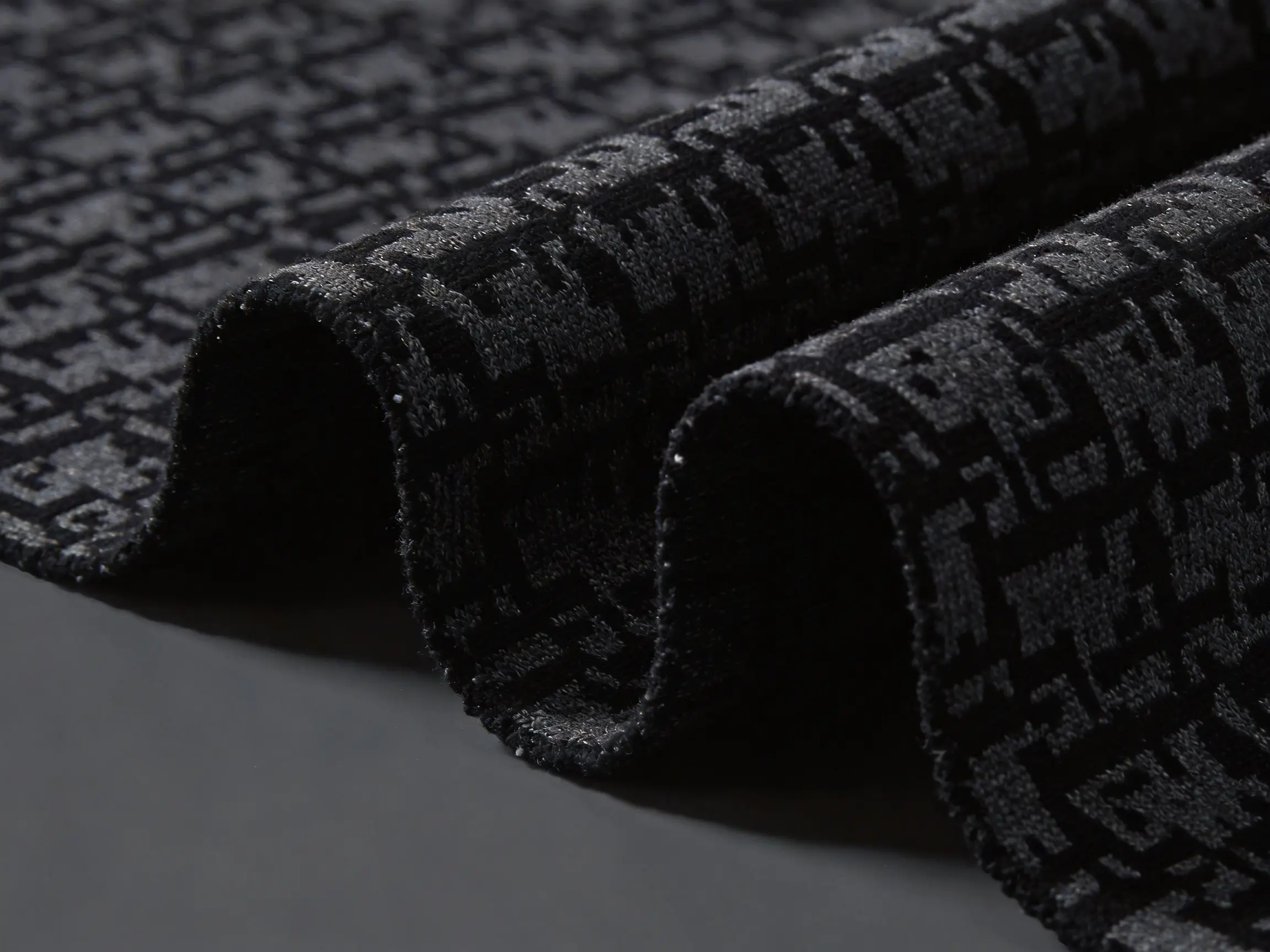
The central aesthetic of Black Slight Intermingled DTY Jacquard Fabric is “stealth luxury.” This means the fabric does not rely on loud color, heavy contrast, or obvious surface decoration. Instead, it uses a subtle black-on-black jacquard pattern created through the interaction of yarn texture, fabric structure, and controlled luster differences. When viewed from a distance, the material appears clean, deep, and refined. When seen up close or under changing light, the jacquard pattern becomes visible, adding depth and visual value without compromising versatility.
This balance is important for modern apparel. Consumers increasingly want garments that are comfortable enough for daily wear, polished enough for commuting, and durable enough for active movement. A plain black fabric may be easy to use, but it can look basic. A brightly patterned fabric may attract attention, but it can be difficult to style and may quickly become outdated. A subtle jacquard surface solves this problem by delivering texture and premium character while remaining highly wearable. It can work in minimalist fashion, sportswear, athleisure, casual business travel apparel, and lifestyle collections.
The slight intermingled effect gives the fabric additional uniqueness. Instead of appearing as a uniform flat black surface, the material shows controlled tonal movement. This is achieved by combining black polyester components with different luster levels and carefully managing the yarn and knitting process. The result is not random streaking or quality inconsistency. It is a designed texture that adds depth and a refined technical appearance. For brands that want black garments to feel richer and more differentiated, this effect is a valuable design tool.
Because the fabric is knitted rather than woven, it provides natural flexibility, drape, and comfort. The addition of 5% spandex gives durable stretch and recovery, helping garments retain shape after movement and washing. The DTY polyester component contributes softness, dimensional stability, and a cotton-like hand feel. Together, these features make the fabric practical for garments that must look structured while still feeling comfortable against the body.
Core Product Specifications
The following table summarizes the key technical data and positioning of the fabric. These specifications are important for designers, sourcing managers, garment factories, and apparel brand developers who need to evaluate whether the material matches target product requirements.
| Item | Specification | Practical Value |
|---|---|---|
| Product Name | Black Slight Intermingled DTY Jacquard Fabric | Premium black-on-black knitted jacquard for apparel differentiation |
| Fabric Category | Knitted Jacquard Fabric | Creates textured patterns through knitting structure rather than surface printing |
| Composition | 95% DTY Polyester, 5% Spandex | Softness, resilience, stretch, and shape recovery |
| Weight | 280 g/m² | Mid-heavy body suitable for hoodies, jackets, sweatshirts, and structured sportswear |
| Width | 165 cm / 65 inches | Improves cutting efficiency and reduces fabric waste in garment production |
| Main Feature | Cotton-like softness with high color uniformity | Enhances wearer comfort and premium visual consistency |
| Surface Effect | Slight intermingled black jacquard texture | Adds depth and understated luxury without excessive contrast |
| Custom Option | Anti-pilling finish available | Improves long-term surface appearance for repeated wear |
| Suggested Uses | Hoodies, sweatshirts, track jackets, commuter apparel, structured sportswear | Supports lifestyle, performance, and premium casual collections |
| Sampling Lead Time | Within 5 days | Supports fast development cycles |
| Bulk Production Lead Time | Approximately 25 days for existing colors | Practical for planned seasonal production |
Why DTY Polyester Matters
Draw textured yarn, commonly known as DTY, plays a central role in this fabric. DTY is produced by texturing polyester filament yarn to create crimp, bulk, elasticity, and a softer touch. Compared with ordinary flat filament yarn, DTY can provide a fuller hand feel and better fabric coverage. It can make polyester-based textiles feel less synthetic and more comfortable, approaching the softness associated with cotton while still retaining polyester’s strength, durability, and easy-care properties.
In this jacquard fabric, DTY is not used as a generic raw material. It is part of the design foundation. The soft texture of DTY supports the fabric’s cotton-like comfort, while the stability of polyester helps the garment maintain shape. DTY can also improve the way light interacts with the surface. When different luster levels or yarn characteristics are combined in a black fabric, a subtle tonal effect becomes possible without relying on different colors. This is especially valuable for black-on-black jacquard, where texture and light reflection must carry the design.
Another advantage of DTY is its suitability for active and leisure garments. Polyester has strong abrasion resistance, dries faster than natural fibers, and can be finished for moisture management. DTY polyester fabrics can be engineered to support air permeability through knitting structure, and additional moisture-wicking finishes can be applied when garments are intended for warmer climates or higher activity levels. This flexibility allows the fabric to serve both fashion and performance markets.
For apparel brands, the use of DTY also brings production benefits. Polyester DTY generally offers stable dyeing performance when processed properly, good dimensional control, and consistent bulk production. These characteristics reduce the risk of inconsistent garment appearance across lots. In a black fabric, where shade variation can be highly visible and difficult to accept, stable raw material control is especially important.
The Value of Knitted Jacquard Construction
Jacquard knitting allows patterns to be built into the fabric structure instead of being printed onto the surface. This creates several advantages. First, the texture is more integrated and durable because it is part of the knitted construction. Second, the pattern can remain visually present after washing better than many surface-only effects. Third, jacquard construction provides depth and tactile interest, giving the fabric a more premium impression.
For black apparel, knitted jacquard is particularly effective. A black printed design may fade, crack, or look too obvious depending on the ink and base material. A plain dyed black fabric can appear flat. A jacquard black-on-black structure creates a quieter but more durable form of decoration. It communicates quality without making the garment difficult to coordinate. This is ideal for modern collections that emphasize quiet sophistication and functional simplicity.
The knitted structure also supports comfort. Knits generally offer more flexibility than woven fabrics, and when combined with spandex they can adapt well to body movement. In hoodies and sweatshirts, this means better ease during daily wear. In track jackets and sportswear, it means garments can move with the wearer rather than restrict motion. In commuter apparel, it helps balance a structured look with practical comfort for sitting, walking, cycling, or traveling.
Jacquard knitting also offers design scalability. Once a structure is developed and stabilized, it can be reproduced for bulk production with consistent pattern repeat and surface appearance. For brands that need reliable production after sample approval, this is essential. A strong manufacturing partner with knitting expertise can help adjust texture intensity, pattern scale, stretch, weight, and finishing direction to match the final garment concept.
Black-on-Black Design: More Than a Color Choice
Black is one of the most important colors in apparel, but it is also one of the most demanding. A poor black fabric may look dusty, uneven, weak in shade, or flat under light. A premium black fabric must have depth, uniformity, surface cleanliness, and the ability to maintain its appearance after wear and washing. Black Slight Intermingled DTY Jacquard Fabric is developed with this challenge in mind.
The fabric uses the concept of tonal variation within black rather than strong contrast. Different luster levels in black polyester create a pattern that appears and disappears depending on viewing angle and lighting. This makes the fabric visually dynamic but still refined. For premium hoodies and jackets, this kind of texture can elevate a basic silhouette. For urban commuter apparel, it adds sophistication without looking flashy. For sportswear, it gives a technical and modern impression.
High color uniformity is another key selling point. In garment production, inconsistent black shade between rolls can cause panels to look mismatched after cutting and sewing. This is a common problem when raw material control, dyeing control, or lot management is weak. Because Hangzhou Jinfeng Textile Co., Ltd. has experience in DTY polyester yarn production and fabric finishing, the company can manage shade and texture from upstream processes through finished fabric inspection. This integrated approach helps reduce risk for apparel manufacturers.
The ability to match a specific black shade is also valuable. Many brands have their own black standard, whether based on physical swatches, seasonal color cards, or spectrophotometer data. The manufacturer can match density and tone according to customer samples or data, making the fabric suitable for coordinated collections. This is especially important when the jacquard fabric must be used together with rib trims, zippers, woven panels, mesh linings, or other black materials in one garment.
Competitive Advantages Over Ordinary Black Knitted Fabrics
Compared with standard black knit fabrics, this product offers several important advantages. The first is surface differentiation. Ordinary black knits often rely entirely on silhouette, branding, or trims to create value. This jacquard fabric gives the garment a built-in premium surface while remaining understated. The fabric itself becomes a selling point, allowing designers to create garments that feel more elevated even with simple cutting.
The second advantage is comfort. DTY polyester provides a softer and fuller hand than many conventional polyester filaments. The fabric is designed to have cotton-like softness, making it suitable for garments worn close to the body or during long periods of daily use. While cotton is comfortable, it can absorb moisture, dry slowly, shrink, and lose shape over time. This DTY polyester-spandex fabric offers a soft feel while maintaining the easy-care and resilience benefits of synthetic fibers.
The third advantage is stretch durability. With 5% spandex, the fabric offers practical elasticity and recovery. This helps garments keep their shape around elbows, shoulders, cuffs, and body areas that experience frequent movement. In premium apparel, shape retention is essential because consumers judge quality not only when trying on a garment but also after repeated wear. A fabric that bags out or becomes loose quickly can damage brand reputation.
The fourth advantage is production yield. The 165 cm width helps garment factories improve marker efficiency and reduce cutting waste. Fabric cost is not only determined by price per kilogram or price per meter. Waste rate, cutting efficiency, and usable width also affect final garment cost. A wider fabric can provide better panel placement for hoodies, jackets, and sweatshirts, especially when producing larger sizes or styles with multiple panels.
The fifth advantage is cost control through direct raw material capability. Because the manufacturer produces and processes DTY polyester yarn as part of its business, it can reduce dependence on external yarn suppliers and manage raw material cost more effectively. This can result in more competitive bulk pricing than competitors who must purchase yarn at higher market prices. At the same time, direct control over yarn quality supports consistency in the final fabric.
The sixth advantage is finishing flexibility. The fabric can be supplied with customized anti-pilling finishing, and additional functional finishes such as moisture-wicking can be considered depending on garment requirements. This makes the product adaptable for different markets, from fashion-focused streetwear to performance-influenced sports jackets. Brands can choose the level of finishing needed for their price point and consumer expectations.
Manufacturing Strength From Yarn to Finished Fabric
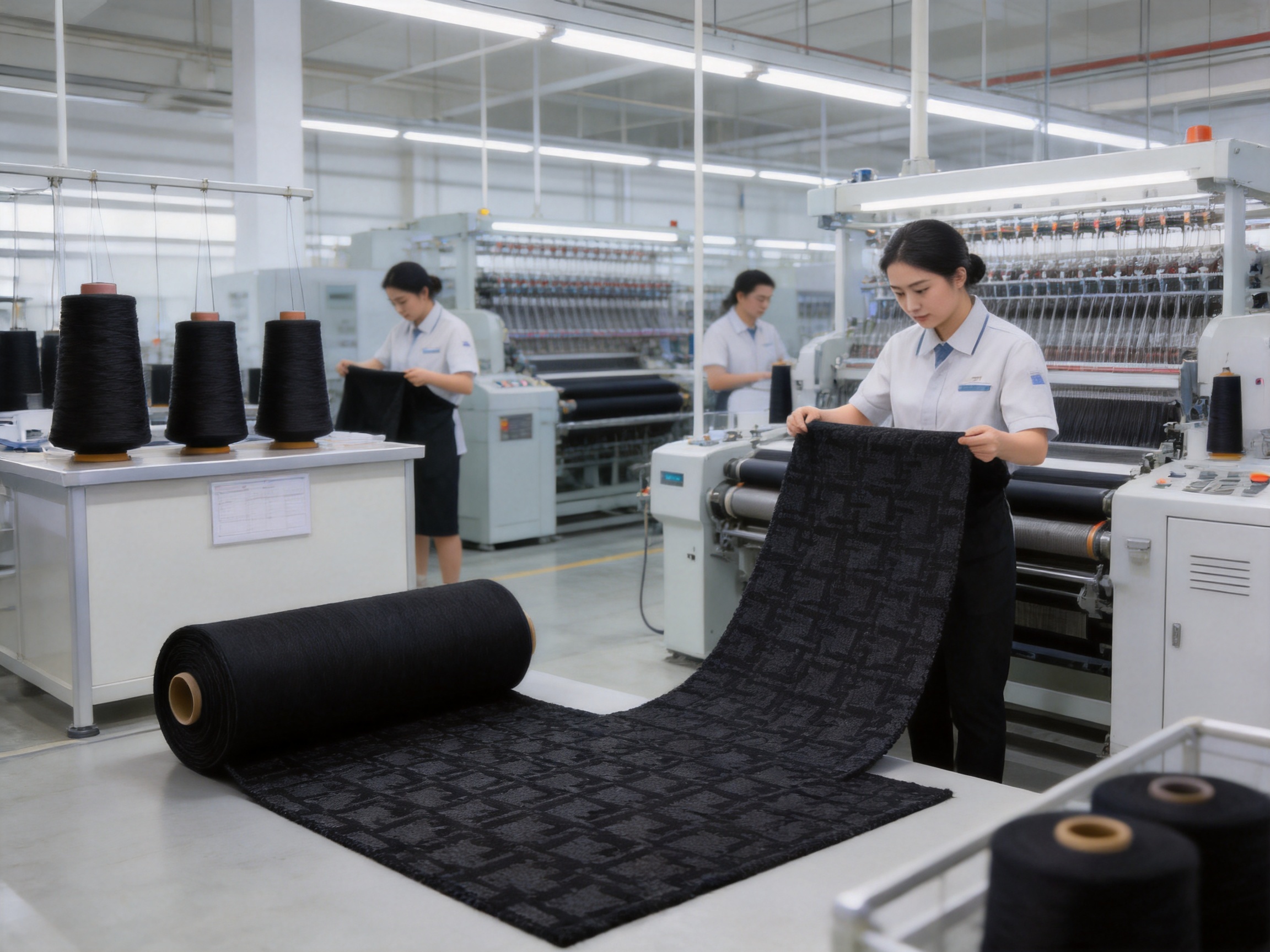
One of the strongest advantages behind this fabric is the manufacturer’s integrated production capability. Hangzhou Jinfeng Textile Co., Ltd. is located in Xiaoshan District, Hangzhou, a region with a strong textile manufacturing foundation. The company covers 32.6 acres and operates a plant area of approximately 18,000 square meters. Its business includes production and processing, post-dyeing, finishing and sales of polyester, spandex, and blended fabrics, as well as DTY polyester yarn production, processing, and sales.
This integrated model matters because fabric quality is determined by many connected processes. Yarn quality affects knitting performance. Knitting structure affects surface texture, stretch, and weight. Dyeing affects shade depth and uniformity. Finishing affects hand feel, pilling resistance, dimensional stability, and final appearance. If each stage is handled by disconnected suppliers, communication gaps and quality variation can occur. Integrated manufacturing allows tighter coordination and faster problem solving.
At the yarn stage, DTY quality must be controlled for denier, crimp, bulk, intermingling, luster, tension, and uniformity. Even small inconsistency can affect the appearance of a black jacquard surface. By managing yarn production and processing, the manufacturer can select or adjust yarn characteristics according to the desired fabric effect. This is especially important for the slight intermingled appearance, where controlled variation is desirable but uncontrolled irregularity is not.
At the knitting stage, machine setting, yarn feeding, loop control, tension, and jacquard pattern programming must be carefully balanced. A mid-heavy 280 g/m² fabric needs body and structure, but it should not become stiff or uncomfortable. The spandex must be incorporated in a way that supports stretch and recovery without causing distortion. The jacquard pattern must remain clear enough to be visible while still subtle enough for the black-on-black aesthetic.
At the dyeing stage, black shade control is critical. Black dyeing is often more complex than it appears because different fibers, yarn structures, and fabric densities can absorb and reflect color differently. The dyeing process must deliver deep tone, levelness, and repeatability. For this fabric, shade uniformity is particularly important because the garment may use large panels where any variation could be visible. The manufacturer’s experience with black shades and ability to match customer standards are key sourcing advantages.
At the finishing stage, the fabric’s final character is developed. Finishing can influence softness, surface smoothness, anti-pilling performance, width stability, shrinkage control, and hand feel. For a premium garment fabric, finishing should enhance the cotton-like softness while preserving the jacquard texture. If the finish is too aggressive, it may flatten the pattern. If it is insufficient, the fabric may not meet expectations for smoothness or long-term appearance. Experienced finishing helps maintain the intended balance.
Quality Control and Consistency
Quality control for this type of fabric must be systematic. It begins before knitting, with yarn inspection and selection. DTY yarn should be checked for uniformity, contamination, oil content, and package consistency. During knitting, operators must monitor fabric weight, width, pattern accuracy, tension, and surface defects. After dyeing and finishing, the fabric should be evaluated for shade, hand feel, dimensional stability, stretch recovery, appearance, and roll-to-roll consistency.
For apparel manufacturers, consistency is more valuable than a single good sample. A sample may look excellent, but bulk fabric must match approved standards. This is where manufacturing discipline becomes crucial. The fabric’s black-on-black jacquard effect depends on subtle visual relationships. If the yarn luster changes, if the dyeing tone shifts, or if the finishing pressure varies, the surface effect may change. Integrated process control helps maintain repeatability from sample to bulk.
Weight consistency is also important. At 280 g/m², the fabric occupies a useful mid-heavy range. If the fabric becomes too light, it may lose structure and premium body. If it becomes too heavy, it may feel bulky and reduce comfort. Maintaining GSM within acceptable tolerance ensures predictable garment performance, costing, and cutting behavior. Width control is similarly important because the 165 cm width is a production advantage only if it remains stable and usable.
Stretch and recovery testing should also be part of evaluation. Garments made from this fabric may be used for movement, travel, and active daily wear. The fabric should stretch comfortably and recover without permanent deformation. The 5% spandex component is designed to support this need, but proper heat setting and finishing are necessary to stabilize performance. Poorly controlled spandex fabrics may twist, shrink, or lose recovery after washing. A capable manufacturer reduces these risks.
Comfort Profile: Softness, Breathability, and Wearability
Comfort is one of the main reasons this fabric is attractive for premium apparel. The DTY polyester yarn gives the material a soft and slightly bulky hand, helping it feel warmer and more natural than flat filament polyester. The knitted construction allows flexibility and a degree of air permeability. The spandex content improves freedom of movement, while the mid-heavy GSM provides body without making the fabric excessively rigid.
A common question about polyester fabrics is whether they trap heat. The answer depends on fabric structure, weight, finishing, and garment design. This fabric is mid-heavy, so it provides more coverage and body than lightweight sports mesh, but its knitted construction allows air movement. For garments intended for colder seasons, this can provide a comfortable balance of warmth and breathability. For higher-intensity use or warmer markets, a moisture-wicking finish can be applied to improve moisture transport and perceived comfort.
The cotton-like softness is especially valuable for hoodies and sweatshirts. Consumers often associate premium casualwear with a soft touch. However, cotton-heavy fabrics may shrink, fade, or dry slowly. This DTY polyester jacquard offers an alternative: a soft hand with better dimensional stability and faster drying potential. For brands building modern lifestyle collections, this combination can create a strong consumer experience.
The fabric’s surface also contributes to wearability. Because the jacquard effect is subtle and not abrasive, it can be used in garments where the outer surface must look refined and the inner feel must remain comfortable. Depending on the garment construction, lining, brushing, or additional finishing choices may further modify the comfort profile. The fabric is versatile enough to support multiple design directions.
Applications in Premium Hoodies and Sweatshirts
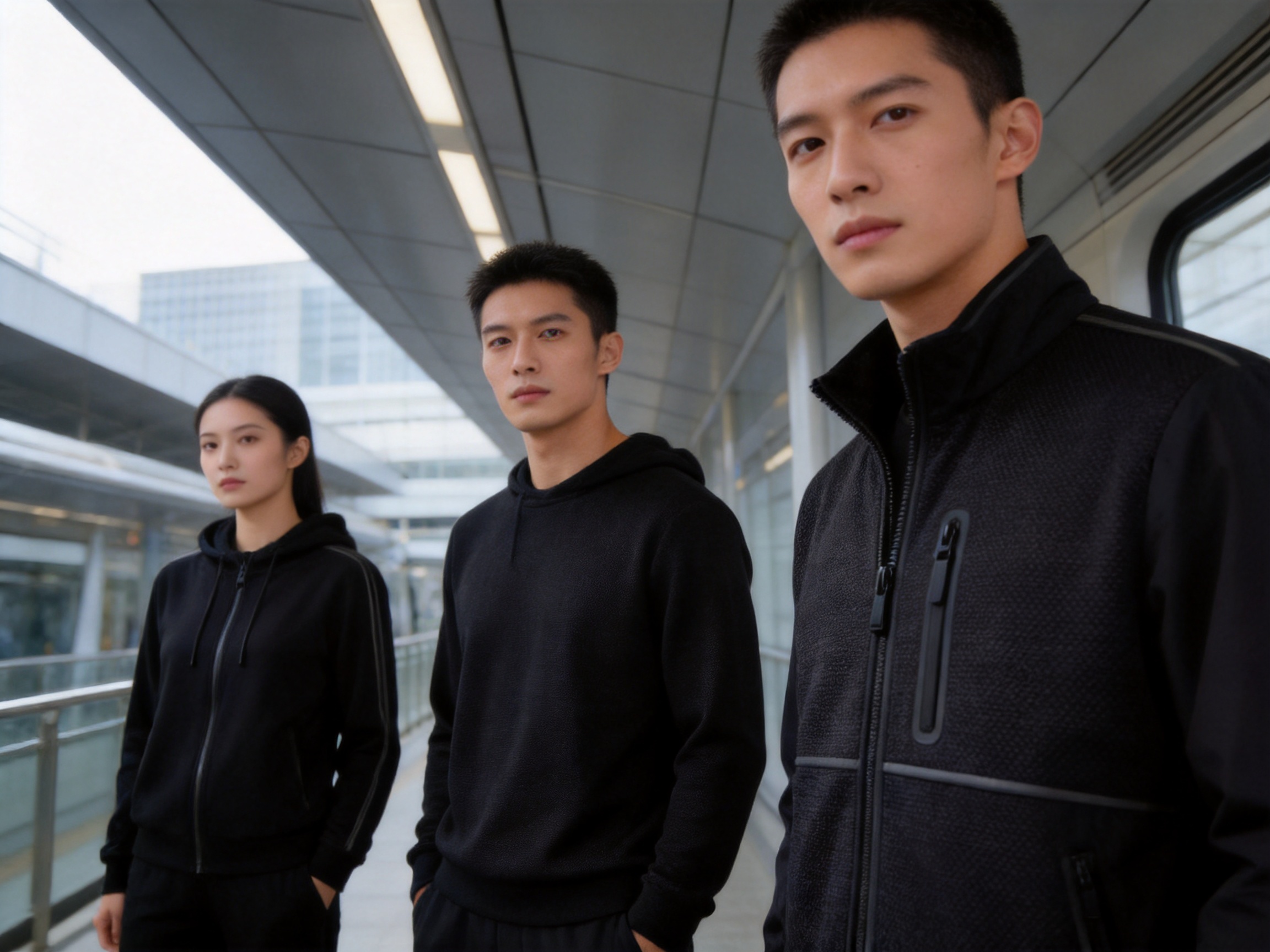
Premium hoodies and sweatshirts are among the best applications for this fabric. These garments require a balance of softness, structure, durability, and style. A hoodie made from ordinary black fleece may be comfortable but visually common. A hoodie made from Black Slight Intermingled DTY Jacquard Fabric can retain the essential comfort of casualwear while offering a more elevated surface. The jacquard pattern makes the garment suitable for higher price points and more design-focused collections.
The 280 g/m² weight provides enough body for hoodies without becoming overly heavy. It can support clean panels, a structured hood, and a neat front appearance. The spandex content helps the garment move comfortably during daily activities, while the polyester base supports shape retention after washing. For sweatshirts, the fabric can create a polished look that works beyond the gym or home environment. It becomes suitable for travel, commuting, casual meetings, and weekend wear.
Because the fabric is black and subtly textured, it pairs well with a wide range of trims. Matte black zippers, tonal drawcords, reflective details, ribbed cuffs, bonded pockets, or minimalist embroidery can all work with the surface. The fabric can support both streetwear and refined athleisure aesthetics. Brands can use it as a hero fabric for capsule collections or as a premium upgrade from basic black knit programs.
For garment factories, the 165 cm width supports efficient cutting of hoodie bodies, sleeves, pockets, and hoods. Wider fabric can improve marker layout, especially for larger sizes. Since hoodies often consume more fabric than T-shirts or lightweight tops, cutting efficiency has a real cost impact. This makes the fabric attractive not only from a design perspective but also from a production economics perspective.
Applications in High-End Track Jackets
Track jackets have evolved from purely athletic garments into lifestyle staples. Consumers now expect them to look modern, fit well, and perform during movement. Black Slight Intermingled DTY Jacquard Fabric is well suited for high-end track jackets because it combines technical appearance with softness and stretch. The black-on-black texture gives a sleek look, while the knitted structure supports mobility.
In a track jacket, the fabric can be used for the main body, sleeves, side panels, or contrast sections. Its subtle jacquard surface can make a simple zip-front silhouette appear more refined. When paired with clean seam lines, tonal zippers, and structured collars, the material can create a premium sportswear image. It can also be combined with woven nylon, mesh, rib, or bonded trims for hybrid designs.
Durable stretch is essential for jackets because the shoulder, arm, and back areas experience frequent movement. The spandex content helps the garment remain comfortable when reaching, driving, cycling, or exercising lightly. Polyester DTY also supports resilience and easy care, making the garment more practical for repeated use. For brands targeting urban active consumers, this fabric can provide a strong balance of appearance and function.
The optional moisture-wicking finish can be useful for track jackets intended for performance or transitional weather. While the base fabric already offers air permeability through its knit structure, functional finishing can further enhance comfort. This allows brands to position the garment as both stylish and practical.
Applications in Urban Commuter Apparel
Urban commuter apparel requires fabrics that can move between environments. A commuter garment may be worn on public transportation, in an office, during travel, while walking outdoors, and in social settings. It must look presentable but remain comfortable. Black Slight Intermingled DTY Jacquard Fabric fits this category because it provides a refined black surface, soft hand feel, stretch, and easy-care potential.
The subtle jacquard effect helps commuter garments avoid the overly casual look of basic sweatshirt fabric. A zip jacket, pullover, structured cardigan, or hybrid blazer made with this fabric can appear modern and polished while still feeling relaxed. The black tone coordinates easily with trousers, joggers, denim, and technical outerwear. This makes it suitable for capsule wardrobes and travel-oriented collections.
For commuters, fabric recovery is important. Garments may be worn while sitting for long periods, carrying bags, or moving through crowded spaces. A fabric that wrinkles badly, stretches out, or loses shape can quickly look unprofessional. Polyester DTY and spandex help maintain a cleaner appearance. While it is still a knit and not a formal suiting fabric, its structure and texture support a more elevated casual look.
The option to customize finishing gives brands further flexibility. Anti-pilling finishing can be important for commuter garments because bags, straps, and frequent wear may cause surface abrasion. Moisture-wicking finishing may be useful for consumers who walk or cycle. This adaptability allows the same base fabric concept to serve different market levels and climates.
Applications in Structured Sportswear
Structured sportswear requires fabric that can hold a defined silhouette while allowing movement. This is different from lightweight performance wear, which often emphasizes maximum stretch and minimum weight. Structured sportswear may include training jackets, warm-up tops, elevated jogger sets, sports-inspired pullovers, and hybrid lifestyle garments. The 280 g/m² weight of this jacquard fabric gives enough body for such designs.
The fabric’s stretch and recovery support motion, while the jacquard texture adds visual depth. This is valuable for sportswear brands that want to create premium lines without relying only on logos or color blocking. The black-on-black effect can communicate a more mature and technical identity. It can appeal to consumers who prefer understated activewear that can be worn outside the gym.
Polyester DTY is also practical for sportswear because it is durable and relatively easy to care for. It can dry more quickly than cotton and can be finished for improved moisture movement. When used in structured sportswear, the fabric can help garments maintain their appearance after repeated washing. The anti-pilling option further supports long-term surface quality.
For production, the fabric’s width and consistency help factories manufacture sportswear with efficient cutting and predictable sewing behavior. Stable fabric reduces the risk of twisting, mismatched panels, or inconsistent garment dimensions. This is especially important for bulk orders where size accuracy and appearance consistency affect customer satisfaction.
Customization Possibilities
Although the product is presented as a black slight intermingled jacquard fabric, customization is an important part of its value. Brands may need a specific black shade, a different finish, adjusted softness, modified pattern intensity, or functional treatment. Because the manufacturer has experience in yarn production, dyeing, finishing, and fabric development, it can support customization more effectively than suppliers who only trade finished goods.
Black shade matching is one of the most important options. A customer can provide a physical color swatch or spectrophotometer data, and the manufacturer can work toward matching tone and density. This is useful when the fabric must coordinate with existing product lines or brand standards. Since black fabrics can vary in undertone, depth, and reflectivity, professional matching can prevent costly production problems.
Anti-pilling finishing is another valuable option. Pilling can reduce the perceived quality of knit garments, especially in areas of friction such as underarms, sides, cuffs, and bag contact points. A customized anti-pilling finish can help preserve the fabric’s premium surface during repeated wear. This is particularly relevant for hoodies, sweatshirts, commuter jackets, and sportswear that consumers expect to use frequently.
Moisture-wicking finishing can also be considered. For garments intended for active use, warmer markets, or travel, moisture management improves comfort by helping sweat move away from the skin and spread across the fabric surface for faster evaporation. This finishing option can help brands position the fabric for performance-inspired collections without sacrificing its refined appearance.
Supply Chain and Commercial Benefits
In addition to design and performance, sourcing teams must consider reliability, cost, lead time, and transaction security. Black Slight Intermingled DTY Jacquard Fabric offers several commercial advantages. The manufacturer’s direct involvement in DTY yarn production creates a cost advantage by reducing raw material dependency. This can support more competitive bulk pricing while maintaining quality control.
The sample lead time of approximately 5 days supports fast development. In modern apparel, brands often work under compressed calendars. Quick sample availability allows designers and product managers to evaluate hand feel, color, texture, and garment suitability without delaying the development process. For existing colors, bulk production can be completed in approximately 25 days, which is practical for planned seasonal programs.
The wide fabric width improves cutting economics. A 165 cm width can reduce waste compared with narrower alternatives, especially for larger panels. This affects the real cost per garment. Even if two fabrics have similar unit prices, the one with better cutting efficiency may be more economical in production. For factories producing hoodies, jackets, and sportswear sets, width can be a meaningful advantage.
Payment security is also part of the sourcing experience. The company accepts secure payments through Alibaba Trade Assurance, helping protect both buyer and seller throughout the transaction process. For international customers, this provides an additional layer of confidence during sample orders and bulk purchasing. Combined with the company’s export capability, this supports smoother cooperation with overseas brands and garment manufacturers.
How the Fabric Helps Apparel Brands Compete
In crowded apparel markets, product differentiation is essential. Many brands sell black hoodies, black jackets, and black sportswear. The challenge is to make these items feel new and worth a premium price. This jacquard fabric helps by adding built-in surface value. A garment made from it can look more developed than one made from ordinary plain knit, even if the silhouette is clean and minimal.
The fabric also supports storytelling. Brands can describe the use of DTY yarn, black-on-black jacquard texture, cotton-like softness, durable stretch, and optional anti-pilling or moisture-wicking finishing. These features give sales teams, e-commerce pages, and product tags meaningful points to communicate. Consumers increasingly want to understand why one garment is better than another. A technical yet refined fabric provides a strong answer.
Another competitive advantage is versatility. The same fabric can be used across multiple product categories, creating a coordinated collection. A brand might use it for a hoodie, track jacket, jogger panel, sweatshirt, and commuter zip top. This creates visual consistency while allowing different styles. Because the fabric is black and subtle, it can remain commercially safe while still offering novelty.
Long-term appearance also affects brand reputation. A garment that looks good in the store but pills, fades, or loses shape quickly can lead to returns and negative reviews. This fabric’s polyester DTY base, spandex recovery, stable jacquard texture, and anti-pilling option help support durability. While final performance depends on garment construction and care conditions, the fabric is designed with repeated wear in mind.
Recommended Garment Design Considerations
Designers using this fabric should take advantage of its subtle texture. Clean silhouettes often work best because they allow the jacquard surface to be seen without visual clutter. Minimalist hoodies, zip jackets, structured sweatshirts, and commuter pullovers can all benefit from the material’s quiet depth. Tonal trims and matte hardware can reinforce the stealth luxury aesthetic.
Pattern placement should consider the jacquard repeat and direction. Even though the black-on-black pattern is subtle, consistent panel orientation can improve the final garment appearance. During sampling, designers should evaluate how the texture looks on large panels, curved areas, pockets, cuffs, and seams. The fabric’s stretch should also be considered in fit development, especially around shoulders, chest, elbows, and hem areas.
Sewing methods should preserve stretch and prevent seam distortion. Appropriate needles, thread, stitch type, and tension settings are important for knitted fabrics with spandex. Garment factories should test seams for recovery and appearance after washing. For premium garments, seam smoothness and panel alignment are part of perceived quality.
Care labeling should reflect the fabric’s composition and finishing. Polyester-spandex knits generally offer easy-care advantages, but excessive heat may affect spandex performance. Proper washing and drying recommendations help consumers maintain garment appearance. If anti-pilling or moisture-wicking finishes are applied, care instructions should also protect those functions.
Sustainability and Responsible Value Considerations
While this fabric is primarily positioned around performance, comfort, and premium aesthetics, responsible sourcing considerations are increasingly important in textile selection. Polyester is durable, and durability can contribute to longer garment life. A garment that retains shape, resists pilling, and remains visually attractive after repeated wear may be used longer, reducing premature disposal.
Production efficiency also contributes to responsible value. The 165 cm fabric width can reduce cutting waste in garment manufacturing. Lower waste means better material utilization and improved cost efficiency. For brands working to reduce production loss, fabric width and marker efficiency should be considered alongside fiber content and finishing choices.
Integrated manufacturing can also support better process control. When yarn, fabric, dyeing, and finishing are coordinated, it may be easier to manage quality and reduce rework. Defective fabric consumes resources and increases waste. Consistent production reduces the need for remakes, sorting, and rejected rolls. This is a practical sustainability-related benefit even when the product is not marketed as an eco-specialty fabric.
Brands interested in additional sustainability directions can discuss options with the manufacturer, such as process optimization, durability-focused finishing, or potential material alternatives depending on development goals. The most immediate responsible advantage of this fabric is its ability to create durable, versatile garments that consumers can wear frequently across different occasions.
Q&A Section
Q1: What makes this fabric different from ordinary black knitted fabric?
Ordinary black knitted fabric usually has a flat surface and depends on garment design or branding for differentiation. Black Slight Intermingled DTY Jacquard Fabric has a built-in black-on-black jacquard texture created through knitting structure and controlled luster variation. This gives garments a premium, subtle, and more sophisticated appearance while retaining the versatility of black.
Q2: Is the fabric soft enough for hoodies and sweatshirts?
Yes. The fabric uses DTY polyester, which provides a fuller and softer hand than many standard filament polyester yarns. It is designed to deliver cotton-like softness while maintaining the durability, shape stability, and easy-care advantages of polyester. This makes it suitable for premium hoodies, sweatshirts, and daily casualwear.
Q3: Does the polyester content make the fabric too hot?
No, not necessarily. The knitted structure allows air permeability, and the fabric is designed for balanced comfort. It is mid-heavy at 280 g/m², so it provides body and coverage, but it is not inherently airless. For warmer climates or more active garments, a moisture-wicking finish can be applied to improve comfort and breathability perception.
Q4: Can the black shade be customized?
Yes. The manufacturer can match a specific black tone based on a physical color swatch or spectrophotometer data. This is important for brands that need the fabric to coordinate with existing collections, trims, panels, or brand color standards.
Q5: What garments are most suitable for this fabric?
The fabric is ideal for premium hoodies, sweatshirts, high-end track jackets, urban commuter apparel, structured sportswear, and sports-inspired lifestyle garments. It is especially suitable for products that need a refined black appearance, soft touch, stretch, and long-term wearability.
Q6: Why is the 165 cm width important?
A wider fabric can improve cutting efficiency and reduce waste in garment production. This is particularly useful for hoodies, jackets, and larger-size garments that require bigger panels. Better fabric utilization can reduce the real cost per garment.
Q7: Is an anti-pilling finish available?
Yes. A customized anti-pilling finish is available. This can help preserve the surface appearance of garments after repeated wear and washing, especially in friction areas such as underarms, sides, cuffs, and areas in contact with bags.
Q8: What is the typical development and production lead time?
Initial sampling can usually be completed within 5 days. For existing colors, bulk production typically takes around 25 days. Actual timing may vary depending on order quantity, finishing requirements, and production schedule.
Q9: Why does direct DTY yarn capability benefit buyers?
Direct DTY yarn capability helps the manufacturer control texture, quality, and cost from the raw material stage. This supports consistent softness, stable jacquard appearance, better shade control, and more competitive bulk pricing compared with suppliers that rely entirely on outside yarn sources.
Yes. The fabric is specifically positioned for premium casualwear, athleisure, commuter apparel, and structured sportswear. Its subtle jacquard texture, black-on-black depth, soft DTY hand feel, stretch recovery, and finishing options make it suitable for brands seeking understated quality and product differentiation.
Conclusion
Black Slight Intermingled DTY Jacquard Fabric is a strong solution for apparel brands that want to elevate black garments without making them loud or difficult to wear. Its value comes from a combination of refined visual texture, cotton-like softness, stretch performance, stable black shade, and production efficiency. The black-on-black jacquard effect gives garments a premium identity, while the DTY polyester and spandex composition provides comfort, durability, and practical wearability.
The fabric’s competitive advantages are clear when compared with ordinary black knits. It offers more surface interest, better design value, durable stretch, optional anti-pilling finishing, moisture-wicking potential, wide-width cutting efficiency, and cost advantages supported by direct DTY yarn capability. These benefits make it suitable for premium hoodies, sweatshirts, high-end track jackets, urban commuter apparel, and structured sportswear.
Hangzhou Jinfeng Textile Co., Ltd. strengthens the product’s value through integrated manufacturing. With experience in DTY polyester yarn production, blended fabric processing, dyeing, finishing, and export sales, the company can control quality from yarn to finished fabric. This reduces sourcing risk and supports consistent bulk production. For brands and garment factories seeking a dependable fabric partner, this manufacturing depth is a meaningful advantage.
In a market where black garments are everywhere, the right fabric can make the difference between basic and premium. This jacquard fabric delivers that difference through subtlety, engineering, and practical performance. It is a modern textile for brands that understand that luxury does not always need to be loud; sometimes, it is found in texture, touch, consistency, and the confidence of a perfectly developed black fabric.
References
1. Hearle, J. W. S., Hollick, L., and Wilson, D. K. Yarn Texturing Technology. Woodhead Publishing.
2. Spencer, D. J. Knitting Technology: A Comprehensive Handbook and Practical Guide. Woodhead Publishing.
3. Saville, B. P. Physical Testing of Textiles. Woodhead Publishing.
4. Horrocks, A. R., and Anand, S. C. Handbook of Technical Textiles. Woodhead Publishing.
5. Collier, B. J., and Epps, H. H. Textile Testing and Analysis. Pearson Education.
6. Kadolph, S. J. Textiles. Pearson Education.
7. Trotman, E. R. Dyeing and Chemical Technology of Textile Fibres. Charles Griffin & Company.
8. Smith, W. C. Smart Textile Coatings and Laminates. Woodhead Publishing.