
Black Slight Intermingled DTY Jacquard Fabric for Premium Apparel
Black fabrics are often judged by details that are not immediately obvious. Surface softness, color depth, pattern clarity, stretch recovery, air permeability, dimensional stability, and performance after washing all contribute to the impression of quality. A fabric may appear simple because it is black, yet the development of a refined black textile requires careful control of yarn characteristics, knitting construction, dyeing, finishing, and inspection. Black Slight Intermingled DTY Jacquard Fabric is designed for apparel manufacturers and brands seeking a sophisticated material with understated visual texture and dependable performance.
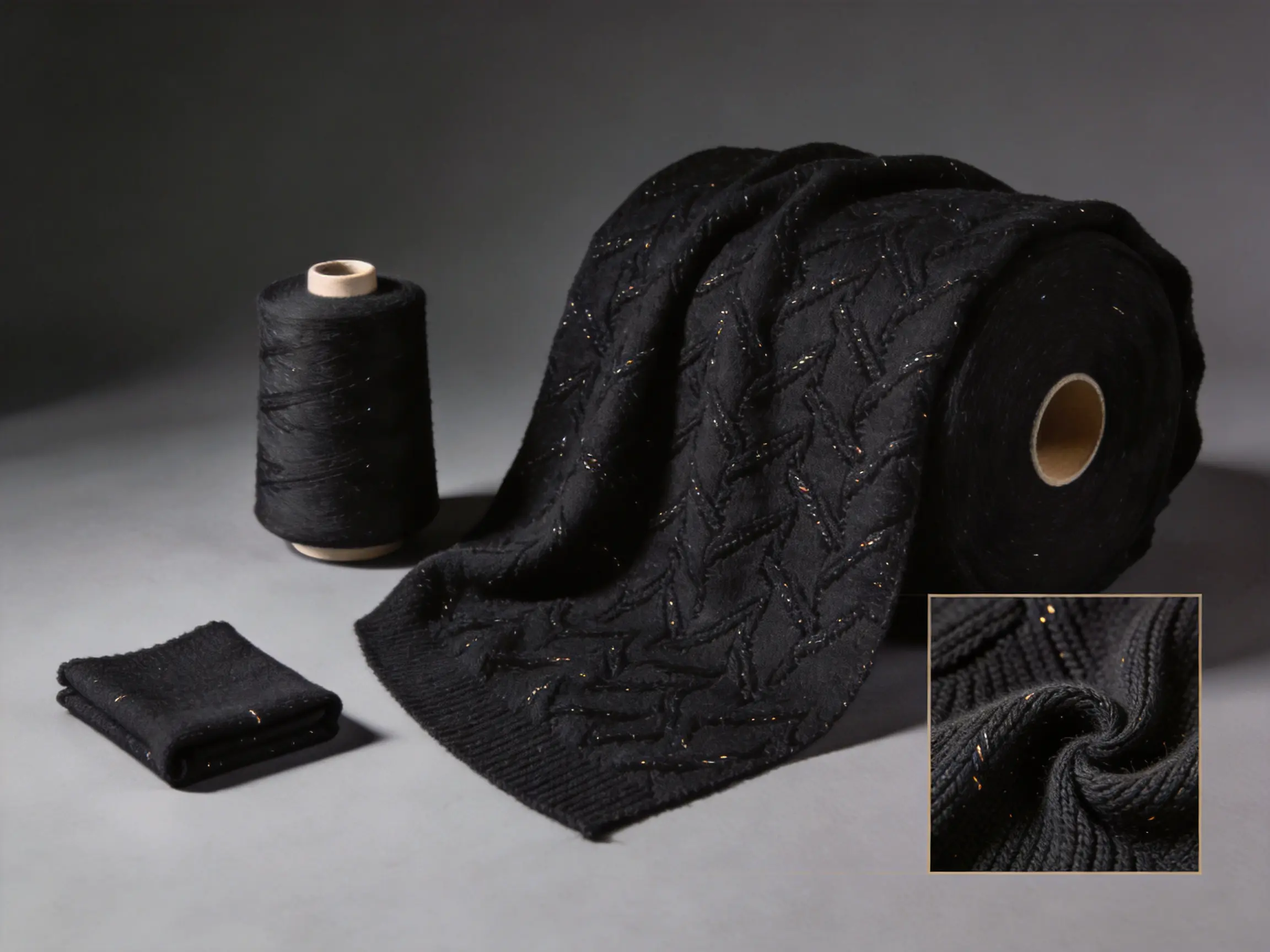
This knitted jacquard fabric combines 95% DTY polyester with 5% spandex. Its 280 g/m² weight gives it a substantial hand suitable for structured sportswear, premium hoodies, track jackets, and urban commuter apparel, while the knitted construction maintains comfort and flexibility. The fabric uses Draw Textured Yarn to create a soft, cotton-like touch. A subtle black-on-black jacquard effect adds depth without creating an overly dramatic contrast, and the slight intermingled appearance brings additional surface interest.
The material is developed for customers who need more than a basic dyed polyester fabric. Its design balances visual restraint with technical practicality. Different luster levels within the black yarn arrangement help produce a discreet pattern that becomes visible through movement and changing light. This makes the fabric appropriate for products positioned between leisurewear, performance clothing, and modern lifestyle apparel.
Understanding the Product Concept
Black Slight Intermingled DTY Jacquard Fabric is a knitted jacquard textile created with textured polyester yarn and a controlled amount of stretch fiber. Unlike a plain single-color fabric, the jacquard structure introduces a patterned surface through the arrangement of knitted elements. The pattern is intentionally subtle. Instead of depending on bright colors or strong printed graphics, the fabric relies on differences in texture, reflection, and luster to create a premium appearance.
The phrase “slight intermingled” refers to the visual and structural interaction of yarns with different surface characteristics. In this fabric, black yarns are not treated as visually identical components. Variations in luster and yarn texture allow selected areas of the jacquard pattern to reflect light differently. Under direct light, the pattern can appear gently defined. In softer lighting, it may become almost tonal and discreet. This effect supports a stealth-luxury design direction in which quality is communicated through close observation rather than obvious decoration.
DTY polyester is central to the product’s performance. Draw Textured Yarn is produced by texturing polyester filaments so that the yarn gains bulk, resilience, and a softer surface character. Compared with a very flat filament yarn, textured yarn can provide a more comfortable hand and a fuller fabric appearance. When knitted into a jacquard construction, DTY helps the fabric maintain a balance between softness and body.
The addition of 5% spandex gives the fabric durable stretch. This is important for garments that need to accommodate body movement, including track jackets, structured sportswear, travel clothing, and fitted sweatshirts. The stretch component also contributes to wearing comfort during sitting, commuting, exercise, and everyday activity. The exact behavior of the finished garment will depend on pattern design, sewing construction, garment washing, and care conditions, but the fiber blend provides a useful foundation for flexible apparel.
Key Technical Specifications
The product is designed as a mid-heavy knitted jacquard fabric. Its weight, width, fiber composition, and finish options make it suitable for apparel that requires both visual substance and comfortable wear. The following specifications summarize the standard product configuration.
| Item | Specification | Practical Importance |
|---|---|---|
| Fabric type | Knitted jacquard fabric | Creates a tonal pattern with a textured and dimensional surface |
| Composition | 95% DTY polyester, 5% spandex | Combines softness, resilience, stretch, and easy-care characteristics |
| Weight | 280 g/m² | Provides a substantial hand for premium leisurewear and structured sportswear |
| Width | 165 cm, approximately 65 inches | Supports efficient marker planning and can reduce cutting waste |
| Color direction | Black with subtle black-on-black tonal patterning | Supports understated premium styling and versatile product coordination |
| Surface character | Soft, cotton-like touch with slight intermingled luster | Improves tactile appeal and visual depth |
| Optional treatment | Customized anti-pilling finish | Can help maintain surface appearance during repeated use and laundering |
| Sampling time | Initial sampling within approximately five days | Helps buyers evaluate the fabric before bulk confirmation |
| Bulk lead time | Approximately twenty-five days for existing colors | Supports planned production schedules for established color requirements |
Specifications should be confirmed against the buyer’s final development requirements before production. Knitted fabrics can show variation according to machine settings, finishing conditions, batch size, and the required tolerance range. For this reason, professional purchasing teams normally approve a representative lab dip, handloom or sample cutting, and final bulk standard before a large order is released.
Why the DTY Construction Matters
DTY is not simply a substitute for ordinary polyester yarn. The texturing process changes the physical character of the filament yarn. Textured filaments develop a more voluminous profile, which can improve softness and help create a fuller knitted surface. This is particularly valuable in a fabric designed to feel comfortable against the skin while still retaining a clean, modern appearance.
For a black jacquard fabric, yarn selection has an additional importance. Black surfaces can reveal unevenness, streaks, unwanted shine, and differences in dye uptake more readily than many medium shades. A controlled DTY supply helps the manufacturer manage yarn consistency before knitting begins. When yarn properties are stable, the fabric is more likely to show uniform texture, balanced pattern definition, and consistent color appearance across production lots.
DTY can also support recovery and resilience in a knitted construction. Polyester is naturally resistant to many forms of deformation, while the textured profile contributes to a comfortable hand. The product’s 5% spandex content further improves elasticity. This combination is suitable for garments that must maintain a polished appearance while accommodating movement.
The manufacturer’s experience in DTY polyester yarn production and processing provides a practical advantage. When yarn production, fabric knitting, post-dyeing, finishing, and sales are coordinated within one business, communication can be more direct than in a supply chain involving multiple independent parties. Technical issues can be traced more efficiently from fabric behavior back to yarn properties, and adjustments can be made with greater awareness of the complete production process.
Subtle Jacquard Patterning and Stealth-Luxury Appeal
The principal visual advantage of this material is its quiet jacquard pattern. Many fashion fabrics depend on large-scale graphics, printed effects, or strong color contrast. This fabric takes a different approach. It uses structure and luster to create a design that is visible without dominating the garment.
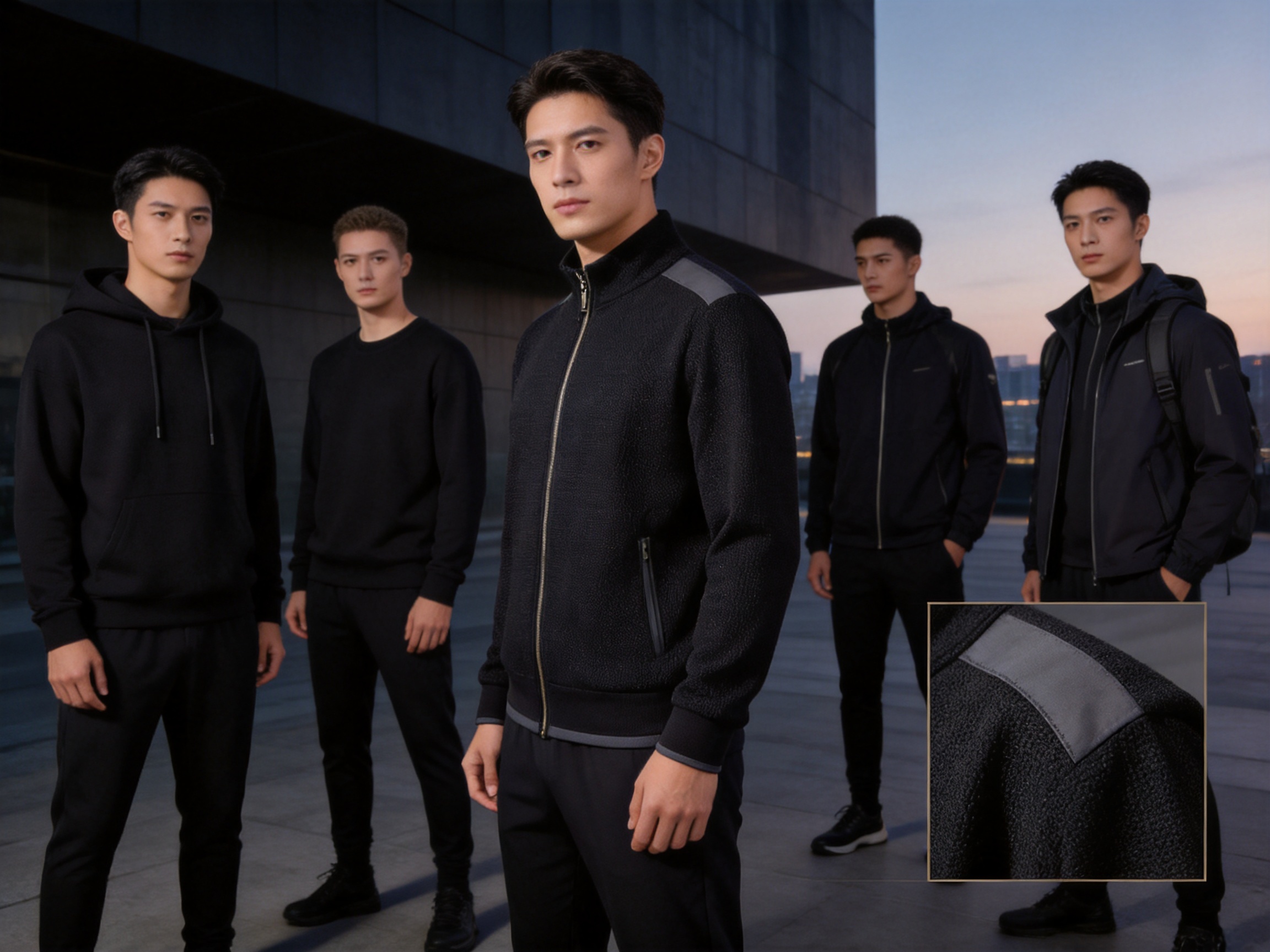
Such a surface can be valuable for premium collections in which designers want a garment to appear distinctive but versatile. A black hoodie made from an ordinary plain knit may look familiar. A black hoodie made from tonal jacquard can retain the easy styling of black while adding a closer-view detail that supports a higher perceived value. The same principle applies to track jackets, overshirts, zip-up sweatshirts, and coordinated travel sets.
The black-on-black effect also provides flexibility during product development. It can work with matte trims, glossy zippers, reflective details, tonal embroidery, printed logos, and contrast panels. Because the base pattern remains restrained, designers can add branding or functional details without creating an overly busy appearance.
Pattern scale and visibility should be evaluated under several lighting conditions. A tonal jacquard may look different in a showroom, under studio lighting, outdoors, or in retail packaging. This variation is part of its appeal, but it also makes sample approval important. Buyers should assess the fabric from near and far distances, after stretching, and after laundering. These checks help confirm that the intended subtlety is maintained in the finished garment.
Softness, Comfort, and Everyday Wearability
One of the product’s strongest functional benefits is its cotton-like softness. Polyester is often selected for durability and easy care, but the hand of ordinary polyester can vary widely. The use of DTY yarn and a knitted construction helps create a softer, fuller touch that is more suitable for apparel worn directly over a base layer or next to the skin.
The 280 g/m² weight offers a balance between lightweight jersey and heavy winter fleece. It gives garments enough body to look structured, while remaining suitable for layering. This makes the fabric useful across transitional seasons and indoor-to-outdoor clothing systems. A designer may use it for a substantial hoodie, a refined sweatshirt, a lightweight jacket, or a polished athletic top, depending on the garment pattern and finishing details.
The knitted structure contributes to comfort by allowing the fabric to flex with the body. The spandex component supports movement, while the textile’s weight can help a garment hang neatly rather than appearing thin or unstable. For urban clothing, this balance is important. Consumers often expect one garment to perform during commuting, casual activity, travel, and social settings.
Comfort is influenced by more than fiber content. Seam placement, garment lining, thread selection, washing treatment, and pattern ease also affect the final wearing experience. Nevertheless, the fabric provides useful material characteristics for brands that want a soft hand without abandoning the durability and practical benefits commonly associated with polyester.
Stretch and Recovery for Structured Sportswear
The 5% spandex blend is intended to provide durable stretch within a stable polyester base. Stretch is valuable in sportswear, but excessive softness or insufficient recovery can cause a garment to lose shape. This fabric is designed to offer a more controlled balance: enough flexibility for active movement, combined with sufficient body for structured apparel.
Potential applications include high-end track jackets, travel tops, fitted sweatshirts, commuter jackets, and fashion-oriented sportswear. In these products, the wearer may reach, bend, sit, walk quickly, or carry a bag for long periods. A fabric with controlled stretch can reduce restriction while preserving a clean silhouette.
Recovery should be assessed in the intended direction of stretch and after repeated cycles. Buyers may request testing for width, length, extension, and recovery according to their internal standards. Garment construction also affects stretch behavior. For example, a tight seam allowance, heavy embroidery, or restrictive lining can limit the practical stretch of the finished product even when the fabric itself performs well.
The fabric can also be considered for panel construction. Designers may combine it with plain knitted polyester, rib, mesh, or woven shell materials. Its tonal jacquard pattern can serve as a main body fabric while simpler materials are used for cuffs, collars, pocket bags, or ventilation zones. This creates a coordinated product without requiring the entire garment to use one construction.
Air Permeability and Moisture Management Options
A common concern about polyester is whether it feels hot during wear. Fiber type alone does not determine thermal comfort. Fabric thickness, knitting density, air movement, garment fit, humidity, and finishing all influence the result. The knitted structure of this fabric allows a degree of air permeability, making it suitable for everyday sportswear and transitional conditions.
The fabric is not positioned as an extreme-heat or ultra-light performance textile. Its 280 g/m² weight gives it a mid-heavy character. It is more appropriate for garments where softness, body, stretch, and visual sophistication are important. For warmer conditions or higher-intensity activity, the manufacturer can discuss a moisture-wicking finish to improve the management of perspiration and enhance perceived breathability.
Moisture-wicking performance should be specified according to the buyer’s testing method. Different brands use different requirements for vertical wicking, drying rate, absorbency, or moisture transport. A finish may also influence hand feel, color appearance, pilling behavior, and care performance. Development samples should therefore be tested after the proposed finishing process rather than relying only on the unfinished fabric.
For urban commuter apparel, comfort may come from a combination of moderate air permeability, stretch, and surface softness. The wearer may move between heated interiors, public transportation, streets, and offices. A versatile textile with a substantial but not excessive weight can support this type of use better than a fabric designed only for a single high-intensity activity.
Color Uniformity and Black Shade Control
Black is a demanding color for textile production. Customers may describe several shades as “black,” but those shades can differ in blue, red, green, brown, gray, depth, or surface brightness. In addition, a black fabric can look different depending on whether the surface is matte, lustrous, brushed, compact, or textured.
This product is developed with particular attention to black shade consistency. The manufacturer can match a requested black shade using a physical swatch or spectrophotometer data. This is useful for brands managing a coordinated collection, private-label programs, uniforms, or repeat orders in which a previous black must be reproduced as closely as possible.
Color matching is most reliable when the buyer provides a clear standard and specifies the viewing conditions. A physical swatch should be clean, representative, and large enough for evaluation. If instrumental data is supplied, the buyer should also confirm the light source, observer conditions, acceptable tolerance, and whether the target refers to the face side, reverse side, or finished garment.
Uniformity should be assessed across the width and length of the fabric, as well as from roll to roll. In tonal jacquard fabrics, buyers should evaluate not only the base black but also the contrast created by different luster levels. The objective is a controlled, intentional pattern rather than random variation.
Anti-Pilling and Surface Durability
Pilling occurs when loose fibers or fiber fragments form small balls on the surface through abrasion. It can affect the appearance of knitwear, particularly in areas exposed to bags, seat belts, arm movement, or repeated washing. The product is available with a customized anti-pilling finish to help protect its surface appearance.
An anti-pilling treatment should be selected according to the intended garment, expected use, and care instructions. No finish can eliminate every form of abrasion under all conditions. However, a suitable treatment, combined with stable yarn quality and controlled knitting, can improve resistance to visible surface change.
The jacquard surface is designed to retain its textural character better than a simple dyed fabric whose appearance depends mainly on color. This does not mean that the fabric is immune to wear. Instead, the structural pattern provides a more durable visual language: even when the garment is used repeatedly, the design is integrated into the knitted construction rather than printed only on the surface.
Buyers should request pilling evaluation using the test method relevant to their market. They may also review dimensional stability, colorfastness to laundering, colorfastness to rubbing, stretch recovery, and snag resistance. Testing should be performed on finished samples where possible, because garment construction and finishing can influence results.
Manufacturing Process and Quality Control
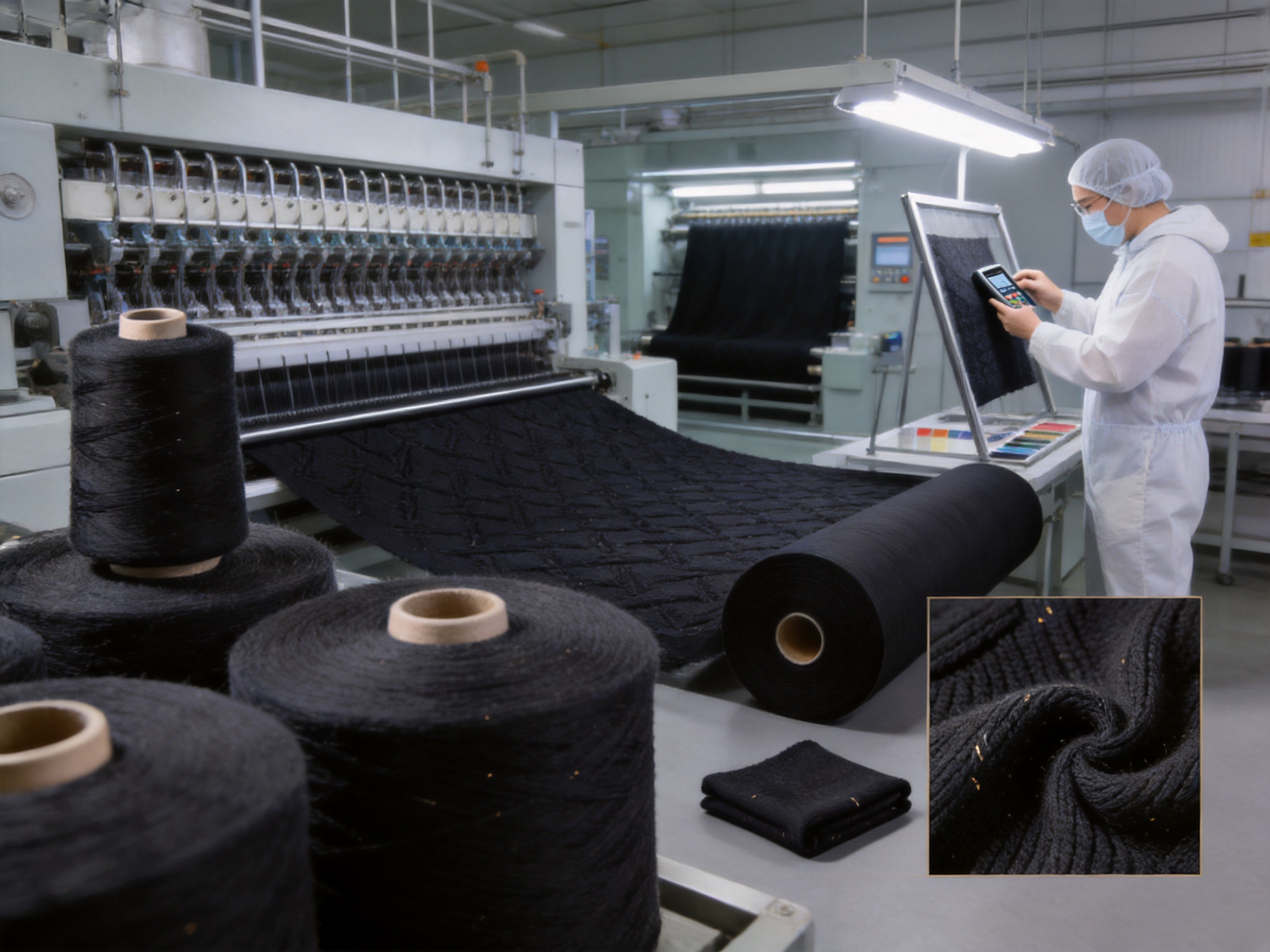
The product is supported by an integrated textile manufacturing model that includes DTY polyester yarn production, fabric production and processing, post-dyeing, finishing, and sales. This integrated structure gives the manufacturer greater visibility over the development chain. Instead of treating yarn, knitting, dyeing, and finishing as unrelated steps, the company can evaluate how each stage influences the final fabric.
Yarn Preparation
Production begins with polyester filament yarn preparation and texturing. DTY processing is used to create the desired bulk, softness, and surface behavior. Yarn parameters must be controlled carefully because variations in texture can influence knitting tension, fabric weight, pattern clarity, and dye appearance.
At this stage, attention may be given to yarn count, filament uniformity, texturing consistency, winding quality, and package condition. Proper preparation reduces the risk of uneven feeding during knitting. Consistent yarn also supports more predictable results when the fabric is dyed and finished.
Knitting and Jacquard Formation
After yarn preparation, the DTY and spandex components are knitted into the jacquard structure. Machine settings determine the pattern, density, width, loop formation, and interaction between the different yarns. The goal is to create a surface that is stable, soft, and visually balanced.
Knitting control is especially important for a fabric containing spandex. The elastomeric yarn must be fed under suitable tension. Excessive or insufficient tension can affect width, stretch, recovery, and finished weight. The jacquard pattern must also remain synchronized throughout the fabric so that the tonal design does not become distorted or irregular.
Dyeing and Post-Dyeing Processing
Once the knitted greige fabric has been prepared, it can undergo dyeing and post-dyeing processes. Black dyeing requires careful control of color depth, leveling, bath conditions, and rinsing. A deep black must be achieved without creating unwanted streaks, harshness, or excessive loss of softness.
Post-dyeing processing can influence the final width, weight, hand, and dimensional stability. The fabric may be relaxed, dried, compacted, or otherwise finished according to the required specifications. Each treatment must be balanced. Over-processing can reduce softness or stretch, while insufficient control may leave the material unstable or uneven.
Finishing and Optional Treatment
Finishing is used to refine the surface and performance of the fabric. Depending on the buyer’s requirements, the material may be developed with an anti-pilling finish or a moisture-wicking finish. Finishing choices should be evaluated with regard to hand feel, color, stretch, wash durability, and production cost.
The ability to discuss finishing options directly with a manufacturer is useful for product developers. A buyer may prefer a softer hand for premium leisurewear, greater surface resistance for commuter clothing, or enhanced moisture management for sportswear. These requirements can be reviewed during sampling rather than treated as fixed assumptions.
Inspection and Shipment Preparation
Before shipment, the fabric should be inspected for width, weight, color consistency, pattern continuity, surface defects, holes, oil marks, and other issues relevant to knitted textiles. Roll presentation and labeling are also important for factory receiving and traceability.
A disciplined inspection process helps reduce avoidable cutting-room problems. Buyers may request inspection reports, approved standards, roll identification, and sample retention. Clear documentation supports repeat orders because it provides a reference for comparing future production with the approved standard.
Advantages Over Basic Polyester and Conventional Alternatives
The first advantage over basic plain polyester fabric is visual differentiation. A plain black fabric may be economical and versatile, but it can appear ordinary when used in premium garments. The slight intermingled jacquard effect adds depth without the cost and visual complexity of a large printed design or elaborate decorative treatment.
The second advantage is tactile quality. DTY construction can provide a softer and fuller hand than a flat, less textured polyester yarn. This is valuable when the garment must communicate comfort as well as performance. A soft touch may support better consumer acceptance, particularly for hoodies, sweatshirts, and garments worn for long periods.
The third advantage is the combination of stretch and structure. Some lightweight stretch fabrics are highly flexible but lack body. Some heavy fabrics have structure but restrict movement. The 95% DTY polyester and 5% spandex blend is intended to provide a middle position suitable for modern sportswear and lifestyle clothing.
The fourth advantage is manufacturing coordination. A supplier with experience in DTY yarn and blended fabric production can work on issues at both the yarn and fabric levels. This can be more effective than asking one supplier to diagnose a problem caused by another supplier’s yarn, or asking a fabric mill to work with a yarn whose properties are not fully documented.
The fifth advantage is material efficiency. The 165 cm width is relatively generous for many apparel applications. Wider fabric can allow more efficient marker planning, especially for larger garment panels, coordinated sets, and structured jackets. Actual savings depend on pattern shape, repeat size, garment size range, and cutting layout, but the width provides an opportunity to reduce waste.
The sixth advantage is customization. Buyers can discuss black shade matching, anti-pilling treatment, moisture-wicking treatment, and other development needs. This flexibility is useful for private-label brands, apparel manufacturers, designers, and importers that need a textile adapted to a specific collection rather than a completely standard commodity fabric.
Applications in Premium Apparel
Premium Hoodies and Sweatshirts
The fabric’s softness, weight, stretch, and tonal pattern make it suitable for elevated hoodies and sweatshirts. It can create a garment with a substantial hand while avoiding the ordinary appearance of a plain black knit. Designers may use clean silhouettes, concealed zippers, tonal drawcords, or minimal branding to emphasize the fabric’s texture.
The jacquard pattern can also be positioned strategically. It may cover the entire garment for a consistent tonal effect, or it may be used on the body while plain fabric is applied to sleeves, side panels, cuffs, or hoods. Such combinations can create visual structure without introducing a second color.
High-End Track Jackets
Track jackets require a combination of movement, polish, and durability. The spandex content supports flexibility, while the 280 g/m² weight gives the garment a more substantial appearance than a thin training jersey. A black jacquard surface can make a track jacket appropriate for both travel and casual social settings.
Designers may pair the material with technical zippers, bonded pockets, reflective piping, mesh inserts, or ribbed trims. The fabric can serve as a refined main body material in collections that combine athletic function with urban styling.
Urban Commuter Apparel
Urban commuter clothing often needs to transition between different environments. It should be comfortable on public transportation, presentable in an office or café, and resilient during repeated use. The soft hand, stretch, tonal design, and durable polyester base support this multifunctional positioning.
The fabric’s black color also simplifies wardrobe coordination. It can be matched with gray, charcoal, white, olive, navy, or other dark neutrals. The subtle pattern allows the garment to appear distinctive without limiting how it is worn with other products.
Structured Sportswear
Structured sportswear uses performance concepts but often requires a more fashionable surface than traditional athletic jersey. This fabric can be considered for warm-up jackets, coordinated sports sets, travel uniforms, premium club apparel, and lifestyle-oriented activewear.
It is best suited to applications where moderate weight, controlled stretch, and surface design are important. For high-intensity sport, buyers should evaluate moisture management, drying speed, abrasion resistance, and thermal comfort against the precise demands of the activity.
Development Guidance for Buyers and Designers
Successful fabric development begins with a clear product brief. Buyers should identify the intended garment, target season, expected retail position, desired hand feel, color standard, stretch requirement, finishing preference, and delivery schedule. A clear brief allows the supplier to recommend the most appropriate construction and treatment.
Sample evaluation should include both fabric-level and garment-level review. At fabric level, inspect width, weight, softness, pattern definition, stretch, recovery, color, and surface uniformity. At garment level, examine drape, seam behavior, pocket construction, zipper installation, hood shape, cuff recovery, and overall appearance after washing.
Because the design is tonal, buyers should approve the fabric under multiple light sources. It is also helpful to photograph or view the material at different distances. The pattern should be subtle but intentional, with no unexplained streaking or inconsistent areas.
Cutting teams should account for the jacquard repeat and fabric direction. If the design has a directional character, all garment pieces may need to be placed consistently. Marker planning should consider the 165 cm width and any required pattern matching. Efficient planning can help realize the material savings associated with the wider fabric width.
Sewing trials are recommended before bulk production. The fabric contains spandex and may require suitable needle selection, thread tension, seam allowance, and feeding control. Stretch stitches or appropriate overlock settings can help preserve comfort and reduce seam stress. The correct sewing method depends on the garment design and factory equipment.
Supply Chain Strength and Commercial Support
The manufacturer operates as an export-oriented textile company integrating research and development, production, processing, and sales. Its facilities are located in Xiaoshan District, Hangzhou, Zhejiang Province, within an industrial area associated with textile manufacturing. The company reports an area of approximately 32.6 acres and a plant area of approximately 18,000 square meters.
Its product capabilities include polyester and spandex blended fabric production, post-dyeing and finishing, and DTY polyester yarn production, processing, and sales. This combination supports customers that require a coordinated source for both yarn and fabric-related development.
Direct control of raw material production can provide a cost advantage in bulk purchasing. It can also improve communication about yarn specifications, production planning, and quality concerns. While final pricing depends on order quantity, color, finish, packaging, and market conditions, a direct manufacturing model can reduce the number of commercial layers between the mill and the buyer.
Sampling within approximately five days for initial development and bulk production in approximately twenty-five days for existing colors provide a useful planning framework. These are indicative lead times and should be reconfirmed according to order details, production capacity, testing requirements, and shipping arrangements.
Secure payment through Alibaba Trade Assurance is available for transactions arranged through the relevant platform. Buyers should review the specific terms of the order, including product specifications, inspection arrangements, shipping obligations, and dispute procedures, before payment.
Quality, Compliance, and Order Considerations
Before placing a bulk order, buyers should confirm the technical specification sheet. Important details may include finished width tolerance, weight tolerance, color tolerance, stretch and recovery range, pilling requirement, shrinkage limit, roll length, packaging method, and inspection standard.
Brands serving regulated markets may also require declarations concerning restricted substances, fiber composition, labeling, chemical management, or social responsibility. These requirements vary by destination and customer policy. The supplier and buyer should agree in writing on which documents, tests, and certifications are required for the order.
For repeat colors, retaining an approved standard is particularly important. Black shades can drift when dye recipes, equipment, raw materials, or finishing conditions change. A physical standard, instrumental data, and written tolerance can work together to protect consistency across production seasons.
Buyers should also consider care labeling. Polyester and spandex blends are generally selected for practical care, but high heat, aggressive tumble drying, excessive ironing, or unsuitable chemicals may affect stretch and surface appearance. The final care instructions should be based on testing of the finished garment, not only on general assumptions about the fiber blend.
Environmental and Efficiency Perspectives
Material efficiency is one practical consideration in textile sourcing. A 165 cm width can support better cutting utilization, although the actual result depends on garment dimensions and pattern layout. Reducing cutting waste can lower the amount of fabric required for a given production quantity and may improve manufacturing economics.
Durability is another aspect of resource efficiency. A fabric that maintains its appearance and fit through repeated wear may support longer garment use. The optional anti-pilling finish is relevant to this objective because surface deterioration can cause consumers to reject a garment even when the underlying structure remains functional.
Environmental performance should be evaluated across the full production chain. Relevant factors may include polyester source, energy and water use, dyeing conditions, finishing chemistry, wastewater management, packaging, transportation, and garment life. Buyers seeking specific environmental claims should request appropriate evidence and avoid relying on general fiber descriptions alone.
The manufacturer’s integrated model can help with process communication. When a buyer asks for a change in softness, color, stretch, or surface performance, the request can be discussed in relation to yarn, knitting, dyeing, and finishing rather than being limited to one isolated process. This may support more efficient product development and reduce unnecessary trial cycles.
Care and Garment Performance
The finished garment’s care performance depends on both fabric properties and production choices. A recommended care program should balance cleaning effectiveness with preservation of color, stretch, hand, and jacquard definition. Mild detergent, controlled washing temperature, and avoidance of excessive heat are commonly considered during development, but final instructions should be determined through testing.
Black garments may show lint, dust, detergent residue, or surface abrasion more visibly than lighter garments. Proper finishing and care communication can help preserve the intended appearance. Consumers should also be advised to separate dark garments when necessary and avoid practices that create avoidable friction.
When testing a sample, buyers should compare the original and washed fabric for shade, width, length, weight, softness, stretch, recovery, pilling, and pattern appearance. A tonal jacquard should remain visually coherent after laundering. If the fabric is intended for heavy use, additional abrasion or repeated wash testing may be appropriate.
Frequently Asked Questions
Does DTY polyester fabric trap heat?
Not necessarily. The knitted construction allows air movement, and the fabric can provide comfortable everyday wear when used in suitable garment designs. However, the 280 g/m² weight makes it a mid-heavy textile rather than an ultra-light summer fabric. For warmer environments or more active use, a moisture-wicking finish can be discussed to improve breathability and moisture management.
Can the supplier match a specific black shade?
Yes. Black shade matching can be developed from a physical color swatch or spectrophotometer data. Buyers should provide a clear target and confirm the acceptable tolerance, viewing conditions, and whether the standard applies to the finished face side. Lab approval is recommended before bulk production.
Is the fabric suitable for high-performance sports?
It can be suitable for structured sportswear, track jackets, warm-up clothing, and lifestyle-oriented activewear. For high-intensity or extreme-weather applications, buyers should test moisture transport, drying rate, abrasion resistance, thermal comfort, and recovery according to the intended activity. The fabric’s strongest positioning is where performance must be combined with a premium tonal appearance and substantial hand.
Can an anti-pilling finish be added?
Yes. A customized anti-pilling finish is available. The treatment should be evaluated on a development sample because it may influence softness, color appearance, stretch, and wash performance. The buyer should specify the required test method and target rating.
What garments are most appropriate for this material?
Recommended applications include premium hoodies, sweatshirts, high-end track jackets, urban commuter garments, structured sportswear, travel apparel, and coordinated lifestyle sets. The fabric can also be used selectively for panels or garment sections where a subtle tonal texture is desired.
What does the 165 cm width offer to garment manufacturers?
The wider format can provide more flexibility during marker planning and may reduce cutting waste compared with narrower fabric. Savings depend on the garment pattern, size range, repeat direction, and cutting arrangement. A factory should conduct a marker efficiency review before making a final material consumption estimate.
How does the jacquard pattern differ from a print?
The pattern is formed through the knitted structure and yarn arrangement rather than being applied only as a surface print. This creates a more integrated tactile effect. The tonal design is produced through subtle differences in texture and luster, so it can appear more restrained and dimensional than a conventional printed graphic.
Can the fabric be used with other materials?
Yes. It can be coordinated with plain knitted polyester, rib, mesh, woven shell fabrics, or contrast trims. Since the base color is black, the material can support tonal garment construction and can also be combined with reflective, matte, or technical components.
What should be approved before bulk production?
Buyers should approve the color, pattern appearance, hand feel, weight, width, stretch and recovery, finish, shrinkage, pilling performance, and packaging standard. A garment prototype or sewing trial is also recommended when the fabric will be used in a new product category.
How long is the production lead time?
Initial sampling is available within approximately five days, while bulk production for existing colors is approximately twenty-five days. Actual timing should be confirmed for each order because quantity, finishing, testing, raw material availability, and shipping requirements can affect the schedule.
Conclusion
Black Slight Intermingled DTY Jacquard Fabric offers a carefully balanced solution for apparel brands and manufacturers seeking a premium black textile with more character than a basic dyed knit. Its 95% DTY polyester and 5% spandex composition combines a soft, cotton-like touch with durable stretch and a substantial 280 g/m² hand. The knitted jacquard structure creates a subtle black-on-black pattern, while the slight intermingled luster supports a refined stealth-luxury aesthetic.
The material’s advantages extend beyond appearance. Its 165 cm width can support efficient cutting, its tonal pattern is integrated into the knitted construction, and its optional anti-pilling and moisture-wicking treatments allow development according to the intended end use. The fabric is suitable for premium hoodies, sweatshirts, high-end track jackets, urban commuter apparel, and structured sportswear.
The manufacturer’s control of DTY polyester yarn production, blended fabric manufacturing, post-dyeing, finishing, and sales provides an integrated foundation for quality management and customization. Direct experience with DTY yarn can support better control of softness, texture, consistency, and fabric performance. For buyers requiring a specific black shade, the ability to work from a physical swatch or spectrophotometer data is an additional advantage.
As with any textile, final suitability should be confirmed through sampling and testing. Buyers should evaluate shade, pattern, hand, stretch, recovery, dimensional stability, pilling, colorfastness, moisture management, and garment construction before confirming bulk production. With appropriate development and quality control, this DTY jacquard fabric can help create garments that combine comfort, durability, efficient manufacturing, and understated visual distinction.
References
1. Textile Exchange. Preferred Fiber and Materials Market Report, general guidance on synthetic fibers, material efficiency, and textile sourcing considerations.
2. International Organization for Standardization. ISO 105 series, general methods for assessing colorfastness of textiles.
3. International Organization for Standardization. ISO 12945 series, methods for evaluating the tendency of fabrics to form pills and other surface changes.
4. International Organization for Standardization. ISO 3801, methods for determining mass per unit area and related textile measurement practices.
5. American Association of Textile Chemists and Colorists. Technical guidance on textile colorfastness, color measurement, and fabric performance evaluation.
6. ASTM International. Textile testing standards covering dimensional change, abrasion, stretch, recovery, and fabric appearance.
7. Technical literature on polyester Draw Textured Yarn, filament texturing, knitted fabric construction, and spandex-blend performance.