
Black and White Grid Knitted Jacquard Fabric: Design, Performance, and Manufacturing Excellence
Black and white grid knitted jacquard fabric combines a clean geometric appearance with the comfort and flexibility expected from a modern knitted textile. Its contrasting pattern gives garments and home-sewing projects a distinctive visual identity, while its knitted construction provides softness, movement, and practical wearability. For designers, apparel manufacturers, and textile buyers, this type of fabric offers an effective way to create products that look structured without becoming stiff or uncomfortable.
The fabric is especially suitable for fashion garments, coordinated separates, jackets, skirts, dresses, tops, accessories, decorative panels, and selected home-based sewing projects. The black and white grid can create anything from a classic checked impression to a contemporary architectural effect, depending on the scale of the pattern, the arrangement of the knit, and the finishing treatment. This adaptability makes it valuable for both seasonal collections and long-term product lines.
Behind the appearance of the finished fabric is a combination of yarn selection, knitting control, jacquard pattern engineering, post-processing, inspection, and careful sales support. A manufacturer with experience in polyester, rayon, spandex-related blended fabrics, knitted jacquard, NTR knitted fabrics, NR knitted fabrics, and drawn textured yarn can coordinate these stages more effectively than a supplier focused on only one part of the textile chain.
This article examines the characteristics of black and white grid knitted jacquard fabric, its advantages over ordinary printed or basic knitted fabrics, its potential applications, and the manufacturing capabilities required to produce it consistently. It also explains how a specialized textile producer can support customers from material development through finishing, quality control, and export supply.
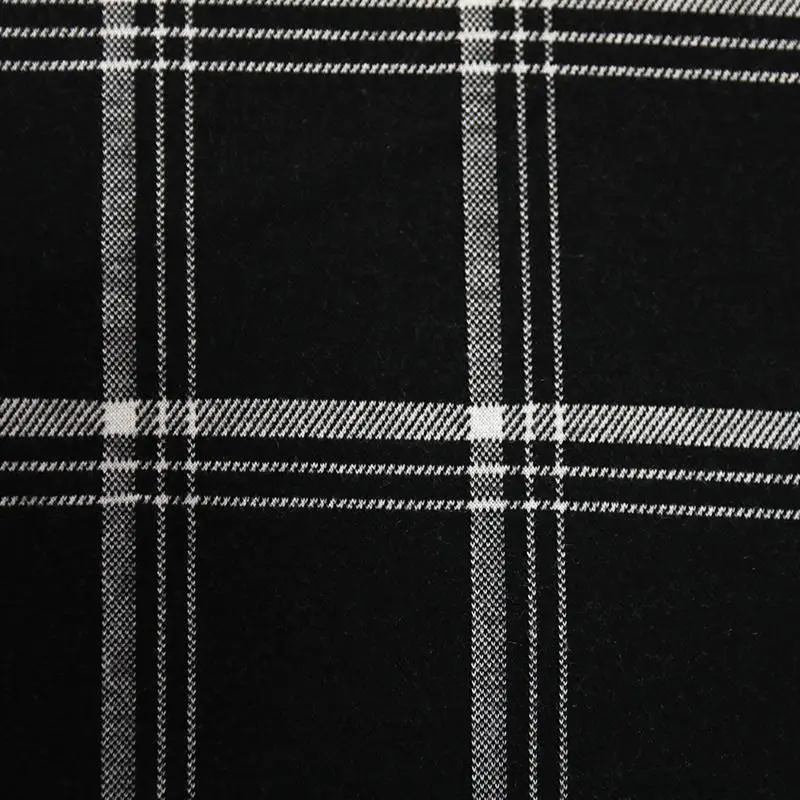
Jacquard Black And White Grid Fabric
Understanding Black and White Grid Knitted Jacquard Fabric
Jacquard fabric is created through a pattern-forming process that controls the arrangement of yarns during fabric production. Unlike a simple surface print, a knitted jacquard pattern is integrated into the structure of the textile. The design is therefore connected with the fabric’s construction rather than merely applied to the outer surface after knitting or weaving.
In a black and white grid fabric, contrasting yarns are organized to form repeated lines, blocks, checks, or intersecting geometric units. The resulting pattern may be fine and understated or bold and highly visible. The grid can be regular, elongated, offset, or combined with other textures. This gives product developers the ability to use the same general concept in different fashion directions.
The knitted base contributes several practical characteristics. It can provide stretch, drape, resilience, and a softer hand than many rigid woven alternatives. The exact performance depends on the fiber composition, yarn specification, knitting structure, fabric weight, finishing process, and the intended end use. Polyester-based structures are often selected for durability, shape retention, and ease of care, while rayon-containing blends may contribute softness, fluidity, and a comfortable touch.
Where required, elastomeric fibers such as spandex can be incorporated into a blended structure to improve elasticity and recovery. The appropriate composition must be selected according to the product’s purpose. A fitted garment, for example, may require more recovery than a decorative panel, while a loose jacket or skirt may prioritize drape and surface definition.
Visual identity of the grid pattern
The black and white color combination is one of the most recognizable combinations in fashion and interior design. It provides strong contrast, allowing the grid to remain visible from a distance and retain its clarity in photographs, displays, and finished garments. The color pairing can support minimalist, classic, modern, casual, or graphic design concepts.
Because the pattern is based on geometric repetition, it can also help manufacturers create coordinated collections. The same grid concept may be developed in different scales, fabric weights, or surface textures. It may be used for a main garment, a contrasting panel, a collar, a sleeve, a waistband, or an accessory. This versatility gives buyers more opportunities to build a unified product range.
Relationship between construction and appearance
The appearance of jacquard knitted fabric is influenced by more than color. The pattern definition depends on yarn fineness, loop formation, knitting tension, gauge, stitch arrangement, and finishing. If the construction is not carefully controlled, the grid may become distorted, uneven, or inconsistent across the width. Professional production therefore requires attention to both creative design and mechanical precision.
A well-developed fabric should maintain a balanced visual effect while preserving the characteristics expected from a knitted material. It should not sacrifice comfort merely to achieve a strong pattern. This balance between appearance and performance is one of the main reasons buyers choose knitted jacquard rather than a basic printed fabric.
Key Advantages Over Conventional Alternatives
Black and white grid knitted jacquard fabric competes with printed fabrics, plain knitted fabrics, simple woven checks, and lower-cost decorative textiles. Each alternative has a role, but jacquard knitting offers several advantages when pattern integration, comfort, and versatility are important.
Integrated pattern construction
A primary advantage is that the design is formed as part of the textile structure. In a printed fabric, the pattern is placed on the surface. With knitted jacquard, the contrasting yarn arrangement contributes to the fabric’s visual and tactile character. This construction can help the fabric maintain its design identity through normal use, provided that the material is properly manufactured and cared for.
The integrated approach also allows designers to create texture and dimension that may be difficult to reproduce through a flat print. Depending on the knitting structure, the grid may have subtle relief, visual depth, or changes in light reflection. These effects can make a finished garment appear more refined and substantial.
Comfort and flexibility
Knitted textiles are generally valued for their flexibility and ability to follow body movement. A knitted jacquard fabric can offer a more comfortable wearing experience than a rigid textile, particularly when used in garments that require ease of movement. The amount of stretch varies according to the construction and fiber composition, so product specifications should be selected carefully for each application.
This flexibility also benefits home-based sewing projects. A sewer can use the fabric for garments that need a combination of style and movement, including dresses, tops, skirts, relaxed jackets, and coordinated accessories. The fabric can support structured visual design without necessarily requiring the stiffness of a traditional woven material.
Strong pattern recognition
The high contrast between black and white gives the grid a clear identity. This can help finished products stand out in a crowded retail environment. A distinctive geometric pattern may attract attention without requiring complicated decoration, embroidery, or additional surface treatments.
The pattern can be used as a central design feature or as one component of a broader collection. It can be paired with solid black, white, gray, neutral, or carefully selected accent colors. This makes the fabric practical for capsule collections and coordinated product planning.
Versatility across applications
Jacquard fabrics are widely associated with garments, but their uses can extend to many home-based sewing and decorative projects. Depending on weight and finishing, black and white grid fabric may be considered for cushions, decorative covers, fabric panels, small accessories, tote bags, and other creative products.
Its versatility is strengthened by the availability of different textures, weights, widths, and compositions. A buyer can request a material that emphasizes softness, structure, elasticity, drape, durability, or surface definition. This makes the category more adaptable than a single-purpose textile.
Potential for long-term product development
A successful textile design often needs to be developed in more than one version. The grid pattern can be adjusted in scale, repeat, contrast, yarn type, or finishing while preserving its original design language. This allows a company to create a family of fabrics for different markets and seasons.
For example, a finer grid may be suitable for a refined blouse or lightweight dress, while a larger grid may work better for outerwear, skirts, or decorative projects. The same visual concept can also be combined with different polyester, rayon, or stretch-blend constructions. Such flexibility is valuable to buyers seeking continuity and variation in their product lines.
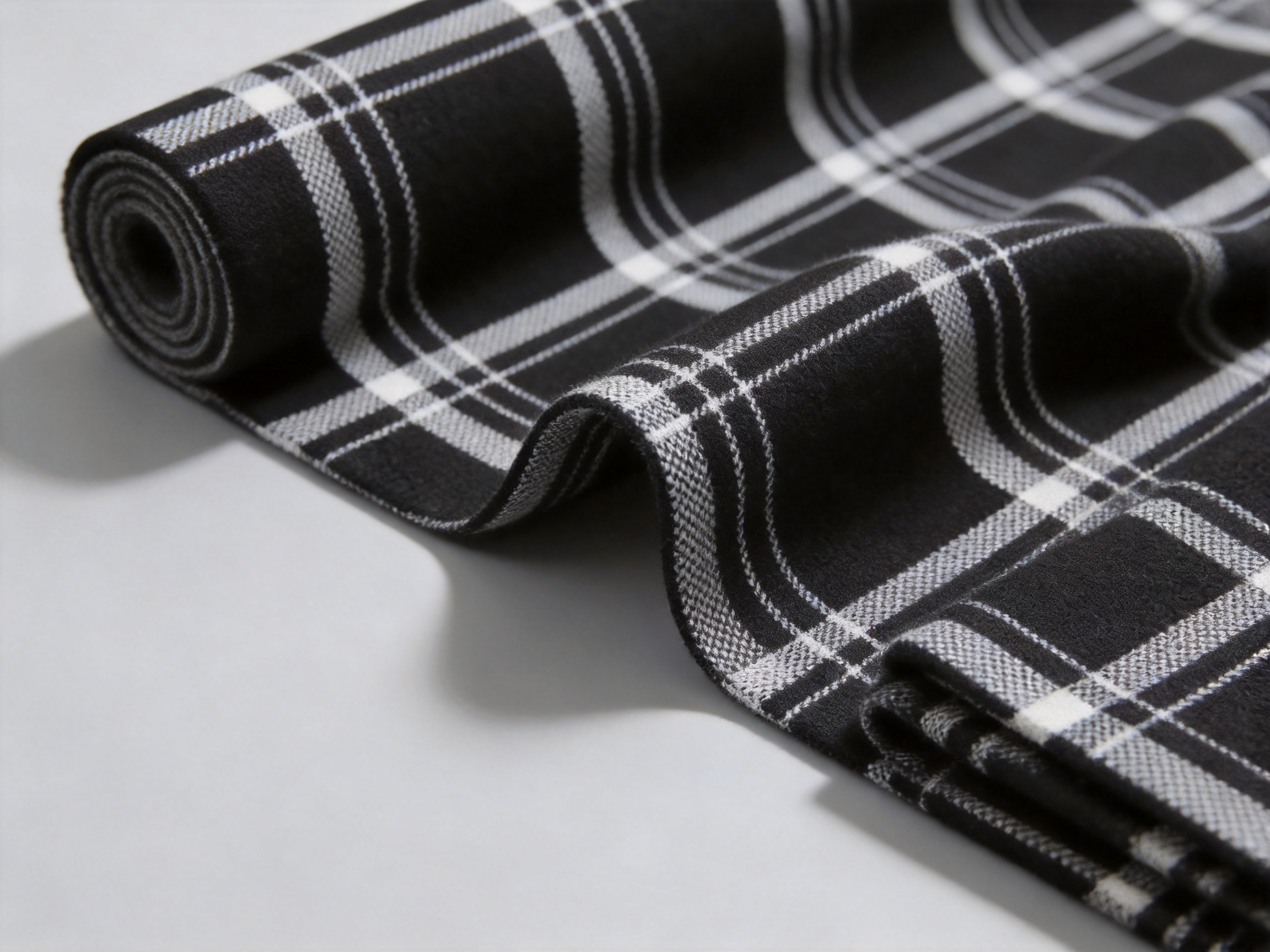
Material Selection and Fiber Composition
The performance of a knitted jacquard fabric begins with the selection of fibers and yarns. Polyester is frequently used in blended textile production because it can contribute strength, dimensional stability, abrasion resistance, and practical care characteristics. It is suitable for many garments and home-sewing applications where the fabric must retain its appearance during regular use.
Rayon can contribute a softer touch, fluid drape, and a more comfortable hand. When blended with polyester, it may help balance durability with softness. The actual result depends on the ratio of the fibers, yarn structure, knitting method, and finishing treatment. Buyers should evaluate the complete fabric specification rather than judging a blend only by its fiber names.
Spandex-related blends may be used where stretch and recovery are needed. Stretch can improve comfort in fitted garments, support ease of movement, and help a fabric conform to design requirements. However, stretch must be matched to the garment pattern and intended use. Excessive or insufficient elasticity can both create production challenges.
Yarn quality and consistency
Yarn consistency affects the appearance of the grid, the regularity of loops, and the stability of the finished fabric. Variations in yarn fineness, twist, color, or tension can become visible in a high-contrast pattern. For this reason, yarn preparation and incoming material inspection are important stages in jacquard production.
Drawn textured yarn, commonly known as DTY, is another important part of a polyester textile manufacturing system. Textured yarn is designed to introduce a degree of bulk, resilience, and surface character compared with a completely smooth filament. Depending on the specification, it can support comfortable hand feel, improved coverage, and a more attractive textile surface.
The suitability of DTY depends on factors such as denier, filament count, texture level, color, and intended knitting structure. A manufacturer experienced in DTY polyester yarn production and processing can better coordinate yarn development with fabric requirements. This integrated knowledge can reduce the risk of selecting a yarn that looks acceptable in isolation but performs poorly during knitting or finishing.
Balancing performance requirements
Material selection should begin with the final product. A fashion manufacturer may prioritize drape, color contrast, and comfort. A workwear or high-use product may place greater emphasis on abrasion resistance and dimensional stability. A home-sewing customer may prefer a balanced fabric that is easy to cut, sew, and care for.
By discussing the end use before production, the supplier can recommend a suitable combination of fiber content, yarn type, knit structure, weight, stretch, and finish. This consultative approach is more effective than offering one standard construction for every customer.
Advanced Manufacturing Process
Producing a consistent black and white grid knitted jacquard fabric requires a controlled sequence of technical operations. The process begins with design interpretation and material preparation, continues through knitting and post-processing, and concludes with inspection, packing, and shipment. Each stage influences the performance of the final product.
Design development and pattern programming
The first stage is converting the desired visual concept into a workable knitted pattern. A grid design must be evaluated for repeat size, line width, contrast, alignment, and compatibility with the selected machine and yarns. The design team may adjust the pattern to account for the natural behavior of knitted loops, which can change slightly when the fabric is relaxed or finished.
Pattern programming is particularly important when the design must be repeated accurately across the width and length of the fabric. The manufacturer must consider how the grid will appear after washing, heat treatment, dyeing, relaxation, and cutting. A technically correct design file is not enough; it must also be tested as a physical fabric.
Yarn preparation
Before knitting, the selected yarns are prepared according to the production requirements. Black and white grid fabric demands reliable color separation and stable yarn feeding because any unintended mixing or tension variation may affect the visual sharpness of the pattern.
Yarn inspection may include checks for appearance, package condition, uniformity, and compatibility with the planned knitting process. Proper storage also matters. Humidity, contamination, and handling can influence yarn behavior. A disciplined preparation system helps reduce avoidable defects before the fabric reaches the knitting machine.
Jacquard knitting
During jacquard knitting, the machine controls the placement and interaction of yarns according to the programmed pattern. The machine settings must be adjusted to achieve the required gauge, loop density, width, weight, and pattern definition. Tension should remain stable so that black and white areas retain consistent proportions and the grid does not become visibly distorted.
Operators monitor the fabric as it is produced, looking for dropped stitches, broken yarns, irregular lines, needle marks, color contamination, and structural inconsistency. Early detection is important because a small issue that is corrected quickly may otherwise continue through a long production roll.
Modern production management combines machine capability with operator experience. Automated controls can improve repeatability, but skilled personnel are still essential for setup, troubleshooting, material changes, and quality judgment. The best results come from combining accurate equipment with a disciplined manufacturing team.
Relaxation and dimensional control
Knitted fabric can change in width, length, and tension after it leaves the machine. Relaxation allows the loops to settle before final measurements and finishing decisions are made. If dimensional behavior is ignored, the fabric may not meet the buyer’s expectations when it is cut or sewn.
Dimensional control is particularly important for a grid pattern. Even minor width or length changes can affect the appearance of squares and lines. A professional process therefore evaluates the fabric in a relaxed state and establishes practical tolerances for production.
Dyeing and color management
Black and white fabrics require careful color management. The black component must provide sufficient depth and consistency, while the white component must remain clean and visually distinct. The choice of dyeing or yarn-coloring method depends on the construction, fiber content, order requirements, and desired appearance.
Color matching should be handled with clear standards and approved samples. Buyers may require consistency between production lots, especially when the fabric is used in coordinated garments or repeat collections. Sample approval before bulk production helps align expectations and reduce misunderstandings.
Finishing operations
Finishing can influence hand feel, width, surface smoothness, drape, shrinkage, and overall appearance. Processes may include heat setting, softening, brushing, compacting, or other treatments selected for the fabric’s intended use. The correct finishing route should enhance the fabric without damaging the jacquard structure or reducing pattern clarity.
For a fabric intended for clothing, finishing should support comfort and sewing performance. For home-based projects, it may also be important to provide a stable surface that is easy to cut and handle. The best treatment depends on the balance of appearance, performance, and cost required by the customer.
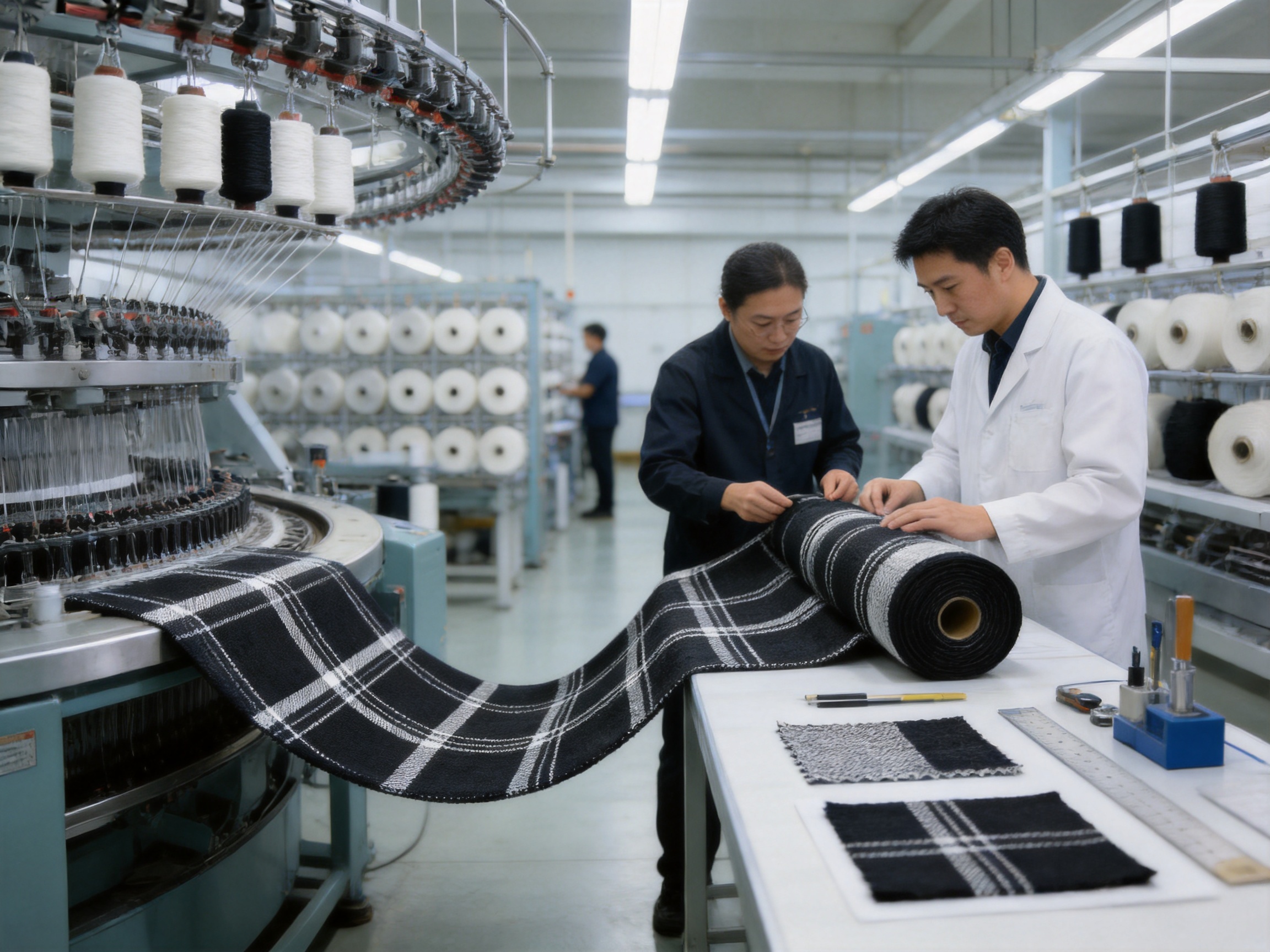
Quality Control and Production Reliability
Quality control is not limited to examining the finished roll. It should be integrated throughout the manufacturing process. A reliable textile supplier checks materials, machine setup, in-process fabric, finishing results, and final packing. This layered approach helps identify problems at the stage where they can be corrected most efficiently.
Common inspection points
For black and white grid knitted jacquard fabric, inspection may focus on pattern alignment, color contrast, fabric width, weight, stretch, recovery, surface defects, holes, dropped stitches, stains, and edge condition. The exact inspection criteria should be agreed upon with the buyer before bulk production.
Pattern alignment is especially important. If the grid shifts across the fabric or changes scale unexpectedly, cutting efficiency and garment appearance may suffer. Consistent knitting tension and careful finishing help maintain the intended design.
Dimensional stability is also significant. A fabric that changes substantially after washing may cause garments to shrink or seams to shift. Testing and communication about expected shrinkage allow the garment manufacturer to make appropriate pattern and production adjustments.
Sample approval and bulk production
A physical sample provides a more accurate basis for evaluation than a digital image alone. It allows the buyer to examine the hand feel, thickness, elasticity, color, pattern scale, drape, and sewing behavior. Once the sample is approved, it becomes an important reference for bulk production.
When producing repeat orders, the supplier should retain relevant production information, including yarn specifications, machine settings, pattern files, finishing instructions, and approved color standards. This supports better consistency from one order to the next and simplifies future development.
Reducing production risk
Manufacturing risk can be reduced through early communication. Customers should provide information about intended use, target weight, preferred width, composition, color standard, order volume, packing requirements, and any testing expectations. The supplier can then determine whether the requested construction is technically and commercially practical.
A manufacturer that handles production, post-dyeing, finishing, and sales within one coordinated organization may be able to respond more quickly than a supplier that outsources every stage. Internal coordination can reduce delays, improve information flow, and make it easier to investigate quality issues.
Applications in Apparel and Home Sewing
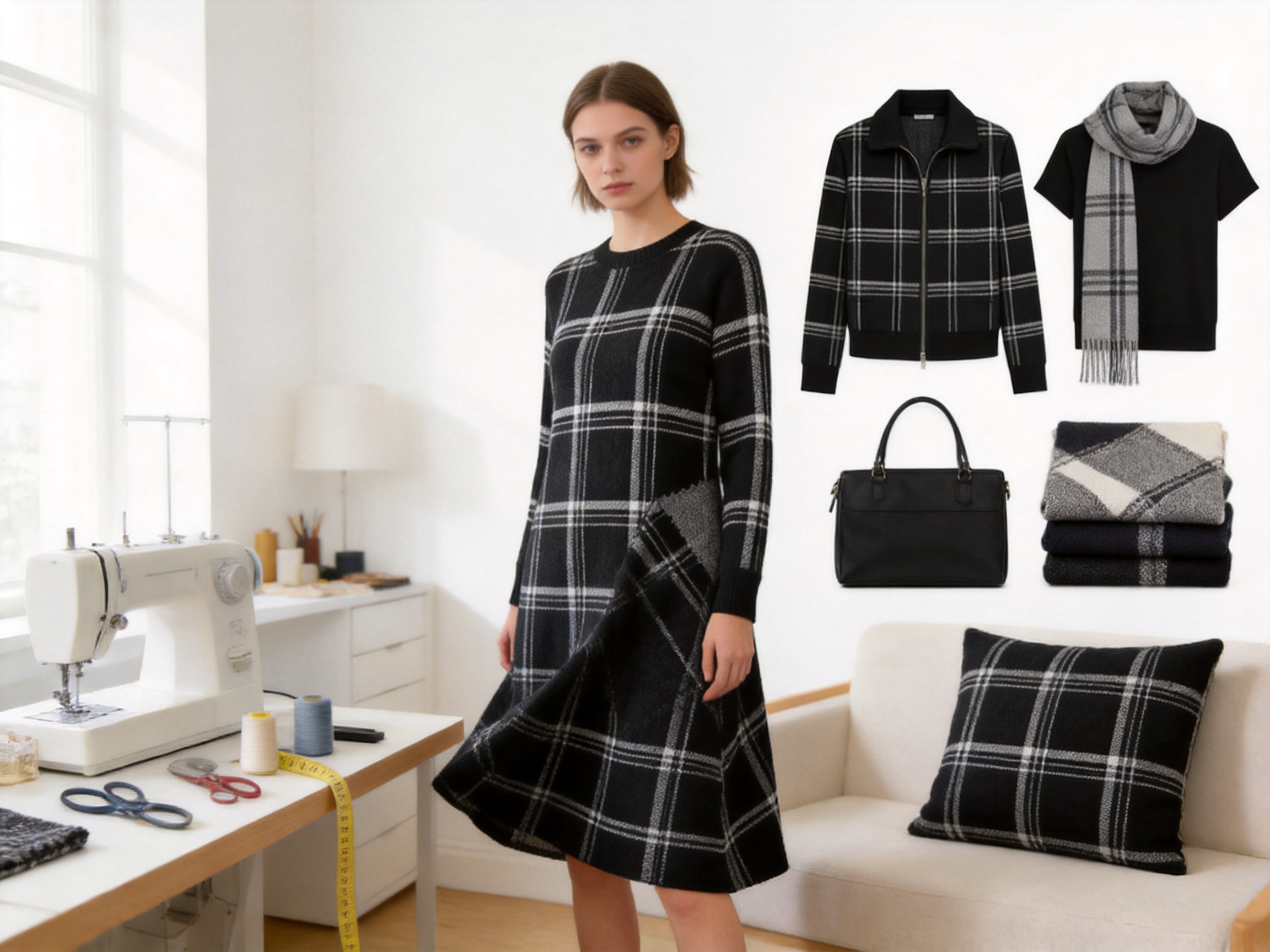
The most popular use for jacquard patterns is garment-making. Black and white grid knitted jacquard fabric is suitable for designers who want a strong visual pattern combined with the comfort of a knitted construction. Its potential applications include dresses, skirts, tops, cardigans, jackets, trousers, coordinated sets, and fashion accessories.
Dresses and skirts
In dresses and skirts, the grid can create a clear silhouette and a memorable surface effect. A smaller grid may produce a more refined appearance, while a larger pattern can emphasize a modern or graphic style. The fabric’s drape and stretch should be matched to the design. Close-fitting styles may require suitable recovery, while relaxed shapes may prioritize fluid movement.
Tops and blouses
For tops and blouses, a black and white grid can function as the main print-like feature without the need for additional decoration. It can be paired with solid-color collars, cuffs, plackets, or panels. Depending on the weight and hand feel, the material may be used for casual garments, fashion tops, or layered pieces.
Jackets and structured garments
A thicker or more stable knitted jacquard can support jackets, overshirts, and other garments that need visual structure. The fabric can offer a more comfortable alternative to some rigid woven materials while retaining a tailored appearance. Designers should consider seam stability, edge behavior, lining requirements, and the way the grid aligns at garment panels.
Accessories
Smaller products such as scarves, bags, headbands, belts, and fabric-covered accessories can benefit from the high-contrast pattern. These applications may use the grid as a statement detail or as part of a coordinated collection. The pattern can remain recognizable even when used on a relatively small surface.
Home-based sewing projects
Jacquard fabrics are also suitable for a range of home-based sewing projects. Depending on the fabric’s weight and construction, potential projects include cushion covers, decorative panels, table accents, fabric baskets, organizers, and creative craft items. The black and white palette is easy to coordinate with many interior styles.
Home sewers should test a small piece before beginning a large project. A sample can reveal how the fabric behaves during cutting, pressing, stitching, washing, and edge finishing. It also allows the sewer to determine whether the pattern should be centered, matched, or deliberately placed for an asymmetrical effect.
Design and Sewing Considerations
Because the grid is geometric, cutting and sewing require more planning than working with a plain fabric. Pattern matching may be necessary at side seams, center fronts, pockets, collars, and other prominent locations. Designers should include sufficient fabric during planning if a continuous visual match is required.
Pattern scale and garment size
The scale of the grid affects how the finished garment is perceived. A small grid can appear subtle and detailed, while a large grid can create a strong graphic statement. The best scale depends on the garment size, silhouette, seam placement, and target market.
Large patterns may require additional attention at curved seams because the lines can change direction or appear uneven. Smaller repeats may be easier to manage, but they can also require high precision to preserve their visual clarity. Sample garments are useful for evaluating these effects before bulk cutting.
Seam and edge behavior
Knitted fabric can stretch or curl at the edge depending on the structure and finishing. Appropriate needles, thread, stitch types, and handling methods should be selected during sewing. The fabric’s stretch direction should be identified before cutting, particularly when the garment design depends on controlled elasticity.
Interfacing, lining, elastic supports, or stabilizing tapes may be used when additional structure is required. These decisions should be based on the fabric’s weight, stretch, and end use rather than applied automatically.
Care and maintenance
Care instructions should reflect the actual fiber composition and finishing treatment. Polyester-rich materials are often valued for practical care, but high temperatures, harsh chemicals, or unsuitable drying methods may still affect appearance and dimensional stability. Rayon-containing blends may require additional attention to washing and drying.
Manufacturers and buyers should establish care recommendations through sample testing. Clear instructions help protect the appearance of the grid and improve customer satisfaction after the garment or home product reaches the market.
Why a Specialized Textile Manufacturer Matters
The quality of a finished jacquard fabric depends on the interaction of multiple technical areas. A supplier may have access to knitting equipment, but that alone does not guarantee consistent results. Experience with yarns, blended fibers, post-dyeing, finishing, quality inspection, and customer requirements is equally important.
A specialized textile manufacturer can provide a more complete development path. The process may begin with a customer’s image, swatch, color request, or application description. Technical staff can then assess the feasibility of the design, recommend a construction, arrange sample development, evaluate the result, and move toward bulk production after approval.
Experience across polyester and blended fabrics also supports better problem-solving. If a buyer wants a softer hand, improved stretch, greater structure, or a different surface effect, the supplier can consider changes to yarn, composition, knitting, or finishing rather than relying on one limited adjustment.
Integrated production and sales capabilities
An organization that integrates research and development, production, processing, finishing, and sales can offer more coordinated service. It can maintain communication between technical and commercial teams, respond to customer feedback, and make production decisions based on both performance and market requirements.
For export customers, integrated support is particularly valuable. International orders often require clear specifications, sample confirmation, careful packing, shipment coordination, and consistent documentation. An experienced export-oriented textile company understands that product quality includes communication and delivery reliability as well as the fabric itself.
Manufacturing scale and facility resources
The supplied company information describes a textile business located in an industrial park in Xiaoshan District, Hangzhou, Zhejiang Province. It covers approximately 32.6 acres and has a plant area of about 18,000 square meters. This operating scale provides a physical foundation for production, processing, finishing, storage, and coordinated order management.
Facility size alone does not determine quality, but it can support more organized workflows and production capacity. When combined with experienced personnel and process control, adequate facility resources help a supplier handle development work and commercial orders more effectively.
Product range and technical experience
The company’s product categories include polyester rayon fabric, knitted jacquard fabric, NTR knitted fabric, NR knitted fabric, and slightly intermingled drawn textured yarn. This range indicates experience with both fabric manufacturing and polyester yarn-related operations.
Such product breadth can benefit customers seeking more than one type of textile. A buyer may develop a jacquard fabric for a fashion collection while also requiring a plain knitted material, a blended fabric, or DTY polyester yarn for related products. Working with a supplier familiar with these categories can simplify sourcing and improve technical continuity.
Comparison of Material Options
The following table provides a general comparison of several common textile approaches. Actual performance depends on composition, construction, finishing, and testing, so the table should be used as a development guide rather than a substitute for a physical sample.
| Material Approach | Pattern Formation | Typical Strengths | Important Considerations |
|---|---|---|---|
| Knitted jacquard fabric | Pattern integrated into the knitted structure | Distinctive texture, flexible construction, strong visual identity, broad design potential | Requires careful tension control, pattern alignment, and dimensional testing |
| Printed knitted fabric | Pattern applied to the surface after fabric formation | Wide image flexibility, efficient for certain short-run designs, broad color possibilities | Surface appearance and hand feel may differ from a structurally integrated jacquard effect |
| Plain knitted fabric | No major integrated pattern or a simple solid appearance | Easy coordination, comfortable construction, efficient for basic products | May require additional decoration or color blocking to achieve the same visual impact |
| Woven checked fabric | Pattern formed by intersecting warp and weft yarns | Potentially stable structure, clear checks, suitable for tailored applications | May offer less stretch or movement than a comparable knitted structure |
| Polyester-rich blended fabric | Can be knitted, woven, or patterned according to the construction | Durability, practical care, blend flexibility, suitability for many product categories | Fiber ratio and finishing must be matched to the required softness and drape |
Commercial Benefits for Buyers and Brands
From a purchasing perspective, black and white grid knitted jacquard fabric offers more than an attractive surface. It can help a product line establish a recognizable design language. A clear grid pattern can be repeated across different garments, accessories, and seasonal products, supporting visual consistency without making every item identical.
The fabric can also reduce the need for complex surface decoration. A strong jacquard structure may provide sufficient design interest on its own, helping simplify styling and product development. This does not eliminate the need for careful garment engineering, but it can make the fabric itself a central design asset.
For wholesalers and manufacturers, the material can serve several market segments. It may appeal to fashion companies seeking graphic textiles, apparel factories requiring coordinated materials, and independent designers looking for distinctive fabrics for small collections. Its suitability for home sewing also broadens the potential customer base.
Customization potential
Customization may involve pattern scale, color arrangement, fiber blend, weight, width, stretch, surface finish, or packaging. The most practical customization route depends on order quantity and production requirements. Customers should discuss these variables early, as changes in construction can affect lead time and cost.
A manufacturer with its own development and processing capabilities can evaluate customization more efficiently. It can determine whether a request should be addressed through yarn selection, pattern programming, knitting settings, dyeing, or finishing. This technical diagnosis prevents unnecessary changes and supports a more predictable development process.
Supply continuity
For ongoing programs, supply continuity is as important as the first sample. Buyers should ask how approved standards are retained, how repeat orders are compared, and how production information is managed. Consistent yarn procurement, documented settings, retained samples, and final inspection all contribute to repeatability.
Long-term cooperation also creates opportunities to improve the product over time. Feedback from garment production or market performance can be used to adjust hand feel, weight, pattern scale, or finishing while maintaining the essential character of the fabric.
Environmental and Operational Considerations
Responsible textile production involves efficient use of yarn, energy, water, chemicals, labor, and packaging. The most appropriate improvement depends on the specific process and facility. Manufacturers can contribute through accurate production planning, reduced rework, careful defect prevention, and efficient use of raw materials.
Quality control has an environmental dimension because defective fabric may require reprocessing or become waste. Preventing pattern errors, color problems, and finishing defects at an early stage helps reduce unnecessary resource consumption. Better first-pass production can therefore support both commercial efficiency and responsible operations.
Buyers can also contribute by selecting realistic specifications and approving samples before bulk production. Clear requirements reduce the likelihood of producing material that later fails to meet expectations. Accurate order planning and communication are practical ways to improve efficiency throughout the supply chain.
How to Evaluate a Supplier
When sourcing black and white grid knitted jacquard fabric, buyers should evaluate the supplier in several areas. Product appearance is important, but it should be considered together with technical capability, production control, communication, and after-sales support.
Product development capability
Ask whether the supplier can develop samples based on a reference fabric, image, pattern concept, or technical specification. A capable development team should be able to discuss pattern scale, fiber composition, stretch, weight, width, and finishing in practical terms.
Manufacturing and processing resources
Review whether the supplier has experience with knitting, dyeing, post-dyeing, finishing, blended fabrics, and DTY polyester yarn. Broader internal knowledge can be advantageous when a project involves several related materials or requires technical adjustments.
Quality communication
Confirm how the supplier handles sample approval, color standards, inspection criteria, tolerances, packing, and repeat orders. Clear communication before production is a strong indicator of a more stable commercial relationship.
Export experience
International customers should consider the supplier’s ability to manage export orders, shipping coordination, documentation, packing requirements, and communication across time zones. A factory may produce attractive fabric, but dependable export execution is also essential to a successful sourcing program.
About the Manufacturing Company
Hangzhou Jinfeng Textile Co., Ltd. is located in Jingjiang Street Industrial Park, Xiaoshan District, Hangzhou City, Zhejiang Province. According to the supplied company information, the business covers approximately 32.6 acres and has a plant area of about 18,000 square meters.
The company is engaged in the production, processing, post-dyeing, finishing, and sales of blended fabrics, including polyester- and spandex-related materials. It also undertakes the production, processing, and sales of DTY polyester yarn. This combination connects yarn knowledge with fabric development and allows the company to serve customers requiring different textile categories.
The company describes itself as a self-employed export enterprise integrating research and development, production, and sales. Its stated business principle emphasizes cooperation, mutual benefit, and service to customers in domestic and international markets. For buyers of knitted jacquard fabric, these capabilities are relevant because the quality of the final product depends on coordination among design, raw materials, machinery, finishing, and commercial support.
The company’s broader product range includes polyester rayon fabric, knitted jacquard fabric, NTR knitted fabric, NR knitted fabric, and slightly intermingled drawn textured yarn. This range provides a foundation for developing black and white grid knitted jacquard fabric as well as complementary materials for apparel and textile projects.
Q&A
What is black and white grid knitted jacquard fabric?
It is a knitted fabric in which black and white yarns are arranged to create a repeated grid, check, or geometric pattern. The design is formed as part of the knitted construction rather than being applied only as a surface print.
What makes knitted jacquard different from printed fabric?
Knitted jacquard integrates the pattern into the fabric structure, which can provide visual depth, texture, and a more dimensional appearance. Printed fabric applies color to the surface of an already formed textile. Each method has advantages, but jacquard is particularly useful when the pattern itself is an important part of the textile’s character.
Is this fabric suitable for clothing?
Yes. Jacquard patterns are commonly used in garment-making. Depending on its weight, stretch, drape, and finishing, black and white grid knitted jacquard fabric may be suitable for dresses, skirts, tops, jackets, cardigans, coordinated separates, and accessories.
Can it be used for home sewing projects?
Yes. The fabric may be considered for cushion covers, decorative panels, bags, scarves, fabric organizers, and other creative sewing projects. A small sample should be tested first to determine its cutting, sewing, pressing, washing, and edge-finishing behavior.
What fibers can be used in the fabric?
Possible constructions include polyester-rich materials, polyester rayon blends, and fabrics containing stretch fibers such as spandex when elasticity is needed. The correct composition depends on the final application and desired balance of durability, softness, drape, stretch, and care performance.
What is DTY polyester yarn?
DTY means drawn textured yarn. It is a textured polyester filament yarn that can provide a different degree of bulk, resilience, and surface character compared with a smooth filament yarn. Its suitability depends on the yarn specification and the planned knitting or fabric construction.
Can the grid pattern be customized?
Customization may be possible in areas such as pattern scale, repeat, color arrangement, fabric weight, width, stretch, composition, and finishing. The feasibility depends on the required specifications, order volume, machine capabilities, and development schedule. Sample approval is recommended before bulk production.
Why is pattern alignment important?
A geometric grid must remain visually consistent across the fabric. Misalignment, distortion, or uneven repeat dimensions can affect cutting, seam matching, and the appearance of finished garments. Stable yarn feeding, knitting tension, relaxation, finishing, and inspection all help protect pattern alignment.
What should buyers check before placing a bulk order?
Buyers should confirm the fiber composition, fabric weight, usable width, stretch and recovery, pattern scale, color standard, dimensional stability, finishing, inspection requirements, packing method, and expected delivery schedule. A physical sample should be approved whenever possible.
How can the fabric be matched with other materials?
The black and white palette pairs naturally with solid black, white, gray, and many neutral tones. It can be used as a main fabric or combined with plain knitted fabrics, polyester rayon blends, stretch materials, or related jacquard constructions. Matching should consider weight, surface texture, stretch, and care requirements.
What are the company’s main manufacturing strengths?
The supplied information identifies experience in blended fabric production and processing, post-dyeing, finishing, DTY polyester yarn, knitted jacquard fabric, NTR knitted fabric, and NR knitted fabric. The company also operates an integrated research and development, production, and sales model and serves domestic and export customers.
How should the finished fabric be cared for?
Care instructions should be based on the actual fiber composition and finishing treatment. Buyers should request or establish care recommendations through sample testing. In general, avoiding unsuitable high heat, harsh chemicals, and rough handling can help preserve the pattern, color contrast, and fabric dimensions.
Conclusion
Black and white grid knitted jacquard fabric offers a strong combination of visual appeal, structural interest, comfort, and application flexibility. Its integrated pattern construction gives it an advantage over ordinary surface decoration when designers want a more dimensional and distinctive textile. The knitted base can support movement and drape, while polyester, rayon, and stretch-blend options allow the material to be adapted to different product requirements.
The quality of this fabric depends on disciplined manufacturing. Pattern programming, yarn preparation, knitting tension, dimensional relaxation, color management, finishing, and final inspection must work together. A supplier with experience in blended fabrics, knitted jacquard, DTY polyester yarn, post-dyeing, and finishing can provide stronger technical support than a supplier offering only a basic fabric catalog.
For apparel manufacturers, designers, wholesalers, and home-sewing customers, the fabric provides a practical foundation for creating garments and decorative products with a recognizable geometric identity. Careful sample evaluation, clear specifications, and close communication with the manufacturer can ensure that the selected construction meets the intended requirements.
With integrated production resources, a broad textile product range, export experience, and a stated commitment to cooperation and customer service, Hangzhou Jinfeng Textile Co., Ltd. is positioned to support the development and supply of black and white grid knitted jacquard fabric and related polyester or blended textile products.
References
1. Supplied product information for Black and White Grid Knitted Jacquard Fabric, including product category, application notes, and fabric image records.
2. Supplied company information for Hangzhou Jinfeng Textile Co., Ltd., including manufacturing location, facility area, product categories, and integrated business activities.
3. Textile terminology reference: knitted jacquard construction, pattern formation, yarn preparation, fabric relaxation, and finishing principles.
4. Textile materials reference: polyester filament yarn, drawn textured yarn, rayon blends, spandex-containing fabrics, and general performance considerations.
5. Apparel manufacturing reference: fabric inspection, pattern matching, dimensional stability, sewing preparation, and garment quality management.